
1. Background
Breast cancer (BC) is the most common malignancy among women and a major cause of death in developed countries (1, 2). Statistical studies have shown that approximately 1 in 9 women will develop BC during their lifetime (3).
Cancer cells exhibit uncontrolled growth and proliferation, a common feature of all cancers, and require energy and building blocks, including lipids. Numerous studies have shown that cancer cells reprogram metabolic pathways, including lipid metabolism, to meet these requirements and promote proliferation and metastasis (4). Cancer cells also increase lipid synthesis and uptake (5). Fatty acids and cholesterol are essential structural components of cell membranes (4, 5). In addition, fatty acids are involved in signaling, and cholesterol contributes to the synthesis of steroid hormones, such as estrogen (6, 7), which play an important role in the etiology of BC (8). Lipids can also suppress the immune system and reduce tumor apoptosis (6).
Several studies have reported that inhibiting cholesterol storage and lipogenesis may represent a therapeutic strategy (5, 9). Therefore, serum lipid profiles may influence cancer development. Several studies have reported association between serum lipid profile components and cancer (5). Serum lipoproteins, such as low-density lipoprotein cholesterol (LDL-C) and high-density lipoprotein cholesterol (HDL-C), regulate cholesterol metabolism (6). HDL-C transports cholesterol from cells to the liver. In contrast, chylomicrons, very-low-density lipoprotein (VLDL), and LDL transport fat molecules and cholesterol to peripheral cells (6).
The prognosis of BC has also been shown to be worse in patients with metabolic syndrome (MetS), which is characterized by at least 3 factors, including hypertriglyceridemia, low HDL-C, abdominal obesity, increased serum glucose, and high blood pressure. High LDL-C is also associated with a poor prognosis in patients with BC (7).
Although several studies have evaluated the association between serum lipid components and BC, the results have been inconsistent, and further research is needed to clarify this relationship.
2. Objectives
This study investigated the association between serum lipid profiles and tumor characteristics in patients with BC.
3. Methods
3.1. Experimental Design and Biochemical Measurements
In brief, blood samples were obtained from 55 women aged 30 - 80 years with BC who underwent surgery at Ordibehesht Hospital in Isfahan, Iran, between 2016 and 2017. None of the patients received preoperative chemotherapy. Patients were excluded if they had a recent history of acute myocardial infarction, percutaneous transluminal coronary angioplasty, an infectious or inflammatory disease, severe liver or renal disease, neoplasms, or hematologic disorders. Owing to limited clinical information for some patients, variables such as menopausal status, body mass index, dietary habits, and use of lipid-lowering medications were not comprehensively evaluated. Histological data, including tumor size, grade, and stage, were recorded by a pathologist. After plasma separation, samples were stored at -70°C for a maximum of 3 months, and lipid levels were measured using routine laboratory methods. Ki-67 nuclear expression was also assessed using immunohistochemistry.
3.2. Statistical Analysis
Statistical analyses were performed using SPSS version 21 (IBM Corporation). Associations between serum lipid profiles and clinicopathological parameters were analyzed using the chi-square test. Spearman rank correlation analysis was used to evaluate correlations between lipid profile parameters and clinicopathological variables.
4. Results
4.1. Relationship Between Serum Lipid Profile and Tumor Indicators
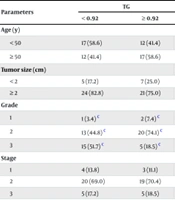
Levels of TG, HDL-C, LDL-C, and TC were categorized as upper or lower based on the mean or median and compared with the clinicopathological characteristics of patients with BC (Table 1). These analyses indicated that LDL-C and TC were significantly associated with patient age and that LDL-C, TG, and TC were significantly associated with tumor grade.
Table 1.
| Parameters | TG | HDL-C | LDL-C | TC | ||||
|---|---|---|---|---|---|---|---|---|
| < 0.92 | ≥ 0.92 | < 1.05 | ≥ 1.05 | < 1.7 | ≥ 1.7 | < 3.37 | ≥ 3.37 | |
| Age (y) | ||||||||
| < 50 | 17 (58.6) | 12 (41.4) | 18 (62.1) | 11 (37.9) | 21 (75.0) c | 8 (26.7) c | 21 (70.0) c | 8 (28.6) c |
| ≥ 50 | 12 (41.4) | 17 (58.6) | 11 (37.9) | 18 (62.1) | 7 (25.0) c | 22 (73.3) c | 9 (30.0) c | 20 (71.4) c |
| Tumor size (cm) | ||||||||
| < 2 | 5 (17.2) | 7 (25.0) | 5 (17.2) | 7 (25.0) | 5 (17.9) | 7 (24.1) | 5 (16.7) | 7 (25.9) |
| ≥ 2 | 24 (82.8) | 21 (75.0) | 24 (82.2) | 21 (75.0) | 23 (82.1) | 22 (75.9) | 25 (83.3) | 20 (74.1) |
| Grade | ||||||||
| 1 | 1 (3.4) c | 2 (7.4) c | 0 (0.0) | 3 (10.7) | 0 (0.0) c | 3 (10.3) c | 0 (0.0) c | 3 (11.1) c |
| 2 | 13 (44.8) c | 20 (74.1) c | 16 (57.1) | 17 (60.7) | 13 (48.1) c | 20 (69.0) c | 14 (48.3) c | 19 (70.4) c |
| 3 | 15 (51.7) c | 5 (18.5) c | 12 (42.9) | 8 (28.6) | 14 (51.9) c | 6 (20.7) c | 15 (51.7) c | 5 (18.5) c |
| Stage | ||||||||
| 1 | 4 (13.8) | 3 (11.1) | 1 (3.6) | 6 (21.4) | 2 (7.4) | 5 (17.2) | 2 (6.9) | 5 (18.5) |
| 2 | 20 (69.0) | 19 (70.4) | 22 (78.6) | 17 (60.7) | 20 (74.1) | 19 (65.5) | 21 (72.4) | 18 (66.7) |
| 3 | 5 (17.2) | 5 (18.5) | 5 (17.9) | 5 (17.9) | 5 (18.5) | 5 (17.2) | 6 (20.7) | 4 (14.8) |
a Values are expressed as No. (%).
b Ki-67 nuclear expression was measured using immunohistochemistry and reported as a percentage.
c Correlation is significant at the 0.05 level.
Associations between lipid profiles and tumor indices were further assessed as continuous variables using bivariate correlation analysis (Table 2). The results showed positive correlations between age and HDL-C, LDL-C, and TC. Negative correlations were also observed between tumor grade and Ki-67, and between tumor grade and TG, HDL-C, and TC.
Table 2.
Correlation Coefficients of Serum Lipid Profile with Clinicopathological Variables of Breast Cancer
| Correlation Coefficient | TG | HDL-C | LDL-C | TC |
|---|---|---|---|---|
| Age (y) | 0.132 | 0.327 a | 0.396 a | 0.409 a |
| Tumor size | 0.009 | 0.004 | 0.083 | 0.069 |
| Grade | -0.364 a | -0.217 | -0.322 a | -0.325 a |
| Stage | 0.042 | -0.081 | -0.090 | -0.100 |
| Ki-67 | -0.395 b | -0.262 | -0.434 b | -0.471 b |
a Correlation is significant at the 0.05 level.
b Correlation is significant at the 0.01 level.
5. Discussion
Lipid metabolism plays an essential role in maintaining cellular homeostasis, and its dysregulation has been implicated in various diseases, including cancer, cardiovascular disorders, and diabetes. Immune cells, such as macrophages, T lymphocytes, B lymphocytes, and neutrophils, depend on lipid metabolism for activation, differentiation, and function, thereby influencing innate and adaptive immune responses (10).
Recent evidence suggests that elevated triglyceride concentrations are associated with systemic inflammation and increased levels of proinflammatory cytokines, including interleukin 6 (IL-6) and IL-12. In addition, lipid metabolism, particularly fatty acids stored as triglycerides, contributes to the differentiation and functional regulation of T-lymphocyte subsets, such as CD4+ and CD8+ T cells, and may consequently modulate inflammatory responses within the tumor microenvironment (11).
Cholesterol also plays an important role in immune regulation through the formation of lipid rafts involved in immune cell signaling. Furthermore, cholesterol metabolism influences neutrophil extracellular trap formation and modulates macrophage activation and polarization. Oxysterols, which are oxygenated derivatives of cholesterol, have also been shown to regulate various macrophage functions and inflammatory pathways. Conversely, immune and inflammatory responses may substantially affect cholesterol synthesis, uptake, and efflux (12).
Accumulating evidence from basic and clinical studies has further demonstrated a role for HDL-C in modulating immune-inflammatory responses, suggesting that lipoproteins may contribute to disease pathogenesis beyond cardiovascular disorders, including cancer progression and tumor immunity (13).
Experimental studies have also suggested that proprotein convertase subtilisin/kexin type 9 (PCSK9), a key regulator of LDL-C metabolism, may play an important role in tumor immunity. Recent preclinical and clinical evidence supports the potential anticancer and immune-stimulatory effects of PCSK9 inhibition through the modulation of immune tolerance within the tumor microenvironment and a reduction in cytokines involved in cancer cell survival (14). However, inflammatory biomarkers, such as C-reactive protein, IL-6, and tumor necrosis factor α, were not evaluated in the present study, which should be considered a limitation. Future prospective studies integrating lipid metabolism, inflammatory biomarkers, and immune profiling may provide deeper insights into the immunometabolic mechanisms involved in BC progression.
We observed that although no separate healthy control group was included, serum lipid parameters were evaluated based on established clinical reference ranges and were generally within normal limits. Nevertheless, significant positive correlations were observed between HDL-C, LDL-C, and TC levels and patient age. These findings are consistent with previous studies demonstrating that lipid profiles may change with age, although the underlying mechanisms remain unclear (15).
The results of this study also showed significant negative correlations between TG, LDL-C, and TC and Ki-67 and grade, which are well-known survival criteria. Ki-67 is a nuclear protein and an indicator of cell proliferation (16), and it indicates a worse prognosis (5). Consistent with these results, Li et al. showed that patients with BC and TG levels below 1.3 mmol/L had worse disease-free survival than patients with TG levels above 1.3 mmol/L (17). Furthermore, a meta-analysis conducted by Ni et al. indicated that TG levels, but not TC or LDL-C levels, had an inverse association with BC risk and that HDL-C had a protective effect against BC depending on menopausal status (8).
Katzke et al. also showed that TG levels were inversely associated with BC risk and HDL-C levels were positively associated with BC risk; however, these factors were inversely associated with cardiovascular disease mortality, indicating a different risk pattern (6). In contrast, Wulaningsih et al. reported that high TG levels were associated with a higher risk of BC death (18). Lu et al. indicated that LDL and VLDL, but not HDL-C, increased survival, migration, and angiogenesis in BC cells, leading to increased tumor aggressiveness (1). Rodrigues dos Santos et al. also reported increased proliferation and migration of BC cells induced by LDL-C and showed that a high LDL-C level promotes BC progression (5). However, Melvin et al. found no significant association between lipid profiles and BC prognosis (7).
The inverse correlations observed in the present study may suggest a complex interaction between lipid metabolism and tumor biology. Although studies on serum lipoproteins in patients with BC have reported conflicting results, available evidence suggests that serum lipoprotein levels may play a role in the occurrence and progression of BC. These discrepancies among studies may be related to differences in study populations, menopausal status, ethnicity, metabolic conditions, tumor heterogeneity, sample size, and analytical methods.
5.1. Study Limitations
The relatively small sample size and the absence of a matched healthy control group should be considered limitations of the present study. Furthermore, potential confounding factors, such as menopausal status, body mass index, dietary habits, diabetes, cardiovascular disease history, and lipid-lowering medication use, were not fully evaluated due to limited clinical information available for some patients. Nevertheless, patients with severe systemic diseases, inflammatory disorders, and recent cardiovascular events were excluded to partially reduce confounding effects. Therefore, larger prospective studies with appropriate control groups are needed to confirm these findings.
5.2. Conclusions
The present finding indicate that serum lipid profile components may be associated with the clinicopathological characteristics of BC. Although the underlying mechanisms remain unclear and previous studies have reported conflicting findings, these findings warrant further investigation in larger prospective studies with appropriate control groups and survival analyses.