
1. Background
Polyendocrine metabolic ovarian syndrome (PMOS), formerly known as polycystic ovary syndrome (PCOS), is one of the most common endocrine disorders in women of reproductive age, affecting approximately 5%–20% of the female population worldwide and imposing a substantial burden because of its associations with infertility, metabolic disorders, and long-term cardiovascular risks (1, 2). According to the Rotterdam criteria, PMOS is a heterogeneous condition characterized by hyperandrogenism, ovulatory dysfunction, and polycystic ovaries (3). However, its etiology remains incompletely understood. PMOS has a substantial genetic component, as evidenced by familial clustering and twin studies (4, 5). Genome-wide association studies have identified multiple susceptibility loci, highlighting the importance of genes involved in hormonal homeostasis, gonadotropin function, and metabolism (4). Insulin resistance and hyperinsulinemia are pivotal in the pathophysiology of PMOS in many women because these mechanisms promote increased ovarian androgen production (6).
The insulin receptor gene (INSR), located on chromosome 19p13.2, plays an essential role in regulating metabolic homeostasis and has strong biological plausibility in insulin-resistant PMOS (7). Genetic association studies in different ethnic groups have supported its involvement. For example, the INSR single-nucleotide polymorphism (SNP) rs2059807 has been reported to significantly increase the risk of metabolic syndrome in Chinese women with PMOS (8). Similarly, the INSR variant rs1799817 has been associated with susceptibility to PMOS in Saudi Arabian women (7). Epigenetic analyses have also shown that altered DNA methylation patterns within INSR are significantly associated with insulin resistance in women with PMOS (9).
Among the numerous reported INSR variants, p.Arg1201Trp (c.3601C>T) and p.Phe409Val (c.1225T>G) were selected for this investigation because of their established pathogenicity in the ClinVar database (Variation IDs 562225 and 14690) and their known association with severe insulin resistance syndromes, such as Rabson-Mendenhall syndrome. These variants are located in functionally critical domains of the insulin receptor, the tyrosine kinase domain and the extracellular domain, respectively, making them biologically plausible candidates for contributing to the insulin-resistant phenotype observed in PMOS. In a case-control study of critical exonic variants among Iranian patients with PMOS, Seyed Abutorabi et al. investigated CYP11B1, FSHR, and INSR using polymerase chain reaction and DNA sequencing of peripheral blood samples. They found no exonic variants in CYP11B1 and only polymorphisms in INSR. However, the FSHR missense variants Ala307Thr and Asn680Ser were significantly more frequent in patients with PMOS than in controls (10).
Despite these advances, most studies have focused on common polymorphisms or epigenetic changes across diverse populations or on DNA obtained from blood. Information remains limited regarding rare disease-causing INSR mutations in target cells that play a pivotal role in the pathogenesis of PMOS. Granulosa cells are integral to follicular development and steroidogenesis (11), making them an important but underexplored target for aberrant insulin signaling in PMOS.
2. Objectives
This study aimed to investigate the presence of, and potential association between, two specific pathogenic INSR variants, p.Arg1201Trp and p.Phe409Val, in granulosa cells isolated from the ovarian follicles of Iranian women with PMOS. By examining these rare variants in disease-relevant tissue, the study sought to clarify the molecular mechanisms of ovarian insulin resistance and to contribute to understanding the genetic basis of PMOS.
3. Methods
3.1. Ethics Statement
The study protocol was reviewed and approved by the Ethics Committee of Dezful University of Medical Sciences (Ethics Code: IR.DUMS.REC.1402.025). All procedures were performed in accordance with the ethical standards of the institutional research committee and the 1964 Declaration of Helsinki. All participants provided written informed consent, and all experiments were conducted in accordance with relevant guidelines and regulations.
3.2. Study Design and Participants
This case-control study was conducted at the infertility treatment center of Dezful Ganjavian Hospital, Iran. The study population consisted of 40 women diagnosed with PMOS and 40 age-matched healthy control women. All participants were candidates for in vitro fertilization (IVF). PMOS was diagnosed according to the Rotterdam criteria, requiring at least 2 of the following 3 features: oligo- or anovulation, clinical and/or biochemical hyperandrogenism, and polycystic ovaries on ultrasonography, after the exclusion of other etiologies. Control participants were healthy, normo-ovulatory women with no signs of hyperandrogenism or polycystic ovarian morphology who were seeking IVF primarily because of male-factor infertility. Exclusion criteria for both groups included concurrent gynecological diseases, thyroid dysfunction, hyperprolactinemia, congenital adrenal hyperplasia, and Cushing syndrome.
3.3. Sample Collection and DNA Extraction
Granulosa cells were harvested from ovarian follicular fluid aspirated during oocyte retrieval for IVF. The cell pellet was processed for DNA extraction using a standard phenol-chloroform-isoamyl alcohol protocol. Briefly, cells were lysed with 1% sodium dodecyl sulfate and digested with proteinase K overnight at 55 °C. DNA was purified using phenol-chloroform-isoamyl alcohol (25:24:1) and chloroform, followed by precipitation with cold isopropanol and sodium acetate. The DNA pellet was washed with 70% ethanol, air-dried, and resuspended in nuclease-free water. DNA concentration and purity were assessed using a NanoDrop spectrophotometer (Nanospec Cube biophotometer, Germany), and DNA integrity was verified by 1.5% agarose gel electrophoresis.
3.4. Genotyping and Variant Analysis
Two pathogenic variants in the INSR gene, NM_000208.4:c.1225T>G (p.Phe409Val) and NM_000208.4:c.3601C>T (p.Arg1201Trp), were selected for analysis. Genotyping was performed using a 2-step method. Initial screening was conducted using high-resolution melting (HRM) curve analysis on a Roche LightCycler 96 System. Specific primers were designed for each amplicon: for p.Phe409Val (F: 5′-TTAGCACTCAGGCCATACAC-3′, R: 5′-TCCTTTCCTTAGACAATCTGG-3′; product size, 195 bp) and for p.Arg1201Trp (F: 5′-ATCCACACACAACTCACCAC-3′, R: 5′-CTGAAGGTTAAGAGCGTGTG-3′; product size, 185 bp). The PCR reaction mixture contained 5 µL of HRM Master Mix (Solis BioDyne), 1 µL of each primer (10 pmol/µL), 2 µL of template DNA (50 - 100 ng), and nuclease-free water to a final volume of 20 µL. The thermal cycling protocol consisted of initial denaturation at 95 °C for 5 min, followed by 40 cycles of 95 °C for 30 s, 58 °C - 59 °C (gradient optimized) for 30 s, and 72 °C for 20 s, followed by a final HRM step from 65 °C to 97 °C with an increase of 0.1 °C/s and continuous fluorescence acquisition. Samples showing melting-curve profiles distinct from those of the wild-type controls were prioritized for confirmation. All samples, including those with atypical HRM profiles and a random subset of those with wild-type profiles, underwent direct Sanger sequencing for definitive confirmation. PCR products were purified and sequenced by a commercial service (Pishgam, Tehran, Iran). The resulting chromatograms were analyzed and aligned to the reference sequence NM_000208.4 using Chromas software version 2.6.6.
3.5. Statistical Analysis
Molecular genetic analyses revealed the absence of both p.Arg1201Trp (c.3601C>T) and p.Phe409Val (c.1225T>G) in all tested samples. Therefore, comparative statistical analyses of genotypic and allelic distributions between the PMOS and control groups, such as the chi-square test and Fisher exact test, were not applicable. All 80 participants, comprising 40 women with PMOS and 40 controls, were homozygous for the wild-type allele at both loci. Because there was no genotypic variation, comparative tests were not conducted. Although these findings suggest that the variants are uncommon, this sample size cannot entirely exclude the presence of very-low-frequency alleles.
4. Results
4.1. Demographic and Clinical Characteristics of the Study Participants
A total of 40 women with PMOS and 40 healthy control women participated in this study. The groups were well matched, with no significant differences in age or body mass index (BMI) (Table 1). Although luteinizing hormone (LH) levels were higher in the PMOS group than in the control group, the difference was not statistically significant (Table 1).
Table 1.
Baseline Demographic and Clinical Characteristics of the Study Participants a
| Characteristics | PMOS Group (n = 40) | Control Group (n = 40) |
|---|---|---|
| Age (y) | 33.33 ± 5.22 (29.00, 38.00) | 33.28 ± 4.97 (29.25, 37.50) |
| BMI (kg/m2) | 26.23 ± 3.76 (23.10, 29.00) | 25.81 ± 3.34 (23.17, 28.45) |
| FSH (mIU/mL) | 5.79 ± 2.07 (3.90, 7.00) | 5.93 ± 2.38 (3.92, 7.50) |
| LH (mIU/mL) | 8.32 ± 4.08 (5.70, 9.70) | 7.09 ± 2.76 (5.45, 8.47) |
a Values are expressed as mean ± SD.
4.2. DNA Extraction and Primer Optimization
DNA was successfully extracted from granulosa cell specimens. Initial PCR amplifications were performed to optimize annealing temperatures for both INSR loci. Gradient PCR was used to identify optimal temperature ranges for robust amplification of 195-bp and 185-bp fragments for the p.Phe409Val (c.1225T>G) and p.Arg1201Trp (c.3601C>T) loci, respectively. PCR product specificity was verified by fragment size and banding pattern on a 1.5% agarose gel. Representative images showing PCR products of the expected sizes are presented in Figure 1. No nonspecific bands were observed, and the no-template control showed no amplification, supporting the absence of contamination.
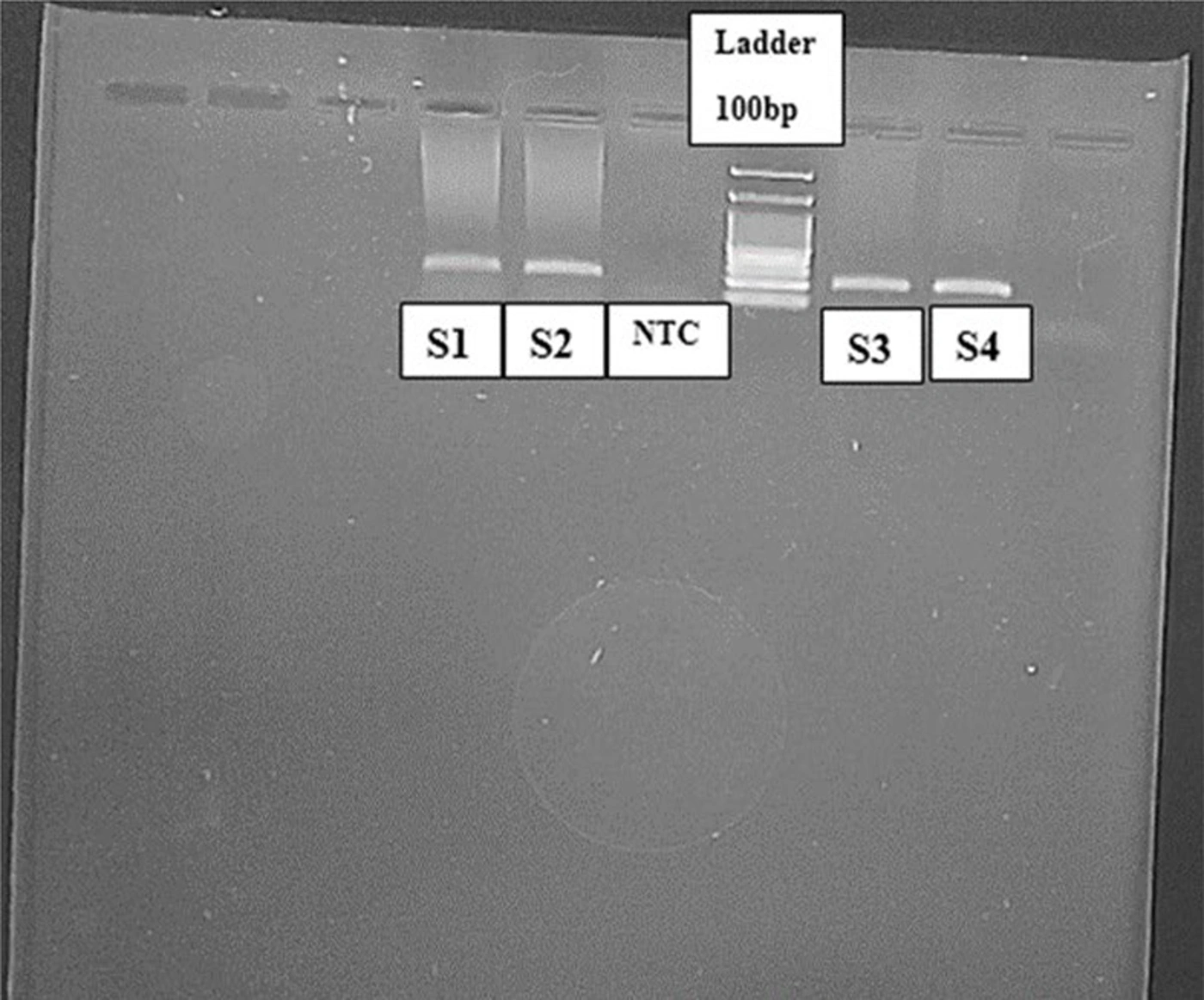
Figure 1.
Validation of specific PCR amplification for INSR genotyping. Representative 1.5% agarose gel electrophoresis of PCR products generated for the two targeted loci. Lane L: 100-bp DNA ladder. Lanes S1/S2: 185-bp amplicon for the INSR p.Arg1201Trp (c.3601C>T) locus. Lanes S3/S4: 195-bp amplicon for the INSR p.Phe409Val (c.1225T>G) locus. Lane NTC: No-template control, confirming the absence of contamination.
4.3. Analysis of the p.Arg1201Trp (c.3601C>T) Variant
HRM curve analysis was performed for the INSR variant p.Arg1201Trp (NM_000208.4:c.3601C>T) in all 80 samples (40 women with PMOS and 40 healthy controls). In the HRM difference plot (Figure 2A), a single melting-curve profile was observed across all tested samples. Sanger sequencing confirmed the wild-type genotype (GG) in all individuals (homozygous for the wild-type allele) (Table 2). A representative Sanger sequencing image is provided in Figure 2B. This variant, which is reported as pathogenic in severe insulin resistance syndromes (ClinVar Variation ID 562225), was not detected in this population.
Table 2.
Genotype Distribution of INSR Variants in PMOS Patients and Controls a
| INSR Variants and Genotypes | PMOS Group (n = 40) | Control Group (n = 40) | Total (n = 80) |
|---|---|---|---|
| p.Arg1201Trp (c.3601C>T) | |||
| Wild-type (GG) | 40 (100) | 40 (100) | 80 (100) |
| Heterozygous (CG) | 0 (0) | 0 (0) | 0 (0) |
| Mutant (CC) | 0 (0) | 0 (0) | 0 (0) |
| p.Phe409Val (c.1225T>G) | |||
| Wild-type (AA) | 40 (100) | 40 (100) | 80 (100) |
| Heterozygous (AG) | 0 (0) | 0 (0) | 0 (0) |
| Mutant (GG) | 0 (0) | 0 (0) | 0 (0) |
a Values are expressed as No. (%).
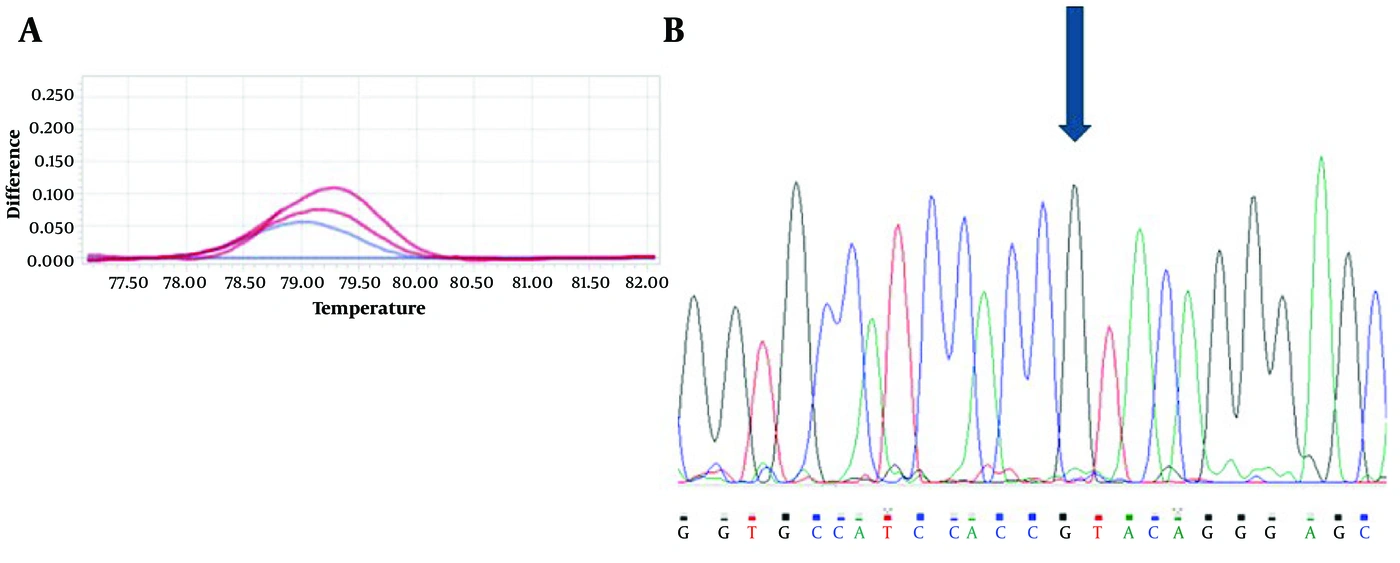
Figure 2.
Genotyping analysis for the INSR p.Arg1201Trp variant. A, High-resolution melting difference plot of samples. All curves overlap completely with the baseline established by wild-type (GG) control samples, indicating the homozygous GG genotype on sequencing. B, Representative Sanger sequencing chromatogram confirming the homozygous wild-type genotype (GG) at this locus. The arrow indicates the analyzed nucleotide position (G).
4.4. Analysis of the p.Phe409Val (c.1225T>G) Variant
Similarly, HRM analysis of the INSR variant p.Phe409Val (NM_000208.4:c.1225T>G) yielded a uniform melting-curve profile across all samples (Figure 3A). Direct sequencing confirmed the absence of this change in both groups; all samples were genotyped as homozygous wild type (AA genotype) (Figure 3B; Table 2). This variant has been classified as pathogenic in ClinVar (Variation ID 14690; dbSNP accession rs121913142) and was not detected in either the PMOS or control group.
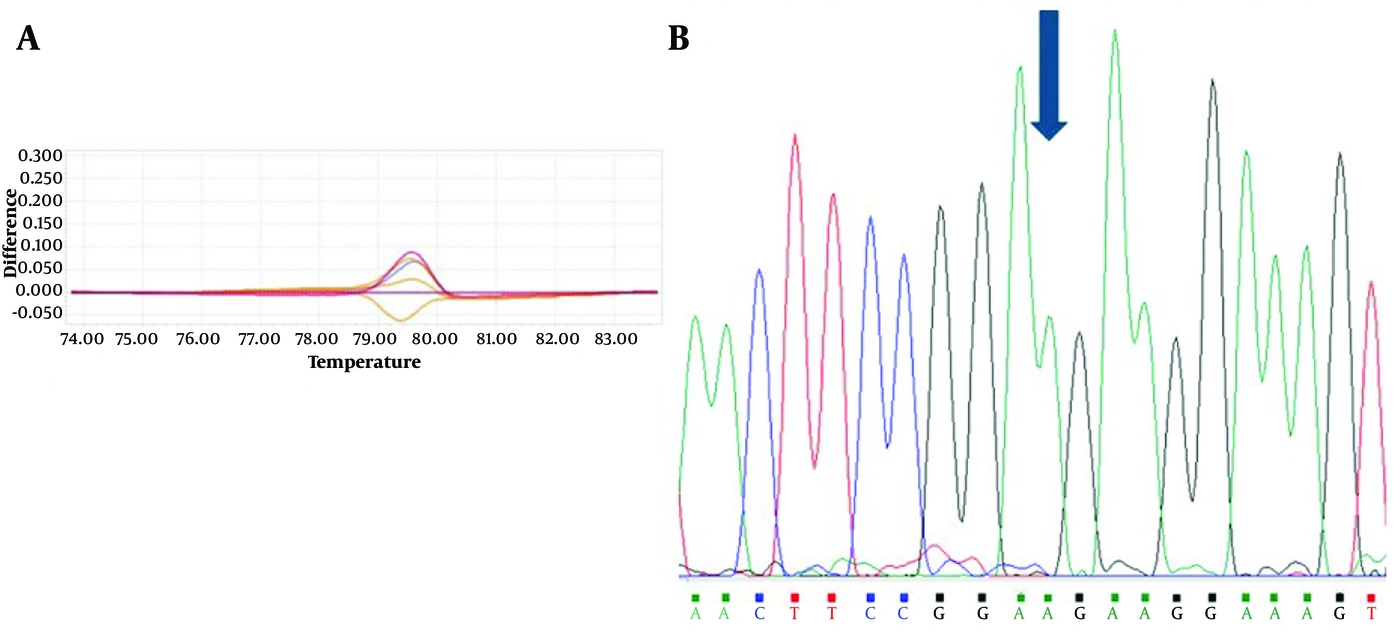
Figure 3.
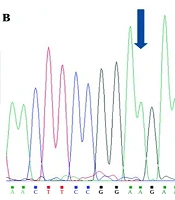
Genotyping analysis for the INSR p.Phe409Val variant. A, High-resolution melting difference plot of samples. All curves overlap completely with the baseline established by wild-type (AA) control samples, indicating the homozygous AA genotype on sequencing. B, Representative Sanger sequencing chromatogram confirming the homozygous wild-type genotype (AA) at this locus. The arrow indicates the analyzed nucleotide position (A).
4.5. Molecular Findings Summary
The two targeted pathogenic INSR variants, p.Arg1201Trp and p.Phe409Val, were assessed by HRM-based genetic screening, with confirmation by Sanger sequencing. Neither variant was detected in any participant, and no heterozygous or homozygous mutant genotypes were identified. These findings indicate genetic homogeneity at these loci in both Iranian women with PMOS and matched healthy controls (Table 2).
5. Discussion
This study investigated two rare pathogenic INSR variants, p.Arg1201Trp and p.Phe409Val, in ovarian granulosa cells from Iranian women with PMOS. Neither variant was detected in women with PMOS or in control participants. However, the sample size of 40 participants per group, although appropriate for targeted screening, limits the statistical power to detect extremely rare variants. Therefore, these negative findings should be interpreted cautiously and are specific to the cohort studied. These results add to the growing evidence of substantial genetic heterogeneity and population specificity in PMOS (12).
Although the present study focused on rare, presumably deleterious variants, numerous studies have linked more common INSR variants to PMOS risk in different populations, underscoring a potential role for this gene in the insulin-resistant phenotype. For example, INSR rs2059807 was significantly associated with PMOS among Indian women (13). Associations have also been reported for rs1799817. In Saudi Arabian women, this SNP was associated with increased susceptibility to PMOS (7), and a study of Indian women also identified it as a risk factor for metabolic disturbances (13). However, this association is not consistent across populations. A study of Polish women found no difference in the rs1799817 genotype distribution between patients with PMOS and controls, although a possible association with acne was observed (14). A study of Turkish women found no association between PMOS and INSR polymorphisms rs2059806 and rs2252673 (15). Similarly, a study in a Kashmiri population found no relationship between rs1799817 and clinical manifestations of hyperandrogenism and ovulatory dysfunction (16).
Additional rare missense INSR variants have also been reported. A 2024 study of Iraqi women with PMOS identified two novel or rare INSR variants, p.Arg1119Trp and p.Pro1205Leu. These variants were predicted computationally to be disease-associated and were linked to an extreme insulin resistance phenotype (17). In contrast to the negative findings for p.Arg1201Trp and p.Phe409Val in the present study, these observations suggest that population-specific rare variants within the same gene may contribute to the PMOS phenotype. Variants in INSR are known to cause severe insulin resistance syndromes, including Rabson-Mendenhall syndrome, highlighting their potential functional impact; however, the variants investigated here were absent from this cohort (18).
The choice of tissue for genetic analysis is an important aspect of study design. Most previous association studies have used peripheral blood cells. In contrast, the present study analyzed granulosa cells, a tissue central to PMOS pathology. Tissue-specific epigenetic changes, including altered methylation of INSR, may contribute substantially to PMOS development (9) and may provide a disease-relevant molecular profile distinct from that obtained from blood.
Overall, the available evidence indicates that INSR involvement in PMOS is complex and multidimensional. Reported changes range from common SNPs in certain populations, such as rs2059807 and rs1799817, to extremely rare pathogenic variants, such as p.Arg1119Trp and p.Pro1205Leu, together with epigenetic mechanisms that influence gene expression. The absence of the specific rare variants investigated in this Iranian cohort suggests that they are unlikely to be major contributors in this group. This finding is consistent with prior research in Iran that reported no meaningful coding variants in INSR and suggested a possible role for genes such as FSHR in PMOS (10). Collectively, the evidence supports PMOS as a highly polygenic and heterogeneous disorder in which insulin resistance is likely attributable to the combined effects of common genetic variants across multiple loci (8), together with epigenetic and environmental factors, rather than primarily to highly penetrant single-gene variants.
5.1. Conclusions
The pathogenic INSR variants p.Arg1201Trp and p.Phe409Val were absent from ovarian granulosa cells of the Iranian women with PMOS examined in this cohort. These findings add to evidence that PMOS is a heterogeneous and polygenic disorder and that the contribution of INSR to its pathophysiology is likely mediated through a combination of common population-specific polymorphisms, rare variants, and epigenetic modifications rather than through the highly penetrant single-gene mutations investigated here. Given the relatively small sample size, these variants cannot be definitively excluded from the broader Iranian population. Future large-scale genomic studies using whole-exome or whole-genome sequencing across diverse ethnic groups and incorporating ovarian tissue-specific epigenetic and transcriptional analyses are needed to further clarify the complex role of insulin signaling in PMOS.