


1. Background
Military personnel in combat environments require complete fitness to meet the physical demands of occupational and combat-related specific tasks (1). Therefore, applying appropriate physical training programs is crucial for military personnel survival and mission success (2). Traditionally, conditioning in the military has been focused on aerobic endurance exercises (e.g., long-running training) and performing calisthenics because it was accessible to prescribe these kinds of exercises when training large numbers of soldiers during physical training (2). However, military demands are also highly dependent on functional muscle strength. Therefore, aerobic exercise alone cannot meet all military personnel demands in training and combat conditions (3).
On the other hand, physical training can also lead to injuries during the act, either as sudden or long-term overuse injuries (3). For example, as routine training, long-distance running can be a primary risk factor for foot injuries among military personnel (4). Therefore, reducing training volumes is the most recommended strategy for injury prevention (4). In addition, in some situations, such as serving in warships, submarines, or limited military camps, where it is impossible to perform some exercises, such as running, it is necessary to do alternative training to maintain and improve military personnel’s physical fitness.
Moreover, several kinematics factors increase the risk of lower extremity injuries (5). These factors include knee valgus, excessive hip adduction and internal rotation, medial knee displacement, or a combination of these motions, referred to as faulty movement patterns. Performing combat-specific training, including jumping, stopping, starting, bounding, climbing, pushing, and sprinting under poor neuromuscular control accompanied by these faulty movement patterns, might put military personnel at risk of lower extremity injuries (6). Previous research demonstrates that injury prevention programs can correct lower extremity faulty movement patterns and kinematics following exercise training using a combination of two or three balance, strengthening, stabilization training, plyometric, or agility exercises in civilians, such as athletes and nonathletic subjects (7). However, the effects of suspension training, including most of these factors in modifying lower extremity kinematics in military personnel, are unclear since there is a potential risk of exposing traumatic events in these individuals when going to war or even training. Such conditions can cause stress and have been associated with various mental health conditions affecting their quality of life and job performance. Although physical activity can improve health-related quality of life and productivity in healthy subjects, the effects of an exercise intervention on mental health and job performance in navy personnel are unclear (8).
Suspension training is a novel and modern form of exercise training that can simultaneously train all physical fitness components, such as flexibility, cardiovascular fitness, power, muscular strength, and endurance (9). Suspension training is currently used in numerous fields because it does not require much space and is easy to use anywhere (9). Therefore, such training would be helpful in the Navy, where personnel is mainly stationed in limited environments, such as battleships and submarines. Moreover, previous studies showed that training in unstable conditions, such as suspension training, could improve performance and motor control to reduce injury incidence (10). To the best of our knowledge, there is no study investigating a suspension-training program’s effectiveness in performance improvement, reducing risk factors of injuries, and increasing mental health among military personnel.
2. Objectives
The current study seeks to determine the effectiveness of an 8-week suspension training program in physical fitness, lower extremity kinematics, mental health, and job performance in Iranian Navy personnel. This study hypothesizes that the suspension-training program will improve physical fitness, lower extremity kinematics, mental health, and job performance in navy personnel.
3. Methods
3.1. Study Design
The present randomized controlled trial will be conducted on two parallel groups, including the intervention by performing a suspension-training program with the total body resistance (TRX) band for 8 weeks and the control with continuing their daily military activities. At the baseline, the assessment will be completed and repeated at the end of the intervention program for all subjects. Figure 1 shows the schedule of the study, and Figure 2 depicts the CONSORT flow diagram. Before the study, all the subjects sign an informed consent form. The Ethics Committee of Research at Baqiyatallah hospital, Iran, approved the study (under No. IR.BMSU.BAQ.REC.1398.016, 2020-1-28). The Iranian Registry of Clinical Trials approved the study protocol (IRCT20180821040843N2, 2020-6-13). The SPIRIT guideline was used to report the apparent and standardized reporting of the trial (11). All subjects’ data will be saved in a protected computer system with limited access.
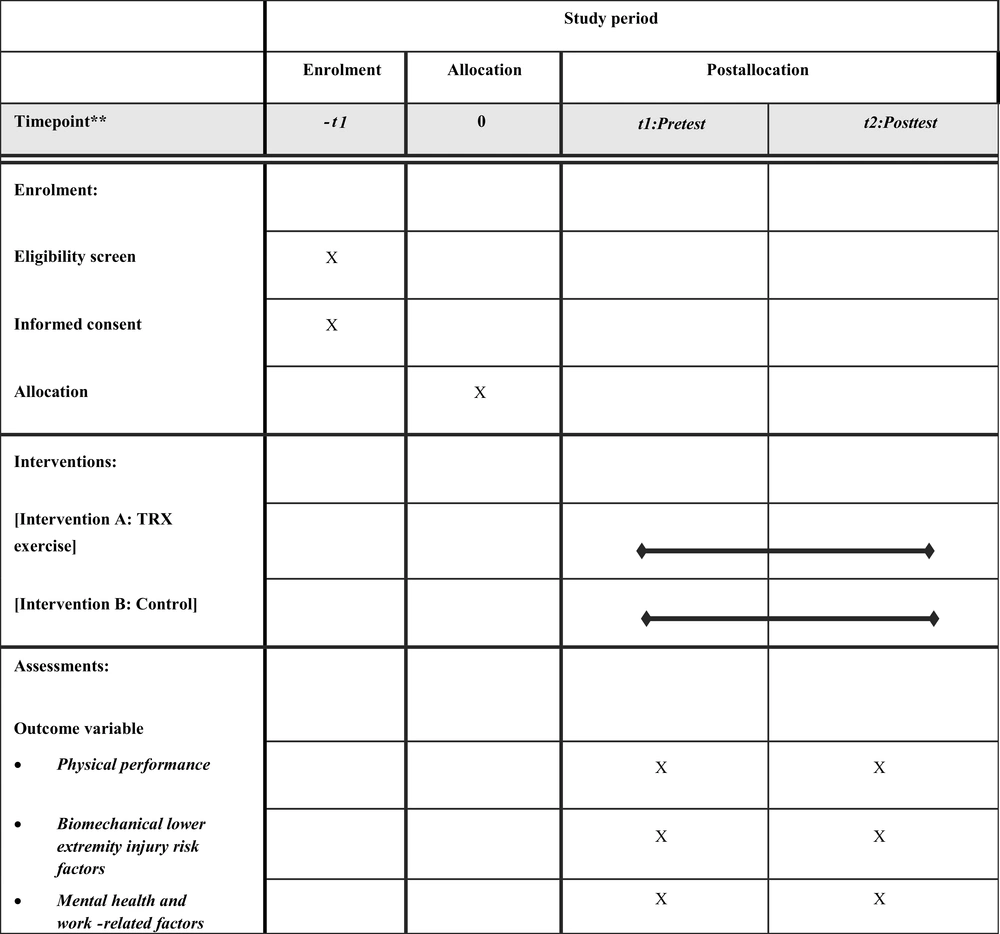
Figure 1.
Schedule of the study
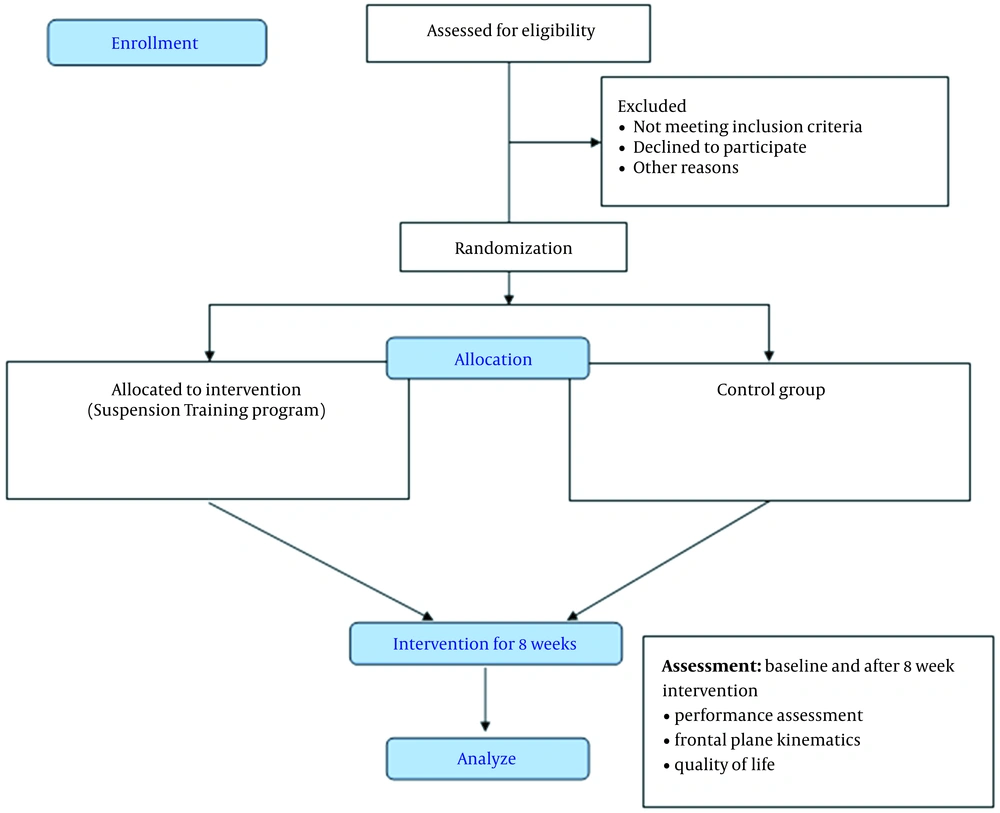
Figure 2.
CONSORT flow diagram
3.2. Study Population and Eligibility Criteria
The sample size has been calculated using G*Power software (version 3.1.9.2; Kiel, Germany) for the subjects, including 50 young men aged 18 to 28 years. This study estimated 20 subjects per group to detect statistical significance in 80% power with d = 0.70 effect size. Assuming a drop-out rate of approximately 20%, 25 subjects are included in each group. The subjects are recruited from the Iranian Navy personnel serving in Bandar Abbas military base through advertisements on bulletin boards. The participants are excluded from the research process with an injury history in the lower extremity making the movement restriction, any visible musculoskeletal deformities in the lower and upper extremities in normal standing posture, loss of more than three training sessions or two sequential sessions, and body mass index under 18 and over 28 kg/m2 (12).
3.3. Randomization
Randomization is applied via a computer-generated block in a 1: 1 ratio followed by a concealed allocation through sealed envelopes with sequentially numbered checkmate. A card inside the envelopes indicates that the subjects are randomly allocated to each group (intervention or control). The subjects are allowed to discontinue the study procedure at any time.
Dealing methods with missing data are conducted at a data review meeting before starting statistical analyses. Data analysts and outcome assessors will be blinded to the subject groups.
3.4. Intervention
Circuit resistance training is one of the best methods to improve cardiovascular-related factors. In addition, suspension training can lead to better performance and motor control to reduce injury incidence due to their characteristics that provide an unstable condition (13). Due to the importance of designing training protocols that involve all physical fitness demands of military personnel in the shortest time and with the minimum facilities to meet the physical demands of occupational and combat-related specific tasks, the current study intervention is designed as circuit resistance training in the form of suspension training with a TRX band.
An 8-week of suspension training with the TRX band is prescribed including three phases.
3.4.1. The Initial Phase (Anatomical Adaptation) (Weeks 1 - 2)
In this phase of the suspension-training program, the emphasis will be on the subject’s cognition, and the purpose will be the quality and learning of the exercises. This phase needs much concentration from the subjects (14) and aims to provide anatomical adaption to transfer the subject to the subsequent phases. Therefore, limited training progress occur in this phase (15). In addition, adequate instruction about using the TRX band will be given to the subject to provide them with sufficient knowledge to use this tool. Exercises in this phase include multi-segment movements with low demand for involving the whole body during the training. Further, it contains exercise numbers 1 - 4 (Figure 3) performed in a circuit form (13). For this purpose, the subject starts from exercise number 1 with predetermined repetition and, without any resting time, goes to the next exercise until all four exercises are completed and the circle ends. The circled numbers in this phase will be 4, and the rest between each circle will be 150 seconds (15).
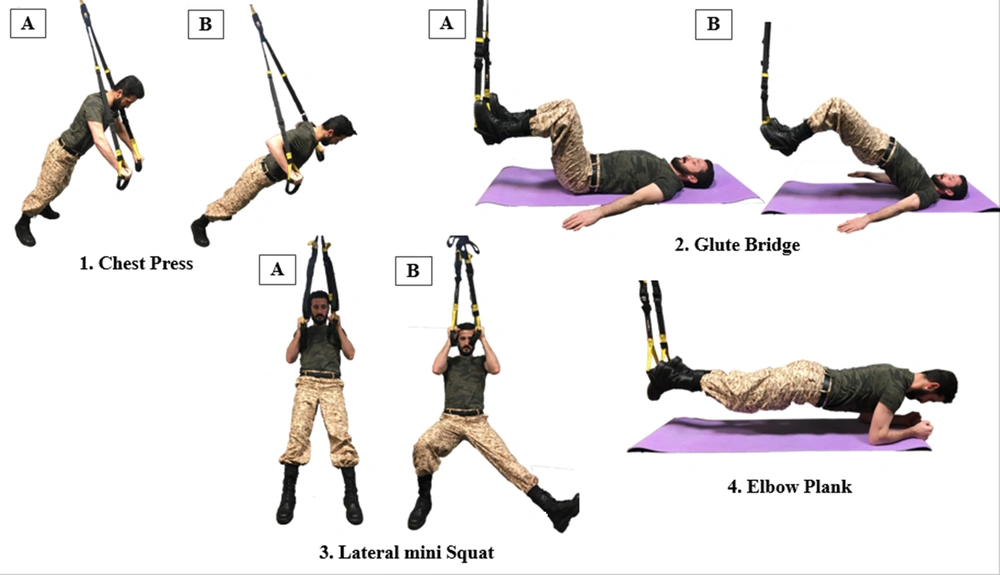
Figure 3.
Exercises numbers 1 - 4 in the initial phase
3.4.2. Improvement Phase (Weeks 3 - 6)
In this phase of the suspension training program, the goal is to create the subject’s necessary tissue adaptations (15). This phase will be the main part of the training program, and most training progress will occur in this phase. Training progress in achieving optimal adaption includes increasing the number of exercises, circles, repetition, and more demanding exercises (16). This phase of the suspension training program in weeks 3 - 4 (Figure 4) includes exercises number 5 - 10; then, in the progress of training during week 5, several exercises will be replaced accordingly (Figure 5), including exercise number 5 with 11, exercise number 6 with 12, exercise number 7 with 13, exercise number 8 with 14, exercise number 9 with 15, and exercise number 10 with 16. As in the previous phase, the exercise will be performed in the circuit form. This phase’s circled numbers will be 5, and the rest between each circle will be 180 seconds (15).
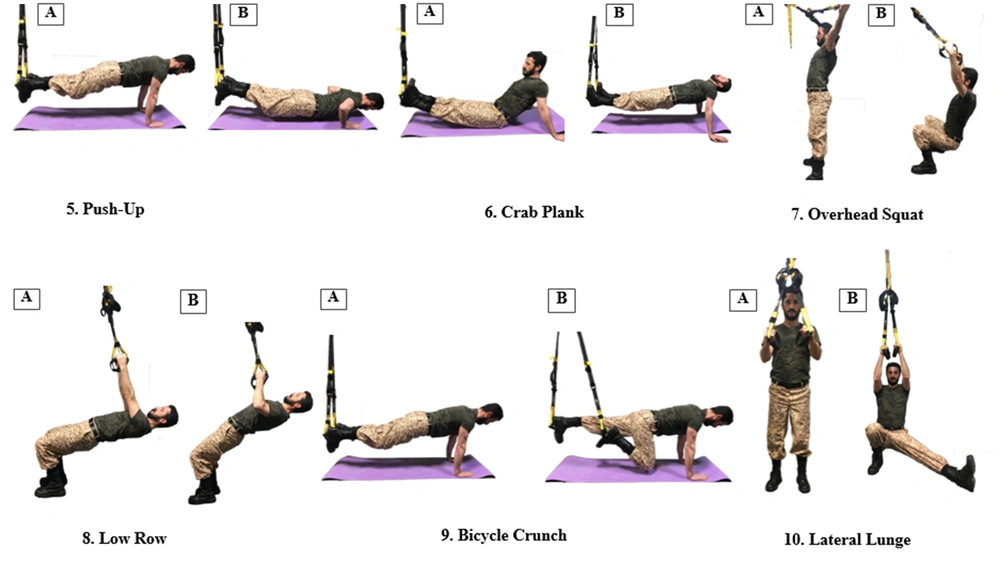
Figure 4.
Exercises numbers 5 - 10 in weeks 3 - 4 of the improvement phase
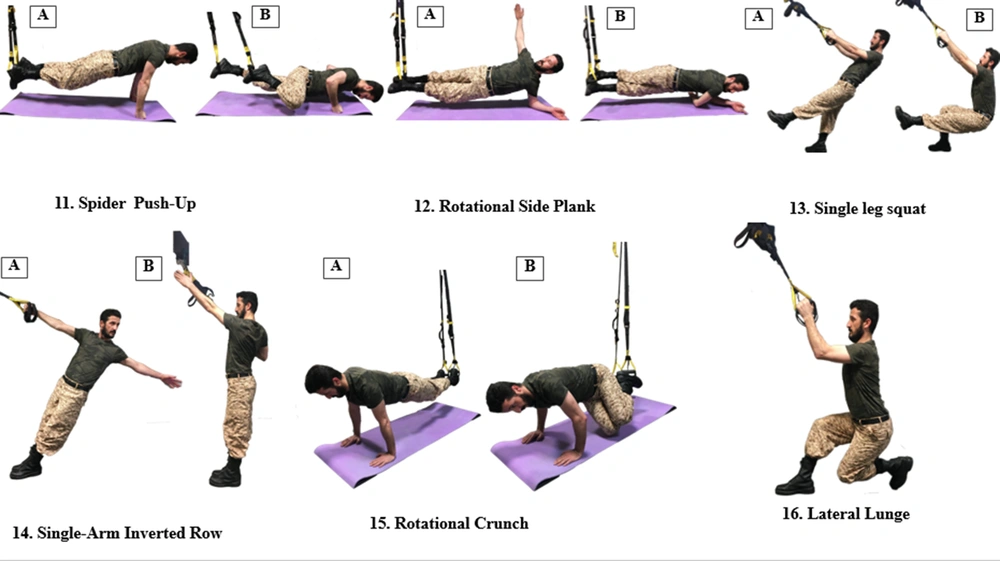
Figure 5.
Exercises numbers 11 - 16 in weeks 5 - 6 of the improvement phase
3.4.3. Maintenance Phase (Weeks 7 - 8)
This phase will stabilize what has been achieved in the previous phases and provide a maximum challenge for the neuromuscular system to achieve the best neuromuscular adaption (15). In addition, it includes all of the last phase exercises, and only one exercise [exercise number 17 (Figure 6)] will be added to this phase. Similar to the two previous phases, in this phase, the exercise will be performed in the circuit form. The circled numbers will be the same as in the last phase (5 circles with 180-second rest between each circle) (15).
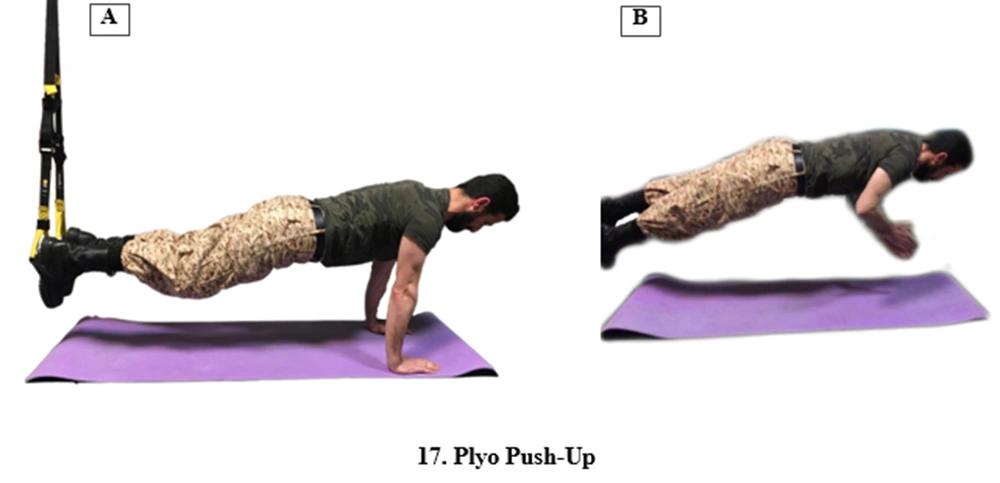
Figure 6.
Exercise number 17 in the maintenance phase
3.5. Outcome Measures
The primary researcher measures all interesting variables including physical performance, biomechanical lower extremity injury risk factors, mental health, and work-related factors at the baseline and 8 weeks after the intervention. Demographic information will be collected before the intervention.
3.6. Physical Performance
For the assessment of physical fitness, several tests will be applied, including the Cooper’s 12-minute run test for cardiovascular function assessment, the deep squat jump for lower extremity muscle strength, push-ups in 60 seconds for upper extremity muscle strength and endurance, and sit-ups in 60 seconds for core muscle strength and endurance (17). The aforementioned tests showed strong correlations with job performance in military personnel (17).
3.7. Biomechanical Lower Extremity Injury Risk Factors
DartfishTM Pro Suite software (version 5.5) will be used to assess biomechanical lower extremity injury risk factors in frontal plane kinematic data duringSS the drop jump task. Frontal plane kinematic data are evaluated regarding several variables, namely knee valgus/varus angle, hip adduction/abduction angle, and tibia adduction/abduction angle. For obtaining the interested kinematic variables, 12 reflective markers will be placed on anatomical landmarks in both sides, including the ASISs, lateral side of tights, lateral epicondyles of the knee, lateral side of shanks, lateral malleolus, and center of the calcaneus. Then, the subjects are requested to perform a drop-jump sequence through a first jump off the box at 40 cm height, then land, and perform an immediate maximum vertical jump (18). No instruction will be given for performing the task; however, the subjects are only asked to land precisely in front of the box to be in the correct position for camera recording. A digital video camera will be placed at the subject’s greater trochanter’s height, 3 meters away from the subject, and aligned perpendicular to the subject’s frontal plane (19). After recording the video with the camera, the recorded videos are transferred to DartFish software (version 5.5) for kinematic variable analysis. The average of three trials is recorded for each subject.
Additionally, this study will utilize the functional movement screen (FMS) test as an additional tool to assess biomechanics quantitatively. It is a series of seven fundamental movement patterns commonly associated with athletic movements, namely deep squat, in-line lunge, hurdle step, shoulder mobility, active straight leg raise, push-up, and rotary stability (20). The FMS, as a combination of seven tests, is scored on an ordinal scale with four categories. The FMS was found to be confidently applied by trained individuals to assess the movement patterns of an active individual (21).
The subjects are tested on three functional movements, including a deep squat, hurdle step, and in-line lunge. These three tests have been chosen because they demonstrate the highest interrater reliability of the seven FMS tests (21). Each test is performed three times, and a score ranging from 3 to 0, with 3 as the best and 0 as the worst, will be assigned according to performance (20). Moreover, these processes will be observed by the primary examiner visually and recorded with a digital camera for further investigation.
3.8. Mental Health and Work-Related Factors
The 36-Item Short Form Health Survey (SF-36) questionnaire is used to measure the health perceptions of military personnel (22). The 36 items of the SF-36 self-administered questionnaire, taking approximately 5 minutes to fill out, measure overall health on eight multi-item scales. These scales cover functional status, well-being, and comprehensive health assessment. This questionnaire was widely used in previous studies on military personnel (23). The Iranian-translated version of the SF-36 questionnaire is used in the current study, which has good validity (24). Individual Work Performance Questionnaire 1.0 is applied to measure work-related factors. This questionnaire’s conceptual framework consists of three basic measurements of the performance scale, including task and contextual and counterproductive work behaviors. This dimension represents the full range of individual work performance and has been shown to have acceptable validity and reliability. This study also includes a single-item question from the Work Ability Index questionnaires. Subjects’ current workability is rated based on a scale of 0 - 10, considering 0 as the worst and 10 as the best and a single-item question will be used about job satisfaction on a scale of 0 - 10 (25).
3.9. Statistical Analyses
The data will be statistically analyzed utilizing IBM SPSS software (version 20) for Windows (SPSS Inc. Chicago, IL, USA). Descriptive data, including mean and standard deviation, are presented for each variable, and the Shapiro-Wilk test is used for analyzing the statistical distribution and variance homogeneity. Using analysis of covariance, the change score from the baseline to follow-up will be the outcome measures (dependent variables). The independent variables are the groups (control vs. intervention). The analyses are controlled for the baseline value of the outcomes. In the case of significant baseline differences between the groups for the descriptive variables, they will be included as control variables in a sensitivity analysis. The effect size is calculated in partial eta-squared (η2). Effect sizes are considered small (0.01), medium (0.09), and large (0.14), and the alpha level was considered 0.05 (26).
4. Discussion
The present study aims to assess the effectiveness of suspension training in performance, lower extremity frontal plane kinematics, and quality of life in the Iranian Navy personnel through a randomized controlled trial study. Traditionally, the military focus has been on aerobic endurance exercises, such as long-running training, because it was accessible to prescribe this kind of exercise when training large numbers of soldiers during physical training. However, these protocols cannot meet all demands of military personnel. Moreover, this kind of exercise increases the risk of injury in this population, especially if accompanied by poor neuromuscular control and uncontrolled movements (4). It has been assumed that suspension training can train all components of physical fitness, including flexibility, cardiovascular fitness, power, muscular strength, and endurance. However, the effectiveness of suspension training has not been investigated in this population. In addition, due to the changing locations of military personnel, feasible and easy-accessible training methods that can be performed anywhere are needed. In contrast to heavyweights, suspension training can be performed using body weight and manipulating lever arm principles of resistance.
Therefore, a randomized controlled trial will be conducted to investigate the effectiveness of suspension training in performance as the primary and lower extremity kinematics and quality of life as the secondary outcomes. If the current training protocol improves performance, lower extremity kinematics, and quality of life in military personnel, various experts and military coaches can use suspension training programs as new methods requiring a minimal facility to improve all supervised military personnel demands.
The present study have some limitations. One of the most important limitations is the recruitment of only male personnel within a specific age range. Therefore, the results of the present study might not be generalizable to all military personnel populations. Another limitation is a double-blind design which is impossible for this study.

