


1. Background
Back pain is a common debilitating condition and an important clinical and epidemic social and economic problem in most industrialized and non-industrialized countries, which imposes direct and indirect costs on society (1). Non-specific chronic back pain is one of the subgroups of back pain, which affects about 85% of patients and has no pathoanatomical symptoms that can be detected by radiography (2). Back pain can be caused by ergonomic and mechanical factors, personal and social factors. Among the ergonomic and mechanical factors, we can mention sitting, insufficient rest between working intervals, performing work with high acceleration and speed, inappropriate body postures, performing repetitive movements with high frequency, lifting or moving heavy objects, in addition obesity, gender, age, etc. (3). Control and stability of the lumbosacral region are very important for the transmission of forces between the lower limbs and the spine. Inability to establish the stability in the lumbosacral region can lead to additional load on the joints, premature fatigue, and reduced trunk muscle endurance (1). Momani et al. emphasized the endurance of trunk flexor and straightener muscles with therapeutic exercise. In addition, they believed that fatigue affects the general ability of people and makes them susceptible to injury even in the face of not so much pressure (4). The decrease in muscle endurance following back pain does not improve by itself unless specific rehabilitation is done to retrain these muscles, so training for stabilizing muscles and developing exercises toward functional skills are essential parts of spinal muscle stability (5). Based on the study done by Wontac-Gong on the effect of bridge exercise with abdominal stretching in a design on an unstable surface on the back in adults for normal back stability. They showed that the correct use of bridge exercise for static recovery, dynamic stability of the back, and performing bridge exercises abdominal drawing in maneuver (ADIM) on an uneven surface is more effective than on a stable surface (6). Surface instability is a new variable in regular rehabilitation and strengthening exercises, which aims to increase muscle activity and improve joint proprioception receptors. The Swiss ball is one of these unstable training surfaces that has been used as a training tool by sports assistants and other sports medicine specialists in the last decade (7). Aziz et al. conducted a research to investigate the effectiveness of central stabilization exercises with and without a physio ball on patients with chronic back pain. The results showed that central stabilization exercises with a physio ball improved pain management, trunk control, and balance compared to people who had done the exercises on a flat surface (8).
Auricular acupuncture is a treatment method based on the image of the microsystem on the external part of the ear. This microsystem represents the whole body. For each part of the body, a point on the external ear is considered. The stimulation of each point of the external ear by this idea affects a certain part of the body. Finally, this stimulation and the body's response to it changes the physical, mental and psychological conditions of people. This treatment has been used to help treat and relieve pain in various diseases (9). In a study, Ushinohama et al. investigated the effect of an ear acupuncture session on pain intensity and condition control in people with chronic back pain. In the survey, people were divided into two groups of ear acupuncture and placebo. The results showed that the intensity of pain decreases in both groups, but in the ear acupuncture group, this pain reduction is greater (10).
2. Objectives
The researcher in the present study aims to answer the question that "do Swiss ball exercises and ear acupuncture affect the amount of pain and endurance of the central muscles of working women with chronic back pain?" And if so, which method is more effective?
3. Methods
The current research is a quasi-experimental type that was carried out in the field. The statistical population of the present study consisted of female patients aged 30 to 55 years with non-specific chronic back pain working in the General Directorate of Registration and Education of Qazvin province. Among the above statistical population, 45 people in the desired age range were selected by available and targeted sampling methods. In order to determine the minimum number of samples in this research, using statistical software for estimating sample size (G*POWER), for test power of 0.95, effect size of 0.80, and significance level of 0.05, the number of at least 15 people was determined for each group. This number was selected based on the existing restrictions of COVID-19. The inclusion criteria were patients with non-specific chronic back pain in the age range of 30 to 55 years old and back pain for which the doctor has not mentioned a specific cause and continues for 12 weeks. The exclusion criteria were the presence of a specific disease in the spine, such as tumors, infections, rheumatoid arthritis, and osteoarthritis.
3.1. The Method of Collecting Information and the Method of Its Implementation
First, written informed consent was obtained from the participants to comply with ethical considerations in the research. Then, the presence or absence of back pain and sports activity were asked by a health questionnaire, in which demographic information such as age, height, weight, work experience, physical activity level, and indicators such as back pain.
3.1.1. Visual Pain Intensity Scale
This scale is a 100 mm or 10 cm long horizontal bar, one end of which is zero, meaning no pain, and the other end is 10, which means the most severe possible pain. Its validity is excellent, and its reliability is ICC = 0.91 (11).
3.1.2. McGill Functional Test
To measure the strength and endurance of trunk muscles, McGill functional tests were used, which have excellent reliability coefficients: Intragroup correlation coefficient (trunk flexor test equal to ICC = 97%), (trunk extensor test equal to ICC = 97%) and plank tests are equal to ICC = 99% (12). It included four crunch tests, modified Biering-Sorensen, and side plank (right and left sides)
3.2. Protocols Used in the Research
Experimental group A received Swiss ball exercises for six weeks (for three sessions a week, each session had 10 minutes of warm-up, 45 - 60 minutes of main exercises, and in the end, they had five minutes of cooling down (main exercises: Four stretching exercises: Sitting on the ball (knees should be at a 90-degree angle) and stretching the arms to the left, and right, spinal extension (supine position on ball), reverse cross on ball, lateral pull (from side) on ball, crunch on ball, belly bridge, plank on ball, plank on the ball from the side (left and right), and squat with the ball on the wall.
Experimental group B (ear acupuncture): The duration of the treatment was six weeks, two sessions per week. In each session, special adhesives containing one millimeter needle were installed on the outer part of one ear (Figure 1). In the next session, these adhesives were removed and discarded, new adhesives on the other ear were installed. This work was done in the office by an acupuncturist. The control group also continued their daily activities during this time.
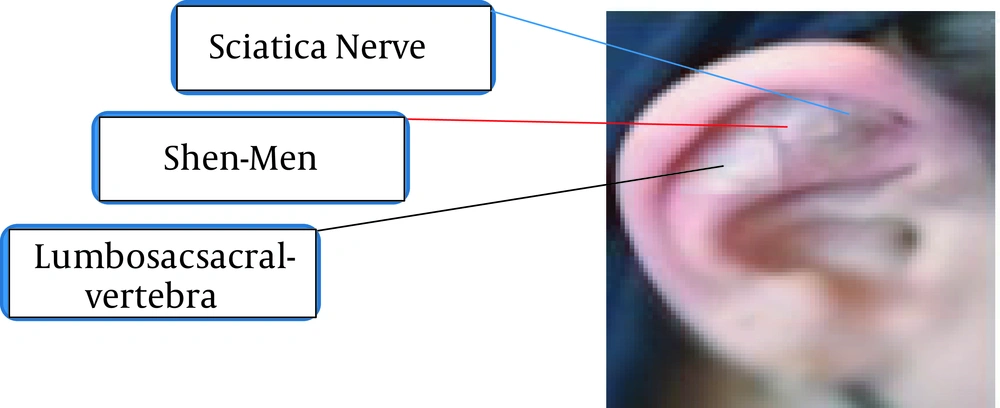
Figure 1.
Place of glue installation on the ear
At the end of the intervention, the post-test of all three groups was conducted according to the pre-test. Then the obtained results were analyzed. In the descriptive statistics section, the mean and standard deviation (SD) were used to describe the data. The normality of data distribution was checked using the Kolmogorov-Smirnov test. Analysis of variance (ANOVA) and paired t-test were used to analyze inter-group and intra-group differences. All statistical calculations were performed using SPSS version 22 software.
4. Results
The demographic characteristics of the research subjects are presented in Table 1.
Table 1.The Demographic Characteristics of the Participants a
| Groups | Number | Age (y) | Height (m) | Body Weight (kg) | BMI |
|---|---|---|---|---|---|
| Acupuncture | 15 | 36.11 ± 3.15 | 175.76 ± 6.75 | 66.76 ± 4.25 | 27.13 ± 4.12 |
| Swiss ball | 15 | 38.23 ± 2.43 | 172.13 ± 7.33 | 62.25 ± 7.02 | 28.26 ± 5.19 |
| Control | 15 | 39.33 ± 3.75 | 169.28 ± 7.45 | 67.37 ± 5.77 | 27.42 ± 3.32 |
a Values are expressed as mean ± standard deviation (SD).
4.1. Checking the Normality of Data Distribution
To determine the data distribution, the Kolmogorov-Smirnov test was used for all the variable directions of this research. Considering that the significance level was< 0.05, the distribution of data is norm.
According to Table 2, there was a significant difference between pre-and post-test of the acupuncture group and the Swiss ball in pain intensity (P = 0.000); however, there was no significant difference between pre-and post-test of the control group in pain intensity (P = 0.582). The effect of six weeks of Swiss ball exercises and ear acupuncture has been shown on pain intensity in working women with non-specific chronic back pain.
Table 2.Pain Intensity and Performance Disability in Three Groups
| Groups | Test Steps | Groups | Tukey's Test | |||
|---|---|---|---|---|---|---|
| Pre-test | Post-test | P-Value | Difference of Means | P-Value | ||
| Pain intensity | ||||||
| Acupuncture | 8.13 ± 1.55 | 6.26 ± 1.03 | 0.000 | Acupuncture-control | -2.266 ± 0.39 | 0.000 |
| Swiss ball | 8.80 ± 0.86 | 6.46 ± 1.18 | 0.000 | Swiss ball-control | -2.066 ± 0.39 | 0.000 |
| Control | 8.66 ± 0.72 | 8.53 ± 0.51 | 0.583 | Acupuncture-Swiss ball | -0.200 ± 0.39 | 0.835 |
According to Table 3, there was a significant difference between the pre- and post-test of the acupuncture and Swiss ball groups in the endurance of the trunk flexor and extensor muscles (P = 0.000 and P = 0.000, respectively). However, there was no significant difference between the pre- and post-test of the control group (P = 0.892 and P = 0.560, respectively), which indicates the effect of acupuncture and Swiss ball exercises on trunk muscle endurance in women with non-specific chronic back pain. According to the pre- and post-test average, motor control exercises have a greater effect on muscle endurance. The results of the ANOVA showed that there was a significant difference between the groups of acupuncture with control, Swiss ball with control in the endurance of trunk flexor muscles (crunch) and trunk extensor muscles (adjusted Sorensen); however, difference was not observed between acupuncture and Swiss ball groups.
Table 3.Endurance of Trunk Muscles (Flexor and Extensor) in Three Groups
| Groups | Test Steps | Groups | Tukey's Test | |||
|---|---|---|---|---|---|---|
| Pre-test | Post-test | P-Value | Difference of Means | P-Value | ||
| Trunk flexor | ||||||
| Acupuncture | 11.8 ± 1.68 | 17.33 ± 2.25 | 0.000 | Acupuncture-control | 5.92 ± 1.60 | 0.005 |
| Swiss ball | 12.60 ± 2.29 | 15.93 ± 1.16 | 0.000 | Swiss ball-control | 3.26 ± 0.82 | 0.000 |
| Control | 12.60 ± 1.99 | 12.66 ± 1.34 | 0.892 | Acupuncture-Swiss ball | 2.59 ± 1.91 | 0.000 |
| Trunk extensor | ||||||
| Acupuncture | 30.13 ± 2.41 | 41.82 ± 2.24 | 0.000 | Acupuncture-control | 12.61 ± 0.42 | 0.000 |
| Swiss ball | 29.73 ± 2.25 | 39.33 ± 3.03 | 0.000 | Swiss ball-control | 10.12 ± 1.21 | 0.000 |
| Control | 29.53 ± 2.72 | 29.20 ± 2.82 | 0.560 | Acupuncture-Swiss ball | 1.49 ± 9.21 | 0.083 |
According to Table 4, there was a significant difference between pre- and post-test of the acupuncture group and the Swiss ball in the endurance of the side muscles of the trunk (left and right flexors) (P = 0.000); however, there was no significant difference between the pre- and post-test of the control group (P = 0.189 and P = 0.363, respectively), showing the effect of Swiss ball exercises and ear acupuncture on the endurance of the side muscles of the trunk in women with non-specific chronic back pain. The results of the ANOVA test showed that there was no significant difference between the Swiss ball and ear acupuncture training groups in the endurance of the side muscles of the trunk (left and right flexors).
Table 4.The Endurance of Lateral Trunk Muscles (Left and Right Flexors) in Three Groups
| Groups | Test Steps | Groups | Tukey's Test | |||
|---|---|---|---|---|---|---|
| Pre-test | Post-test | P-Value | Difference of Means | P-Value | ||
| Trunk lateral flexor (right) | ||||||
| Acupuncture | 13.53 ± 3.35 | 17.60 ± 3.26 | 0.000 | Acupuncture-control | 4.14 ± 0.17 | 0.000 |
| Swiss ball | 13.66 ± 3.30 | 17.26 ± 2.78 | 0.000 | Swiss ball-control | 3.19 ± 9.31 | 0.000 |
| Control | 13.66 ± 3.30 | 13.46 ± 3.09 | 0.189 | Acupuncture-Swiss ball | 0.33 ± 1.48 | 0.845 |
| Trunk lateral flexor (left) | ||||||
| Acupuncture | 12.93 ± 3.19 | 16.40 ± 3.04 | 0.000 | Acupuncture-control | 3.65 ± 1.18 | 0.000 |
| Swiss ball | 12.93 ± 2.84 | 16.13 ± 2.61 | 0.000 | Swiss ball-control | 3.53 ± 1.05 | 0.000 |
| Control | 12.66 ± 2.68 | 12.86 ± 2.68 | 0.363 | Acupuncture-Swiss ball | 0.1 ± 1.052 | 0.731 |
5. Discussion
The purpose of this research was to compare the effects of Swiss ball exercises and ear acupuncture on pain and muscle endurance in patients with non-specific chronic back pain. The results of the present study showed that performing a course of ear acupuncture treatment and Swiss ball exercises reduced pain and increased the endurance of trunk muscles in patients with non-specific chronic back pain. Muscular strength and endurance are important factors of health and physical fitness. Moreover, 80% of lower back pains are muscular in nature and can be corrected with strengthening exercises in the abdomen and lower back. It is thought that with strength training, the strength and function of the connective tissue around the joint of these patients were improved, while pain and imbalance decreased (13).
Today, Swiss ball exercises have been introduced as a new and practical method to improve muscle adaptations in the mentally retarded. Atrophy and thinness of the trunk muscles in patients with non-specific chronic back pain can be considered one of the reasons for the weakness of trunk muscle endurance (14). Halliday et al. have stated that the back muscles, as the postural and supporting muscles of the body, contract faster and atrophy and weaken to a greater extent than other muscles, and this decreases the endurance of the muscles (15). Many researchers have established the basis of the treatment in preventing the progression of symptoms in patients with back pain based on the removal of forces on the spine and back. Therefore, exercising on a stable surface, which increases the forces on the spine, is considered harmful (16), while a person can control his weight and reduce the forces on the spine by exercising with a Swiss ball (17). Patients with chronic mechanical back pain have impaired proprioception and sensory accuracy, and these disorders are related to the pain level of these patients. Deep receptors transfer joint and muscle information via sensory nerves to central nervous centers, and what improves stability and prevents injury is neuromuscular coordination (18). Due to strengthening the muscles around the joint and reducing the pressure on it, as well as increasing sensory and proprioceptive feedback, Swiss ball sports exercises can create an ideal environment for performing physical exercises to improve balance, strength, and muscle endurance; as a result, they improve the performance of these patients (19). Heydari et al. conducted a study entitled "comparison of the effect of central stability exercises on the Swiss ball and TRX on the central stability and balance of women with non-specific chronic back pain-clinical trial research". The results of this research showed that both exercises on the suspended ball using the TRX cable had a significant effect on the static and dynamic balance and stability of the central body region, but there was no significant difference between the effects of the exercises on the ball and suspended groups (20). Therefore, exercises with a Swiss ball can increase muscle endurance and subsequently improve back pain and disability in patients. Therefore, exercises increase the endurance capacity of flexor and extensor muscles in creating stability of the trunk, and it greatly improves pain and inability to function by raising the threshold of fatigue of the trunk muscles (12).
Acupuncture improves back pain and disc pain in other parts of the spine by two mechanisms. It increases the immune cells and interstitial fluid around the affected disc. As a result of compensating for the reduction of disc water and increasing the body's activity to repair the patient's intervertebral disc, eliminating the patient's pain by blocking the post-synaptic nerve fiber, and reducing pain by stimulating the nerves located in muscles and other tissues, this acupuncture stimulation can induce the release of endorphins, encephalin, and beta-endorphins, which have a pain-relieving effect like morphine. These factors are secreted from the spinal cord-midbrain-pituitary and hypothalamus (21). Reducing inflammation through the secretion of relevant factors is another property of acupuncture, which is also the mechanism of anti-inflammatory pills such as indomethacin. Reducing muscle contraction and improving joint movement increase blood flow. This mechanism of acupuncture effect can also reduce edema, swelling, and bruising (21). A review of the perspectives of eight different physicians published in 2019 on their extensive clinical experience using acupuncture as a treatment for chronic low back pain, this research found that although each individual's techniques may be different, acupuncture has a positive effect on pain relief of chronic back pain in elderly patients (22). The results of this research are consistent with those of Jitendra and Anandh (6), Aziz et al. (8), Halliday et al. (15), and Haydari et al. (20). This alignment can be due to the space and training environment and the similarity in the type of treatment.
5.1. Conclusions
In general, the findings of the current research confirm the increase in the endurance of the flexors and extensors of the lumbar vertebrae and the lateral flexors, followed by a reduction in pain. Therefore, it can be concluded that these two therapeutic methods may influence the variables of trunk endurance and pain intensity in patients with non-specific chronic back pain. Despite being cheap and available, these new-emerging treatments for back pain have gained less attention in Iran due to the lack of popular culture and the haste in recovery, as well as the preference for drug treatments and even surgery. These methods are pain-free, drug-free, and non-invasive. It is suggested that coaches and officials use this method in training or rehabilitation programs for patients with non-specific chronic back pain. It is also recommended that other effective factors in the treatment and reduction of symptoms related to non-specific chronic back pain, such as medicine and water therapy, should be compared with these two mentioned methods (Swiss ball and ear acupuncture) in future studies.
5.2. Ethical Considerations
Following the principles of research ethics: The research proposal was approved by the Deputy of Research and Technology and the Ethics Committee of Qazvin University of Medical Sciences (code: IR.QUMS.REC.1400.284). Written informed consent was obtained from all samples. All the research units were assured that the personal information would be considered completely confidential and they could withdraw from the cooperation whenever they wanted without any problem.

