


1. Background
Nursing is a medical profession that offers direct and immediate services to a wide range of patients/clients, groups, and communities throughout life (1, 2). Nurses are responsible for providing a major part of health care, and their performance is rooted in personal motivation and largely determines the quality of patient care (3, 4). Nurses make up a significant portion of hospital staff (5). Research has shown that 59% of health professionals worldwide are nurses, and only one third of them are satisfied with their job (6, 7).
At least 50% to 80% of health care services worldwide are provided by nurses and, therefore, they play a key role in offering safe and quality services in different wards of the public and private hospitals (8). Needless to say, the satisfaction of this group affects the success of the hospital and the quality of health care (9). But nurses from different countries are generally deprived of favorable opportunities to get a job in health centers. Their professional identity is not clear, and without professional development, interpretation, and definition of the role of nurses, there are risks of improper use of nurses as well as erroneous interpretation of the compliance/non-compliance of the customer satisfaction policies issued by the healthcare institute or the government (10).
Studies have shown that an acceptable public image of the profession significantly affects nurses. For example, the negative attitude of people in the UK has been discovered to convince the nurses not to consider their job as a profession (11). A study in Spain has found that job fairness, career advancement opportunities, and rewards affect nurses' professional performance (12). Another study has suggested that maintaining and promoting job satisfaction improves the nurses' endurance in workplaces. A study in Sweden has revealed that a large number of nurses are determined to leave their posts (13). Another study has demonstrated that factors such as lack of employment and a tendency to quit the job are important causes of the nursing shortage (14). Salaries, benefits, and rewards have also been detected to affect the work performance quality of the nurses (15). Furthermore, a positive work environment and supportive supervision can motivate nurses to work in hospitals (16).
Despite the rapid development of communities around the world as well as the serious role played by nurses in communities, fulfilling the needs of the nursing community had not received enough research attention.
2. Objectives
The present study aimed to investigate the performance of hospitals in meeting the needs of nurses.
3. Methods
3.1. Participants and Setting
The present study was a cross-sectional study performed from March to August, 2021, in selected hospitals in Iran. The statistical population, including nurses working in 18 Iranian hospitals, was selected using the snowball method. All nurses received written information about participation criteria and were given a choice to abandon the study at any given point. Participation was voluntary and written informed consent was obtained from all participating nurses. Then the data in the questionnaires were reviewed confidentially. Finally, 683 nurses completed the questionnaire.
3.2. Inclusion Criteria
Inclusion criteria were: (1) nurses with at least one year of work experience; (2) an informed consent signed by nurses to participate in the research.
3.3. Research Tools
Initially, 18 hospital managers and 3 prominent researchers agreed that questionnaire was a useful and valid tool to assess hospital performance in meeting the needs of the nursing staff. Our data collection tool was a researcher-made questionnaire consisting of demographic information about the participants (e.g., age, gender, marital status, education, type of hospital, job role, type of work unit) and four additional items for assessing the hospital performance in meeting the needs of nurses. This five-choice Likert questionnaire was designed and categorized into four items (i.e., career promotion, material factors, job position, and spiritual factors) with 40 sub-categories. In the job promotion category, following items were included: holding training courses, job development, and enrichment, and updating professional skills; the items in spiritual factors inquired about: paying attention to the needs and religious beliefs of nurses, satisfaction with the quality of work life, and feeling comfortable in the workplace; and finally, the items in material factors and job position inquired about: incentive payments and attention to tastes and interests. The questionnaires were completed online. It should be noted that the alpha coefficient for the questionnaire was 0.725. The validity of the present questionnaire was measured based on the content and form; to this end, various information sources were examined and reviewed under the observation of the supervisor and some other professors and experts.
3.4. Data Analysis
The items and criteria were prioritized and weighed by adopting the method of hierarchical analysis process, and the matrix of pairwise comparisons of items was obtained. Furthermore, the average performance of hospitals was determined using a pie chart. A total of 683 nurses completed the questionnaire. The mean and standard deviation of the age of nurses participating in the study were 27.5 and 7.9 years, respectively; and their mean work experience was 18.2 years. The majority of the participants were females (73.6%). Also, 85.9% of participants had a bachelor's degree, 65.6% of them were shifted nurses, and 51.3% of them had 10 to 20 years of work experience. The highest coefficient of performance in meeting the needs of nurses in hospitals was recorded for job promotion, followed by the items of spiritual and material factors, and the lowest coefficient of importance was found for the job position.
4. Results
In the present study, the needs of nurses were categorized into four items, including job promotion, material factors, job position, and spiritual factors, each of which had 10 sub-categories. Then the importance coefficient of hospitals' performance in meeting the needs of nurses was examined from the perspective of nurses. A total of 683 nurses completed the questionnaire. The mean and standard deviation of the age of nurses participating in the study were 27.5 and 7.9 years, respectively, and their mean work experience was 18.2 years. The majority of the nurses were females (73.6%), 85.9% of them had a bachelor's degree, 65.6% of them were shifted nurses, and 51.3% of them had 10 to 20 years of work experience. The highest coefficient of performance in meeting the need for nurses in hospitals was recorded for job promotion, followed by the items of spiritual and material factors, and the lowest coefficient of importance was found for job position.
The importance coefficient of hospitals' performance regarding job promotion was determined using hierarchical analysis technique and based on the following table. The criterion for holding training courses, with a weight of 0.98, was the highest coefficient of importance and the criterion of job development and enrichment, with a weight of 0.34, was the lowest coefficient of importance. When evaluating the importance coefficient of the performance of hospitals regarding material factors using the hierarchical analysis technique, the criterion of significant difference in monthly salaries with physicians with a weight of 0.94 was found to be the least important factor. Evaluating the coefficient of the importance of the performance of hospitals concerning spiritual factors using the hierarchical analysis technique, moreover, the criterion for awarding a plaque for new ideas and positive work with a weight of 0.85 had the highest coefficient of importance. Criterion of obligatory pilgrimage against new ideas and positive works with a weight of 0.37 had the lowest coefficient and was also statistically significant. As for the job position, performing tasks in line with the goals of the hospital with a weight of 0.79 had the highest coefficient of importance, whereas the attention to nurses’ tastes and interests, with a weight of 0.09, had the lowest coefficient of importance (Table 1).
Table 1.Evaluation of the Coefficient of Importance of Hospitals' Performance to Meet the Needs of Nurses
| Branch | Coefficient | Criterion | Coefficient |
|---|---|---|---|
| Job promotion | 0.63 | Holding educational courses | 0.98 |
| Career development and enrichment | 0.36 | ||
| Priority in determining career path | 0.40 | ||
| Participation in educational projects | 0.77 | ||
| Career promotion steps are performed | 0.82 | ||
| Upgrading professional skills | 0.66 | ||
| Valuing new ideas | 0.52 | ||
| The hospital seeks to improve the quality of their jobs | 0.43 | ||
| Improving effective communication skills and negotiation skills | 0.57 | ||
| Creating a competitive spirit among nurses | 0.79 | ||
| Spiritual factors | 0.62 | Paying attention to the needs and religious beliefs of nurses | 0.65 |
| Satisfaction with the quality of work life | 0.53 | ||
| Integrity between employees and managers | 0.57 | ||
| Pilgrimages against new ideas and positive works | 0.36 | ||
| Feeling relaxed at work | 0.78 | ||
| Respecting the nursing staff | 0.73 | ||
| Hospital attention to staff happiness | 0.53 | ||
| Awarding a plaque of appreciation for new ideas and positive work | 0.84 | ||
| Dealing with the nursing staff with openness and generosity | 0.64 | ||
| Dealing with the nursing staff with justice and fairness | 0.66 | ||
| Material factors | 0.57 | Incentive payments | 0.48 |
| Pay appropriate bonuses and benefits | 0.55 | ||
| Significant differences in monthly salaries with physicians | 0.94 | ||
| Develop new methods for paying nurses | 0.50 | ||
| Pay salaries fairly and in proportion to the workload | 0.43 | ||
| Amenities for nursing staff | 0.57 | ||
| Skills based payment | 0.65 | ||
| Competency-based payment | 0.62 | ||
| Knowledge-based payment | 0.48 | ||
| Performance-based payment | 0.56 | ||
| Job position | 0.52 | Appointments based on merit | 0.68 |
| Paying attention to tastes and interests | 0.09 | ||
| Creating a positive work environment and feel comfortable | 0.72 | ||
| Paying attention to physical and mental needs | 0.29 | ||
| Paying attention to providing work equipment and work clothes suitable for nurses | 0.63 | ||
| Paying attention to working hours and conditions | 0.35 | ||
| Attention to independence and freedom of action at work | 0.40 | ||
| Suitability of physical space and ambient light | 0.78 | ||
| Using the opinions and information of the nursing staff in decisions | 0.51 | ||
| Performing tasks consistent with the goals of the hospital | 0.79 |
The final evaluation of four items of nurses’ needs was considered in the form of pairwise comparison matrices. The incompatibility rate in the job promotion item was 0.07, and because this value was less than 0.1, it was acceptable, and there was no need to resolve the incompatibility. The incompatibility rate for the item of spiritual factors was 0.01, which was less than 0.1; therefore, it was acceptable, and there was no need to resolve the incompatibility. Moreover, according to Table 2, the incompatibility rate for material factors was less than 0.1; consequently, it was acceptable, and there was no need to resolve the incompatibility. Finally, the job status item was less than 0.1; as a result, it was acceptable, with no need to resolve the incompatibility (Table 2).
Table 2.Matrix of Pairwise Comparisons of Criteria
| Matrix of Pairwise Comparisons of Criteria | Incompatibility Rate |
|---|---|
| Job promotion | 0.07 |
| Spiritual factors | 0.01 |
| Material factors | 0.02 |
| Job position | 0.04 |
This study also examined the mean performance of hospitals in studying the needs of nurses. Based on the results, the highest mean performance of hospitals in meeting the needs of nurses was related to the items of job promotion and spiritual factors, and the lowest mean performance of hospitals in meeting the needs of nurses was related to the item of job status (Figure 1).
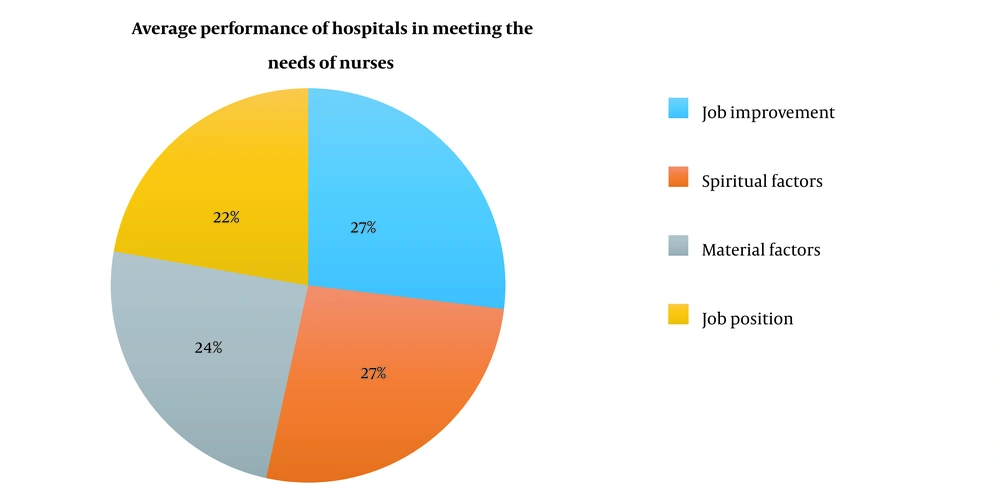
Figure 1.
Average performance of hospitals in meeting the needs of nurses
5. Discussion
The essential needs of nurses were related to factors such as job promotion, material factors, job status, and spiritual factors. In a study by Bhatnagar et al., it was shown that career advancement of healthcare workers motivated them and affected their performance (17). In our study, the highest priority coefficient (0.63) was detected for job promotion. Some studies have also demonstrated that insufficient attention is paid to nurses' career advancement (18, 19), which was inconsistent with the results of the present study. In the study by Schopman et al., the effect of salary increases on nurses' job satisfaction was investigated, and the correlation matrix was detected to be 0.183 (20). The second coefficient of importance of hospital performance was related to spiritual factors. Two of the criteria for spiritual factors are quality of work life and feeling of comfort in the workplace, although several studies have revealed that nurses neither have a good quality of work life nor do they enjoy enough comfort (21-23). In the study by Morton et al, however, most nurses were discovered to feel comfortable in their work environment (24). In our study, the matrix of pairwise comparisons of material factors showed an incompatibility rate of IR = 0.02, which was acceptable and, therefore, eliminating incompatibility was not necessary. In the study by Halldorsdottir et al., the most important incentives for nurses were financial rewards (18), which contradicted our study results. Holmberg et al. argue that nurses are not motivated solely by financial rewards (19), which was consistent with our study findings. In the study by Kitsios et al., nurses were found to feel insufficient satisfaction with their job position (25), which was in concordance with our study results. In the study by Lambrou et al., nurses were found satisfied with their job position (26), which was not consistent with our study results. Though extensive studies have investigated the nursing profession from different aspects, only few of them examined the social and professional status of nurses; therefore, only the study results from relevant studies were used in the present study. In this regard, the results of monotheistic research as well as the results from other studies, have shown that there is a significant relationship between professional status and job rank in nursing, job satisfaction, and the nurses’ interests in the profession (P = 0.0005) (27).
5.1. Conclusions
In sum, the performance of hospitals regarding the fulfillment of the nurses’ needs was not satisfactory enough despite the hospital managers’ attempts to improve the performance. Some of the hospitals’ weaknesses included inattention to career development and enrichment as well as obligatory pilgrimage against the idea. New and positive jobs, payment proportionate to the workload, as well as attention to the tastes and interests of the nurses were some requirements necessary to fulfill. Given the factors such as the enormous job difficulty of nursing, the shortage of nursing staff in Iran, and the long retirement period in nursing profession, it was highly recommended that the process of evaluating the performance of hospitals in meeting the needs of nurses should receive sufficient and constant attention. It was also suggested that the corrective measures concerning job promotion, spiritual factors, material factors, and job position should be designed and implemented by policymakers and hospital managers in the healthcare system. By doing so, the public image of the nursing profession may have been improved, although it required sustained effort and careful planning.


