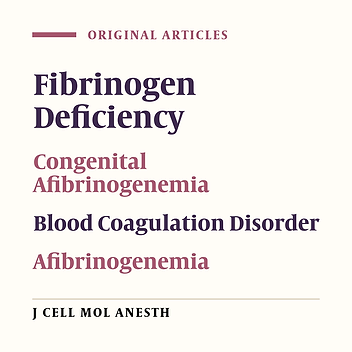
Image Credit:J Cell Mol Anesth
Outline
Bleeding Episodes Among Patients with Congenital Fibrinogen Disorders, a Study On 12 New Iranian Patients
Authors

Abstract
Background: Congenital fibrinogen disorders (CFDs) comprise about 10% of rare bleeding disorders (RBDs). CFDs are divided into two groups of quantitative (afibrinogenemia and hypofibrinogenemia) with autosomal recessive inheritance pattern, and qualitative (dysfibrinogenemia, hypodysfibrogenemia) disorders, mainly with autosomal dominant inheritance pattern. Sistan and Baluchestan Province in Iran, with its high rate of consanguineous marriages, has a high incidence of RBDs including CFD. In the current study, we report clinical manifestations of patients with CFDs.Methods: Twelve new Iranian patients from Sistan and Baluchestan Province with different types of CFDs were selected for this study. Diagnosis of CFDs was based on clinical features and familial history followed by laboratory assessment by routine and specific coagulation tests including prothrombin time (PT) and activated partial time tests (APTT), as well as FI activity assay by Clauss method.Results: Out of 12 patients, 3(25%) had afibrinogenemia, 7(58.3%) had hypofibrinogenemia while 2(16/7%) were suspected of having dysfibrinogenemia. Although umbilical cord bleeding (UCB) 9(75%) was the most common clinical presentation among the study population, this feature was not observed among patients with dysfibrinogenemia. Hematoma (100%) was the most common presentation of patients with dysfibrinogenemia.? Conclusion: Results of this study revealed that some clinical presentations are the diagnostic features of CFDs and can be used for precise and in-time diagnosis CFDs in conjunction with family history and laboratory findings.Keywords: Fibrinogen Deficiency; Congenital Afibrinogenemia; Blood Coagulation Disorder; Afibrinogenemia
Highlights
References
- 1.References are in the PDF file of the article.
Copyright
© 2018, Author(s). This open-access article is available under the Creative Commons Attribution 4.0 (CC BY 4.0) International License (https://creativecommons.org/licenses/by/4.0/), which allows for unrestricted use, distribution, and reproduction in any medium, provided that the original work is properly cited.
Similar Articles
Prevalence of Rare and Common Bleeding Disorders in Kurdistan Province of Iran
Dorgalaleh A, Rashid Panah J, Varmaghani B, Beigi P, Ahmadi A. Prevalence of Rare and Common Bleeding Disorders in Kurdistan Province of Iran. J Cell Mol Anesth. 2019;4(4):e149593. doi: https://doi.org/10.22037/jcma.v4i4.29074
Burden of Congenital Factor XIII Deficiency in Iran
Dorgalaleh A. Burden of Congenital Factor XIII Deficiency in Iran. J Cell Mol Anesth. 2017;2(3):e149544. doi: https://doi.org/10.22037/jcma.v2i3.16263
The Founder Effect? -FXIII Deficiency in Southeast Iran: A Molecular Study Report
Shahraki H, Dorgalaleh A, Fathi M, Tabibian S, Teimourian S, et al. The Founder Effect? -FXIII Deficiency in Southeast Iran: A Molecular Study Report. J Cell Mol Anesth. 2020;5(4):e149647. doi: https://doi.org/10.22037/jcma.v5i4.31852
Complete Genotype and Clinical Phenotype of Hemophilia B: A Study on Iranian Patients
shakouri M, Hosseini MS, Dorgalaleh A, Shahidi M, Zaker F. Complete Genotype and Clinical Phenotype of Hemophilia B: A Study on Iranian Patients. J Cell Mol Anesth. 2021;6(1):e150285. doi: https://doi.org/10.22037/jcma.v6i1.33722
c.559 T>C as The Most Common Mutation of Factor XIII Deficiency in Iranian Patients is not Restricted to Southeast Iran
Dorgalaleh A, Tabibian S, Varmaghani B, Tamadon G, Boustani H, et al. c.559 T>C as The Most Common Mutation of Factor XIII Deficiency in Iranian Patients is not Restricted to Southeast Iran. J Cell Mol Anesth. 2016;1(4):e149521. doi: https://doi.org/10.22037/jcma.v1i4.13508
- Scopus by DOI: 1
Last Update: 1 day ago
- Scopus by Title: 1
Last Update: 1 day ago
- Scopus by Title (Ref): 1
Last Update: 1 day ago
- CrossRef: 0
Last Update: 6 days ago
- OpenAlex: 0
Last Update: 2 days ago
- OpenCitations: 0
Last Update: 4 days ago