
1. Background
Significant changes in a child's cognitive and neurological development occur during the toddler years, which typically lasts between 12 and 36 months. During this time, infants rapidly develop their language, memory, attention, problem-solving, and social skills. They also developed physical coordination and motor skills. The development of these skills is critical to the child's success in school and life, as they provide the foundation for further learning and social interaction (1).
Neurological development in infancy involves the growth and maturation of the brain, including the formation of new neural pathways and the strengthening of existing ones. This process is enhanced by experiences and interactions with the environment, such as play, exploration, and socialization (2).
Cognitive development in infancy is closely linked to neurological development, as brain growth and maturation allow the development of increasingly complex cognitive abilities (3).
Several studies have shown the influence of perinatal and postnatal factors on cognitive development in infancy, but most of them have been performed on preterm infants and infants hospitalized in the neonatal intensive care unit, and few similar studies have been performed on term infants who have not had hospitalizations (4-6) so in this study, we focused on these seemingly low-risk children to investigate the relationship between perinatal and postnatal factors and cognitive development in healthy toddlers.
2. Objectives
Therefore, in this study, we investigated perinatal and postnatal factors affecting the cognitive development of non-hospitalized term infants between 18 and 22 months of age.
3. Methods
The sample size was determined based on the cognitive score from a study by Madaschi et al. (7), which was reported to be 64.78 ± 10.85. Considering an alpha value of 0.05, an error value of 3, and the formula below, the sample size was calculated to be at least 48 cases for comparison.
In this retrospective cross-sectional study, we censused every infant until the sample size was reached, considering the inclusion and exclusion criteria. Finally, we studied 50 toddlers who were born between March 2015 and March 2016. The inclusion criteria for the study were healthy infants with a comprehensive infant record, had parental consent, were between 18 and 22 months of age at the time of the vaccination medical consultation, were contacted by the researchers as described below, and were residents of Zahedan City. Exclusion criteria included premature birth or hospitalization for any reason during the neonatal period.
This study focused on toddlers born at Ali ibn Abi Talib Teaching Hospital in the city of Zahedan, southeastern Iran.
This study was approved by the Research Ethics Committee of the Zahedan University of Medical Sciences (IR.ZAUMS.REC.1396.027).
Parents were then contacted by the researchers, and the aims and methods of the study were explained to them. If the parents agreed, the child was enrolled in the study, and demographic information and risk factors were obtained from the medical records of the baby and the baby's mother. An appointment was made for the child to visit the Growth and Development Outpatient Clinic at Ali ibn Abi Talib Teaching Hospital; prior to the scheduled arrival of the participant minor and their guardians, preparations were made to ready the experimental testing environment according to the study protocol. In accordance with the pre-arrangements made with the parents, the toddlers were subjected to the Bayley-3 test (8).
Prior to the data collection, written informed consent was obtained from the parents of the children by the researchers.
If the toddlers did not sufficiently cooperate or the parents were unwilling to proceed with the test, they were replaced with toddlers born during the study interval who were 18-22 months of age at the time of the study (2017 - 2018) via a simple random procedure using a random number generator for medical record numbers.
According to the guidelines of the Bayley test, toddlers aged 18 - 24 months were divided into three groups on visual recognition memory, problem-solving, object permanence, attention to novelty, and early problem-solving tasks according to cognitive assessment as follows: Competent, with scores between 21 and 33; Emerging, with scores between 17 and 20; and At Risk, with scores between 0 and 16 (9). The results of this test and other findings from the cases were summarized in a data collection form.
After assessing the distribution of the variables using the Kolmogorov-Smirnov test, the data of the toddlers were statistically analyzed using the Mann–Whitney U test, Kruskal–Wallis test, and Pearson's correlation coefficient according to the type of variable. These factors included birth weight, gender, toddler weight, birth head circumference, and toddler head circumference. Maternal age, route of delivery, hyperbilirubinemia, parity, infant nutrition, and mother’s educational level were analyzed using SPSS version 21. The statistical significance level for all analyses was set at P < 0.05, and the confidence interval (CI) at 95%.
4. Results
Of the 76 children studied according to the inclusion criteria, 26 were excluded due to lack of parental or child cooperation. Of these, 21 cases were excluded from the study because the parents did not consent or were unable to attend the study site, and five cases were removed from the study because the child did not cooperate and were replaced by simple randomization. Ultimately, 50 eligible toddlers were included in the analysis.
According to the results, the average cognitive score of toddlers aged 18 to 22 months, measured by the Bayley-3 test, was 22.68 ± 2.69.
Based on the results, the cognitive scores of three toddlers (6%) were classified within the At-Risk group, five toddlers (10%) were classified within the Emerging Group, and the remaining 42 toddlers (84%) were classified into the Competent Group.
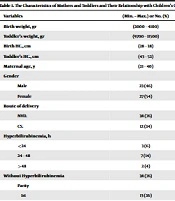
The baseline characteristics of the toddlers are shown in Table 1. The results showed that birth weight (P < 0.001), toddlers’ current weight (P = 0.035), and maternal age (P = 0.001) were significantly related to the cognitive score of toddlers between 18-24 months of age.
Table 1.
The Characteristics of Mothers and Toddlers and Their Relationship with Children’s Cognitive Score
| Variables | (Min. – Max.) or No. (%) | Mean + SD. (Cognitive Score) | r | P-Value |
|---|---|---|---|---|
| Birth weight, gr | (2000 – 4100) | 3038 ± 436.36 | 0.447 | <0.001 a |
| Toddler's weight, gr | (9700 – 11500) | 10572 ± 414.55 | 0.298 | 0.035 a |
| Birth HC., cm | (28 – 38) | 33.88 ± 2.17 | 0.220 | 0.126 a |
| Toddler's HC., cm | (43 – 52) | 46.85 ± 2.10 | 0.337 | 0.337 a |
| Maternal age, y | (21 – 40) | 29.96 ± 4.61 | - 0.461 | 0.001 a |
| Gender | 0.136 a | |||
| Male | 23 (46) | 23.13 ± 2.70 | ||
| Female | 27 (54) | 22.29 ± 2.68 | ||
| Route of delivery | 0.596 b | |||
| NVD. | 38 (76) | 22.65 ± 2.54 | ||
| CS. | 12 (24) | 22.75 ± 3.25 | ||
| Hyperbilirubinemia, h | <0.001 c | |||
| <24 | 3 (6) | 17.33 ± 3.21 | ||
| 24 – 48 | 7 (14) | 20.28 ± 2.92 | ||
| >48 | 2 (4) | 22.50 ± 2.12 | ||
| Without hyperbilirubinemia | 38 (76) | 19.53 ± 4.43 | ||
| Parity | 0.839 c | |||
| 1st | 13 (26) | 22.69 ± 3.35 | ||
| 2nd & 3rd | 23 (46) | 22.69 ± 2.73 | ||
| >3rd | 14 (28) | 22.64 ± 2.09 | ||
| Nutrition | 0.200 c | |||
| Breast milk | 18 (36) | 23.66 ± 1.68 | ||
| Infant formula | 14 (28) | 21.77 ± 3.24 | ||
| Both | 18 (36) | 22.44 ± 2.87 | ||
| Mother's education level | 0.002 c | |||
| Illiterate | ||||
| Mother | 6 (12) | 21.50 ± 1.64 | ||
| Father | 7 (14) | 21.57 ± 2.87 | ||
| Basic reading and writing skills | ||||
| Mother | 24 (48) | 21.70 ± 2.85 | ||
| Father | 13 (26) | 23.33 ± 2.83 | ||
| Middle school degree | ||||
| Mother | 13 (26) | 23.76 ± 2.31 | ||
| Father | 14 (28) | 21.64 ± 2.97 | ||
| High school diploma | ||||
| Mother | 4 (8) | 24.50 ± 0.57 | ||
| Father | 12 (24) | 23.50 ± 1.88 | ||
| University degree | ||||
| Mother | 3 (6) | 25.66 ± 1.52 | ||
| Father | 4 (8) | 24.00 ± 2.16 |
Abbreviations: Min, minimum; Max, maximum; SD, standard deviation; NVD, normal vaginal delivery; CS, cesarean section.
a Pearson's correlation coefficient
b Mann–Whitney U test
c Kruskal–Walli’s test
In contrast to gender, mode of delivery, parity, and nutrition, which had no significant effect on the toddler cognitive test scores (P > 0.05), showing elevated bilirubin levels (P < 0.001) and maternal education level (middle school degree, high school diploma, or university degree) (P = 0.002) had a significant effect on the toddler cognitive test scores.
5. Discussion
The findings of the current investigation demonstrate that several perinatal characteristics, including maternal chronological age at the time of delivery, level of maternal education attained, infant weight at birth, child weight at the time of assessment, and documented history of neonatal hyperbilirubinemia within the initial postpartum period exhibited meaningful associations with variations in cognitive performance as evaluated during early childhood.
Based on the results, the cognitive scores of 3 toddlers (6%) fell into the At Risk Group, 5 toddlers (10%) fell into the Emerging Group, and the remaining 42 toddlers (84%) were classified into the Competent Group which is within acceptable ranges according to the guidelines of the Bayley test (8, 9).
Study participants were selected based on specific inclusion criteria in order to establish a well-defined sample population suitable for addressing the research questions. Individuals between 18 - 22 months of age residing in Zahedan City who had no documented health conditions or developmental abnormalities based on comprehensive medical records were considered eligible. Additionally, only those minor subjects whose parents or legal guardians provided written informed consent were enrolled. Selecting infants in this age range captures a critical developmental window where major cognitive advancement occurs and allows the validated Bayley scales to be used. Comprehensive records provide important perinatal and neonatal data like birth weight, maternal age, and delivery complications that may impact cognitive development. Restricting the geographic boundary to people living in the Zahedan area reduces variability from other regions and represents the local population. Obtaining written informed consent from parents or legal guardians was necessary to confirm voluntary enrollment, which is a crucial ethical principle when involving human subjects, particularly pediatric populations, in research activities. Overall, these criteria allow access to a specific population during a key developmental timeframe while also ensuring ethical research standards.
The exclusion criteria for premature birth and neonatal hospitalization were chosen for several important reasons. Premature birth is a known risk factor for adverse cognitive outcomes, so excluding premature infants eliminates a major confounding variable. Neonatal hospitalization suggests complications or illnesses that could independently impact cognition so excluding these cases controls for health status. Together, these criteria allow the study to focus on a relatively homogenous, healthy sample of "low-risk" toddlers at baseline and assess the impact of more subtle variables. By excluding premature infants and those hospitalized as newborns, variability from pre-existing conditions is reduced. This helps establish a sample of healthy infants to then identify perinatal and postnatal factors subtler than major prematurity or illness that may still impact cognitive development. Overall, these exclusion criteria minimize major confounding effects on cognition in order to isolate subtler factors.
Previous studies have found that maternal age is an important variable for cognitive development in children. Teenage mothers may face additional challenges, such as limited financial resources, lower social support, and lower educational attainment, which may indirectly affect children's cognitive development. They may have less access to prenatal care and are less well-informed about childrearing practices. On the other hand, older women may have more established careers and higher socioeconomic status. They may have more resources to invest in their child's development, such as better access to healthcare, quality education, and an enriched home environment (10). Our study on the age range of our mothers (21 - 40 years) found a significant and negative association between maternal age and a child’s cognitive performance, which is consistent with previous findings. However, because the present study examined only the 21- to 40-year-old age groups, further studies examining the effects of maternal age across a broader range, including adolescent mothers (younger than 18 years) and older mothers (older than 40 years), are needed. Broadening the age range could provide further insights. Longitudinal studies tracking children of various age groups and their maternal caregivers over an extended period could elucidate longer-term impacts of maternal age on cognitive development. Direct comparisons between discrete maternal age brackets (e.g., adolescent vs. third-decade mothers) may explicate intergroup differences and mechanisms underlying associations between maternal age and child cognition. Additionally, evaluating interventions like social support, parenting education, and financial assistance for mitigating detrimental impacts on teen or older mothers could be informative. Repeating investigations across diverse populations and settings could assess generalizability and determine paternal age and paternal-maternal age interaction effects on youth development.
Maternal education is often associated with higher socioeconomic status, which may be beneficial for cognitive development in children. Mothers with higher levels of education tend to have better access to resources, such as books, educational toys, and a stimulating environment. They may also be more knowledgeable about child development and engage in enriching their interactions with their infants. Conversely, lower maternal education is associated with socioeconomic disadvantages that may negatively affect children's cognitive abilities. Limited access to resources and knowledge about child development may lead to fewer opportunities for cognitive stimulation and a less supportive home environment (11). The results of our study also confirm this problem. However, further research is needed to examine how maternal education level influences the quality of mother-child interactions, availability and use of learning materials in the home, parenting knowledge and practices, and utilization of community resources supporting cognitive development. Studies should also analyze academic readiness and achievement as outcome measures, follow children longitudinally, consider generational effects and family influences, replicate findings in diverse populations, evaluate relevant parenting education programs, and assess mothers' beliefs about child development and how these relate to parenting approaches across education levels. A comprehensive understanding of how maternal education impacts toddler cognition will require observation of parent-child dynamics in the home, analysis of materials and experiences provided, consideration of broader family and community contexts, longitudinal tracking of academic trajectories, and replication in varied settings.
Babies born with low birth weight are at a higher risk of cognitive deficits in their development. This is because crucial brain development occurs during the later stages of pregnancy. Births that are too early or too small interrupt this normal process of brain development. Areas related to learning, memory, executive function, and language are the most affected (6). This is contrary to the results of our study, which found a positive correlation between birth weight and cognitive status in infants.
Children’s weight and growth in infancy also affect their cognitive abilities. Malnutrition or being underweight can slow brain and body development. An adequate diet of healthy foods supports optimal brain growth and function, as neural connections multiply rapidly during infancy. Deficiencies in essential vitamins, minerals, and nutrients impede cognitive development (12, 13). Our study also showed an association between the child’s weight and cognitive status.
Existing studies have linked untreated severe neonatal jaundice requiring phototherapy or exchange transfusion with poorer neurological outcomes and cognitive abilities later in childhood. Children may have deficits in fine motor skills, language development, memory, attention, and visuospatial processing (14). Our study results were consistent with these findings.
This study, which found no correlation between breastfeeding and children’s cognitive abilities, differs markedly from much of the existing literature showing positive effects (15, 16). There are some possible reasons for this discrepancy, such as the timing of the study (most studies show effects occurring later, such as at school-going age). Testing may have been too early to detect more subtle effects); the definition of breastfeeding-the "all/none" categorization does not account for the dose-response observed at longer durations (e.g., > 6 months) and the limited sample size.
5.1. Limitations
This investigation has several limitations that should be acknowledged. The sample size of 50 toddlers from a specific geographic region may not be fully representative of the broader population. The narrow age range of 18-22 months provides insights into a critical developmental stage but cannot characterize longer-term trajectories. The binary categorization of breastfeeding did not account for dose-response effects that may occur at longer durations. Causation cannot be determined from the observed statistical associations. Additionally, the observational design means other unaccounted variables may impact findings. Follow-up studies should enroll larger, more diverse samples across expanded age ranges. Breastfeeding should be treated as a continuous variable measuring duration. Experimental and quasi-experimental designs may better isolate causal mechanisms. Overall, while this study identified meaningful associations during a key developmental window, the limitations affect generalizability and causal inferences.
5.2. Conclusions
Our investigation discovered a correlation between increased neonatal birth weights (within normal parameters) and sufficient infantile weight gain, as well as advanced maternal educational attainment and the absence of neonatal jaundice, with elevated cognitive assessment results at 18 - 22 months of age. Inversely, toddlers within the same age range gestated by older maternal subjects displayed decreased cognitive scores. Through examination of the statistical association, we can ascertain the underlying causal mechanisms of this relationship. Additional research endeavors should be conceived and actualized to garner further elucidation.