
1. Introduction
Pericardial cyst (PC) is a rare disease in pediatrics. The most common cause of pericardial cysts (PCs) is congenital abnormalities that occur in the middle mediastinum. Inflammation, malignant lesions, and chest trauma are less common causes. Pericardial cysts account for approximately 6% of all mediastinal masses and up to 11% of all mediastinal cysts. They are most often asymptomatic and found incidentally. Pericardial cysts are identified by echocardiography or CT scan and confirmed by histopathology after successful surgical excision. The global incidence of PCs is 1 in 100,000 people. Previously, twenty cases of PCs have been reported in patients younger than 18 years (1-3). This study introduces a pediatric case with a final diagnosis of a giant PC.
2. Case Presentation
A 12-year-old boy presented with a history of chronic cough since the age of 3. The initial diagnosis was hyper-reactive airway, and he was treated with an antihistamine, salbutamol, and corticosteroid spray. Despite drug treatment, his symptoms were not relieved. He also experienced several episodes of syncope and dyspnea in the last month, leading to a referral to the pediatric cardiology clinic. He was originally from Afghanistan but resides in Robat Karim in south of Tehran, Iran. His birth history was unremarkable, and he was immunized according to the Iranian routine vaccine schedule. On examination, the patient was well-nourished and well-developed, with a pulse rate of 100/min. Lung and abdominal examinations were normal. On precordial examination, heart sounds were soft without murmur.
Transthoracic echocardiography (TTE) was performed, revealing a large extra-cardiac cyst on the roof of the left atrium measuring 85 × 70 mm, mild to moderate left atrial enlargement (LAE) and left ventricular enlargement (LVE), left ventricular ejection fraction (LVEF) of 60%, moderate mitral regurgitation (MR), normal right atrial (RA) and right ventricular (RV) size with normal function, mild to moderate tricuspid regurgitation (TR), and a pressure gradient (PG) of 20 mmHg, with no pericardial effusion (Figure 1).
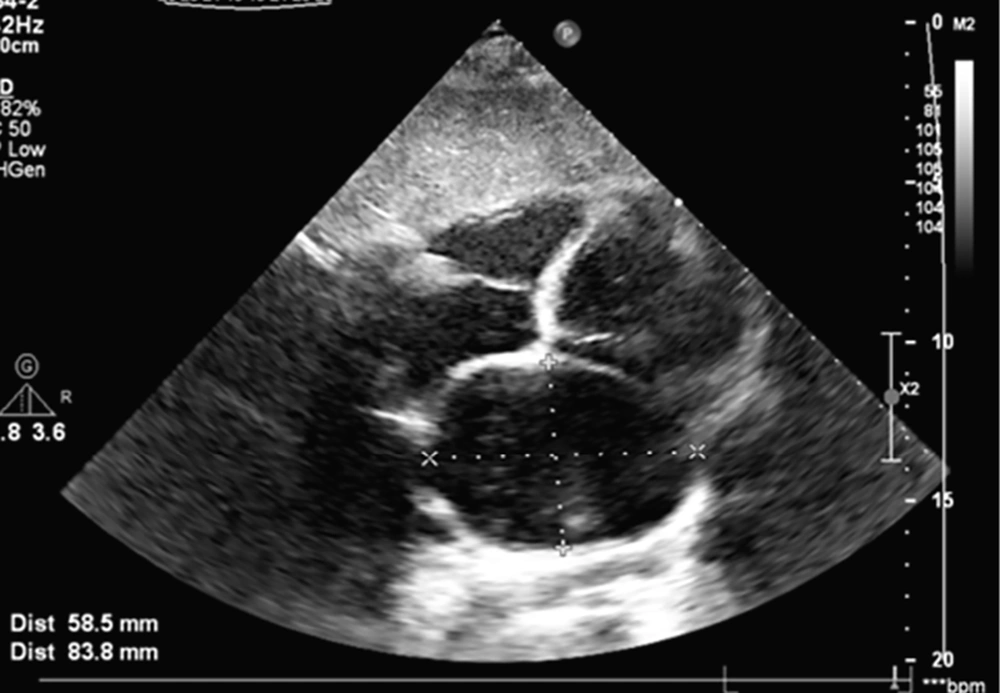
Figure 1.
Pericardial cyst (PC) in echocardiography
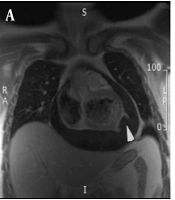
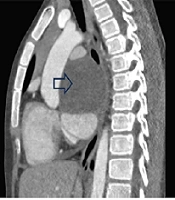
Cardiac computed tomography angiography (CTA) was performed, showing a large cystic lesion measuring approximately 88.5 × 88 × 59 mm posterior to the ascending aorta and on the roof of the left atrium, which could be a diverticulum of the pericardium or a developmental cyst such as a bronchogenic cyst (Figure 2). Hematological laboratory tests showed hemoglobin of 13.9 g/dL, white blood cell count of 10,000 cells/µL, platelet count of 164,000/mm3, and erythrocyte sedimentation rate of 2 mm/h. The chest X-ray (AP-lateral view) and cardiac CTA are shown in Figures 2 and 3.
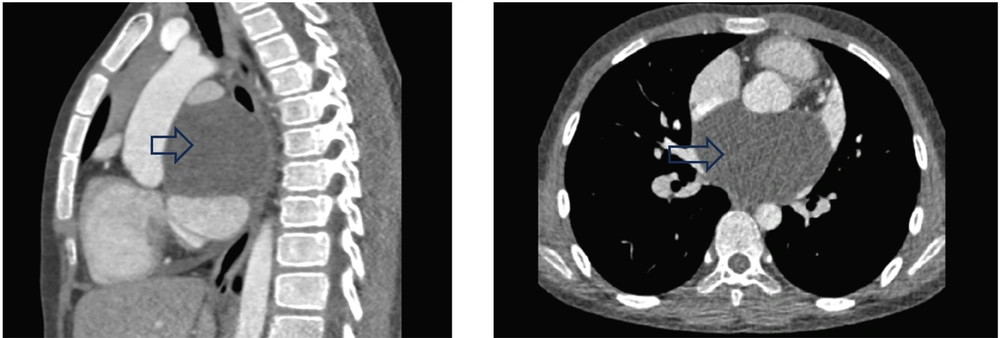
Figure 2.
Pericardial cyst (PC) in cardiac computed tomography angiography (CTA)
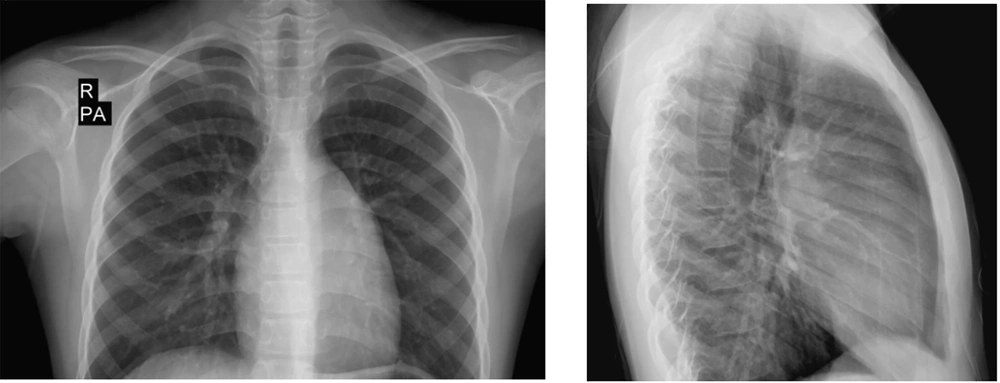
Figure 3.
Chest X-Ray (AP-lateral view)
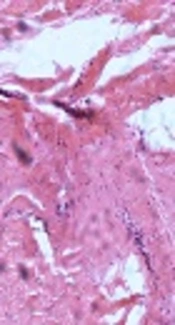
Due to the patient’s symptoms and the size of the epicardial cyst, surgical management was recommended, and the cyst was excised via median sternotomy. Histopathological examination revealed hypocellular and few mixed inflammatory cells in a proteinaceous background without malignant cells, and a direct smear for BK was negative for acid-fast bacilli. He was discharged in good condition with no signs or symptoms after surgical recovery.
3. Discussion
Pericardial cyst is a rare disease in pediatrics and typically occurs in middle-aged adults. Although the majority of PCs are asymptomatic, the compression effect on mediastinal structures can present with symptoms such as chest pain, dyspnea, and tachypnea (3, 4). Approximately 70% of PCs originate from the right cardiophrenic angle, followed by the left cardiophrenic angle, posterior, and anterior superior mediastinal space (4, 5). In this case, we diagnosed the cyst on the roof of the left atrium. The majority of PCs are less than 3 cm in size, so a PC larger than 5 cm can be considered a giant PC (1). This patient presented with a giant PC, which is rare in pediatrics and has been reported in only a few cases previously. Kumar et al. reported a giant PC (10.0 cm × 9.5 cm × 9.0 cm) in a 5-year-old child with chest pain for 3 months (1). Noori et al. documented a rare case of a 9-year-old boy with a PC (8 × 7 × 6 cm) next to the posterior wall of the left ventricle who presented with palpitations. Similarly, our patient had a giant PC, although its location differed from that of the reported case (6). Moreover, Noyes et al. mentioned an 11-year-old boy with asthma and wheezing, who had a round mass in the right cardiophrenic angle on chest X-ray and a homogeneous mass measuring 2.5 × 4.9 cm next to the right pericardium on lung CT scan. Thoracoscopic excision was performed for him (7). Panthee et al. reported that during a planned surgical procedure to repair a one-year-old boy’s ventricular septal defect and patent ductus arteriosus, the surgical team identified a previously undiagnosed, sizeable PC. The team decided to excise the cyst in addition to performing the necessary repairs to the heart defects (8). Shirzadi et al. reported a 12-year-old boy with posterior mediastinal opacity detected on chest X-ray due to respiratory symptoms during the coronavirus pandemic. There was a PC on the posterior wall of the left atrium on TTE. He was asymptomatic, so follow-up was considered for him (5).
In general, conservative follow-up or surgical management depends on the size and shape of PCs, the patient’s symptoms, and the surgeon’s experience. Surgical management is considered for most large PCs and symptomatic patients (2). This patient is unique because there are few reports in the pediatric group. He was symptomatic with a large PC more than 5 cm on the roof of the left atrium, so a surgical approach was considered for him. Furthermore, the surgical approach was a safe and effective option for him.
3.1. Conclusions
Pericardial cyst is a rare disease in pediatrics, and in symptomatic cases with a large PC, similar to our case, surgical management can be a safe and effective treatment.