
1. Background
Voiding cystourethrography remains the primary imaging test for detecting vesicoureteral reflux and assessing lower urinary tract function in pediatric patients (1, 2). The procedure requires insertion of a urethral catheter, filling the bladder with contrast material, and dynamic fluoroscopic imaging during the voiding phase (3). Although diagnostically valuable, VCUG is often perceived by children as painful and intimidating. Anxiety, crying, and movement can compromise image quality and make completion of the examination challenging (4, 5).
To mitigate distress, clinicians use both behavioral strategies and pharmacologic sedation. Nonpharmacologic methods, such as parental presence, distraction, and play therapy, provide partial relief but may not ensure sufficient cooperation, particularly in younger children (6, 7). Consequently, sedative medications are frequently considered to improve tolerance while maintaining adequate consciousness for voiding (8).
Among sedative agents, midazolam and chloral hydrate are commonly used for pediatric procedural sedation (9). Midazolam is a short-acting benzodiazepine that exerts anxiolytic, sedative, and amnestic effects by potentiating gamma-aminobutyric acid-mediated neurotransmission in the central nervous system. It has a rapid onset, short recovery time, and favorable safety profile, making it suitable for brief diagnostic procedures (10). Chloral hydrate, in contrast, is a nonbenzodiazepine sedative-hypnotic agent that acts through conversion to trichloroethanol, which enhances gamma-aminobutyric acid receptor activity. It provides reliable sedation but has a slower onset and longer duration of action, which can prolong recovery (11, 12). Given these pharmacologic differences, comparing the efficacy and safety of intramuscular midazolam and oral chloral hydrate may help determine the optimal sedation approach for children undergoing VCUG (13).
2. Objectives
Despite the widespread use of midazolam and chloral hydrate, evidence directly comparing these agents in the context of VCUG, in which the preservation of natural micturition is essential for diagnostic accuracy, remains limited. Therefore, this randomized, single-blind clinical trial was conducted to evaluate and compare the sedative efficacy, level of cooperation, ease of separation from parents, and safety profile of intramuscular midazolam and oral chloral hydrate in children undergoing VCUG.
3. Methods
3.1. Study Design and Participants
This randomized, single-blind clinical trial included 150 children aged 2 - 12 years who were candidates for VCUG. Participants were randomly assigned to 1 of 3 groups: intramuscular midazolam, oral chloral hydrate, or a control group with no medication. Children were recruited from the Pediatric Clinic of Amir Kabir Hospital, Arak University of Medical Sciences, based on indications for VCUG determined by a pediatric nephrologist. Indications included urinary tract infection, urinary incontinence, and hydronephrosis suspected to be associated with vesicoureteral reflux or other lower urinary tract anomalies.
3.2. Sample Size Calculation
The sample size was calculated before study initiation based on a comparison of proportions between groups, using a 2-sided significance level of α = 0.05 and an expected effect size derived from previous studies. Assuming a generalizable proportion of 0.03 and power considered sufficient for clinical inference, the minimum required sample size was estimated. Based on this calculation, 50 participants were allocated to each group, resulting in a total sample size of 150 children.
3.3. Randomization and Blinding
Participants were allocated to the 3 study groups using a computer-generated randomization sequence with a 1:1:1 allocation ratio. This procedure ensured that each child had an equal probability of assignment to the intramuscular midazolam, oral chloral hydrate, or control group. Allocation concealment was maintained by assigning the randomization sequence to an independent staff member who was not involved in recruitment, intervention delivery, or outcome assessment.
No formal matching procedure, such as individual matching based on age or other baseline characteristics, was applied. Instead, randomization was used as the primary method to balance potential confounders across groups. Although randomization reduces the risk of systematic bias, minor baseline imbalances between groups may still occur by chance, particularly with moderate sample sizes. This issue represents a potential limitation of the study and has been acknowledged accordingly.
3.4. Inclusion and Exclusion Criteria
The inclusion criteria were as follows: children aged 2 - 12 years of either sex, an indication for VCUG, American Society of Anesthesiologists physical status class I or II, and written informed consent from parents or legal guardians.
The exclusion criteria were as follows: a history of chronic systemic disease, such as renal failure or respiratory disorders; recent use of narcotic medications; known hypersensitivity to midazolam or chloral hydrate; diagnosed chronic psychiatric or neurologic disorders; and a history of seizures.
3.5. Procedure and Outcome Measures
Children in the midazolam group received intramuscular midazolam at 100 - 150 μg/kg, those in the chloral hydrate group received oral chloral hydrate at 0.5 cc/kg of a 6% solution, and those in the control group received no sedative. The drugs were administered 30 minutes before VCUG.
Voiding cystourethrography was performed by the same radiologist to ensure procedural consistency. The assessed outcomes were child cooperation during catheterization, image acquisition, and urination; ease of separation from parents; postvoid residual urine volume; and adverse drug effects.
Child cooperation was scored as good, indicating mild irritability; fair, indicating moderate irritability; or poor, indicating severe irritability. Ease of separation from parents was rated on a 4-point scale: easy, indicating no crying or movement; mild resistance, indicating brief crying; moderate resistance, indicating increased crying or movement; and severe resistance, indicating persistent crying and excessive movement. Postvoid residual urine volume was recorded in milliliters. Adverse drug effects were recorded by the attending nephrologist and radiologist. Outcome assessment was performed by a blinded resident investigator to reduce observer bias.
3.6. Ethical Considerations
Ethical approval was obtained from the Ethics Committee of Arak University of Medical Sciences (approval code: IR.ARAKMU.REC.1394.318; project number 1200). Written informed consent was obtained from all parents or guardians. Confidentiality and voluntary withdrawal were ensured in accordance with the Declaration of Helsinki. The trial was registered in the Iranian Registry of Clinical Trials (IRCT2016041927494N1).
3.7. Statistical Analysis
Data were analyzed using SPSS version 26 (SPSS Inc, Chicago, IL, USA). Descriptive statistics were used to summarize demographic and clinical characteristics. Quantitative variables were analyzed using the Student t-test, and categorical variables were analyzed using the chi-square test.
To support a comprehensive interpretation of the results, effect size measures, such as odds ratios, where applicable, were reported with corresponding 95% CIs. P values were also presented; however, they were not interpreted in isolation. Instead, both the magnitude of effect and the precision of estimates were considered when interpreting the findings. A P value < 0.05 was considered statistically significant.
4. Results
4.1. Baseline Characteristics
A total of 150 children aged 2 - 12 years, with a mean age of 4.33 ± 2.04 years, were included in the study. The mean ages of participants in the midazolam, chloral hydrate, and control groups were 4.14 ± 2.12, 3.96 ± 1.56, and 4.80 ± 1.14 years, respectively. There was no statistically significant difference in age among the 3 groups (P = 0.211). Overall, 71 (47.3%) participants were boys and 79 (52.7%) were girls, with no significant difference in sex distribution among the groups (P = 0.140).
4.2. Child Cooperation During VCUG
4.2.1. Cooperation During Catheterization
Cooperation during catheterization differed significantly among the 3 groups (chi-square test, P = 0.023). Good cooperation, defined as mild irritability, was observed in 82% of children receiving midazolam, compared with 56% in the chloral hydrate group and 12% in the control group. The odds of achieving good cooperation were significantly higher in the midazolam group than in the control group (OR, 33.6; 95% CI, 11.0 - 102.5) and the chloral hydrate group (OR, 3.6; 95% CI, 1.5 - 8.7). Chloral hydrate was also associated with higher odds of good cooperation than the control group (OR, 9.3; 95% CI, 3.4 - 25.4) (Table 1).
Table 1.
Cooperation During Catheterization by Study Group a
| Cooperation Level | Midazolam (n = 50) | Chloral Hydrate (n = 50) | Control (n = 50) | P Value | Effect Size (OR, 95% CI) |
|---|---|---|---|---|---|
| Good (mild irritability) | 41 (82) | 28 (56) | 6 (12) | 0.023 | Midazolam vs control: 33.6 (11.0 - 102.5); chloral hydrate vs control: 9.3 (3.4 - 25.4); midazolam vs chloral hydrate: 3.6 (1.5 - 8.7) |
| Fair (moderate irritability) | 6 (12) | 13 (26) | 29 (58) | ||
| Poor (severe irritability) | 3 (6) | 9 (18) | 15 (30) |
a Values are expressed as No. (%) unless otherwise indicated. Cooperation of children during catheterization. The midazolam group demonstrated significantly higher cooperation than the chloral hydrate and control groups (chi-square test).
4.2.2. Cooperation During Image Acquisition
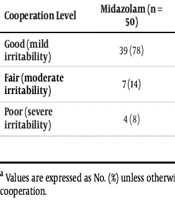
Cooperation during image acquisition differed significantly among the groups (chi-square test, P = 0.041). Good cooperation was reported in 78% of children in the midazolam group, 54% in the chloral hydrate group, and 22% in the control group. Compared with controls, children receiving midazolam had substantially higher odds of good cooperation (OR, 12.6; 95% CI, 4.8 - 33.4), and chloral hydrate was also associated with improved cooperation (OR, 4.2; 95% CI, 1.8 - 10.0). Midazolam was associated with higher odds of good cooperation than chloral hydrate (OR, 3.0; 95% CI, 1.3 - 6.9) (Table 2).
Table 2.
Cooperation During Image Acquisition by Study Group a
| Cooperation Level | Midazolam (n = 50) | Chloral Hydrate (n = 50) | Control (n = 50) | P-Value | Effect Size (OR, 95% CI) |
|---|---|---|---|---|---|
| Good (mild irritability) | 39 (78) | 27 (54) | 11 (22) | 0.041 | Midazolam vs control: 12.6 (4.8 - 33.4); chloral hydrate vs control: 4.2 (1.8 - 10.0); midazolam vs chloral hydrate: 3.0 (1.3 - 6.9) |
| Fair (moderate irritability) | 7 (14) | 11 (22) | 23 (46) | ||
| Poor (severe irritability) | 4 (8) | 12 (24) | 16 (32) |
a Values are expressed as No. (%) unless otherwise indicated. Cooperation of children during image acquisition. The midazolam group showed the highest proportion of good cooperation.
4.2.3. Cooperation During Urination
Cooperation during urination differed highly significantly among the study groups (chi-square test, P < 0.001). Good cooperation was observed in 88% of children receiving midazolam, compared with 48% of those receiving chloral hydrate and 14% of controls. Midazolam markedly increased the odds of good cooperation compared with both the control group (OR, 45.6; 95% CI, 13.9 - 149.2) and the chloral hydrate group (OR, 7.9; 95% CI, 3.0 - 20.8). Chloral hydrate was also associated with significantly higher odds of good cooperation than the control group (OR, 5.7; 95% CI, 2.3 - 13.9) (Table 3).
Table 3.
Cooperation During Urination by Study Group a
| Cooperation Level | Midazolam (n = 50) | Chloral Hydrate (n = 50) | Control (n = 50) | P-Value | Effect Size (OR, 95% CI) |
|---|---|---|---|---|---|
| Good (mild irritability) | 44 (88) | 24 (48) | 7 (14) | < 0.001 | Midazolam vs control: 45.6 (13.9 - 149.2); chloral hydrate vs control: 5.7 (2.3 - 13.9); midazolam vs chloral hydrate: 7.9 (3.0 - 20.8) |
| Fair (moderate irritability) | 2 (4) | 17 (34) | 33 (66) | ||
| Poor (severe irritability) | 4 (8) | 9 (18) | 10 (20) |
a Values are expressed as No. (%) unless otherwise indicated. Cooperation during urination was highest in the midazolam group, indicating significantly better tolerance of the procedure (chi-square test).
4.3. Ease of Separation from Parents
Ease of separation from parents differed significantly among the groups (chi-square test, P < 0.001). Easy separation was achieved in 64% of children receiving midazolam, 42% receiving chloral hydrate, and 16% of controls. Compared with the control group, the odds of easy separation were significantly higher among children receiving midazolam (OR, 9.9; 95% CI, 3.9 - 25.0) and chloral hydrate (OR, 3.8; 95% CI, 1.6 - 9.2). Midazolam was also superior to chloral hydrate in facilitating separation from parents (OR, 2.5; 95% CI, 1.1 - 5.4) (Table 4).
Table 4.
Ease of Separation from Parents a
| Separation Score | Midazolam (n = 50) | Chloral Hydrate (n = 50) | Control (n = 50) | P Value | Effect Size (OR, 95% CI) |
|---|---|---|---|---|---|
| Easy | 32 (64) | 21 (42) | 8 (16) | < 0.001 | Midazolam vs control: 9.9 (3.9 - 25.0); chloral hydrate vs control: 3.8 (1.6 - 9.2); midazolam vs chloral hydrate: 2.5 (1.1 - 5.4) |
| Mild resistance | 13 (26) | 18 (36) | 4 (8) | ||
| Moderate resistance | 3 (6) | 7 (14) | 22 (44) | ||
| Severe resistance | 2 (4) | 4 (8) | 16 (32) |
a Values are expressed as No. (%) unless otherwise indicated. The sedative groups showed significantly better ease of separation compared with the control group.
4.4. Postvoid Residual Urine and Adverse Effects
The mean postvoid residual urine volume was 6.43 ± 2.3 mL in the midazolam group, 7.12 ± 4.2 mL in the chloral hydrate group, and 8.89 ± 4.8 mL in the control group. Although the residual urine volume tended to be lower in the sedated groups, the differences were not statistically significant (1-way analysis of variance, P = 0.51). The mean difference in residual urine volume was -2.46 mL for midazolam versus control and -1.77 mL for chloral hydrate versus control (Table 5).
Table 5.
Postvoid Residual Urine Volume by Group a
| Groups | Mean ± SD (mL) | P-Value | Effect Size (Mean Difference vs Control; mL) |
|---|---|---|---|
| Midazolam | 6.43 ± 2.3 | 0.51 | -2.46 |
| Chloral hydrate | 7.12 ± 4.2 | -1.77 | |
| Control | 8.89 ± 4.8 | Reference |
a No significant differences were observed in residual urine volume among groups (1-way analysis of variance).
Adverse events were uncommon. No adverse events were observed in either the midazolam or control groups. One child (2%) in the chloral hydrate group developed mild skin erythema. Given the very low event rate, effect estimates were imprecise; nevertheless, the OR for adverse events in the chloral hydrate group compared with the midazolam group was 3.06 (95% CI, 0.12 - 76.8). No serious adverse events occurred during the study (Table 6).
Table 6.
Adverse Events a
| Groups | Adverse Event | Number of Patients |
|---|---|---|
| Midazolam | None | 0 |
| Chloral hydrate; No. (%) | Mild erythema | 1 (2) |
| Control | None | 0 |
a Adverse events were minimal. Only 1 mild skin erythema was observed in the chloral hydrate group.
5. Discussion
This randomized, single-blind clinical trial evaluated and compared the sedative efficacy and safety of intramuscular midazolam and oral chloral hydrate in children undergoing VCUG. Both agents significantly improved cooperation and reduced anxiety and distress during catheterization, imaging, and urination compared with the control group. However, midazolam demonstrated a greater sedative effect and higher cooperation scores than chloral hydrate across all procedural stages, indicating superior clinical efficacy.
Although multivariate regression analysis is commonly recommended to adjust for potential confounders, particularly in observational studies, the present study was designed as a randomized clinical trial with the primary aim of comparing treatment groups rather than developing a predictive model. Therefore, the primary analyses were based on between-group comparisons. Randomization was used to reduce the influence of confounding variables, including differences in baseline characteristics, such as reason for admission. However, some degree of imbalance may still occur by chance, particularly with moderate sample sizes. Future studies with larger populations may consider stratified randomization or multivariate regression analysis to further adjust for residual confounding factors and enhance the robustness of the findings.
The results of the present study are consistent with previous research demonstrating that midazolam provides effective anxiolysis and sedation for children undergoing diagnostic imaging and invasive procedures (14). In the randomized trial by Azarfar et al. (10), oral midazolam significantly reduced stress and discomfort during VCUG without compromising diagnostic accuracy. Similarly, Alizadeh et al. (15) observed that midazolam-treated children exhibited lower anxiety levels and improved procedural tolerance compared with those who received placebo. Our findings reinforce these observations, confirming the role of midazolam in improving cooperation and procedural success in pediatric VCUG.
In contrast, chloral hydrate, although historically regarded as a reliable sedative, showed relatively weaker performance in this study. Several trials have reported effective sedation with chloral hydrate in pediatric neuroimaging and echocardiography, with success rates of 80% - 97% at doses of 60 - 100 mg/kg (12, 16, 17). For example, Alomar et al. (9) and Ganigara et al. (18) found that chloral hydrate produced adequate sedation for MRI and echocardiographic studies in most children. However, these procedures require prolonged immobility, whereas VCUG involves multiple interactive steps, including voluntary voiding, which may be less compatible with the depth of sedation induced by chloral hydrate. Therefore, our findings suggest that although chloral hydrate provides satisfactory sedation, its pharmacologic profile may not optimally match the dynamic requirements of VCUG.
The superiority of midazolam in our trial can be attributed to its rapid onset, short duration of action, and potent anxiolytic and amnestic properties, which facilitate child cooperation during sequential procedural steps. Fallah et al. (7) found oral chloral hydrate at 75 mg/kg to be more effective than low-dose intranasal midazolam at 0.2 mg/kg for CT sedation. These variations highlight the importance of drug dose, route of administration, and procedural context in determining sedative effectiveness. In our study, intramuscular administration of midazolam ensured predictable absorption and a more consistent onset, possibly accounting for its superior performance compared with oral chloral hydrate.
Regarding safety, no major adverse reactions were reported in any group, and only 1 mild erythematous reaction occurred in the chloral hydrate group. These results align with prior studies indicating that both agents are well tolerated in pediatric populations when administered within recommended dosing limits (11, 19). Furthermore, postvoid residual urine volumes did not differ significantly between groups, confirming that neither sedative interfered with bladder emptying or diagnostic accuracy, which is a key consideration in VCUG.
Collectively, our findings suggest that midazolam provides more effective sedation and cooperation than chloral hydrate for children undergoing VCUG, with minimal side effects and preserved diagnostic validity. Chloral hydrate remains a safe alternative when intramuscular administration is contraindicated or undesirable. Given the importance of child comfort and procedural success in pediatric urologic imaging, midazolam can be recommended as the preferred sedative for VCUG.
5.1. Limitations
This study had several limitations. First, it was conducted at a single center and had a modest sample size, which may restrict the generalizability of the findings. Second, blinding could not be extended to the radiologist and caregivers because of the nature of the interventions. Third, the relatively small sample size in each group may have reduced statistical power and limited the ability to detect some significant differences between groups. Therefore, the findings should be interpreted with caution, and larger, adequately powered studies are required to validate these results.
Additionally, heterogeneity in the reasons for patient admission may have introduced potential confounding effects. Differences in baseline disease severity and clinical indications for hospitalization could influence both outcomes and responses to treatment. Although inclusion criteria were applied to minimize variability, residual confounding cannot be excluded. The reasons for admission across the study groups included urinary tract infection, urinary incontinence, and hydronephrosis. These clinical indications may reflect different underlying disease severity and patient characteristics, which can influence cooperation during VCUG, response to sedation, and procedural outcomes.
Although random allocation was used to assign participants to study groups, imbalance in baseline clinical indications may still have occurred due to chance. Such heterogeneity represents a potential confounding factor that may affect the interpretation of treatment effects. In particular, differences in baseline discomfort, infection status, or urinary symptoms could have influenced behavioral responses during the procedure. Future studies are recommended to use stratified randomization based on admission indication or apply multivariable statistical adjustment to better control for this potential source of bias.
5.2. Conclusions
This randomized clinical trial demonstrated that both intramuscular midazolam and oral chloral hydrate are effective and safe sedative agents for children undergoing VCUG. Both medications significantly improved cooperation and reduced anxiety compared with the control group, while midazolam provided superior cooperation during catheterization and urination. No serious adverse events or clinically significant differences in postvoid residual urine volume were observed, confirming the safety of both agents at standard doses.
The faster onset, better cooperation scores, and shorter recovery time associated with midazolam make it a preferable option for short diagnostic procedures such as VCUG. In contrast, chloral hydrate may still be useful when deeper or longer sedation is required. Overall, midazolam offers an effective, well-tolerated, and practical option for pediatric sedation in urinary imaging, improving both procedural success and child comfort.