1. Background
Febrile seizures are the most prevalent type of seizure in children, occurring in 2% - 5% of children (1, 2). They mainly affect children aged 6 months to 5 years, with a peak incidence between 12 and 18 months of age (3, 4).
A febrile seizure is a seizure episode that occurs in the presence of fever (> 38.0°C/100.4°F) when the fever is not due to a central nervous system (CNS) infection (2, 5). Febrile seizures represent transient disturbances in brain function. Because children’s nervous systems are not fully developed and brain function is often not well regulated, even a minor stimulus may trigger marked neuronal excitation, resulting in a seizure (6).
Febrile seizures can be classified as simple or complex according to their clinical characteristics. Simple febrile seizures are generalized seizures that last less than 15 minutes, whereas complex febrile seizures have focal features and last longer than 15 minutes (7-10). Any viral or bacterial illness can cause febrile seizures, and they can also occur after vaccination (11). Despite the use of antipyretics during fever in children with febrile seizures, evidence that antipyretics reduce the risk of this disorder is limited (12, 13). Studies have shown that antipyretics are not an effective way to prevent seizure recurrence (14). There are 3 management methods for febrile seizures: rectal diazepam if the seizure lasts longer than 2 - 5 minutes, oral diazepam for 48 hours after the onset of fever, and anticonvulsant drugs such as phenobarbital, sodium valproate, and levetiracetam (15).
There is some evidence supporting the effectiveness of diazepam prophylaxis in preventing recurrent febrile seizures, and most reports suggest that this treatment is effective (16). Some studies have shown that anticonvulsant drugs are ineffective in preventing seizure recurrence in children with fever and seizures. In a cohort study, Knudsen et al. followed children with fever and seizures for 12 years, and the results showed that oral diazepam during fever did not reduce neurological complications (17). Overall, the effectiveness of anticonvulsant drugs in preventing febrile seizures and the need for their use remain controversial (18).
Some vaccinations are known risk factors for febrile seizures in children. In addition, the post-vaccination risk period differs among vaccines (19, 20). Febrile seizures are among the adverse effects of mumps, measles, and rubella (MMR) and DPT vaccination. A major parental concern is the occurrence of seizures after vaccination, which may lead to the unscientific omission of some vaccines and deprive children of the benefits of vaccination (21). Researchers have found a small increased risk of febrile seizures during the 5 to 12 days after a child's first MMR vaccination (22).
2. Objectives
Given the limited number of studies investigating the effect of oral diazepam on vaccine-associated febrile seizures, we conducted this study to evaluate the effectiveness of prophylactic oral diazepam in preventing recurrent febrile seizures after vaccination, specifically after DPT and MMR vaccines, in Iran in 2023.
3. Methods
3.1. Participants and Study Design
To assess the effectiveness of oral diazepam in preventing recurrent febrile seizures after vaccination between 2 groups, a sample size of 128 patients was determined based on data from a previous study and the following formula. Statistical power was set at 80%, with a 95% confidence level.
This randomized controlled trial with blinded outcome assessment was conducted in 2023 in 128 patients with a history of febrile seizures after vaccination who were referred to Abuzar and Golestan hospitals in Ahvaz and to private pediatric neurology clinics in Khuzestan, North Khorasan, and East Azerbaijan provinces.
Eligible participants were recruited from referral pediatric hospitals (Abuzar and Golestan) and private pediatric neurology clinics across multiple provinces. These centers function as tertiary referral sites for children with neurological conditions. Cases were identified based on a documented history of febrile seizures temporally associated with prior vaccination, confirmed through medical records and evaluation by pediatric neurologists. This targeted recruitment strategy enabled the inclusion of high-risk patients despite the relatively low prevalence of vaccine-associated febrile seizures. Febrile seizures were defined as fever (≥ 100.4°F or 38°C) without concomitant CNS infection (23).
The inclusion criteria were 1) children aged 6 months to 6 years and 2) a history of febrile seizures after MMR and DPT vaccination.
The exclusion criteria were 1) age younger than 6 months or older than 6 years, 2) a history of an allergy to oral diazepam, 3) continuous use of anticonvulsants in childhood, 4) omission of the vaccine from the patient's vaccination schedule for any reason, and 5) CNS infections, neurological disorders, metabolic diseases, or other conditions predisposing to seizures.
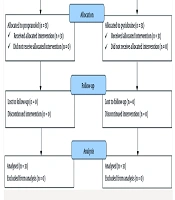
Two patients were excluded because they declined to participate in the study. Therefore, the final analysis was performed on 128 patients (Figure 1).
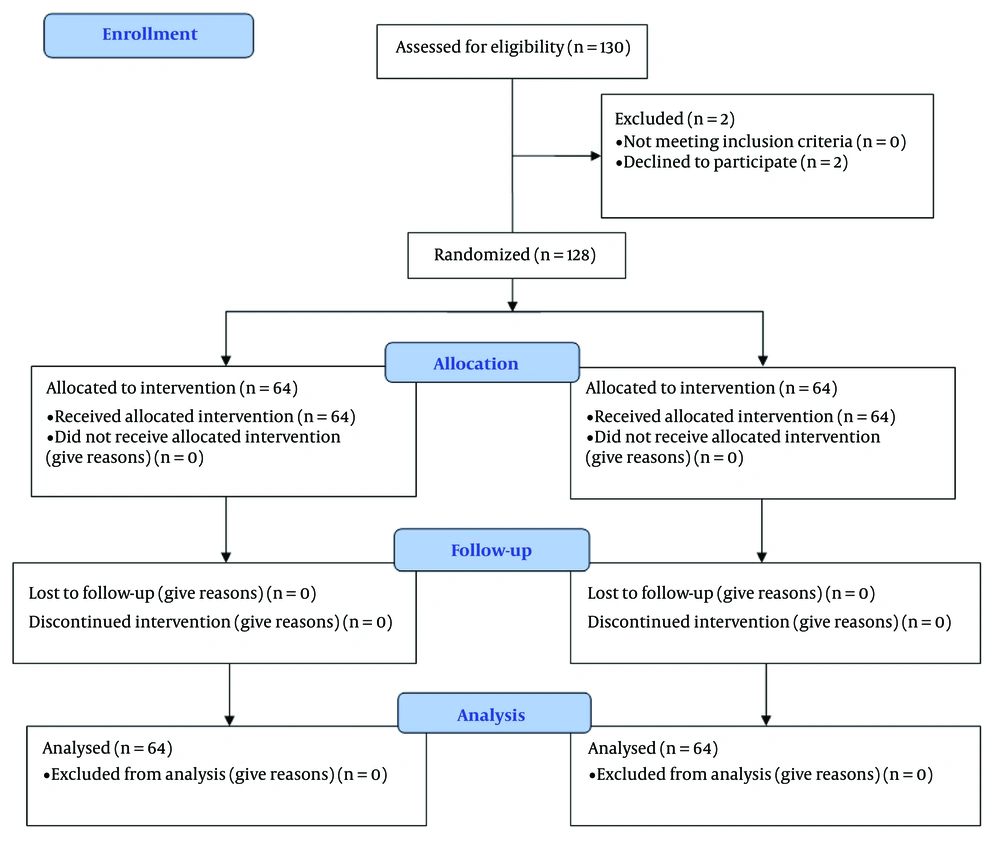
Figure 1.
CONSORT flow diagram
3.2. Randomization
After parental consent was obtained, eligible participants were assigned to 2 equal groups of 64 patients using block randomization with blocks of 4. The allocation ratio was 1:1. This approach was used to randomly allocate participants while maintaining equal sample sizes throughout the study. Blocks consisted of condensed and balanced groupings with predetermined assignments, ensuring a consistent number of participants in each group. A random block method with an initial block size of 4 was used to divide 128 participants into control and intervention groups. The algorithm calculated all possible allocations of 2 participants to the control (C) and intervention (I) groups, yielding 6 combinations (IICC, ICIC, ICCI, CIIC, CICI, and CCII). Blocks were then randomly selected to assign all participants. Using this procedure, the control and treatment groups each included 64 participants.
The first group received diazepam tablets at a dose of 1 mg/kg/day, with a maximum dose of 5 mg every 8 hours, for the first 48 hours after vaccination. The pharmaceutical company producing diazepam is approved by the Iranian Food and Drug Administration. The second group received rectal diazepam tubes at a dose of 0.5 mg/kg for seizure control. A 5-mg diazepam rectal tube was prescribed for children weighing less than 15 kg, and a 10-mg diazepam rectal tube was prescribed for children weighing more than 15 kg.
The tablets were 5 mg. If a child was unable to swallow the tablet or had a low body weight and required a dose of less than 5 mg, parents were trained to dissolve the tablet in 5 mL of water, accurately calculate the appropriate dose, convert milligrams to milliliters, and administer the medication as a solution. The 48-hour regimen was selected to provide short-term prophylaxis during the early post-vaccination period, when fever is most likely to occur.
3.3. Blinding
Although the study was designed as a double-blind randomized trial, full blinding of caregivers was not feasible because of the nature of the intervention. However, outcome assessment was performed by investigators who were blinded to group allocation. Therefore, the study was considered an assessor-blinded randomized trial.
For data collection, a specific questionnaire was completed for each child, including name, sex, date of birth, developmental status, history of neonatal seizures, family history of seizures, history of hospitalization after birth, seizure type, occurrence of febrile seizures, and drug side effects. On the seventh and fourteenth days after vaccine injection, parents were asked about the occurrence of febrile seizures and drug side effects. The occurrence of febrile seizures and drug side effects was then compared between the 2 groups.
3.4. Statistical Analysis
SPSS version 22 was used for statistical analysis. Quantitative variables are presented as mean ± SD. Qualitative parameters are reported as number (percentage). The Kolmogorov-Smirnov and Shapiro-Wilk tests were used to evaluate the normality of the data. Independent-samples t tests were used to compare mean differences between groups. Chi-square tests were used to assess associations between categorical variables. A P value less than 0.05 was considered statistically significant.
4. Results
4.1. Demographic and Clinical Variables
In the present study, 128 children were included and divided into 2 groups of 64: the oral diazepam group and the control group. The mean age was 15 ± 10.18 months in the oral diazepam group and 13 ± 10.13 months in the control group (P = 0.27). The proportion of female children was 34.38% in the oral diazepam group and 65.62% in the control group. Cesarean section was observed in 56.2% of children in the oral diazepam group. None of the children had a history of neonatal seizures; however, there was a family history of epilepsy in first-degree relatives. All children in the control group had generalized seizures. Only 2 children in the oral diazepam group had focal seizures. Based on the analysis, there were no significant differences between the 2 groups in age, sex, or family history of epilepsy (P > 0.05). Further details are provided in Table 1.
| Variables | Oral Diazepam Group (n = 64) | Control Group (n = 64) | P-Value |
|---|---|---|---|
| Age (mo) | 15 ± 10.18 | 13 ± 10.13 | 0.27 |
| Gender | 0.11 | ||
| Female | 22 (34.38) | 42 (65.62) | |
| Male | 42 (65.62) | 22 (4.38) | |
| Type of delivery | 0.06 | ||
| Cesarean | 28 43.75 | 46 (28.12) | |
| Vaginal | 36 (56.2) | 18 (71.87) | |
| Gestational age at birth | 0.57 | ||
| Preterm | 6 (9.37) | 8 (12.5) | |
| Term | 58 (90.62) | 56 (87.5) | |
| Developmental delay | 0.99 | ||
| Yes | 2 (3.12) | 2 (3.12) | |
| No | 62 (96.87) | 62 (96.87) | |
| Family history of epilepsy in first-degree relatives | 0.22 | ||
| Yes | 4 (6.25) | 8 (12.5) | |
| No | 60 (93.75) | 56 (87.5) | |
| Type of seizure | 0.15 | ||
| Generalized | 62 (96.87) | 0 (0) | |
| Focal | 2 (3.12) | 64 (100) |
a Values expressed as No. (%) or mean ± SD.
b P-values were derived from the chi-square test for age variable and independent samples t-test for other variables.
4.2. Febrile Seizures and Drug Side Effects
Follow-up on the seventh day after vaccine injection showed that 6 children in the control group had seizures, whereas no seizures occurred in the oral diazepam group, indicating that the occurrence of febrile seizures was significantly lower in the oral diazepam group than in the control group (P = 0.012). Follow-up on the fourteenth day after vaccine injection showed that 8 seizures occurred in the control group (12.5%) and 2 seizures occurred in the oral diazepam group, indicating that the occurrence of febrile seizures was lower in the oral diazepam group than in the control group (P = 0.048). The side effects of oral diazepam were not significant (P = 0.12) (Table 2).
Table 2.
Comparison of Febrile Seizures and Drug Side Effects Between the 2 Groups a
| Variables | Oral Diazepam Group (n = 64) | Control Group (n = 64) | P-Value |
|---|---|---|---|
| Occurrence of febrile seizures (7th day) | 0 (0) | 6 (9.37) | 0.012 |
| Occurrence of febrile seizures (14th day) | 2 (3.12) | 8 (12.5) | 0.048 |
| Occurrence of drug side effects | 12 (18.75) | 6 (9.37) | 0.12 |
a Values are expressed as No. (%).
Data are presented as frequency (percentage). P values were derived from the chi-square test.
5. Discussion
The management of febrile seizures remains controversial. Given the frustration associated with daily medications, researchers have sought agents that can safely and effectively prevent febrile seizures. The most extensive experience has been with diazepam, a drug with a wide safety margin (15).
The present study aimed to determine the effect of prophylactic oral diazepam on preventing recurrent febrile seizures in patients with a history of febrile seizures after vaccination, especially after MMR and DPT vaccination.
Based on our findings, prophylaxis with oral diazepam can prevent the recurrence of febrile seizures after vaccination in children.
Few studies have been designed to assess the effectiveness of oral diazepam in preventing febrile seizures and drug side effects after vaccination. In a study conducted by Soltani et al. to evaluate the preventive effect of oral diazepam on the recurrence of febrile seizures after pertussis vaccine injection, oral diazepam significantly prevented convulsive attacks following post-vaccination fever (24). These findings are similar to those of the present study, in which the rate of febrile seizures was lower in the oral diazepam group.
Another study in Japan reported that the seizure recurrence rate in the oral diazepam group was 0% to 16%, whereas the rate in the rectal diazepam group was 10% to 36%.
In a study by Rosman et al. conducted in 406 children with febrile seizures, oral diazepam was well tolerated when administered in 3 doses and reduced the risk of recurrent febrile seizures by 50% (15). The findings of the present study are consistent with several previous reports suggesting a beneficial effect of diazepam in reducing recurrent febrile seizures. Rosman et al. reported that intermittent oral diazepam reduced recurrence risk, and similar results have been observed in other studies (15). In contrast, some studies have found no significant benefit, which may be attributable to differences in study design, patient selection, and timing of administration. In the present study, the observed reduction in seizure recurrence after vaccination, particularly after MMR and DPT vaccination, may be related to the short-term anticonvulsant effect of diazepam during the early post-vaccination period. The safety profile was also comparable between groups, consistent with previous studies reporting good tolerability of short-term diazepam use in children.
In contrast to our findings, the study by He showed that treatment with oral diazepam could not significantly reduce the recurrence rate of febrile seizures (6). Differences in study design may explain the discrepancy between these findings. In He's study, the effectiveness of diazepam was compared with that of sodium valproate for the prevention of febrile seizures.
In the study by Faraji Gavgani et al., which compared diazepam with phenobarbital for preventing recurrent febrile seizures in children younger than 6 years, the risk of recurrent febrile seizures was lower in the diazepam group than in the phenobarbital group. However, this difference was not statistically significant (25).
An investigation was conducted in 85 children with febrile seizures to evaluate the effect of diazepam compared with phenobarbital. The results showed that both drugs were useful, and the risks of recurrent febrile seizures in the diazepam and phenobarbital groups were 18.2% and 32.3%, respectively. The results of the present study are consistent with previous studies and indicate the favorable effects of oral diazepam in reducing recurrent febrile seizures, especially after vaccination. In previous studies, diazepam was generally prescribed during febrile illnesses, and vaccine-induced fever was not investigated. Studies using rectal diazepam as a suppository or solution have reported febrile seizure recurrence rates between 10% and 36%. Only a few researchers have studied oral diazepam and have reported relapse rates between 0% and 16%. In a double-blind, placebo-controlled study, compliance was very poor. Therefore, the results to date have been inconclusive.
In our study, although diazepam was administered for 48 hours, patients were followed for 14 days because the risk window for febrile seizures after certain vaccines, particularly the MMR vaccine, may extend from 5 to 12 days after vaccination. Therefore, extended follow-up was necessary to capture delayed seizure events. However, the discrepancy between the duration of prophylaxis and the follow-up period should be considered when interpreting the results.
The current study has several strengths and limitations. In our study, samples were selected only from patients who had febrile seizures after vaccine injection, especially after MMR and DPT vaccination; this specific population has not been studied in this way to date, which is one of the strengths of this study. Another strength is that risk factors for recurrent febrile seizures were similar between the 2 groups and probably did not have a significant effect on the results. One limitation of this study is the inability to achieve full double-blinding because of the nature of the intervention, which may introduce performance bias.
5.1. Conclusions
Prophylactic oral diazepam may help reduce the recurrence of febrile seizures after vaccination, particularly after MMR and DPT vaccination. The safety profiles of oral and rectal diazepam appear comparable. Further multicenter studies with larger sample sizes are recommended to confirm these findings and establish definitive evidence.