
1. Background
Dental fear and anxiety can disrupt pediatric dental treatment by increasing distress, limiting cooperation, and contributing to avoidance of subsequent care. Recent pooled evidence indicates that dental fear/anxiety affects a meaningful minority of young children (1). Injection and extraction are particularly challenging because the child must cooperate, remain still, and tolerate anticipated unpleasant sensations. For this reason, contemporary pediatric dental guidance emphasizes nonpharmacological behavior guidance as a core component of routine and moderately invasive care (2).
Distraction is attractive in pediatric dentistry because it is usually simple, low risk, and acceptable to families and clinicians (3). VR extends conventional audiovisual distraction by placing the child in an immersive visual and auditory environment, which may reduce attention to the dental setting. Systematic reviews and meta-analyses suggest that VR may reduce dental pain or anxiety, but the magnitude and consistency of effects vary across procedures, devices, comparators, and outcome instruments (4-6). VR has also been incorporated into dental education and simulation, including preclinical endodontic training (7). Pediatric studies have reported beneficial effects of VR during inferior alveolar nerve block, mandibular pulpotomy, and extraction-related treatment (8-11). However, most available trials have compared VR with routine care or other distraction approaches. A practical question remains for short chairside procedures: Does active interaction with a VR game provide additional benefit beyond simply viewing immersive content during an invasive dental visit? (4-11)
2. Objectives
This split-mouth crossover trial compared interactive VR with observer-only VR during mandibular posterior tooth extraction in children aged 8 - 10 years. The primary endpoint was post-extraction dental fear/anxiety assessed using the FIS. Secondary endpoints included the reverse-scored FBRS, HR at prespecified procedural stages, and parent satisfaction after each visit.
3. Methods
3.1. Study Design
An analyst-masked split-mouth crossover clinical trial was conducted in the Department of Pediatric Dentistry, Zahedan Dental School, Zahedan, Iran. Each child received both VR formats during 2 mandibular extraction appointments separated by 1 week. Analyst-masked indicates that the statistician/data analyst worked with coded intervention labels during dataset preparation and statistical analysis. It does not indicate masking of participants, parents or legal guardians, the operator, the in-session behavior scorer, or the video reviewer.
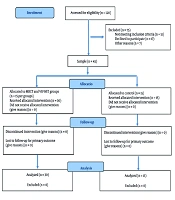
Reporting was guided by CONSORT items relevant to within-person and crossover trials and by the Template for Intervention Description and Replication (TIDieR) checklist (12-14). The 1-week interval was used to separate the 2 extraction appointments; however, potential learning, clinic familiarity, VR familiarity, and anticipatory effects between visits were considered when interpreting the findings. Participant flow is shown in Figure 1.
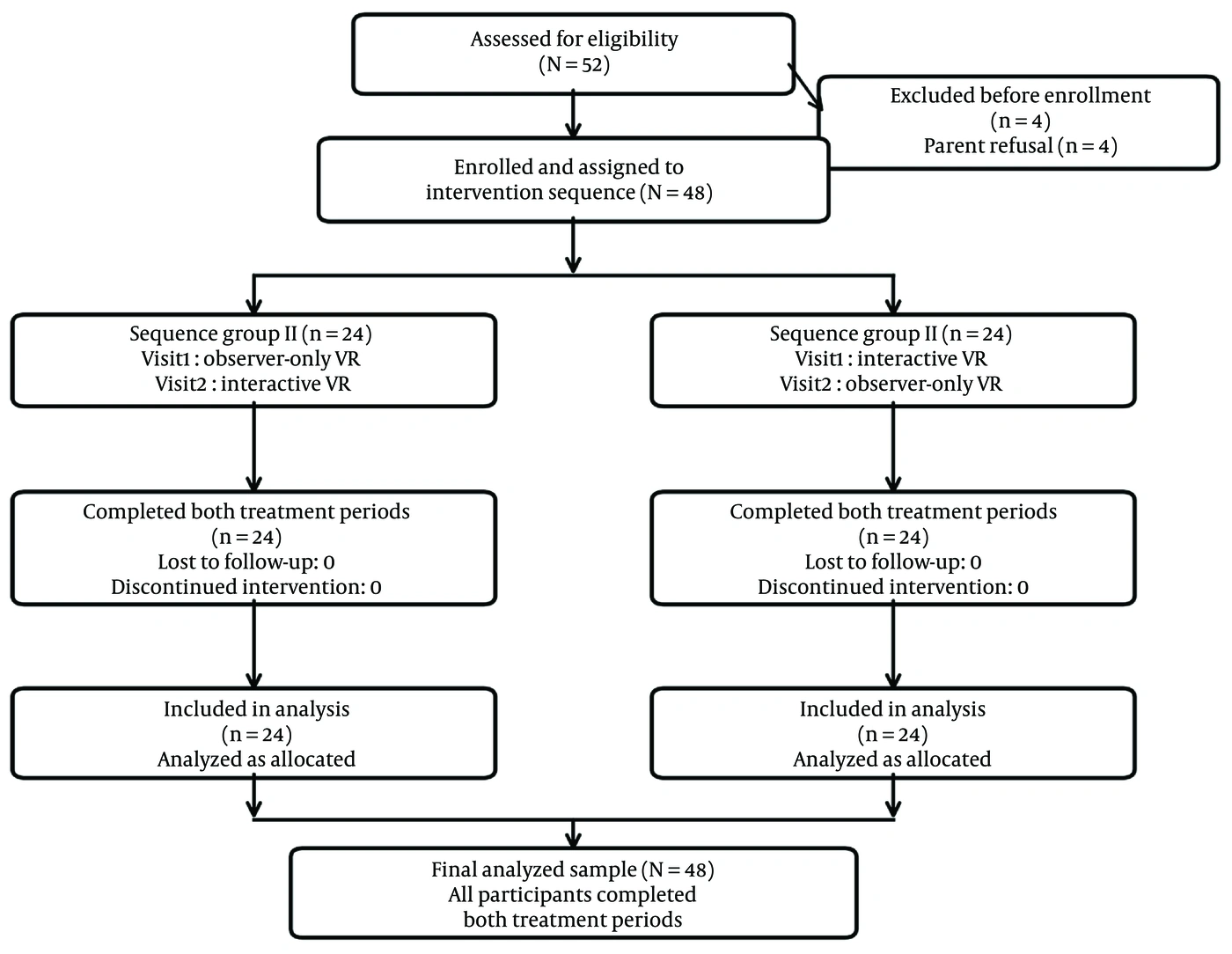
Figure 1.
Participant flow through the split-mouth crossover trial. All enrolled children completed both intervention periods. Sequence groups were assigned one by one in an alternating order.
3.2. Setting, Study Period, and Participants
Recruitment took place from 22 November 2025 to 20 March 2026 (1 Azar 1404 to the end of Esfand 1404) in the pediatric dentistry clinic of Zahedan Dental School. The source population comprised children aged 8 - 10 years attending routine dental services who required bilateral extraction of mandibular canines or primary molars. Screening began only after written consent had been provided by a parent or legal guardian.
Children were eligible if they had bilateral mandibular canines or primary molars indicated for extraction, Grade I mobility with approximately similar root length, a Frankl cooperation rating of 3 or 4 at screening, willingness and ability to wear the VR headset, and only 1 planned extraction per mandibular quadrant without additional mandibular treatment. Children also had to have had no previous invasive medical treatment and no previous dental treatment.
Exclusion criteria were systemic illness; ocular, motor, or auditory problems; allergy to local anesthetic agents; acute dental infection; parent-reported CFSS-DS score above 38; parental concern about possible ocular effects of VR; and refusal of parental permission.
3.3. Sample Size
For the anxiety endpoint, the sample-size calculation used alpha = 0.05, beta = 0.20, an expected within-child mean change of 1.5, and a standard deviation of 2.0. The minimum calculated sample was 32 children. To protect against attrition, the target was increased to 48 children. Fifty-two children were assessed; 4 were not enrolled because their parents declined participation, and 48 entered and completed both intervention periods.
3.4. Sampling, Matching, and Allocation
Eligible children were allocated sequentially to Sequence Groups I and II using an alternating sequence. The first eligible child entered Group I, the next entered Group II, and this pattern continued until recruitment ended. Because assignment followed a predictable alternating sequence, recruiting personnel could anticipate the next group; this issue was considered when interpreting internal validity and selection bias.
Age balance was sought by classifying children as aged 8 - 9 or 9 - 10 years, with 24 children in each category. To improve sex balance, the first 2 boys were assigned to Groups I and II in order, followed by the first 2 girls in the same order, and this pattern continued during recruitment.
Sequence Group I received observer-only VR at visit 1 on the right side and interactive VR at visit 2 on the left side. Sequence Group II received interactive VR at visit 1 on the right side and observer-only VR at visit 2 on the left side. Therefore, the right side was treated at the first visit and the left side at the second visit for all participants. Because side and visit period were linked in this design, period and sequence were retained in the adjusted models and interpreted conservatively.
3.5. Blinding
Masking of children, accompanying parents or legal guardians, the clinical operator, and the trained assistant who scored in-session FBRS was not feasible because the 2 VR conditions were visibly different and required different levels of child engagement. Parents could also see mirrored VR content on a tablet. The pediatric dentistry specialist who reviewed the videos did not deliver the treatment; however, complete masking of the video reviewer was not feasible because the headset and child interaction with VR content could appear in the recordings. Only the statistician/data analyst was masked to intervention labels during data preparation and analysis.
3.6. Intervention Procedures
All procedures were performed in the same quiet clinical environment. The same parent or legal guardian accompanied the child in the waiting area and treatment room during both visits, and no other child was present in those areas at the same time. No pharmacologic behavior-management method was used.
Before enrollment in the main trial, feasibility was assessed in 10 children of similar age; these pilot observations were excluded from the final analysis. During the pilot phase, the mean duration from seating in the dental chair to completion of extraction was approximately 10 minutes. To maintain comparability, children with difficult extractions or procedures lasting more than 12 minutes were excluded.
At the beginning of each visit, the parent completed the CFSS-DS. After seating and before topical anesthesia, the child was instructed about the VR headset and its use. The assigned VR condition then began. Topical anesthesia used 20% benzocaine gel (Bnzotop; DFL, Rio de Janeiro, Brazil). An inferior alveolar nerve block was then delivered with 2% lidocaine containing 1:80,000 epinephrine (Persocaine-E; Darou Pakhsh, Tehran, Iran) at 21 °C. Injections were administered over 90 seconds with a 27-gauge, 35-mm needle (C-KJECT; CK Dental Ind. Co., Korea) and syringe (Sterilife; Anthogyr Co., Sallanches, France). Extraction started 5 minutes later. The headset was removed immediately after extraction, and post-extraction instructions were given to the accompanying parent.
The VR device was an Oculus 2 headset (Meta, China). In the interactive condition, children played Astro Bot Rescue Mission. In the observer-only condition, children watched Piper (Pixar). Both conditions began at the same clinical point and continued until extraction was complete; thus, VR exposure duration followed the procedure length. During both sessions, children were instructed to keep the head stable and avoid turning left or right during injection and extraction. The VR display was mirrored on a tablet so the parent or legal guardian could view what the child was seeing. The 2 contents differed in interactivity, task requirements, and content type; this difference was considered when interpreting active-versus-passive VR effects.
A second-year pediatric dentistry resident explained VR, administered local anesthesia, and performed the extractions. The same trained assistant fitted the headset and headphones throughout the trial. The accompanying parent or legal guardian was the same at both appointments.
3.7. Outcome Measures and Timing of Assessments
The primary endpoint was dental fear/anxiety after extraction, assessed by child self-report using the FIS. Secondary endpoints were observed behavior, HR, and parent satisfaction. The FIS is a 5-face instrument scored from 1 to 5 (15, 16). Observed behavior was assessed with the FBRS, a 4-category observational measure used in pediatric dentistry (2). The conventional Frankl score was used for screening eligibility; for outcome analysis, FBRS was reverse-scored so that larger values indicated poorer cooperation or more negative observed behavior. Parent satisfaction was recorded at the end of each visit using a 0 - 10 visual analogue scale. HR was measured with a fingertip pulse oximeter (Contec CMS50).
FIS was recorded at t0, after seating and before VR explanation, and at t2, after extraction. FBRS and HR were recorded at t0, at t1 after completion of local anesthetic injection, and at t2. Parent satisfaction was obtained only at t2. The trained assistant explained the FIS before the child selected the face that best represented their feeling. The same assistant scored FBRS from approximately 2 meters from the dental chair. For verification, all procedures were video recorded with the child's full body visible. After completion of all procedures, a pediatric dentistry specialist reviewed the videos and corrected study forms when discrepancies were detected. Because the headset and child interaction could be visible on video, the specialist reviewer could not be considered fully masked to intervention type or visit sequence. Differences between the assistant's FBRS score and the specialist's video review were resolved by the specialist reviewer according to the predefined FBRS categories. Formal inter-rater agreement was not calculated.
3.8. Monitoring, Fidelity, and Tolerability
The trained assistant continuously observed the child during VR exposure. Children were instructed to report discomfort during headset use. If discomfort, fear, or severe sudden movement occurred, VR exposure was stopped and the participant was withdrawn. The same trained assistant recruited participants, recorded demographic information, scheduled visits, supervised children during procedures, and answered parental questions. All 48 enrolled children completed both sessions. No separate symptom-grading checklist was used for minor VR-related symptoms.
3.9. Statistical Analysis
Statistical significance was evaluated using 2-sided tests with the threshold set at P < 0.05. IBM SPSS Statistics 26.0 (IBM Corp., Armonk, NY, USA) was used for descriptive statistics, paired tests, and repeated-measures analysis of variance. R 4.3.2 (R Foundation for Statistical Computing, Vienna, Austria) was used for baseline-adjusted mixed-effects modeling with the lme4 and lmerTest packages.
Continuous variables are presented as the mean and standard deviation, whereas categorical variables are shown as counts and percentages. Because each child received both VR conditions, treatment comparisons were based on within-participant methods. For HR and reverse-scored FBRS, recorded at t0, t1, and t2, 2-factor repeated-measures ANOVA examined treatment, time, and the treatment-by-time interaction. For FIS, recorded at t0 and t2, the same within-participant framework was applied using 2 time points. The Greenhouse-Geisser correction was used when the sphericity assumption was not satisfied. Paired comparisons contrasted the 2 VR formats at each assessment point.
To account for the crossover structure, baseline-adjusted mixed-effects models were fitted for post-injection and post-extraction outcomes. Treatment, baseline score, period, and sequence were entered as fixed effects, and participant was modeled with a random intercept. Parent satisfaction was examined using a paired t-test and a mixed-effects model including treatment, period, and sequence.
FIS and FBRS are ordinal instruments. They were summarized and analyzed as continuous scores to remain aligned with the repeated-measures approach and common reporting in this clinical area. Their ordinal nature was considered when interpreting the results. Ordinal sensitivity analyses were not performed, and no formal multiplicity correction was applied across repeated time-point comparisons. Therefore, secondary findings, especially FBRS results, should be regarded as supportive rather than definitive.
3.10. Ethical Considerations and Trial Registration
The trial was conducted in accordance with the Declaration of Helsinki and received approval from the ethics committee of Zahedan University of Medical Sciences (IR.ZAUMS.REC.1404.230). Before enrollment, written informed consent was obtained from a parent or legal guardian. Each child received an age-appropriate explanation, and willingness to participate and use the headset was confirmed before enrollment and at both visits. Children were told to report discomfort during VR exposure; refusal or inability to tolerate the headset would have led to discontinuation. A separate written child-assent form was not recorded. The trial was registered in the Iranian Registry of Clinical Trials (IRCT20110325006105N9) on 30 October 2025, before the first participant was recruited.
4. Results
Figure 1 summarizes screening, sequence assignment, follow-up, and analysis. Among 52 children assessed for eligibility, 4 were not enrolled because their parents declined participation. The remaining 48 children entered the trial, completed both treatment sessions, and were included in the final analysis. No child discontinued the intervention. No VR-related treatment interruption, procedure delay, or withdrawal was recorded. Because a separate symptom-grading checklist was not used, mild transient symptoms could not be quantified.
The final sample comprised 25 boys (52.1%) and 23 girls (47.9%). The mean age was 107.9 ± 7.4 months (range, 97 - 120 months). Twenty-four children were aged 8 - 9 years and 24 were aged 9 - 10 years. Sequence Group I (observer-only VR followed by interactive VR) and Sequence Group II (interactive VR followed by observer-only VR) each included 24 children (Table 1).
Table 1.
Participant Characteristics and Crossover Sequence Distribution a
| Characteristic | Value |
|---|---|
| Age (mo) | 107.9 ± 7.4 (97 - 120) |
| Age group (y) | |
| 8 - 9 | 24 (50.0) |
| 9 - 10 | 24 (50.0) |
| Gender | |
| Male | 25 (52.1) |
| Female | 23 (47.9) |
| Crossover sequence | |
| Observer-only first, interactive second | 24 (50.0) |
| Interactive first, observer-only second | 24 (50.0) |
a Values are expressed as mean ± SD (Range) or No. (%). Abbreviations: SD, standard deviation; VR, virtual reality.
Table 2 presents outcome values for both VR conditions at each assessment point. In both conditions, mean HR, FIS, and reverse-scored FBRS increased from baseline to later stages, indicating greater physiological arousal, higher self-reported anxiety, and less favorable observed behavior as the treatment progressed.
Table 2.
Outcome Values by Assessment Time and VR Format a
| Outcome | Interactive VR | Observer-only VR |
|---|---|---|
| Heart rate, beats/min | ||
| t0 (baseline) | 89.06 ± 10.18 | 88.23 ± 10.59 |
| t1 (post-injection) | 98.38 ± 13.66 | 95.42 ± 13.10 |
| t2 (post-extraction) | 104.90 ± 15.79 | 102.60 ± 14.46 |
| Facial Image Scale | ||
| t0 (baseline) | 1.63 ± 0.82 | 1.58 ± 0.74 |
| t2 (post-extraction) | 3.15 ± 1.54 | 2.88 ± 1.42 |
| Reverse-scored Frankl Behaviour Rating Scale | ||
| t0 (baseline) | 1.48 ± 0.50 | 1.48 ± 0.50 |
| t1 (post-injection) | 2.54 ± 1.07 | 2.27 ± 1.01 |
| t2 (post-extraction) | 2.58 ± 1.13 | 2.29 ± 1.05 |
| Parent satisfaction at t2 | 7.48 ± 1.96 | 7.56 ± 1.83 |
a Values are mean ± SD. t0 = after seating and before VR explanation; t1 = after completion of local anesthetic injection; t2 = after extraction. FIS was recorded only at t0 and t2; parent satisfaction was recorded only at t2. Abbreviations: HR, heart rate; SD, standard deviation; VR, virtual reality. Higher reverse-scored FBRS values indicate poorer cooperation or more negative observed behavior.
Repeated-measures findings are presented in Table 3. HR, FIS, and reverse-scored FBRS each showed significant procedural-stage effects. No treatment-by-time interaction was detected for HR or FIS, but such an interaction was detected for reverse-scored FBRS, suggesting that behavioral patterns differed between the VR formats. In paired comparisons, HR was higher during interactive VR than during observer-only VR at t1 (P = 0.016), with no significant difference at t0 or t2. FIS did not differ between formats at t0 or t2. Reverse-scored FBRS was similar at baseline but was higher during interactive VR at t1 (P = 0.018) and t2 (P = 0.012), indicating less favorable observed behavior during and after the procedure. Because FBRS is ordinal and multiple time-point comparisons were not adjusted for multiplicity, these secondary results were interpreted cautiously.
Table 3.
Within-Participant Repeated-Measures Analysis of Treatment and Time Effects a
| Outcomes | Treatment Effect | Time Effect | Treatment × Time Interaction |
|---|---|---|---|
| Heart rate | F(1, 47) = 4.47; P = 0.040; eta2 = 0.087 | F(2, 94) = 61.92; P < 0.001; eta2 = 0.568 | F(2, 94) = 0.87; P = 0.424 |
| FIS | F(1, 47) = 2.03; P = 0.160; eta2 = 0.042 | F(1, 47) = 69.35; P < 0.001; eta2 = 0.596 | F(1, 47) = 1.44; P = 0.237 |
| Reverse-scored FBRS | F(1, 47) = 7.01; P = 0.011; eta2 = 0.130 | F(2, 94) = 69.65; P < 0.001; eta2 = 0.597 | F(2, 94) = 3.57; P = 0.032 |
a Higher reverse-scored FBRS values indicate poorer cooperation or more negative observed behavior. Greenhouse-Geisser correction was applied when required. HR and FIS showed strong procedural-stage effects without significant differential time patterns; reverse-scored FBRS increased more during interactive VR. Because FBRS is ordinal and no multiplicity adjustment was applied, this finding should be interpreted cautiously. Abbreviations: FIS, Facial Image Scale; FBRS, Frankl Behaviour Rating Scale; VR, virtual reality.
Table 4 reports the baseline-adjusted mixed-effects treatment estimates, with period and sequence retained in the models. The trial was not designed or powered to estimate independent period or sequence effects; these variables were included to support a conservative interpretation of the treatment estimates. After baseline adjustment, observer-only VR was associated with slightly lower reverse-scored FBRS at t1 and t2. Adjusted treatment differences for HR and the primary FIS endpoint were not statistically significant. Parent satisfaction was comparable in the paired analysis (mean difference, interactive minus observer-only, -0.08 ± 1.49; P = 0.699) and in the mixed-effects model.
Table 4.
Baseline-Adjusted Mixed-Effects Treatment Estimates a
| Outcome/Time Point | Treatment Contrast | Beta Estimate | 95% CI | P-Value |
|---|---|---|---|---|
| Heart rate at t1 | Observer-only vs interactive | -2.12 beats/min | -4.38 to 0.13 | 0.065 |
| Heart rate at t2 | Observer-only vs interactive | -1.70 beats/min | -5.35 to 1.94 | 0.360 |
| FIS at t2 | Observer-only vs interactive | -0.25 | -0.57 to 0.08 | 0.134 |
| Reverse-scored FBRS at t1 | Observer-only vs interactive | -0.27 | -0.51 to -0.03 | 0.025 |
| Reverse-scored FBRS at t2 | Observer-only vs interactive | -0.29 | -0.53 to -0.05 | 0.017 |
| Parent satisfaction | Observer-only vs interactive | 0.08 | -0.33 to 0.50 | 0.694 |
a Mixed-effects models were fitted in R using lme4 and lmerTest. Treatment, baseline value, period, and sequence were modeled as fixed effects; participant was included with a random intercept. Parent satisfaction was modeled without baseline adjustment because it was collected only at t2. Negative beta estimates favor observer-only VR. Abbreviations: CI, confidence interval; FIS, Facial Image Scale; FBRS, Frankl Behaviour Rating Scale; VR, virtual reality. Higher reverse-scored FBRS values indicate poorer cooperation or more negative observed behavior.
5. Discussion
This split-mouth crossover trial did not demonstrate overall superiority of interactive VR over observer-only VR during mandibular posterior tooth extraction in cooperative children aged 8 - 10 years. Self-reported anxiety and physiologic arousal increased as treatment advanced, as expected during injection and extraction. Interactive VR did not lower FIS scores, lower HR, or increase parent satisfaction. Reverse-scored FBRS was slightly less favorable with interactive VR after injection and extraction. Because sequence assignment followed a predictable one-by-one pattern, the findings should be interpreted as adjusted within-participant associations rather than as strong causal evidence.
The results are consistent with pediatric dental literature indicating that VR effects depend on the procedure, device, content, comparator, and outcome measure (4-6, 8-11). Earlier studies have mostly compared VR with routine care, audiovisual distraction, or other simple behavior-guidance techniques. The present study addressed a narrower implementation question: whether active participation in VR provides measurable additional value over an observer-only immersive experience during a short, invasive dental procedure. In this setting, interactivity did not appear to confer an advantage.
A plausible explanation is that both VR formats operate through immersive sensory engagement that competes with attention to threatening procedural cues. During extraction, cooperation with mouth opening, stillness, and clinical instructions may be more important than participation in a game. Interactive VR may add cognitive or motor load, and game content may reduce attention to clinician instructions. The 2 VR formats also used different content: the interactive format was a game, whereas the observer-only format was an animation. Therefore, the behavioral difference cannot be attributed solely to interactivity; it may also reflect content type, attentional load, propensity to move, audiovisual intensity, or emotional tone. This may partly explain why observer-only VR showed more favorable observed behavior while self-reported anxiety and parent satisfaction remained similar.
The significant stage effects across HR, FIS, and FBRS indicate that injection and extraction remained stressful even with immersive distraction. Thus, the findings should not be interpreted as evidence that VR eliminates dental anxiety. Rather, when VR is used as an adjunctive distraction method, a simpler observer-only format may be adequate and may better fit the workflow of short pediatric extractions.
Recent pediatric VR and behavior-guidance literature also indicates that implementation should be tailored to the clinical context. Evidence summaries and narrative reviews describe VR as a promising but heterogeneous adjunct for dental anxiety and pain management (17, 18). Practical integration may depend on staff training and workflow (19), parental acceptability (20), and monitoring for transient symptoms such as dizziness, nausea, visual strain, or headset intolerance (21, 22). Pediatric digital health studies similarly emphasize workflow planning (23). Experimental distraction research further suggests that task characteristics and attentional demand can affect pain perception and behavioral response (24). In the present trial, no withdrawal-level safety problem was identified, but structured symptom grading was not used; future work should include standardized tolerability measures.
5.1. Strengths and Limitations
This study has several strengths. The crossover design reduced between-child variability because each child served as their own comparator. Clinical procedures, anesthetic administration, VR exposure, and assessment timing were standardized. The final sample exceeded the calculated minimum, all enrolled children completed both periods, and the outcomes included subjective, observational, physiologic, and parent-reported measures. The pragmatic dental school clinic setting also supports relevance to routine pediatric dental practice.
Several limitations should be considered. Sequence assignment followed a predictable alternating pattern, which may have introduced selection bias and limited causal inference. Masking was restricted to the statistician/data analyst. Children, parents or legal guardians, the operator, the assistant who recorded FBRS, and the specialist video reviewer were not masked because the interventions and child interaction with VR were visible. Observed behavior scores may therefore have been influenced by observer bias, and inter-rater agreement for FBRS was not quantified. The trial also lacked a no-VR control group, so it cannot estimate the absolute benefit of VR compared with conventional care. The 1-week interval may not have eliminated learning, clinic familiarity, VR familiarity, or anticipatory effects from the first extraction visit. Because the right side was always treated first and the left side second, side and period effects could not be completely disentangled. The single-clinic setting and inclusion of cooperative children with Frankl scores of 3 or 4 may limit generalizability to younger, highly anxious, or uncooperative children. FIS and FBRS were analyzed as continuous outcomes although they are ordinal scales; because multiplicity adjustment and ordinal sensitivity analyses were not performed, FBRS results should be interpreted cautiously. Finally, a structured checklist for mild VR-related symptoms was not used.
Future research should use stronger sequence generation and allocation concealment, include a usual-care or non-VR comparator, and consider child familiarity with digital technologies, content preference, and procedure duration. Future crossover trials should prespecify the primary outcome hierarchy, collect data suitable for assessing period and sequence effects, use independent masked outcome assessment where feasible, consider video masking or duplicate scoring, quantify inter-rater reliability, and use structured VR tolerability checklists. Studies among more anxious or less cooperative children may clarify whether interactive VR is useful for subgroups that require stronger engagement or motivation.
5.2. Conclusions
Within the limitations of a single-center crossover design and predictable one-by-one sequence assignment, interactive VR was not superior to observer-only VR for reducing anxiety-related responses during mandibular posterior tooth extraction in cooperative children aged 8 - 10 years. Observer-only VR produced similar self-reported anxiety and parent satisfaction and slightly more favorable observed behavior after injection and extraction. Because it requires less child input and may be easier to integrate into a short procedure, observer-only immersive distraction may be a practical behavior-guidance option for pediatric dental extractions. Stronger causal conclusions require future trials with stronger allocation methods.