1. Background
Pregnancy is defined as high risk, in illicit-drug-user women, as it is associated with medical problems in both the mother and the newborn. These women have a higher incidence of sexually-transmitted infections including syphilis, HIV infection and hepatitis; they also usually have inadequate prenatal care(1-3).Risks of preterm labor, intrauterine growth retardation, premature rupture of membrane (PROM), as well as perinatal morbidity and mortality are higher in a drug-abuser pregnant woman (4-6). Illicit drug usage is often associated with multiple social, psychosocial, behavioral, and medical risk factors, including poverty, stress, depression, lack of social support, physical abuse, household violence, and poor nutrition (2, 6-8). The abovementioned comorbidities, present in most illicit drug abusers, are among the factors that make it difficult to determine a cause-and-effect relationship between abuse of a drug and its maternal and neonatal outcomes.
Physical dependence to narcotics occurs in most infants born to current drug-abuser mothers, because of placental transfer of opiates. Intrauterine opiate exposure is associated with neonatal abstinence syndrome (NAS), shortly after birth (9). Withdrawal symptoms usually occur 4 - 6 hours following the last opioid exposure and reach the peak in 48 - 72 hours (10). Among neonates who have had intrauterine exposure to opiates, 55% - 94% will experience some degrees of NAS (9). About 3/4 of newborns with NAS require pharmacological therapy (11). Approximately 40% of exposed neonates are admitted to neonatology units for treatment of NAS, 30% of which are for conditions related to prematurity or low birth weight (LBW) (12). Most studies of prenatal opiate, heroin or methadone usage, show increased rates of LBW, preterm birth, and reduced fetal growth parameters; however, few have investigated the associated risk factors. Rates of neonatal hyperbilirubinemia and respiratory distress syndrome are lower in offspring of addicted mothers. There is little evidence on significant long-term effects of intrauterine exposure to illicit drugs, although some subtle developmental effects have been noted mainly for marijuana and cocaine (6).
Patterns of substance abuse vary in different countries as well as between different groups within the same country. Choice of drug abuse varies, depending on the drug availability, cost, race, ethnicity, and cultural differences (9). According to the data from National Survey on Drug Use and Health on May 2012, among American women aged 15 to 44, pregnant black women were more likely than pregnant white and Hispanic women to have used any illicit drugs during the month preceding the study (7.7%, 4.4%, and 3.1%, respectively) (13). In western countries, overall, marijuana is the most commonly-used illicit drug during pregnancy (2, 10, 14), followed by cocaine and opiates (2). The incidence of poly-drug abuse among pregnant women in those countries varies from 26.5% to 28.9% (3, 4). Tobacco smoking and alcohol consumption are prevalent among some women in western societies and many women continue using them during pregnancy (14-16).
The term opioid refers to natural and synthetic substances, with morphine-like activity. Opiate refers to a subclass of opioids consisting of alkaloid compounds extracted from opium, including morphine, codeine, heroin, and methadone. These are the forms typically used in western countries (17). Opium has traditionally been used for treating illnesses and alleviating physical and mental stress, as well as for recreational and social purposes in eastern societies (18, 19). Several Asian countries continue to be major opium producers and abuse of this substance is a major problem in this region (3, 19). Opium has always been the most widely-abused substance in Iran (18, 20-23). Studies in Iran have shown that the rate of opium addiction is between 2.1% to 20% in different social groups (22). According to the United Nations World Drug Report of 2006, the number of opiate users in Iran was estimated to be above one million (21, 24). National data sources estimated this number between 1,200,000 - 2,000,000 the majority being male (21). Geographically, Iran is a passage route for drug trafficking between the opium-producing areas of Afghanistan and central Asia to Europe. The consequence of drug trafficking through Iran may be the increasing availability of opium, influencing the prevalence of opium usage (21).
Kerman is a large province in Iran, located near the opium-trafficking route. The current study was performed in Rafsanjan, the second largest city of Kerman. A household survey in Kerman in 2005 showed that the frequency of opium abuse was 17.1% and opium dependency rate was 5.3%. The most common method of drug usage was inhalation (23).
2. Objectives
The aim of the present study was to evaluate the perinatal consequences of opium abuse in pregnant women of Rafsanjan and compare the results with a control group of pregnant women with no history of addiction.
3. Patients and Methods
This case-control study was carried out at Niknafs maternity hospital affiliated to Rafsanjan University of Medical Sciences and covered a one-year period from January 2008 to January 2009. In this period, 5329 pregnant women gave birth at Niknafs hospital. After delivery, all mothers with live birth deliveries, who gave their consent, were interviewed by trained general physicians according to a structured questionnaire designed by the study investigators. Physicians were trained for nonjudgmental and indirect questioning. In accordance with the protocol approved by the hospital Review Board; informed consent was required for participation and confidentially was secured. In this study, an addict was defined as an individual who used a substance for purposes other than a medical indication and was dependent on it.
Polydrug usage was defined as a simultaneous dependency on two or more classes of illicit drugs.
The postpartum data was primarily collected from the medical records in addition to the interview (only self-reports). Routine urine toxicology test was not used in this study. Mothers who indicated using an illicit drug during pregnancy were enrolled in the opium addicted group. They were questioned about the type of substance, drug dosage, interval of substance abuse, duration of addiction, the average number of cigarettes smoked per day, and alcohol consumption. Heavy cigarette smoking was defined as ≥ 5 cigarettes smoked per day. Only mothers with at least one year history of opium addiction, and minimum one dose per day of opium usage during their current pregnancy were selected and enrolled in the study. The control group was defined as mothers who never used illicit drugs during their entire life, and delivered their babies during the same period in the Niknafs hospital. A control infant was defined as one whose mother denied using any type of illicit drug during her life.
Once enrolled in the study, information about demographic characteristics and medical conditions for each mother and her newborn was collected on a data sheet. The following information was recorded for each case and control subject: a special code instead of a name, age, residential location (rural or urban), socioeconomic condition, maternal education level, prenatal care status, addiction status of the baby’s father, marriage status, type of delivery, peripartum mortality, premature rupture of membrane (PROM), and preterm delivery. Rural or urban residence was determined on the basis of the mother’s address. Good economic condition was defined as owning a house and family income of ≥ 400 US dollars/month. Lack of either of the above was defined as poor economic condition. In this study, adequate prenatal care was defined as at least two visits (one during 6 - 10 and one in 26 - 30 weeks of gestation) to an obstetric clinic and testing for routine prenatal laboratory tests (CBC, electrolytes, blood group, VDRL, hepatitis B antigen, hepatitis C antibody, HIV antibody, and urinalysis). Premature rupture of membranes was defined as rupture of the amniotic membrane before the onset of labor. Premature delivery was defined as delivery before 37 weeks of gestation.
The following data concerning each newborn were recorded; Apgar scores of 1 and 5 minutes, birth weight, head circumference, gestational age, type of congenital malformation, and presence or absence of NAS in neonates of addicted mothers. Low Apgar score was defined as < 7 at either 1 or 5 minutes. LBW was defined as a birth weight less than 2500 g, regardless of the gestational age. Prematurity was defined as delivery of a live-born infant before 37 weeks of gestation. Small head circumference was defined as head circumference < 10th percentile for gestational age. All babies born to addicted mothers were monitored in the nursery. Signs and symptoms of neonatal abstinence syndrome were monitored and scored using the Finnegan scale (25). A score of ≥ 6 was needed for NAS diagnosis. Examination by the pediatrician and ruling out of any other pathologic condition was required for the diagnosis. Neonates with Finnegan score ≥ 8 received pharmacologic therapy with phenobarbital 5 - 7 mg/kg/day in two divided doses for 5 - 7 days.
Data analysis was carried out using SPSS-16 statistical package. After the description analysis, chi-squared test was used to analyze nominal variables and T-test and ANOVA were used to analyze the continuous data. P values less than 0.05 were considered statistically significant.
4. Results
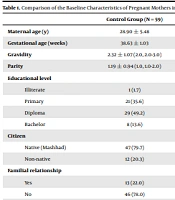
During the study, 45 opium-addicted mothers were enrolled; all were married and used no illicit drug other than opium (self-reported). Their drug usage method was only inhalation. In all cases, opium inhalation began as a recreational habit in their family, but this pattern gradually progressed to addiction. None of the mothers smoked cigarettes heavily or consumed alcohol. None received methadone replacement therapy during prenatal care; they had only been advised to reduce the opium dosage, but usually did not comply with the advice. The control group consisted of 45 randomly-selected mothers with no history of drug abuse. None of them were heavy cigarette smokers or consumed alcohol. Table 1 shows the demographic characteristics in both groups. There was no significant difference between the mean ages of the two groups. In the opium-addicted group, there were 2 (4.4%) mothers below 18 years. Their educational level was significantly lower than that the control group (P = 0.001). Poor economic condition was significantly more prevalent in addicted mothers (P = 0.001). Frequency of women with opium-addicted husbands was significantly lower in the control group (P = 0.001). There was no significant difference between the case and control subjects regarding the residence place, adequate prenatal care, or results of infectious disease screenings.
Table 1.
Demographic Characteristics of Opium-Addicted and Control Group Mothers
| Characteristics | Cases, No. (%) | Controls, No. (%) | P Value |
|---|---|---|---|
| Maternal age, y a | 0.340 | ||
| < 18 | 2 (4) | 0 | |
| 18 – 35 | 40 (89) | 41 (91) | |
| > 35 | 3 (7) | 4 (9) | |
| Maternal education | 0.01 | ||
| Primary school | 28 (62) | 12 (27) | |
| High school | 8 (18) | 10 (22) | |
| > High school | 9 (20) | 23 (51) | |
| Socioeconomic condition | 0.001 | ||
| Poor | 24 (53) | 1 (2) | |
| Good | 21 (47) | 44 (98) | |
| Residential location | 0.426 | ||
| Urban | 25 (56) | 26 (58) | |
| Rural | 20 (44) | 19 (42) | |
| Adequate prenatal care | 0.396 | ||
| Yes | 35 (78) | 37 (82) | |
| No | 10 (22) | 8 (18) | |
| Opium-addicted husband | 0.001 | ||
| Yes | 36 (80) | 5 (11) | |
| No | 9 (20) | 40 (89) |
aThe mean age was 28.7 ± 5.6 years (16 - 43) for the case and 28.4 ± 5.3 years (19 - 40) for the control group; P = 0.340.
Table 2 compares the maternal complications between the case and control groups. As shown in the Table, there was one (2.2%) maternal death due to complications of severe dystocia in the control group. The incidences of PROM and premature labor in opium-addicted mothers were greater than that of control group, but the differences were not significant (P = 0.1 and P = 0.2, respectively). In this study, cesarean section rate (C-section) was significantly higher for the control group compared to the opium-addicted group (P = 0.001). Reasons for C-section are specified in Table 2.
Table 2.
Maternal Complications Among Opium-Addicted and Control Group Mothers
| Maternal Complications | Cases, No. (%) | Controls, No. (%) | P Value |
|---|---|---|---|
| Peripartum maternal mortality | 0 | 1 (2.2) | 0.500 |
| PROM a | 8 (17.8) | 4 (8.9) | 0.100 |
| Premature delivery | 6 (13.3) | 3 (6.6) | 0.200 |
| C-section delivery | 18 (40) | 35 (77.8) | 0.001 |
| Mother’s wish | 0 | 12 (34.3) | |
| Fetal distress | 6 (33.3) | 8 (22.8) | |
| Repeat C-section | 2 (11.1) | 8 (22.8) | |
| Dystocia | 1 (5.5) | 3 (8.6) | |
| PROM b | 8 (44.4) | 4 (11.6) | |
| Post-term delivery | 1 (5.5) | 0 |
aAbbreviation: PROM, premature rupture of the amniotic membranes before the onset of labor.
bOne of the reasons for C-section.
Table 3 demonstrates a comparison of neonatal outcomes between the opium and control groups. Neither the opium-exposed nor the control neonates demonstrated low Apgar score. Birth weights of neonates were significantly lower for the opium-addicted group compared with the control group (P = 0.001). Although there were more cases of prematurity and small head circumference among the opium-addicted cases compared with the control group, the differences were not statistically significant (P = 0.100 and P = 0.100, respectively). Six of the nine LBW neonates in the opium-addicted cases were premature, and three were full-term. The three LBW neonates among the control group were premature. Two neonates in the opium-addicted group and one neonate in the control group had small head circumference and all three were small for gestational age (SGA) premature babies. Congenital malformation as meningomyelocele was found in one neonate in the opium-addicted group. In the control infants, one neonate suffered from congenital heart disease (ventricular septal defect). Of the 45 neonates exposed prenatally to opium, 32 (71.1%) developed NAS within a period of 4 - 48 hours, 25 of which had a Finnegan score of 9 or 10, requiring treatment. Seven neonates in the opium-exposed group and four in the control group were prescribed with antibiotics for suspicion to sepsis; antibiotics were discontinued if the culture results were negative.
Table 3.
Neonatal Complications in Offspring of Opium-Addicted and Control Mothers
| Neonatal Complications | Cases, No. (%) | Controls, No. (%) | P Value |
|---|---|---|---|
| Low Apgar score (< 7 at either 1 or 5 minutes) | 0 | 0 | |
| Prematurity, wk (< 37 weeks GA a)b | 6 (13.3) | 3 (6.6) | 0.100 |
| Low birth weight, kg (<2500 g birth weight regardless of GA)c | 9 (20) | 3 (6.6) | 0.001 |
| Small head circumference, cm (< 10th percentile for gestational age) d | 2 (4.4) | 1 (2.2) | 0.100 |
| Congenital malformation | 1 (2.2) | 1 (2.2) | 0.700 |
aAbbreviation: GA, gestational age.
bRange and Mean ± SD of gestational age in cases versus controls: 35 - 43 (38.6 ± 1.7) vs. 36 - 40 (38.9 ± 0.9), P = 0.324.
cRange and Mean ± SD of birth weight in cases versus controls: 2.100 - 3.670 (2.780 ± 0.377) vs. 2.500 - 4.200 (3.230 ± 0.462). P = 0.001.
dRange and Mean ± SD of head circumference in cases versus controls: 31.5 - 35 (33.5 ± 1) vs. 34 - 35 (34.5 ± 1.4), P = 0.100.
5. Discussion
Forty-five of 5329 (0.8%) pregnant women who delivered their babies in the Niknafs hospital reported opium consumption. This number is likely an underestimate of the true prevalence of opium usage during pregnancy in this population since the data were obtained solely by maternal self-reports in the postpartum period. Many women addicted to illicit drugs may have denied the fact because they were not confident of remaining anonymous and suspected legal persecution. Some simply did not believe that their addiction might have been harmful to their babies, and therefore declined participation in the survey. Unwillingness for disclosure of addiction and fear of legal persecution has been reported by other researchers, too (2, 4, 9, 10, 18, 26). Data collection through self-reporting is a cost-effective way to assess the effects of illicit drug usage during pregnancy. This method has been applied in many other studies (4, 9, 27, 28). Substance-abusing mothers are more likely to be young (14, 29), usually within the age range of 18-30 (14). In the current investigation, the opium-addicted mothers were in the age range of 16 - 43, a wider range compared to previous reports. We found a significant difference in the educational level between the addicted and control subjects. Twenty-eight cases (62.2%) did not receive education beyond primary school. Lower level of education in pregnant addicts has been observed in previous studies (14, 29). In this study, opium was the only illicit substance of abuse and there was not a significant difference in the usage rate between residents of urban and rural areas. All women of rural areas in the opium-addicted and control groups as well as the majority of women of urban areas in both groups were housewives. Opium-addicts had significantly lower economic condition (P = 0.001). The correlation between lower household income and addiction during pregnancy has been found in previous studies (4, 7). In a report by Correia et al. 59% of 164 pregnant addicts were unemployed (29). Abdel-Latif et al. reported that neonates of substance-using mothers in rural areas of New South Wales were exposed more frequently to nonopioid drugs, whereas neonates from such mothers in urban areas were often exposed to opiates (4). Hans et al. reported that black women and poorer women particularly use cocaine, while white women and better educated women are more likely to use alcohol (7). Considering prenatal care, our data did not show a significant difference between opium-addicted cases and the control group. In a review by Schempf et al. early prenatal care was defined as an initial visit within the first trimester with four or more total visits. Having an unwanted pregnancy and not receiving early prenatal care were associated with both cocaine and opiate abuse (2). In another report, pregnant addicts had limited prenatal care and did not receive drug therapy (26). In several previous studies, poor prenatal care was a common problem in alcohol consumers (12, 17, 30). In a report from Portugal, 82% of 164 pregnant addicts had not planned their pregnancy and had attended their first prenatal clinic in the 19th week of pregnancy (29). The opium-addicted and control groups in the current study did not differ regarding the adequacy of prenatal care, i.e. at least two prenatal visits to an obstetric clinic at 6 - 10 weeks and 26 - 30 weeks of gestation, and obtaining prenatal laboratory tests. While these criteria provide a reasonable measure of comparing groups within this specific population, lack of further prenatal care details limit the generalizability of the findings to other investigations which used more stringent definition for adequate prenatal care within their study population. Our data indicated that, compared to the control group mothers, the opium-addicted women were more likely to have opium-addicted husbands. Substance-abusing women commonly have relationship with men who are also drug users (7, 29). These women were likely to have been raised by parents who were substance abusers, and they may have addicted children as well (2, 20). The majority of cases in the present study had opium smokers in their family including their husbands or other close relatives.
Results of laboratory tests for sexually-transmitted diseases in the present study were negative in the both groups. In a report from Spain, two of 16 heroin-addicted pregnant women had a history of syphilis and five were positive for HIV infection (1). In a 10-year survey from Spain on infants of substance-using pregnant women, HIV infection was found in 2% and hepatitis C infection in 3% of neonates (31). In another 10-year survey from Croatia, of 85 pregnant heroin and/or methadone addicts, 49% were hepatitis C virus and 14% hepatitis B virus carriers (32). In a report by Correia et al. 61% of 164 pregnant addicts were unmarried (29). They possibly had multiple partners. Some of them were polydrug users, practicing different routes of administration such as injection. Absence of sexually-transmitted diseases in our population may be due to all participants being married women, maintaining a single partner, and using inhalation rather than injection method. The rate of abnormal serology in pregnant women who use opiates is directly related to the route of drug administration and lifestyle (5). In our study, both groups did not report heavy cigarette smoking during pregnancy, and did not drink alcohol. In a report from Australia, 62% of pregnant women presented in a methadone therapy clinic, smoked more than 10 cigarettes per day (12). In a survey from USA, over half of pregnant and 2/3 of nonpregnant women used cigarettes and alcohol (14). Cigarette smoking among mothers who used cocaine and/or opiate resulted in significantly lower birth weight in their newborns (15). In a sample of polydrug abusers, the adverse outcomes of smoking in the newborns were more serious than that of substance abuse (16). Cigarette smoking is strongly related to fetal growth restriction, while alcohol is a known teratogen (2). In Iran, cigarette smoking is not socially accepted for women, and alcohol consumption is forbidden in Islamic countries.
All of the cases in this study were single-drug abusers. In a recent study from Tehran (capital of Iran), the prevalence of substance abuse among 100,620 deliveries in five university hospitals was 0.5%. The most common abused substance was opium (62.6%), followed by crack (a mixture of heroin and amphetamine, 20.3%) (25). In a study by Lifshitz et al. 12 (54.5%) of 22 female drug abusers were addicted to two to three drugs (11). In a report from Croatia, a combination of heroin and methadone had been used in 11% of 85 pregnancies (32). Consumption of different classes of substances has been observed in several studies (3, 15, 19, 29). The high incidence of poly-substance abuse further complicated the attribution of specific perinatal complications to a specific substance (9). None of our cases received methadone therapy. This kind of therapy is not a routine treatment in obstetric clinics of Iran, and pregnant addicts are usually advised to decrease the drug dosage. Treatment of opium-addicted women with methadone seemed to increase the growth parameters of their infants compared with women who did not receive methadone (26). Early administration of methadone in heroin-addicted pregnant women was associated with increased maternal care and reduced premature labor (12). On the other hand, there has been some evidence that methadone, when used in pregnancy, has been associated with an increased risk of perinatal mortality, premature delivery, and LBW, compared to nonusers (5). The risks and benefits of methadone therapy should be carefully evaluated before its administration.
There were no maternal perinatal death in the opium-addicted group, but one mother died of severe dystocia in the control group. Premature delivery and PROM were more prevalent in the cases with opium abuse, but were not significantly higher than control group. Several studies showed that maternal use of heroin and other opiates increased the risk of abruptio placenta, eclampsia, premature labor, stillbirth, and intrauterine growth retardation (2, 26). Vucinovic et al. showed that premature delivery was significantly more common in pregnant addicts (32). Fajemiokun-odudeyi et al. showed that opiate usage in pregnant women carried a significant risk of preterm delivery that might be associated with other lifestyle factors rather than drug usage itself (5). There have been other studies reporting that maternal use of opiate or cannabis did not seem to be associated with LBW or preterm birth (2, 3). Aside from an anorexic effect, no other mechanism for the effect of opiates on fetal growth or timing of delivery has been described (2). Drug abuse is one of the predisposing factors for a high-risk pregnancy and its complications include interventional or instrumental delivery. In a report from Israel, out of 22 female drug abusers admitted to the delivery room, four were subjected to C-section for maternal reasons (11). A case-control study by Goler in USA showed that the prevalence of C-section in pregnant addicts and controls were relatively similar (17.2% vs. 17.8%) and all of the C-sections were due to obstetrical reasons (33). The results of our study showed that C-section delivery was more prevalent in control subjects, and more than 1/3 of C-section procedures in this group were due to the mothers’ wishes. C-section deliveries in opium abuse cases were less frequent but more likely due to obstetrical reasons.
Prematurity and LBW are linked with low Apgar score and neonatal death. We did not find low 1- and 5-minute Apgar scores in the neonates of both groups. There was no neonatal death in either group of infants in the current study. In a previous report, 5-minute Apgar scores for 23 of 24 narcotic-exposed neonates were 9 or 10 (11). In Vucinovic’s study, seven of 85 opiate-exposed newborns (8%) had 5-minute Apgar score ≤ 7. In their study of prenatal opiate exposure, 21% of the infants were premature, 33% had LBW, and four died in the neonatal period (32). Infants of substance-using mothers were significantly more likely to have lower gestational age, birth weight and head circumference compared with nonexposed infants (4).
In the present study, the frequency of LBW among the opium-exposed neonates was significantly higher than the control group neonates (20% vs., 6.6%, respectively), but there was no significant difference in the head circumferences between the two groups. Two other limited studies found no differences in head circumference or delivery time among opiate-exposed and nonexposed infants (34, 35). In another investigation, opiate usage was not significantly related to LBW after adjustment of smoking and lack of prenatal care (2). There were six premature babies in nine LBW cases in our study. The opium-addicted women, the majority of whom had poor economic condition, were at higher risks of PROM and premature labor. Consequences of drug abuse will result from a combination of specific toxic effects of illicit drugs and nonspecific effects of the environment (30). The incidence of congenital anomalies in our study was 2.2% (1 of 45) in the both groups. The incidence of congenital anomalies in several previous reports varied from 2.8% to 16.3% (4, 19, 31). In a report from Croatia, the risk of congenital anomalies was 3-fold in a group of addicted mothers (32). No consistent pattern of anomalies has been attributed to illicit drug usage in large-scale epidemiological studies (2, 10).
Our data indicated that 32 of 45 (71.1%) opium-exposed newborns suffered from NAS. Newborns with NAS score of ≥ 8 were transferred to the neonatology unit for treatment. A factor not recorded as part of our study was the duration of hospitalization. In a previous report, the need for treatment for NAS was a major reason for transferring neonates born to opioid-dependent women to the neonatology unit (12).
A potential limitation of this study was that we did not ask about the previous history of maternal medical illnesses such as diabetes or hypertension, stillbirth or abortion, history of illnesses in the neonates' siblings, and the number of children in the family. Another significant limitation was the small sample size which probably affected the outcomes.
The study population investigated in this research was a unique sample of pregnant addicts. Contrary to many previous studies, our study group members were not polydrug abusers, heavy cigarette smokers, alcohol consumers, or unmarried women with unwanted pregnancies, and were not positive for antibodies of sexually-transmitted infections. Similar to many other reports, majority of the participants especially among the opium-addicted group, were from low socioeconomic backgrounds with poor levels of education, and a familial structure encouraging their addiction such as husbands practicing substance abuse. Subjects were addicted to opium smoking as opposed to alternative methods of drug delivery such as injection. While the results did not reveal any significant difference between the study and control groups regarding the obstetric complications in mothers, opium-exposed infants, compared to the control group, were more likely to be categorized as LBW. These data should be interpreted considering the exact role of in-utero opium exposure beside other genetic, personal, and environmental factors which probably contributed to the fetal growth restriction.