1. Background
Acute pyelonephritis is one of the common childhood infections, whose repeated relapse can cause damage to the kidney (1, 2). Approximately 8% of girls and 2% of boys younger than 7 years will be affected by urinary tract infection at least once (3).
If pyelonephritis is not diagnosed and treated properly, it may lead to chronic renal diseases, such as renal failure, hypertension, and kidney scarring (2, 4, 5).
Symptoms of urinary tract infections in children are nonspecific. Children with urinary tract infections may refer to the hospital due to malnutrition, diarrhea, vomiting, irritability, and growth failure signs (6, 7). On the other hand, taking the urine sample from out-patients children is difficult (8).
Therefore, the diagnosis of pyelonephritis based on the criteria used for adults is not always possible. This can lead to misdiagnosis in children, who are suffering from pyelonephritis and eventually lead to kidney problems. As an example, sometimes the negative results of urine culture can be caused by antibiotic intake before sampling, which eventually lead to the misdiagnosis of pyelonephritis. Furthermore, the diluted urine or lack of laboratory facilities can cause negative urine culture (9, 10).
Despite the absence of urinary tract infection, positive result may be due to the lack of standards and sterile conditions at the time of urine sampling. Longtime interval between urine sampling and performing urine test can result in a positive urine culture and urine nitrite even in the absence of urinary tract infection (9, 10). On the other hand, in some cases, up to 9% of acute pyelonephritis may be associated with negative urine culture (11).
The researchers sought to find a way for the definitive diagnosis of pyelonephritis (12-16). Dimercaptosuccinic acid (DMSA) renal scintigraphy is one of the methods, which in spite of a negative urine culture, can help diagnose a kidney infection (12). Therefore, this study aimed at determining the role of DMSA renal scintigraphy in the diagnosis of urine culture negative urinary tract infection.
2. Methods
This cross- sectional study was conducted on 193 children with urinary tract infection who referred to Qazvin children hospital, affiliated to Qazvin University of Medical Sciences from October 2010 to October 2013. Qazvin children hospital is the only teaching and referral hospital in Qazvin province. The study protocol was approved by the ethics committee of Qazvin University of Medical Sciences.
Demographic characteristics, clinical signs and symptoms, laboratory results including WBC count, C-reactive protein (CRP), and erythrocyte sedimentation rate (ESR), urine analysis (WBC, bacteria, and nitrites), urine culture, and imaging findings were recorded based on hospital documents.
Inclusion criteria were age older than one month and younger than 12 years and diagnosis of urinary tract infection. Exclusion criteria were age > 12 years or < one month, past history of urinary tract infection, absence of DMSA renal scan, receiving antibiotic before the onset of the sign and symptoms of urinary tract infection, any type of renal disease, past history of vesicoureteral reflux, hydronephrosis, and renal scars.
Urinary tract infection was defined as signs and symptoms compatible with urinary tract infection and pyuria. Signs and symptoms compatible with urinary tract infection were as follow: (1) fever (> 38.5°C) with no apparent source, vomiting, decreased appetite, and irritability for infants; (2) abdominal pain and voiding frequency with or without fever for toddlers; (3) dysuria, frequency, urgency, and abdominal or flank pain with or without fever for older children. Pyuria was defined as positive leukocyte esterase or ≥ 5 white blood cells per high-power field on spun urine.
Suspected pyelonephritis was defined as increased ESR, increased CRP, and signs and symptoms compatible with acute pyelonephritis. ESR > 20 was considered as increased ESR, and CRP > 10 was considered as increased CRP. Acute pyelonephritis signs and symptoms were fever, vomiting, flank pain, dysuria, and frequency.
Positive urine culture was defined as asingle organism ≥ 105 CFU/mL in the urine culture, or combination of colony count ≥ 104 CFU/mL and symptomatic child if a midstream clean-catch specimen was available, or any organism growth in suprapubic aspirates (17). Negative urine culture was defined as colony count < 102 CFU/mL for a microorganism cultured in a urine-bag or mid-stream urine sample or more than one microorganism (mixed) growth.
Urine sample was obtained using catheter in a bagged urine sample in children younger than 2 years old to avoid high rate of contamination. In infants, suprapubic urine sample was collected one hour after feeding or after intravenous hydration. Midstream urine sample was taken from children older than 2 years.
The gold standard for the diagnosis of pyelonephritis was abnormal DMSA renal scan. DMSA renal scan was performed during the first 7 days of hospitalization and the results were reported by a single nuclear medicine specialist. Single or multiple hypoactive areas, centropenia, size discrepancy between both kidneys, and totally or partially reversible lesion on DMSA renal scan were considered as abnormal DMSA renal scan. Any findings which might have shown previous or congenital renal scar including small or deformed kidneys in DMSA renal scan were part of exclusion criteria (11). VCUG and ultrasonography were also available for all patients.
Data were described as mean ± SD or number (percent). Categorical variables were analyzed using chi square test. Considering the renal DMSA scan as the gold standard for the diagnosis of pyelonephritis, the sensitivity, specificity, positive predictive value (PPV), and negative predictive value (NPV) were calculated for urine culture. P-values less than 0.05 were considered as statistically significant.
3. Results
A total of 193 patients with a diagnosis of urinary tract infection entered the study, and of them 175 (90.7%) were female. The mean age of patients was 35.7 ± 31.3 months; 32.6% of patients were less than one-year-old; 147 (76.2%) were febrile at the time of admission and had signs and symptoms compatible with pyelonephritis. Of 147 patients, 80 (41.5%) had suspected pyelonephritis; 91 patients received antibiotics before taking the urine sample.
Urine culture was found to be positive in 125 (64.8%) patients and negative in 68 (35.2%) patients. E.coli was found in urine culture of 103 (82.4%) patients and other pathogens were observed in 22 (17.6%) patients. Of 80 patients with suspected pyelonephritis, 41 had positive urine culture, while 39 had negative urine culture (P: 0.001). Of 91 patients, who received antibiotic, 38 (41.8%) had negative urine culture.
DMSA was abnormal in 59 (30.6%) patients. Of 59, 9 (15.3%) did not have fever and 24 (40.7%) had negative urine culture. Considering the DMSA renal scan as the gold standard, the sensitivity, specificity, PPV, and NPV of the urine culture for the diagnosis of pyelonephritis were 59.32%, 32.83%, 28%, and 64.70%, respectively.
Of 80 patients with suspected pyelonephritis, 19 (23.8%) had abnormal DMSA renal scan and positive urine culture, while 21 (26.3%) had abnormal DMSA renal scan and negative urine culture (P: 0.327). Among patients with suspected pyelonephritis, the sensitivity, specificity, PPV, and NPV of the urine culture for the diagnosis of pyelonephritis were 47.5%, 45%, 46.34%, and 46.15%, respectively.
Of the 91 patients who received antibiotic, 17 (18.7%) had negative urine culture in the presence of abnormal DMSA renal scan. The DMSA renal scan was found to be abnormal in 24 (23.3%) patients with urine culture containing E. coli and in 11 (50%) patients with urine culture containing microorganisms other than E. coli (P: 0.018).
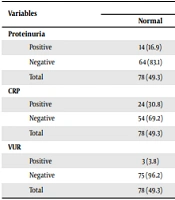
Of 193 patients, 55 (28.5%) had abnormal ultrasonography results and 29 (15%) had abnormal VCUG. VCUG and ultrasonography were reported to be abnormal for only 20 (33.9%) out of 59 patients with abnormal DMSA renal scan.
4. Discussion
Rapid diagnosis of acute pyelonephritis, especially in young children, is very important because the risk of renal scarring is high in the early life of children (18). Diagnosis of pyelonephritis is based on positive urine culture with clinical and biological markers and of course abnormal DMSA renal scan (11). On the other hand, acute pyelonephritis with negative urine culture has been reported in previous studies (11, 19).
In the present study, about 41% of patients with pyelonephritis had negative urine culture. In Nammalwar et al. study, 38% of children with pyelonephritis, proved by DMSA renal scan, had negative urine culture (20), which is similar to the present study. In a study by Nikibakhsh et al., abnormal DMSA renal scan was found in 67.7% of children with abnormal urinalysis and negative urine culture (12). In a study conducted in Belgium, approximately 9% of patients with pyelonephritis had negative urine culture (11). This difference may have various causes. One of the main reasons may be the lower colony counts due to defects in urine concentration. The other influential factors are drinking large amounts of fluids before sampling, reduction in the amount of urine in the bladder due to repeated urination, the existence of antibiotic in urine, and ureteral obstruction (9, 21-25). The other causes of negative urine culture, in spite of urinary tract infection, can be anaerobic bacteria and slow growers that are not always followed in routine urine cultures (11, 26, 27).
In the present study, 15.3% of patients with abnormal DMSA did not have fever. In Nikibakhsh et al. study, no fever was detected in up to 50% of patients, who had abnormal DMSA renal scan (12). These findings reflect the fact that fever cannot be a special sign and symptom for children with pyelonephritis.
In the present study, 35.2% of patients with urinary tract infection had negative urine culture. In another study, 141 out of 386 patients (36.5%) with urinary tract infections had negative urine culture, and abnormal DMSA renal scan was reported in 44 patients with negative urine culture (19) which is in accordance with the present study.
In the present study, based on the negative urine culture with suspected pyelonephritis, 26.3% of patients with pyelonephritis could have been missed without performing DMSA renal scan. To some extent, these results are similar to the Tsao et al. study (19). This similarity strongly encourages us to do DMSA renal scan in patients with signs and symptoms compatible with pyelonephritis, especially if there is abnormal urinalysis, even with negative urine culture.
Also, due to the possibility of a negative urine culture in children with urinary tract infections, DMSA renal scan should be part of FUO management protocol, especially if there are symptoms of a urinary tract infection. Also, DMSA renal scan should be considered in any patient with severe infection without known etiology, and especially if there is abnormal urinalysis. Renal ultrasound could not replace DMSA renal scan, as it was normal in 66% of patients with pyelonephritis.
In conclusion, about 41% of patients with pyelonephritis could have been missed based on equivocal or negative urine cultures. Because the differentiation of the upper and lower urinary tract infection is difficult in children and there is a probability of antibiotic use prior to performing urine culture, DMSA renal scan should be considered for the diagnosis of pyelonephritis in children with a negative urine culture and abnormal urinalysis. DMSA renal scan may be abnormal in the absence of signs and symptoms of suspected pyelonephritis in children.