
1. Background
According to the World Health Organization, infants born earlier than 37 weeks after the first day of the last menstrual period are considered preterm (1). Although the rate of preterm birth is reduced from 12.8% in 2006 to 11.4% in 2013, it still includes a significant number of births (2). Preterm birth is the leading cause of neonatal mortality and is the most common cause of death in children under five years, globally (3, 4). Today, neonatal death rate in Iran is higher than those of many other Middle-Eastern countries (5).
The decrease in mortality rate within the first hours after birth is an important matter to assess the health indicators in a country (6). Researches show that the improvement of nursing-midwifery care and neonatal intensive care units (NICUs) play a significant role in reducing the mortality rate in preterm infants with very low birth weights (7).
Perinatal factors and the physiological status of the infant during hospitalization are effective in the prognosis of death or survival of infant admitted to NICUs. In order to improve the quality of services provided for this vulnerable group in NICUs, a tool is needed to predict mortality rate and efficiently evaluate the results of the medical team’s performance. This prognosis is obtained through scoring systems designed for such tasks (8, 9).
One of these scoring systems is the score for neonatal acute physiology (SNAP) and its subsequent editions, including the score for neonatal acute physiology with perinatal extension (SNAPPE-II) (8, 10). Given that it is easy to measure SNAPPE-II variables and that can be implemented in the shortest time possible, this system can be used as a basis to make decisions and as a proper scale to predict the mortality rate of preterm and vulnerable infants (11).
While a significant number of preterm and under-weight infants are hospitalized in NIUCs, a clinical risk assessing is not accurately determined so far. Iran has an approximately high neonatal death; therefore, the need for a proper tool seems necessary in order to classify infants at the time of admission, develop clinical plans and their subsequent follow-ups, and estimate the need for clinical care over time. Also, the employment of outcome predicting tools especially for high risk neonates should become a routine monitoring in NICUs.
2. Objectives
The present study aimed at examining the predictive ability of SNAPPE-II system, as an easy and time-effective tool, and determining the risk of death in preterm infants hospitalized in NICUs.
3. Methods
In the current cross sectional study, according to the inclusion criteria, simple sequential sampling was used. The research population consisted of premature infants meeting the inclusion criteria hospitalized in the NICU of Vali-e-Asr Hospital, Tehran, Iran; an academic, state referral center. The samples meeting the inclusion criteria consisted of infants with a birth-weight less than 1500 g or a gestational age under 32 weeks hospitalized in the NICU during the first 12 hours after birth. The infants with lethal congenital anomalies, incomplete data, and/or the ones discharged with parental consent during the study were excluded. The study protocol was approved by the Ethics Committee of Shahid Beheshti University of Medical Sciences (ethical code: IR.SBMU.PHNM.1395.682). Moreover, after explaining the objectives and the procedure of the research to the parents of the enrolled infants, oral and written informed consents were obtained from them in order to involve their infants in the study.
The research instrument consisted of a SNAPPE-II questionnaire. Neonatal variables such as the mean blood pressure during the first 12 hours after birth, the low body temperature, the ratio of partial pressure arterial oxygen to the inspired oxygen (PaO2/FiO2 ratio), the lowest serum pH, frequent seizure incidence, urine output, the Apgar score at birth, birth weight, and being small for gestational age (SGA) were recorded. Each item was scored according to the scores specified in the instrument and the final score was calculated for each infant. The total scores range 0 - 171 in SNAPPE-II; scores above 40 are a strong predictor of death (10).
In the current study, according to the sample size formula (12),
at least 200 samples were needed. However, since there were more samples available for data collection, 344 infants were studied to achieve a higher accuracy. After collecting the necessary information, data were transferred into SPSS version 23 and analyzed. The impact factors and odds ratio were extracted from logistic and linear regression equations and tests. The sensitivity, specificity, and cutoff point of the SNAPPE-II scoring system were determined. Additionally, positive predictive value (PPV), negative predictive value (NPV), LLR+, and true positive and false positive were calculated. In all cases, P < 0.05 was considered as the level of significance for the differences between the groups. Power of study was 80%. The ROC curve was used to estimate the cutline (chi-square = 5.47 ,P-value = 0.7).
4. Results
Totally, 344 infants (131 males, 163 females) met the inclusion criteria of the study for which the SNAPPE-II scoring system was completed; 253 of the infants (73% of males, 75% of females) survived 24 hours after birth, and 91 of them died during this time; therefore, no significant gender difference was observed between the survived and deceased infants (P = 0.664). Some of the infants’ demographic data are presented in Table 1.
Table 1.
Demographic Data of Infants in the Two Study Groups
| Variable/Group | Mean ± SD | P Value |
|---|---|---|
| Weight, g | 0.001** | |
| Survivors | 1210.73 ± 281.90 | |
| Non-survivors | 912.67 ± 334.09 | |
| Birth height, cm | 0.001** | |
| Survivors | 39.09 ± 3.83 | |
| Non-survivors | 77.34 ± 4.64 | |
| Head circumference, cm | 0.001** | |
| Survivors | 44.27 ± 2.35 | |
| Non-survivors | 34.25 ± 2.09 | |
| Ventilation time, d | 0.001** | |
| Survivors | 6.55 ± 2.36 | |
| Non-survivors | 8.30 ± 6.10 |
Therefore, it was observed that the survived infants were heavier, taller, and had larger head circumferences than the deceased ones. They also underwent ventilation for fewer days. During the first 24 hours after birth, the scores obtained in the SNAPPE-II scoring system were calculated in both groups of survivor and non-survivor infants. The results indicated that the mean scores were significantly lower in the survived infants than the other group (Table 2).
Table 2.
Mean SNAPPE-II Score for Survived and Deceased Infants in the First 24 Hours After Birth
| SNAPPE-II | Number | Mean ± SD | P Value |
|---|---|---|---|
| Survivors | 253 | 16.94 ± 16.46 | 0.0001* |
| Non-survivors | 91 | 51.60 ± 22.98 |
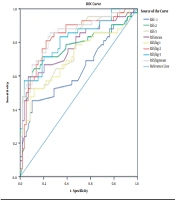
The area under curve was measured. The results confirmed the diagnosis accuracy of the SNAPPE-II system (Table 3). Additionally, the ROC curve was drawn for SNAPPE-II system (Figure 1).
Table 3.
The Area Under ROC Curve and Diagnosis Accuracy of SNAPPE-II Scoring System
| Area Under the Curve | Standard Error | P Value | Confidence Interval | |
|---|---|---|---|---|
| Upper Bound | Lower Bound | |||
| 0.888 | 0.020 | < 0.001 | 0.928 | 0.848 |
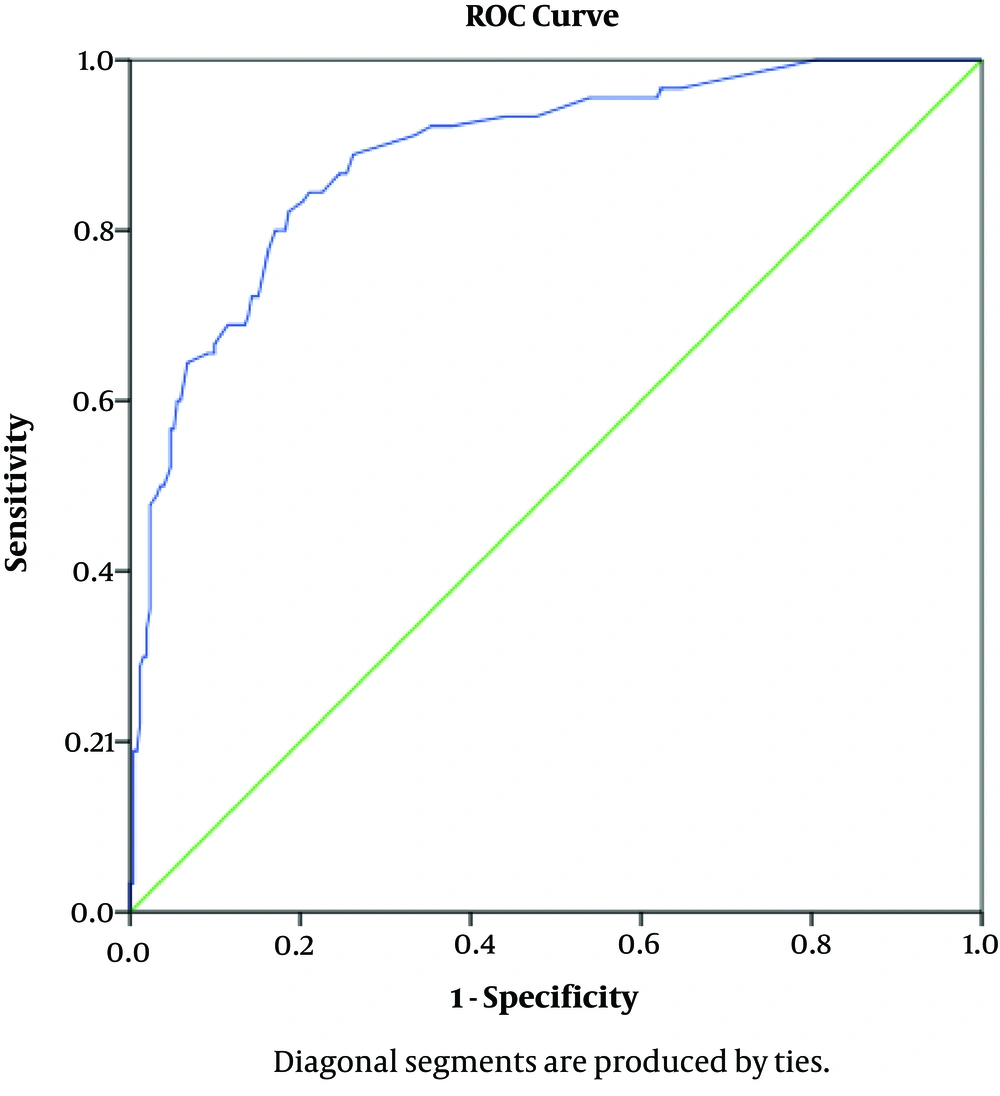
Figure 1.
ROC curve for SNAPPE-II scoring system
Sensitivity, specificity, and cutoff point were also calculated in SNAPPE-II scoring system. The cutoff point was 27.5 and the Youden index, 0.64, according to Youden’s approach. The sensitivity and specificity at the cutoff point of 27.5 were 79% and 85%, respectively.
PPV and NPV of the SNAPPE-II system were 58.9% and 93.4%, respectively. Moreover, in cases where the infant’s death was predicted by the tool, the chances of a real death or in other words the positive likelihood ratio (LLR+) was 4.01 and the likelihood of survival or false positive (LLR-) 0.197.
When analyzing the factors affecting death, using the logistic regression test (Table 4), no separate and independent correlations were observed among PaO2/FiO2 ratio (odds ratio (OR) = 1.136, P = 0.33), serum pH (OR = 0.94, P = 0.70), seizure (OR = 1.14, P = 0.32), urine output (OR = 1.39, P = 0.053), Apgar score (OR = 1.123, P = 0.14), and death. There were significant correlations between the infant’s birth weight (OR = 1.502, P = 0.004), body temperature (OR = 1.389, P = 0.049), blood pressure (OR = 1.383, P = 0.02), and the outcome mortality. Mortality risk increased as a result of weight loss, hypothermia, and hypotension. Additionally, there was a significant correlation between the total SNAPPE-II score and the outcome neonatal mortality (OR = 1.081, P = 0.00).
Table 4.
Logistic Regression Results of Predictive Factors on Neonatal Mortality
| Factor | Odds Ratio | P Value | Confidence Interval | |
|---|---|---|---|---|
| Upper Bound | Lower Bound | |||
| Mean blood pressure | 1.389 | 0.021 | 1.049 | 1.823 |
| The lowest body temperature | 1.389 | 0.049 | 1.002 | 1.925 |
| PaO2/FiO2 | 1.136 | 0.337 | 0.876 | 1.472 |
| The lowest serum pH | 0.942 | 0.701 | 0.693 | 1.280 |
| Seizure | 1.142 | 0.328 | 0.876 | 1.489 |
| Urine output | 1.398 | 0.053 | 0.996 | 1.963 |
| 5-minute Apgar | 1.123 | 0.142 | 0.962 | 1.312 |
| Birth weight | 1.502 | 0.004 | 1.136 | 1.985 |
| SGA | 0.925 | 0.538 | 0.721 | 1.186 |
| SNAPPE-II score | 1.081 | 0.0001 | 1.001 | 1.995 |
5. Discussion
Scoring systems are essential to make clinical decisions by identifying variables related to neonatal death. For example, the SNAPPE-II scoring system used in the current study (10) predicts the neonatal mortality risk in the first 12 hours after birth. However, it is not designed to be used over several days. However, the distinctive attribute of SNAPPE-II is its applicability for all birth weights. It combines birth weight and the severity of underlying diseases as independent mortality risk factors, and accordingly, would be a basis for clinical decision-making.
Neonatal mortality rate in the present study was 26.4% by SNAPPE-II scoring system. In the studies conducted at several NICUs, this amount varied 4.3% to 11% in Canada (13), 26% in South American countries, 8.9% in Brazil, and 15% in Italy (14, 15). In two different studies in India, the neonatal mortality rate ranged about 23.2% to 38% (16, 17). In Iran, this amount is reported 12.5% in Tehran Children’s Medical Center and 34% in Motazedi Hospital in Kermanshah (18, 19). According to Babaei et al. the mortality rate was 13% (20). These differences in neonatal mortality rate are mainly the result of the quality of hospital services, the equipment, and facilities of ICUs, and the ratio of nurses to admitted infants. However, different sample sizes in the abovementioned studies also justify the differences to some extent.
The mortality rate of preterm infants can also be predicted by SNAPPE-II. A higher score increases the likelihood of death. In a study, 8.83% of infants with a score above 40 did not survive. As the score increased, the mortality rate also increased significantly (20). According to the results of the above study, the mean total SNAPPE-II score was 16.94 in the survived infants, and 51.60 in the deceased ones. In another study conducted in Indonesia, these scores were reported 15 and 46.6 for the survived and deceased infants, respectively (21). Besides, in Thailand, it was 23.5 and 36.5 for the survived and deceased neonates, respectively (22).
In the current study, the neonatal variables associated with the outcome mortality consisted of weight, body temperature, blood pressure, and total SNAPPE-II score. In similar studies, variables that had significant relationships with mortality outcome included one- and five-minute Apgar scores and gestational age, which were the most important factors in predicting mortality, respectively (20). Another study also found that the overall SNAPPE-II score, perinatal asphyxia, and congenital malformations were significantly correlated with neonatal death (23). The results of the study conducted by Lime et al. showed that the SNAPPE-II score had a direct relationship with the length of hospitalization (24).
In the current study, the sensitivity of SNAPPE-II system was 79%, its specificity was 85%, and the cutoff point 27.5. In other words, in case of implementing this instrument for an infant and achieving a score above that value, there would be an 80% mortality probability. Another study calculated the sensitivity of SNAPPE-II as 60%, while in another one its sensitivity and specificity were reported 94% and 83%, respectively (25).
In the current study, the area under SNAPPE-II curve was 89%. Other studies reported this value 83.5% and 91% (10).
According to the results of the study, the system had PPV and NPV of 58.9% and 93.4%, respectively. In other words, about 59% of the infants with high scores died and almost 93% of neonates with low scores survived. In a research, PPV of the system was 88% (26). Another examination reported PPV and NPV of 66% and 96%, respectively (27).
In the present study, infants with gestational age less than 32 weeks were enrolled. Due to the fact that the SNAPPE-II does not include the gestational age as an item in the scoring, the study also did not have the ability to calculate the correlation between the gestational age and the final score due to lack of data. It is suggested that this issue be considered in future studies.
5.1. Conclusions
The final score obtained from SNAPPE-II scoring system is the predictor of neonatal death, which shows a higher mean value compared with other studies and may indicate that the survived infants had worse conditions.
According to the results of the current study, the sensitivity, specificity, and cutoff point of the SNAPPE-II scoring system were calculated. Additionally, this tool was easy-to-use, fast, accurate, and applicable to infants with different weights. Therefore, this scoring system is effective as a predictor of mortality in high-risk infants. On the other hand, the completion of this tool within the first 12 hours after birth and its short complete time made it easier to be routinely employed while providing medical care for Iranian infants. In the present study, incomplete recorded data led to sample attrition and was considered as one of the limitations of the study. It is recommended to determine the predictability of the abovementioned scoring system in other NICUs in Iran and conduct complementary studies with different facilities and healthcare personnel in order to check the accuracy and authenticity of the system, and determine the precise score, which predicts the outcome of neonatal mortality.