
1. Background
Suicide is a complex and multifaceted phenomenon resulting from the interplay of multiple biological, psychological, and social factors (1). In recent years, suicide has ranked as the fourth leading cause of death globally among the 15 - 29 age group (2). Despite substantial investments in suicide prevention, the World Health Organization (WHO) reported an increase in suicide rates in 2021 (3). The incidence of suicide attempts peaks in mid-adolescence. A meta-analysis investigating common social harms among students identified four prevalent issues: Suicide, violence, addiction, and sexual deviance (4, 5). Research on suicide focuses on two key aspects: Suicidal ideation and suicide attempts (6). Suicidal ideation encompasses a spectrum of thoughts, ranging from vague considerations of ending one's life to full-blown suicidal plans. It essentially refers to any self-destructive thought and is particularly prevalent during adolescence and puberty (7).
One of the key correlates that can promote mental and physical health is meaning in life (8). Meaning in life is a vital element that provides coherence to an individual's worldview and serves as a crucial factor for their psychological and spiritual well-being. Rahgozar and Giménez-Llort (8) emphasize that life has meaning under any circumstances, and when an individual's search for meaning is hindered, they become psychologically vulnerable. It is important to determine whether meaning in life serves as a useful predictor of well-being among adolescents (9). Meaning in life refers to the subjective perception that life has purpose, direction, and significance (10). Meaning in life serves as a buffer against hopelessness and despair, two key factors associated with suicidal ideation. When adolescents perceive their lives as having meaning, they are more likely to develop coping mechanisms, engage in goal-directed behavior, and build resilience in the face of challenges.
Another relevant correlate during adolescence is a set of psychological strengths known as psychological capital (11). Psychological capital is defined as "a positive psychological state that is reflected in the patterns of thinking, feeling, and behaving that people display as they strive to accomplish their goals" (12). It comprises four main components: Self-efficacy, optimism, hope, and resilience. Two of these components, optimism and hope, are included in a list of 24 variables that can enhance individual well-being (13). Psychological capital can predict levels of mental and physical health and reduce suicidal thoughts (14, 15). Evaluating the effectiveness of different interventions on psychological variables is necessary to identify the most accurate treatment methods based on research evidence.
Various treatments have been proposed for suicide ideation and related disorders. One of the psychotherapeutic approaches that has recently gained considerable attention and demonstrated promising effects in the context of suicide is acceptance and commitment therapy (ACT) (16). Acceptance and commitment therapy is a psychological intervention that utilizes mindfulness and acceptance-based strategies alongside commitment and behavior change techniques to enhance psychological flexibility (17). Given that ACT primarily targets cognitive flexibility, this flexibility leads to alternative solutions that ultimately contribute to a decrease in suicide-related thoughts (18). By fostering acceptance of difficult emotions and experiences, ACT helps adolescents detach from unhelpful thoughts that can fuel suicidal ideation. Additionally, ACT helps adolescents clarify their values and identify meaningful goals, promoting a sense of purpose and direction in life. Research has shown that ACT can effectively reduce suicidal thoughts, promote meaning in life, and enhance psychological capital (19, 20).
In recent years, suicide rates have witnessed a significant increase in Iran, particularly in Khuzestan Province. Between 2012 and 2016, a total of 1159 suicide cases were reported, and among the 27 cities in the province, Izeh had the highest suicide rate during these five years, with 75 suicides per population ratio (21). Moreover, studies conducted on the prevalence of suicidal thoughts among Iranian students have reported a rate of up to 7.49% (22). The student population constitutes a considerable portion of the country's young generation and will be the future builders of the nation. Therefore, they must enjoy mental health and psychological well-being. Considering the knowledge gap in the area of promoting meaning in life and psychological capital among students, ACT, as a cost-effective intervention, can potentially play a pivotal role in their optimal development by strengthening variables related to adolescent skills such as psychological capital and meaning in life.
2. Objectives
Accordingly, this study aimed to investigate the effectiveness of ACT on the meaning of life and psychological capital among male students with suicidal ideation.
3. Methods
This quasi-experimental study employed a pre-test-post-test with control group design. The statistical population consisted of all male high school students with suicidal thoughts in the Izeh city during the 2022 - 2023 academic year. Initially, four high schools were randomly selected using a multistage cluster random sampling method from 14 male high schools in Izeh. The Beck Suicide Ideation Scale (23) was administered to the students from the selected schools to screen and identify students with suicidal thoughts. Then, 30 students with scores equal to or higher than the cut-off point (six) on the questionnaire were selected based on the inclusion criteria. These students were then randomly assigned to either the ACT intervention group or a control group receiving treatment as usual (n = 15 per group). The control group received standard mental health services offered by the school or community but did not participate in the ACT intervention. A priori power analysis was conducted using G*Power software to determine the appropriate sample size. The analysis was based on an anticipated effect size of 1.10, a desired power of 0.90, and a significance level (alpha) of 0.05. Inclusion criteria were: Male gender, enrolled in the eleventh or twelfth grade, having suicidal thoughts, no history of psychotropic drug use no diagnosis of acute or chronic mental disorders, written informed consent from parents to participate in the study, age range of 15 to 18 years. Exclusion criteria were: Unwillingness to continue treatment, undergoing concurrent psychiatric or psychotherapeutic treatment, missing two or more treatment sessions.
This research was approved by the Islamic Azad University, Khorasgan Branch, with the ethics code IR.IAU.KHUISF.REC.1401.315. The ethical considerations of the study included: Complete confidentiality was maintained for all participants. Their personal information was kept confidential and was not shared with anyone outside of the research team. Participants had the right to withdraw from the study at any time without penalty. Written informed consent was obtained from all participants before they began the study. The consent form explained the purpose of the study, the procedures involved, and the potential risks and benefits of participation.
3.1. The Meaning in Life Questionnaire
The Meaning in Life Questionnaire (MLQ) was developed by Steger et al. (24) to assess the presence and search for meaning in life. The MLQ is a 10-item measure that taps into two dimensions of meaning in life: Presence of meaning and search for meaning. The questionnaire is scored on a 4-point Likert Scale from "very little" to "very much", with higher total scores indicating a greater sense of meaning in life. Example items include "I know what gives my life meaning" and "I am searching for meaning in my life." The Cronbach's alpha for the MLQ in the present study was 0.72.
3.2. The Psychological Capital Questionnaire
The Psychological Capital Questionnaire (PCQ) was developed by Luthans et al. (25) to measure psychological capital, which is defined as "a positive psychological state of development that is reflected in the patterns of thinking, feeling, and behaving that people display as they strive to accomplish their goals" (24). The PCQ is a 24-item measure that consists of four subscales: Hope, resilience, optimism, and self-efficacy. The questionnaire is scored on a 6-point Likert Scale from "strongly disagree" (1) to "strongly agree" (6). Example items include "I am confident that I can successfully complete any task I set for myself" and "I tend to be optimistic about my chances of success." The Cronbach's alpha for the PCQ in the present study was 0.80.
3.3. Intervention
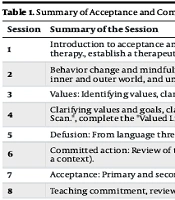
Acceptance and commitment therapy: The ACT intervention consisted of eight 75-minute sessions based on the protocol developed by Hayes et al. (26). The therapy sessions were conducted by an experienced and certified therapist under the supervision of the research supervisor (Table 1).
Table 1.
Summary of Acceptance and Commitment Therapy Intervention Sessions
| Session | Summary of the Session |
|---|---|
| 1 | Introduction to acceptance and commitment therapy and agenda setting, provide an opportunity for clients to get acquainted with each other and the goals of therapy., establish a therapeutic relationship and assess the severity of problems. Introduce mindfulness-based practice, "The Focusing Exercise." |
| 2 | Behavior change and mindfulness, create creative helplessness towards past solutions through metaphor and questioning (creative hopelessness, exploring the inner and outer world, and understanding that the problem is not the solution). Mindfulness practice. |
| 3 | Values: Identifying values, clarifying values, actions, and barriers |
| 4 | Clarifying values and goals, clarify values (using relevant metaphors). Explore barriers. Set goals and introduce committed action. Mindfulness practice "Body Scan.", complete the "Valued Living Pathways" form. |
| 5 | Defusion: From language threats (exploring fusion and defusion and practicing defusion exercises using metaphor). |
| 6 | Committed action: Review of therapy - committed action - mindfulness and self-observation practice (explain the concepts of role and context, observing oneself as a context). |
| 7 | Acceptance: Primary and secondary suffering - commitment and barriers to acceptance - mindfulness walking - emphasizing the present moment. |
| 8 | Teaching commitment, reviewing life story, identifying value-based behavioral patterns, and summary. |
3.4. Data Analysis
Data analysis was conducted using the statistical package for social sciences (SPSS) version 26 software. Prior to analysis, the normality of the data was assessed using the Shapiro-Wilk test. Homogeneity of variances, a key assumption for parametric tests like ANCOVA, was evaluated using Levene's test.
4. Results
The participants in this study included 30 male high school students with an average age of 17.15 ± 1.46 years. Table 2 presents the descriptive statistics, including means and standard deviations (SD), for the research variables in the experimental and control groups at the pre-test and post-test stages.
Table 2.
Descriptive Statistics for Meaning in Life and Psychological Capital Scores in the Experimental and Control Groups at Pre-test and Post-test
| Variables | Mean ± SD | P (Within-Group) | |
|---|---|---|---|
| Pre-test | Post-test | ||
| Meaning in life | |||
| Acceptance and commitment therapy (ACT) group | 33.60 ± 8.15 | 41.20 ± 6.67 | 0.009 |
| Control group | 30.53 ± 9.55 | 29.53 ± 7.55 | 0.753 |
| P (between-group) | 0.352 | 0.001 | - |
| Psychological capital | |||
| Acceptance and commitment therapy (ACT) group | 68.13 ± 13.28 | 79.40 ± 8.61 | 0.010 |
| Control group | 67.80 ± 15.17 | 63.53 ± 13.75 | 0.426 |
| P (between-group) | 0.950 | 0.001 | - |
The results showed that the mean scores of meaning in life and psychological capital in the experimental group increased significantly more from pre-test to post-test than in the control group. These differences were further analyzed using inferential statistics. The results of the Shapiro-Wilk test confirmed the normality of the data distribution for the variables of meaning in life (W = 0.97, P = 0.820) and psychological capital (W = 0.91, P = 0.138) at the pre-test and post-test stages. The Levene test results for meaning in life (F = 1.30, P = 0.264) and psychological capital (F = 0.02, P = 0.890) indicated that the assumption of homogeneity of variances was met. To compare the two groups at the post-test stage, an analysis of covariance (ANCOVA) was performed on the meaning in life and psychological capital scores. The results are presented in Table 3.
Table 3.
ANCOVA Results for Meaning in Life and Psychological Capital Scores
| Variables | SS | df | MS | F | P | η2 |
|---|---|---|---|---|---|---|
| Meaning in life | 809.93 | 1 | 809.93 | 19.07 | 0.001 | 0.42 |
| Psychological capital | 1680.55 | 1 | 1680.55 | 54.36 | 0.001 | 0.68 |
The results presented in Table 3 indicate that the mean scores of meaning in life (F = 19.07. P < 0.001, η2 = 0.42) and psychological capital (F = 54.36. P < 0.001, η2 = 0.68) in the experimental and control groups at the post-test stage were significantly different after controlling for the pre-test scores. This indicates that ACT was effective in enhancing meaning in life and psychological capital in male high school students with suicidal ideation at the post-test stage.
5. Discussion
The present study aimed to investigate the effect of ACT on meaning in life and psychological capital in male high school students with suicidal ideation. The results confirmed the effectiveness of ACT on meaning in life in the experimental group compared to the control group. These findings are consistent with previous research (27, 28).
There is growing evidence for the effectiveness of ACT in addressing a wide range of mental health concerns, including suicidal ideation in adolescents (29). Acceptance and commitment therapy, a contextual cognitive behavioral therapy, emphasizes psychological flexibility by fostering acceptance, mindfulness, and values-based action. These core principles hold particular relevance for adolescents struggling with suicidal ideation. Students with suicidal ideation may not live in the moment due to chronic entanglement and fusion patterns. They may not feel a sense of meaning in life and enjoy life due to being preoccupied with thoughts. Such individuals may become entangled and fused with the thought that "life is not worth living." Therefore, these individuals may become depressed even with all the things necessary for a good life, such as a successful career, romantic relationships, or the respect of others.
According to Hayes et al. (26) individuals who do not feel a sense of meaning in life do not have a sense of completeness and usefulness due to their perspective on themselves, the world, and the future. Since these individuals immerse themselves in meaningless and negative thoughts and emotions, they do not have appropriate social interactions. However, by participating in ACT therapy sessions, they achieve a different attitude or relationship with their thoughts, feelings, and emotions. With emotional defusion, mindfulness, and greater self-awareness, and living in the moment, the sense of meaning in life increases in them (30). Furthermore, the ACT therapist trained male high school students with suicidal ideation to have a more mindful, non-judgmental, and accepting approach to stressful problems. During the therapy sessions, individuals learned that the contents of their mind are not as dangerous as they thought. In the acceptance and defusion stage and related techniques, they learned to let go of controlling and coping with thoughts and emotions and be more willing to accept their thoughts, feelings, and inner contents. Through this process, by reducing anxiety and related negative thoughts, the necessary ground was prepared for promoting meaning in life in them.
The results of this study also confirmed the effectiveness of ACT on the psychological capital of high school students. This finding is consistent with previous studies (31, 32). Explaining the results of ACT on the psychological capital of male high school students with suicidal ideation, it can be stated that ACT increases the psychological flexibility of clients through mindfulness, committed action, and direct behavioral intervention in determining their important goals. According to the present study, ACT increases optimism and self-efficacy. On the other hand, ACT encourages students to fully and without resistance connect with their experiences and accept them without judgment as they move towards their valued goals by calling for a decrease in experiential avoidance and an increase in psychological flexibility through acceptance of unpleasant and unavoidable thoughts and emotions, such as anxiety, and also through cultivating mindfulness to neutralize excessive engagement with distressing thoughts and identifying personal values related to behavioral goals. This is effective in increasing optimism (32).
It seems that during the ACT training course, male high school students with suicidal thoughts took a step towards rebuilding and their identity by accepting themselves and accepting their responsibilities, feelings, and thoughts. They also gained a broader perspective and became more resilient by learning that humans are not perfect and mistakes are forgivable. Ultimately, the increase in optimism and resilience as components of psychological capital led to its increase. Another explanation that can be given for the effectiveness of ACT in increasing psychological capital and reducing suicidal thoughts in male high school students is related to the unique feature of postmodern and third-wave therapies. This refers to the important point that problem description is separate from distressing urges and behaviors. The ACT therapist, using this key point in the therapy process, taught the students those suicidal thoughts are separate from their personality. Through the process of defusion, the intensity of unpleasant and disturbing emotions and thoughts in them decreased. Therefore, it seems that the satisfaction of students with suicidal thoughts changed with the awareness of this issue, and this increased satisfaction ultimately led to the improvement of their psychological capital.
The present study, like any research endeavor, has limitations that should be considered when interpreting the findings. First, the study involved a sample of male high school students with suicidal ideation in the city of Izeh. This limits the generalizability of the results to other populations. Caution is needed when applying these findings to individuals outside this specific age range, gender, and cultural background. Second, the study relied on self-report questionnaires to measure meaning in life, psychological capital, and suicidal ideation. While questionnaires are a common tool in psychological research, they are susceptible to social desirability bias, where participants may report answers they believe are socially acceptable, rather than their true experiences. In addition to the previously mentioned limitations regarding sample demographics and self-report measures, the present study did not include a long-term follow-up component.
Subsequent studies should investigate the efficacy of ACT interventions in a wider array of populations, including women and teenagers across various age groups and cultural backgrounds. Additional research endeavors could incorporate diverse methodologies, such as clinical interviews or experience sampling techniques, to procure more thorough and detailed data. Furthermore, future investigations should incorporate prolonged follow-up evaluations to assess the long-term impact of the intervention.
5.1. Conclusions
The present study provides evidence for the effectiveness of ACT in enhancing meaning in life and psychological capital among male high school students experiencing suicidal ideation. These findings suggest that ACT, implemented under the supervision of a qualified therapist, can be a valuable intervention for improving psychological well-being in this population. Specifically, ACT may be beneficial in fostering meaning-making and promoting psychological capital components such as self-efficacy, optimism, hope, and resilience in adolescent boys. From a clinical standpoint, the present study suggests that ACT can be a valuable tool for mental health professionals working with adolescent males experiencing suicidal ideation. Clinicians may consider incorporating ACT principles into their treatment approaches to help adolescents cultivate meaning in life, build psychological capital, and ultimately reduce their vulnerability to suicidal thoughts and behaviors.