


1. Background
Diabetes mellitus, a group of metabolic disorders, is characterized by elevated blood glucose levels, typically exceeding 126 mg/dL fasting, resulting from varying degrees of insulin resistance or impaired insulin secretion. This metabolic disorder hinders the body's ability to effectively utilize glucose (1). Globally, approximately 145 million individuals live with diabetes, while in Iran, the prevalence exceeds 3.5 million, with a significant proportion remaining undiagnosed. Recent research indicates that one in every five individuals over the age of 30 in Iran has diabetes or is at risk (2). Diabetes is associated with numerous psychosocial, economic, and familial consequences for affected individuals (3). These may include feelings of failure, hopelessness, and decreased life expectancy, as well as emotions such as fear, anger, guilt, and despair related to the disease (4). Furthermore, individuals with diabetes often experience reduced motivation for self-care and inadequate disease management, leading to poor treatment adherence (5).
Treatment adherence among individuals with diabetes can be significantly compromised by various factors, leading to a deterioration in physical health (6). Defined as the extent to which individuals follow health recommendations, adhere to medication regimens, adopt healthy lifestyle practices, and comply with medical advice, treatment adherence is a complex behavioral process influenced by individual patient characteristics, the physician-patient relationship, and the healthcare system (7). Non-adherence to treatment can result in treatment failure, increased healthcare costs, frequent hospitalizations, diminished treatment benefits, higher mortality rates, and increased healthcare utilization (8).
A significant contributing factor to non-adherence in diabetes patients is the frequent co-occurrence of psychological problems and disorders, which can impair a patient's ability to manage their condition. This decreased ability to control diabetes, in turn, can exacerbate psychological difficulties, creating a reciprocal relationship (9). Consistent with these findings, a study by Świątoniowska-Lonc et al. (10) revealed significantly low levels of treatment adherence among diabetes patients, attributing this to various economic, psychological, and familial factors.
Individuals with diabetes frequently encounter a range of psychosocial challenges that can significantly impact their psychological well-being. These challenges encompass personal, psychological, familial, and social factors, such as the emotional burden of chronic illness management, the fear of long-term complications, and the potential for social stigma (11). Psychological well-being is a multidimensional construct encompassing various aspects of positive psychological functioning and experience. It includes, but is not limited to, affective components such as happiness and life satisfaction; cognitive components such as a sense of purpose and meaning in life; social components such as positive relationships and social integration; and personal growth components such as self-acceptance, autonomy, and personal development. This broader understanding of psychological well-being recognizes the interconnectedness of emotional, cognitive, social, and personal factors in contributing to an individual's overall sense of flourishing and optimal functioning (12).
The intricate interplay between physical health and psychosocial factors profoundly influences the overall psychological well-being of individuals living with diabetes. In recent years, there has been growing recognition of the critical importance of addressing the unique psychosocial needs of this population, as emotional and social adjustment aspects have often been overlooked in traditional diabetes care models (13). Research increasingly emphasizes the pivotal role of the social environment in promoting health and mitigating the negative impacts of diabetes (14). Consistent with this, a study by Massey et al. (15) found that individuals with diabetes exhibited significantly lower levels of psychological well-being compared to the general population.
A variety of approaches have been implemented to support individuals with diabetes and optimize their disease management. Psychological interventions, specifically designed to enhance the psychological well-being of this population, have emerged as a crucial area of focus (15). Among these interventions, emotion-focused therapy (EFT) has shown particular promise in improving treatment adherence and overall psychological well-being among individuals living with diabetes. The chronic nature of diabetes, coupled with the inherent fluctuations in blood glucose levels, can significantly contribute to emotional disturbances such as anxiety, depression, and anger (16).
Emotion-focused therapy, a blend of experiential and systemic therapies, has been closely linked to reductions in psychological distress. As an experiential and process-oriented therapy, EFT emphasizes not only bringing to awareness the denied or distorted cognitive content of clients but also creating new meanings based on clients' bodily experiences (17). After establishing a therapeutic relationship, therapists employing this approach teach clients emotion regulation skills. This therapeutic framework focuses on emotions and helps individuals develop self-regulation strategies (18). The EFT incorporates components such as focusing on positive emotions, emotional reappraisal, and finding new meanings to foster better interpersonal relationships, ultimately leading to increased psychological well-being by facilitating the modification and transformation of negative emotions (19).
Emotion regulation encompasses the processes through which individuals modulate their emotional experiences, including the type, timing, experience, and expression of emotions (20). In the context of diabetes management, effective emotion regulation is crucial because the demands of managing the condition, such as adhering to medication regimens and dietary restrictions, can be stressful and emotionally challenging. Many patients experience feelings of inadequacy when adhering to these regimens, which can negatively impact their mood and, subsequently, blood glucose control. Furthermore, negative emotions such as anger, sadness, and guilt are common among individuals with diabetes, increasing their need for effective emotion regulation strategies (21). Research evidence suggests that individuals with diabetes often struggle with regulating their emotions, which, as reported in various studies, can significantly impact treatment adherence and psychological well-being (22).
Emotion-focused therapy may be a valuable tool for improving emotion regulation in individuals with diabetes. The EFT is a form of psychotherapy that involves tapping on specific acupressure points while focusing on negative emotions. This process is thought to disrupt negative emotional circuits in the brain, leading to a reduction in emotional intensity and improved emotional regulation (19). By helping individuals with diabetes better regulate their emotions, EFT may improve treatment adherence and glycemic control. Studies have shown that EFT can reduce anxiety, depression, and stress, all of which can negatively impact diabetes management (20). Additionally, EFT may help individuals with diabetes develop coping skills for dealing with the emotional challenges of living with the condition (11).
2. Objectives
Examining mediators is crucial in developing more effective or cost-efficient treatments. Therefore, this study investigated the mediating role of emotion regulation in the relationship between EFT and both treatment adherence and psychological well-being in patients with diabetes.
3. Methods
This study employed a quasi-experimental design with two groups: An experimental group and a control group. It was a pre-test-post-test design with a control group and a two-month follow-up period. The study population consisted of patients with diabetes who visited the diabetes clinic in Ahvaz in 2023. A sample of 30 individuals was selected using a convenience sampling method and randomly assigned to two groups of 15 (one treatment group and one control group). A priori power analysis using G*Power determined a sample size of 15 per group (effect size = 1.10, alpha = 0.05, power = 0.90). Random assignment was conducted using a random number table (Figure 1).
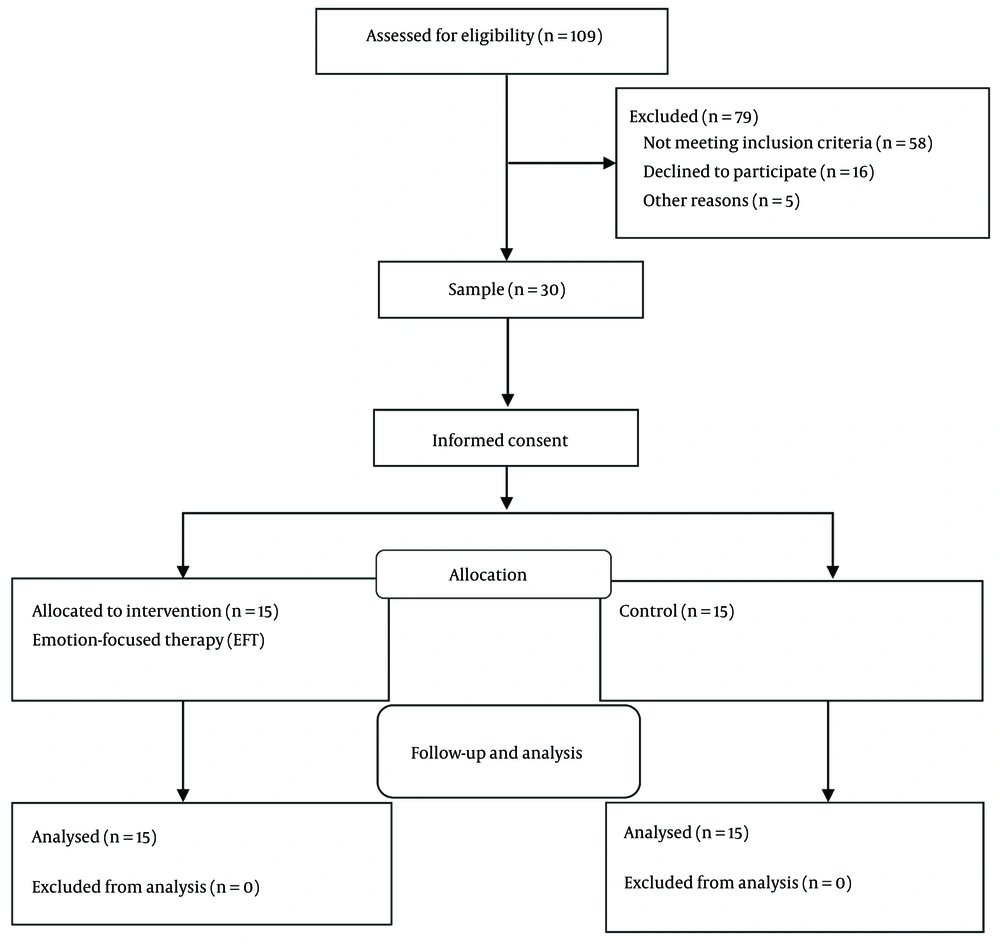
Figure 1.
Consort flow diagram of the participants
Inclusion criteria for the study included a diabetes diagnosis of at least one year, informed consent to participate in the study, an age range of 20 to 60 years, and at least a high school education. Exclusion criteria included participants' non-cooperation, failure to answer questionnaire items, absence from more than two sessions, and prior receipt of psychological treatment before entering the study.
The experimental group received eight weekly 90-minute EFT sessions, while the control group was placed on a waitlist and received no intervention during the study period. A summary of the EFT sessions is presented in Table 1.
Table 1.A Summary of the Emotion-Focused Therapy Sessions
| Sessions | Content |
|---|---|
| 1 | This session involves introductions between the therapist and the clients. After introducing himself/herself, the therapist outlines the treatment goals for the group and then proceeds to assess the clients. The therapist also explains the different types of emotions to the group members. |
| 2 | In this session, anger, depression, and other emotional skills, as well as problem-solving skills, are discussed. |
| 3 | In the third session, through practical exercises, clients learn about the consequences of anger and bullying. |
| 4 | The therapist strives to increase clients' awareness of the consequences of delaying the process of forgiveness. |
| 5 | In the fifth session, which is a continuation of the mindfulness session, the therapist helps clients articulate their values and act in accordance with them. |
| 6 | In this session, with the therapist's guidance, clients express their regret for aggressive and unhealthy approaches and behaviors that lack appropriate emotion regulation. They learn to find healthier ways to meet their needs. |
| 7 | In the seventh session, clients learn to replace negative emotions with positive ones. The therapist also asks clients to review their progress towards their goals. |
| 8 | In the final session, group members learn to review their progress and continue moving in the same direction. They also strive to practice forgiveness in their lives. |
Intervention fidelity was ensured through several methods: Sessions were delivered by a certified EFT therapist; a detailed treatment manual was followed; regular supervision meetings were held with an EFT consultant; and a random sample of sessions was audio-recorded and reviewed by the consultant.
3.1. Instruments
3.1.1. The Treatment Adherence Questionnaire
The Treatment Adherence Questionnaire (TAQ) (23) is a 40-item validated instrument designed to assess treatment adherence in patients with chronic diseases. It employs a 5-point Likert scale across seven subscales: Attention to treatment, willingness to participate, ability to adapt, integration of treatment into life, adherence to treatment, commitment to treatment, and hesitation in implementing treatment. Scores range from 0 to 200, with higher scores indicating better adherence. The TAQ has demonstrated strong internal consistency, with a Cronbach's alpha of 0.92 (23).
3.1.2. Ryff’s Scale of Psychological Well-Being
Ryff’s Scale of Psychological Well-being is an 84-item measure that assesses six dimensions of psychological well-being: Positive relations with others, autonomy, environmental mastery, personal growth, purpose in life, and self-acceptance (24). Items are rated on a six-point Likert scale, with higher scores indicating greater well-being. Total scores range from 84 to 504. The scale has demonstrated strong internal consistency in previous research, with a Cronbach’s alpha of 0.82 (25), and showed acceptable reliability in the current study, with a Cronbach’s alpha of 0.79.
3.1.3. The Emotion Regulation Questionnaire
The Emotion Regulation Questionnaire (ERQ), developed by Gross and John, is a self-report measure that assesses two primary emotion regulation strategies: Reappraisal and suppression. Participants rate items on a 7-point Likert scale, with higher scores indicating greater use of the respective strategy (26). The ERQ has demonstrated strong psychometric properties, with a Cronbach's alpha of 0.91 reported by Hasani (27).
3.2. Data Analysis
A repeated measures analysis of variance (ANOVA) was used to test the hypotheses. Prior to the ANOVA, descriptive statistics, including means and standard deviations, were calculated. The Kolmogorov-Smirnov and Mauchly's tests were used to assess normality and sphericity, respectively. The Greenhouse-Geisser correction was applied if sphericity was violated. Bonferroni post hoc tests were used to identify specific group and time point differences following significant main effects or interactions. Mediation analysis was conducted using the bootstrapping method.
4. Results
Participants in this study consisted of 30 patients with type 2 diabetes. The mean age of participants in the EFT and control groups was 46.88 ± 5.71 and 49.07 ± 6.39 years, respectively. The duration of diabetes in the control group was 6.75 ± 2.50 years, and in the EFT group, it was 7.68 ± 3.17 years. Table 2 presents the descriptive statistics (means and standard deviations) for treatment adherence, psychological well-being, and emotion regulation in both the experimental and control groups at the pre-intervention, post-intervention, and follow-up stages. To ensure the validity of the repeated measures analysis, the Kolmogorov-Smirnov test was used to verify the normality of the distribution for treatment adherence and psychological well-being variables. Additionally, Mauchly's test was conducted to assess the homogeneity of variances. To test the research hypotheses and determine the efficacy of EFT on treatment adherence and psychological well-being, a repeated measures ANOVA was performed. The results, presented in Table 2, indicated a significant effect of EFT on both treatment adherence and psychological well-being. The results of the repeated measures ANOVA, presented in Table 3, indicated significant within-group improvements in treatment adherence (F = 39.49, P < 0.001, partial η² = 0.75) and psychological well-being (F = 432.03, P < 0.001, partial η² = 0.97) for the EFT group over time.
Table 2.Means and Standard Deviations of Research Variables a
| Variables and Phases | EFT Group | Control Group |
|---|---|---|
| Treatment adherence | ||
| Pre-intervention | 59.35 ± 3.67 | 59.14 ± 3.71 |
| Post-intervention | 68.85 ± 5.06 | 60.28 ± 4.34 |
| Follow-up | 65.71 ± 4.61 | 59.63 ± 4.61 |
| Psychological well-being | ||
| Pre-intervention | 112.42 ± 5.41 | 111.36 ± 5.99 |
| Post-intervention | 132.85 ± 4.63 | 111.72 ± 6.24 |
| Follow-up | 129.50 ± 4.48 | 111.35 ± 6.33 |
| Emotion regulation | ||
| Pre-intervention | 20.92 ± 2.86 | 20.85 ± 3.37 |
| Post-intervention | 34.85 ± 4.29 | 21.50 ± 3.61 |
| Follow-up | 33.14 ± 4.84 | 20.28 ± 3.38 |
Abbreviation: EFT, emotion-focused therapy.
a Values are expressed as mean ± SD.
Table 3.Results of Repeated Measures ANOVA for Within-Group Effects in the Emotion-Focused Therapy Group
| Variables | SS | df | MS | F | P | ηp2 |
|---|---|---|---|---|---|---|
| Treatment adherence | 753.47 | 1.62 | 463.92 | 39.49 | 0.001 | 0.75 |
| Psychological well-being | 2960.90 | 1 | 2960.90 | 432.03 | 0.001 | 0.97 |
After confirming the significant effect of EFT on the study variables, a post hoc Bonferroni test was conducted to determine the specific differences between the pre-intervention, post-intervention, and follow-up stages of these variables. The results of this test are presented in Table 4. According to the results, there were significant differences between the pre-intervention and post-intervention scores for treatment adherence and psychological well-being (P < 0.001). Therefore, EFT was effective in improving these variables. Moreover, since the differences between the pre-intervention and follow-up scores for the examined variables were also significant (P < 0.001); the effects of EFT on treatment adherence and psychological well-being were sustained over time.
Table 4.Bonferroni Post-hoc Test for Paired Comparison of Treatment Adherence and Psychological Well-Being Across Time Points
| Variables | Phase A | Phase B | Mean Difference (A-B) | SE | P |
|---|---|---|---|---|---|
| Treatment adherence | Pre-intervention | Post-intervention | 9.50 | 1.61 | 0.001 |
| Follow-up | 6.36 | 1.52 | 0.001 | ||
| Post-intervention | Follow-up | -3.14 | 1.77 | 0.086 | |
| Psychological well-being | Pre-intervention | Post-intervention | 20.43 | 1.84 | 0.001 |
| Follow-up | 17.08 | 1.81 | 0.001 | ||
| Post-intervention | Follow-up | -3.35 | 1.66 | 0.054 |
The indirect effects of EFT on treatment adherence and psychological well-being, mediated by emotion regulation, are presented in Table 5. Results indicate a significant indirect effect of EFT on treatment adherence through emotion regulation (β = 0.76, P < 0.001). Similarly, EFT significantly influenced psychological well-being indirectly through emotion regulation (β = 0.96, P < 0.001). The model fit indices suggest a good fit of the model examining the effect of EFT on treatment adherence and psychological well-being, mediated by emotion regulation (standardized root mean square residual [SRMR] = 0.045, normed fit index [NFI] = 0.90).
Table 5.Indirect Effects of Emotion-Focused Therapy on Treatment Adherence and Psychological Well-Being Mediated by Emotion Regulation
| Paths | β | t | P-Value |
|---|---|---|---|
| EFT → treatment adherence through emotion regulation | 0.76 | 10.06 | 0.001 |
| EFT → psychological well-being through emotion regulation | 0.96 | 96.18 | 0.001 |
Abbreviation: EFT, emotion-focused therapy.
5. Discussion
This study aimed to investigate the efficacy of EFT in improving treatment adherence and psychological well-being among individuals with diabetes, mediated by emotion regulation. The findings suggest that EFT may have led to improvements in treatment adherence among patients with diabetes at post-test and follow-up. These results are consistent with findings from previous research by Aghel Masjedi et al. (28). To explain the impact of EFT on treatment adherence, based on previous empirical evidence, it can be argued that a lack of emotional awareness is associated with lower treatment adherence. Individuals with lower emotional awareness are less likely to engage in treatment, allowing their emotions to overwhelm them, which negatively impacts their treatment process. Consequently, they may neglect routine medical check-ups, fail to adhere to prescribed diets, and require constant reminders and external pressure to continue their treatment (28). One potential explanation for this phenomenon is that when individuals lack awareness of their emotions, they are also unaware of the underlying processes leading to these emotions, as well as the physical stressors associated with their illness, such as diabetes. As a result, they may be less inclined to seek treatment. Therefore, EFT, by enhancing emotional awareness, promotes greater treatment adherence. Patients with diabetes, as a result of the increased emotional awareness gained through EFT, experience improved adherence to their treatment regimens.
The findings of this study support the efficacy of EFT in enhancing the psychological well-being of individuals with diabetes. These results align with previous research conducted by Halamova et al. (29). To explain the impact of EFT on psychological well-being, based on previous empirical evidence, it can be argued that individuals with diabetes, as a result of EFT, experience increased positive emotions and reduced negative emotions, thereby gaining greater control over their circumstances and improving their overall psychological well-being. This process involves emotional acceptance rather than attempts at immediate suppression or avoidance. Instead of attempting to directly alter external circumstances, individuals learn to regulate the intensity of their emotional responses to stressful situations (17). In essence, they come to accept diabetes as a chronic condition and focus on managing their emotions to cope with the challenges associated with the disease. Consequently, EFT, by fostering awareness of both positive and negative emotions, promoting acceptance, and facilitating timely expression, plays a significant role in improving the psychological well-being of individuals with diabetes.
This study found that EFT improved treatment adherence and psychological well-being in diabetic patients, with emotion regulation acting as a mediator. The EFT helps individuals develop adaptive emotion regulation strategies, leading to better coping, treatment re-evaluation, and adherence. The mediation analysis confirmed that improved emotion regulation partially explained the positive changes in adherence. Similarly, improved emotion regulation through EFT enhanced psychological well-being by providing coping strategies for diabetes-related stressors, reducing negative emotions, and increasing positive emotions (30). While emotion regulation was identified as a key mediator, other factors such as self-efficacy and social support may also play a role and warrant further investigation.
This study had several limitations: A small sample size limiting generalizability and statistical power; convenience sampling introducing potential selection bias; a weak, no-intervention control group making it difficult to isolate the effects of EFT; and a lack of blinding, potentially leading to performance bias. Future research should use larger, more representative samples, active control groups, blinding where possible, and longer follow-up periods.
5.1. Conclusions
The findings of this study suggest a potential benefit of EFT for improving treatment adherence and psychological well-being in individuals with diabetes, potentially through the mediating role of emotion regulation. By targeting emotional processes and enhancing emotion regulation skills, EFT may contribute to improved diabetes self-management and overall quality of life. The observed effects at follow-up hint at possible sustained benefits. These findings suggest that EFT could be a valuable adjunct to standard diabetes care, offering a more comprehensive and holistic approach to addressing the psychological and emotional needs of individuals with this condition.
This study offers preliminary insights for clinical practice. If replicated in larger, more rigorous studies, these findings suggest that EFT could be a valuable adjunct to standard diabetes care. Clinicians working with patients with diabetes should be cognizant of the significant emotional challenges these individuals face, which can impact their adherence to treatment plans and overall well-being.


