
1. Background
Bipolar disorder is a chronic psychiatric illness characterized by high recurrence rates, comorbidity, and significant functional impairments (1). Marked by alternating episodes of depression and mania or hypomania, it affects approximately 2% of the global population, ranking among the leading causes of disability worldwide (2). It disrupts mood, energy, activity, concentration, and daily functioning, with three subtypes: Bipolar I (severe mania and depression), bipolar II (hypomania and depression), and cyclothymic disorder (3-5). Most patients (50 - 66%) report onset before age 18, with 15 - 28% before age 13, though prevalence varies culturally (6). The disorder profoundly impacts family relationships and psychosocial functioning, creating challenges for both patients and their families (7).
Dysfunctional family functioning is a hallmark impairment in bipolar disorder (8). Family functioning, defined as the overall quality of family interactions and support, is critical for healthy physical and psychological development (9, 10). The McMaster model of family functioning outlines six dimensions: Problem-solving (coping with instrumental and emotional issues), communication (clear vs. vague exchanges), roles (task and responsibility allocation), affective responsiveness (emotional responses to stimuli), affective involvement (emotional closeness), and behavioral control (behavioral management styles) (11, 12). Families with a bipolar member often experience high unexpressed emotions, disengagement, low adaptability, and strained interpersonal relationships, reducing family cohesion and support compared to normative environments (13, 14). For example, low cohesion, high conflict, and poor adaptability can exacerbate mood symptoms in bipolar patients (15), contributing to persistent deficits in family relationships and life satisfaction (16).
Parents of children with bipolar disorder face unique challenges, including heightened stress from managing unpredictable mood episodes, financial strain from treatment costs, and impacts on their own mental health, such as anxiety or depression (7). These difficulties often disrupt family dynamics, making parents a critical focus for intervention, as they typically coordinate care and maintain household stability, unlike siblings or extended family who may have less direct responsibility. Despite this, research has largely centered on patients, leaving caregivers’ needs underexplored.
Metacognitive therapy (MCT), developed by Wells (17), is an evidence-based intervention grounded in the self-regulatory executive function model. It targets the cognitive attention syndrome — maladaptive coping mechanisms like worry, rumination, and avoidance — that exacerbate distress and prolong negative emotions (18). The MCT addresses positive and negative metacognitive beliefs (e.g., “worrying helps me prepare” or “I can’t control my thoughts”) through techniques like Socratic questioning, behavioral experiments, and mindfulness-based attention training (19). By enhancing attentional control and reducing self-focused attention, MCT fosters adaptive coping (20). While MCT is effective for anxiety, depression, and bipolar symptoms (21-24), its application to family-level outcomes is less studied. By improving parents’ cognitive flexibility and emotional regulation, MCT is expected to enhance their problem-solving, communication, and emotional responsiveness, thereby strengthening family functioning. For instance, Batmaz et al. (25) found MCT improved cognitive attention syndrome and metacognitive beliefs in bipolar patients, suggesting potential benefits for caregivers.
Given the research gap in addressing caregivers, this study focuses on parents to improve family functioning, a critical protective factor for bipolar disorder outcomes (14). By targeting parents’ cognitive processes, MCT may alleviate family-level strain, offering a novel approach to support families.
2. Objectives
This study investigates the effectiveness of MCT on family functioning in parents with a child diagnosed with bipolar II disorder.
3. Methods
This study employed a quasi-experimental pre-test, post-test, and 3-month follow-up design. The population consisted of parents with children diagnosed with bipolar II disorder, referred to counseling centers in Isfahan, Iran, in 2023. A convenience sampling method was used to select 30 parents. To determine the sample size, a power analysis was conducted using G*Power software, indicating that 30 participants (15 per group) were sufficient to detect a medium effect size (Cohen’s d = 0.95) with a significance level of α = 0.05 and power of 0.80. Participants were randomly assigned to two groups — MCT (n = 15) or control (n = 15) — using a random number generator to ensure balanced allocation.
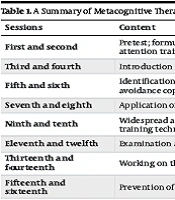
The child’s bipolar II diagnosis was confirmed by a licensed psychiatrist based on DSM-5 criteria through clinical interviews and medical records. The MCT group received eight weekly 120-minute sessions of MCT, as outlined in Table 1. The control group was placed on a waiting list, informed they would receive therapy after the study, and received no intervention or additional support during the study period to avoid confounding effects.
Table 1.
Summary of Metacognitive Therapy Sessions
| Sessions | Content |
|---|---|
| 1 | Introduction to the patient's family and a specialized interview; exploring family problems and attitudes toward the illness; introducing bipolar disorder and its episodes; identifying early signs of the illness and the family's role in addressing initial symptoms. |
| 2 | Introducing treatment methods; emphasizing the patient's and family's cooperation with the referring physician to complete treatment; discussing the role of psychotherapy as an adjunctive treatment in reducing disease recurrence; examining the role of nutrition, sleep, and regular daily social activities in mood regulation. |
| 3 | Discussing the family's role in creating or reducing stress; the role of stress in increasing disease recurrence; identifying sources of stress in the family; identifying signs of tension in the family; examining the characteristics of successful families in dealing with stress; recognizing all of the above in the patient's family. |
| 4 | Practicing problem-solving skills; examining the patient's current situation and the relationship of others with him/her; discussing the level of acceptance of the illness in the patient and others; examining the patient's place in the family hierarchy; the patient's performance in relation to assigned tasks in the family. |
| 5 | Importance of creating value in family members, impact of instability in self-worth on behavior and mood; examining the impact of feelings of worthlessness, bipolar disorder, and instability in self-worth; how to help the patient achieve a desirable sense of self-worth. |
| 6 | Discussing the impact of cognitions on relationships; identifying old schemas of the couple at the beginning of their relationship; cognitive biases and mood disorders; cognitive biases and pathological communication; effective strategies to reduce bias and promote effective thinking. |
| 7 | Emotions and their role in cognition and memory; the role of emotion in bipolar disorder; the emotional role in family mental health; examining how to express emotions in the family in the current situation; teaching emotion expression. |
| 8 | Defining the concept of conflict; understanding the naturalness of conflict between oneself and others; examining different ways people communicate to resolve conflict and choosing the best solution; practicing conflict resolution and teaching how to cope with it; summarizing the discussion and concluding all sessions; reviewing the reactions of participants in this training course; conducting the post-test. |
3.1. Inclusion Criteria
- Both parents attended therapy sessions.
- At least one year had passed since the child’s diagnosis.
- No prior or concurrent participation in similar interventions.
- Informed and voluntary consent.
- Confirmed child diagnosis of bipolar II disorder.
3.2. Exclusion Criteria
- Missing more than two sessions.
- Failure to complete assignments.
- Incomplete pre-test, post-test, or follow-up questionnaires.
- Parental separation or divorce.
All participants completed the Family Assessment Device (FAD) Questionnaire at pre-test, post-test, and a 3-month follow-up to assess family functioning.
3.3. Measure
The McMaster FAD is a 60-item self-report questionnaire developed by Epstein in 1983 to assess perceptions of family functioning based on the McMaster Model of Family Functioning. Respondents rate items on a 4-point Likert scale (ranging from "totally agree" to "totally disagree") to indicate the extent to which their family exhibits specific behaviors or characteristics. The FAD consists of seven subscales: Problem-solving, communication, roles, affective responsiveness, affective involvement, behavioral control, and general functioning. The minimum and maximum scores on this scale are 60 and 240, respectively. Specific ranges for each dimension are as follows: Communication (9 - 36), affective involvement (7 - 28), roles (11 - 44), general functioning (12 - 48), problem-solving (6 - 24), affective responsiveness (6 - 24), and behavioral control (9 - 36). In this model, higher scores indicate poorer family functioning (26).
Studies have confirmed its construct validity in distinguishing healthy from dysfunctional families, with significant correlations between FAD subscales and clinical assessments of family dynamics (27). Yousefi (27) reported a Cronbach's alpha coefficient of 0.92 for the questionnaire. In this study, the Cronbach's alpha coefficient was 0.82, indicating strong internal consistency reliability.
3.4. Data Analysis
Descriptive statistics, including mean and standard deviation, were utilized to summarize the data. Inferential statistics, specifically repeated measures analysis of variance (ANOVA), were employed to analyze the data using SPSS version 26.
4. Results
Thirty parents of children with bipolar II disorder participated in this study, divided into two groups: Metacognitive therapy and control. The MCT group consisted of 8 mothers and 7 fathers, while the control group included 7 mothers and 8 fathers. In the MCT group, the mean age of mothers was 41.43 years (SD = 4.47), and in the control group, it was 41.12 years (SD = 5.61). The mean age of fathers in the MCT group was 46.71 years (SD = 3.90), and in the control group, it was 48.38 years (SD = 6.87).
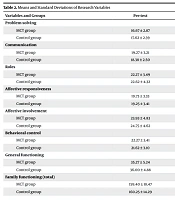
Table 2 presents the means and standard deviations for family functioning variables across pre-test, post-test, and follow-up assessments for both the MCT and control groups. Significant improvements (P < 0.001) were observed in the MCT group across all measured domains — problem-solving, communication, roles, affective responsiveness, affective involvement, behavioral control, general functioning, and total family functioning — with substantial reductions in mean scores from pre-test to post-test, indicating positive changes. These improvements were largely maintained at the three-month follow-up.
Table 2.
Means and Standard Deviations of Research Variables
| Variables and Groups | Pre-test | Post-test | Follow-up | P-Value |
|---|---|---|---|---|
| Problem-solving | ||||
| MCT group | 16.67 ± 2.87 | 14.13 ± 2.47 | 14.47 ± 2.10 | 0.001 |
| Control group | 17.62 ± 2.39 | 15.87 ± 2.12 | 16.75 ± 2.26 | 0.214 |
| Communication | ||||
| MCT group | 19.27 ± 3.21 | 15.40 ± 2.69 | 16.13 ± 2.90 | 0.001 |
| Control group | 18.38 ± 2.50 | 19.18 ± 3.41 | 18.82 ± 2.33 | 0.470 |
| Roles | ||||
| MCT group | 22.27 ± 3.49 | 18.13 ± 2.77 | 18.53 ± 2.72 | 0.001 |
| Control group | 22.62 ± 4.32 | 22.06 ± 3.43 | 22.50 ± 3.60 | 0.935 |
| Affective responsiveness | ||||
| MCT group | 19.73 ± 3.33 | 15.73 ± 2.02 | 15.27 ± 2.12 | 0.001 |
| Control group | 19.25 ± 3.41 | 18.94 ± 3.41 | 18.56 ± 3.20 | 0.572 |
| Affective involvement | ||||
| MCT group | 23.93 ± 4.83 | 20.20 ± 3.51 | 21.33 ± 3.72 | 0.001 |
| Control group | 24.75 ± 4.62 | 25.81 ± 4.00 | 25.30 ± 3.94 | 0.129 |
| Behavioral control | ||||
| MCT group | 22.27 ± 3.41 | 17.80 ± 2.73 | 18.87 ± 2.70 | 0.001 |
| Control group | 21.62 ± 3.10 | 21.56 ± 3.07 | 22.19 ± 3.88 | 0.660 |
| General functioning | ||||
| MCT group | 35.27 ± 5.24 | 30.00 ± 5.06 | 31.07 ± 5.02 | 0.001 |
| Control group | 36.00 ± 4.88 | 34.87 ± 5.07 | 35.56 ± 4.54 | 0.800 |
| Family functioning (total) | ||||
| MCT group | 159.40 ± 18.47 | 131.40 ± 13.74 | 135.67 ± 13.62 | 0.001 |
| Control group | 160.25 ± 14.29 | 158.31 ± 12.97 | 159.63 ± 14.72 | 0.908 |
Abbreviation: MCT, metacognitive therapy.
In contrast, the control group showed no statistically significant changes in any of the measured variables across the assessment periods, suggesting that the observed improvements in the MCT group were attributable to the intervention rather than time or other extraneous factors.
To test the normality assumption, Shapiro-Wilk tests were conducted for each component and the total family functioning score for both groups at the pre-test, post-test, and follow-up stages. Results indicated that the data were normally distributed. Levene's test was used to assess the homogeneity of variances for the components and the total family functioning score between groups, and results indicated that the assumption of homogeneity of variances was met. Table 3 presents the results of a repeated measures ANOVA examining the effects of MCT on family functioning components and total family functioning scores. Results showed a significant main effect of group for problem-solving (F = 25.17, P < 0.001), communication (F = 22.29, P < 0.001), roles (F = 29.60, P < 0.001), affective responsiveness (F = 54.11, P < 0.001), affective involvement (F = 24.73, P < 0.001), behavioral control (F = 11.93, P < 0.001), general functioning (F = 23.28, P < 0.001), and total family functioning score (F = 67.41, P < 0.001). Additionally, there was a significant main effect of time for all family functioning components and the total family functioning score (P < 0.001). These findings indicate that MCT significantly impacted family functioning components and the overall family functioning score (P < 0.001).
Table 3.
Repeated-Measures Analysis of Variance Results
| Variables and Sources | MS | F | P-Value | ηp2 |
|---|---|---|---|---|
| Problem-solving | ||||
| Time | 202.14 | 18.76 | 0.001 | 0.47 |
| Group | 183.28 | 25.17 | 0.001 | 0.38 |
| Communication | ||||
| Time | 326.28 | 20.17 | 0.001 | 0.49 |
| Group | 176.30 | 22.29 | 0.001 | 0.35 |
| Roles | ||||
| Time | 280.04 | 9.83 | 0.001 | 0.32 |
| Group | 337.95 | 29.60 | 0.001 | 0.41 |
| Affective responsiveness | ||||
| Time | 301.90 | 16.83 | 0.001 | 0.45 |
| Group | 445.46 | 54.11 | 0.001 | 0.56 |
| Affective involvement | ||||
| Time | 785.97 | 19.71 | 0.001 | 0.48 |
| Group | 319.08 | 24.73 | 0.001 | 0.37 |
| Behavioral control | ||||
| Time | 224.51 | 17.35 | 0.001 | 0.45 |
| Group | 121.45 | 11.93 | 0.001 | 0.522 |
| General functioning | ||||
| Time | 855.10 | 16.29 | 0.001 | 0.44 |
| Group | 565.78 | 23.28 | 0.001 | 0.36 |
| Family functioning (total) | ||||
| Time | 19098.13 | 33.19 | 0.001 | 0.61 |
| Group | 14155.07 | 67.41 | 0.001 | 0.62 |
5. Discussion
The present study aimed to investigate the effectiveness of MCT on family functioning in parents with a child diagnosed with bipolar II disorder. The findings of this study, demonstrating a significant impact of MCT on family functioning in families with a member diagnosed with bipolar II disorder, align with a growing body of research highlighting the efficacy of MCT in various clinical populations. As previously noted, Baroi and Muhammad (28) reported improvements in depression, anxiety, and stress among students with learning difficulties following MCT, suggesting the therapy's broad applicability across diverse mental health challenges. Similarly, Darehshoori Mohammadi et al. (29) found MCT beneficial in enhancing family functioning among families with children diagnosed with attention-deficit/hyperactivity disorder. These studies, alongside the current findings, underscore MCT's potential to address cognitive and emotional dysregulation that often manifests across a spectrum of disorders, impacting both individual and familial well-being.
Metacognitive training is a psychological intervention that has demonstrated its effectiveness in improving cognitive insight, symptom management, and social cognition in individuals with first-episode psychosis (29). Furthermore, metacognitive training has shown better results in women compared to men with first-episode psychosis. Metacognitive therapy is a relatively recent psychological intervention that has emerged as a promising treatment for bipolar disorder. It addresses the limitations of traditional cognitive-behavioral therapy by focusing on a broader range of cognitive processes, including metacognition (28). Metacognition, the awareness and understanding of one's own thought processes, plays a critical role in shaping our thoughts, emotions, and behaviors. By targeting metacognitive processes, MCT aims to help individuals with bipolar disorder become more mindful of their thoughts and beliefs, and to develop more adaptive ways of thinking (17). This can lead to improved emotional regulation, reduced symptoms of depression and mania, and enhanced overall well-being (24).
One of the core principles of MCT is that dysfunctional metacognitions can contribute to the development and maintenance of bipolar disorder. These metacognitions may involve negative beliefs about oneself, the world, and the future, as well as maladaptive strategies for coping with stress and negative emotions (22). By identifying and challenging these negative metacognitions, MCT can help individuals develop more positive and realistic perspectives (25).
Our findings revealed that family functioning was most significantly impaired in the subscales of affective response, affective involvement, roles, behavioral control, overall functioning, communication, and problem-solving. Notably, significant differences were observed in the subscales of roles, affective involvement, and overall functioning. Affective response pertains to family members' readiness to provide appropriate emotional responses, while affective involvement refers to the quality of affection, attention, and investment family members have in each other. In the context of depression, individuals with bipolar disorder often experience reduced mood, social withdrawal, and isolation, hindering their ability to engage in healthy emotional and verbal interactions with family members (7). Moreover, family members of individuals with bipolar disorder may struggle to express emotions, both positive and negative. The quantity and quality of emotional responses in these families may be incongruent with situational demands. Difficulties in intimacy and closeness among family members could contribute to impairments in affective response (9).
Metacognition is a significant factor in the development and maintenance of psychological disorders (17). Metacognitions influence emotional processing and responses to trauma by affecting metacognitive knowledge and strategies, which in turn alter beliefs and interpretations of specific symptoms (24). Thus, by changing negative beliefs, metacognitions help individuals develop a more positive outlook towards themselves and others, leading to improved social functioning.
Several limitations inherent in this study warrant careful consideration. Firstly, the participant pool was confined to parents of individuals diagnosed with bipolar II disorder who were actively seeking counseling services in Isfahan, Iran, during 2023. This specific geographical and cultural context potentially restricts the generalizability of the findings to broader populations, including those residing in different regions, varied cultural settings, or with disparate access to mental health resources. Secondly, the reliance on the FAD, a self-report instrument, introduces the possibility of social desirability bias, wherein participants might have underreported familial dysfunction to present a more favorable self-image. Furthermore, the limited sample size may have restricted the statistical power to detect smaller effect sizes or subtle variations across the subscales of family functioning. The quasi-experimental design, while pragmatic, lacked the rigor of a fully randomized controlled trial, potentially introducing selection biases or unmeasured confounding variables. Lastly, the study did not assess the severity of the children's bipolar II symptoms or their direct influence on family functioning, which could have moderated the intervention's effectiveness.
5.1. Conclusions
The current study yields compelling evidence supporting the efficacy of MCT in improving family functioning among parents of children with bipolar II disorder. The intervention demonstrably enhanced critical dimensions of family functioning, including problem-solving, communication, and emotional regulation, with these improvements maintained at the three-month follow-up assessment. These findings underscore MCT's potential as a valuable adjunct to pharmacological interventions for bipolar disorder. By addressing maladaptive metacognitive beliefs and fostering cognitive flexibility, MCT furnishes parents with tools to effectively manage stress, navigate familial conflicts, and promote healthier interpersonal dynamics, thereby enhancing both parental well-being and overall family functioning.
Clinicians can integrate MCT into clinical practice by offering structured group or individual sessions tailored for parents, emphasizing techniques such as attention training and Socratic questioning to mitigate rumination and anxiety related to their child's condition. This approach can serve as a complementary modality to existing family therapy or psychoeducational programs, providing parents with practical strategies to bolster communication and emotional responsiveness, potentially reducing caregiver burden and enhancing family resilience.
Future research should pursue several avenues to expand upon these findings. Firstly, longitudinal studies with extended follow-up periods are warranted to assess the long-term sustainability of MCT's effects on family functioning and its potential to mitigate relapse risk in children with bipolar II disorder. Secondly, randomized controlled trials employing larger, more diverse samples across varied cultural and socioeconomic backgrounds could enhance the generalizability of these findings. Thirdly, investigating the specific mechanisms through which MCT exerts its impact—such as alterations in metacognitive beliefs or attentional control—via mediation analyses could elucidate the pathways through which it improves family outcomes.