


1. Background
Students are at risk of more significant psychological distress due to the transition from adolescence to young adulthood, especially high school to university, and exposure to challenging and potentially stressful situations (1). Psychological distress refers to individual's general psychopathology along with perceived depression symptoms, anxiety, and stress (2). In other words, psychological distress is an emotional state of a person in response to a particular stressor or need that may result in temporary or permanent injury (3). A diagnosis of psychological disorder is based on the presence of other symptoms in addition to psychological distress. Therefore, various areas of a person's performance are interfered as a less severe psychological (4). Statistics indicate that the prevalence of anxiety and depression symptoms in human communities ranges between 19 and 30%. In addition, based on the report by WHO in 2020, depression was the most prominent disorder and the second leading cause of death in the human population (1).
Attachment style is one of the factors contributing to the prevalence or exacerbation of stress, anxiety, and depression symptoms (5). Attachment consists of a long-lasting emotional bond between the growing child and a caregiver that affects social development and psychological performance throughout life (6). Studies have confirmed that early attachment relationships sustain in adulthood and play an important role in an individual's emotional dysfunctions and performance and their intimate relationships throughout life (6). Bowlby suggests that infants respond based on their attachment style to separation from and return to their mother, including secure attachment, insecure-avoidant attachment, and anxious/ambivalent attachment (7). Insecure attachment style may lead to a lack of security in interpersonal relationships and problems in identifying reality and controlling internal states and emotions, which provide the grounds for unhealthy behavior patterns, anxiety, depression, and stress (8). Bonacquisti et al. (3) reported that insecure attachment in adults is negatively correlated to mental health and related areas, including feelings of vitality, cheerfulness, motivation, freshness, and hope (3). Spruit et al. (9) found a significant positive correlation among ambivalent attachment style and depression, anxiety, and stress in children and adolescents (9).
Alexithymia can play the mediating role in the relation of insecure attachment style with anxiety, depression, and stress given the significance role of emotions in perceiving self and others' feelings (10) and the relationship of a child with his/her parents in forming and recognizing emotions in the early years of life (11). Multifaceted alexithymia includes difficulties identifying feelings (DIF), emotions, and bodily stimuli related to emotional arousal, describing feelings (DDF) to others, and limited visualization. Externally oriented thinking (EOT) and pragmatic, reality-oriented, or objective thinking are the other symptoms (12). Individuals with alexithymia exaggerate normal physiological arousal, misinterpret the somatic signs of emotional arousal, and express emotional helplessness through somatic complaints (13). Preece et al. (14) demonstrated that individuals with alexithymia have difficulty adopting to stressful situations, leading to high levels of psychological distress, anxiety, and stress symptoms. The researchers sought to reduce the stress load experienced by alexithymia as a defense mechanism to become a stable personality trait (14). Basharpour and Jani (15) indicated that mindfulness and alexithymia could significantly predict depression and anxiety in female victims of spousal violence (15).
Considering the high prevalence of psychological distress in students and the negative impact of depression, anxiety, and stress, it is important to research the underlying causes of psychological distress. Domestic literature indicated that the relationship of insecure attachment with psychological distress has been investigated almost directly without considering the mediating role of effective factors.
2. Objectives
The present study aimed to explain the causal model of psychological distress in university students based on insecure attachment mediated by alexithymia.
3. Methods
Structural equation modeling (SEM) was the primary analysis method in this study. The statistical population comprised all university students between 20- and 40-years old studying at Islamic Azad Universities of Tehran in 2019 - 20. According to Kline (16), at least 20 samples are needed for each parameter. Given the number of parameters in this study (10 parameters), a 200-participant sample was required, and larger sample size was considered to prevent possible loss. Multi-stage cluster sampling was used to select three universities among all Islamic Azad universities in Tehran. Two faculties from each university, two classes from each faculty, and 30 students from each class were selected. The primary sample consisted of 360 participants who completed the questionnaires, among which 55 questionnaires were incomplete and excluded from the study (final sample = 305 students). Given the COVID-19 outbreak, in-person completion of the questionnaires was impossible. Therefore, an electronic questionnaire was sent to students with general explanations about research objectives and how to complete the questionnaires. The inclusion criteria were being a student at Islamic Azad Universities in Tehran, ranging in age from 20 to 40, being aware of research objectives, and signing informed consent to participate in the study. The exclusion criteria included failure to answer over 30% of questions and the use of a specific answering pattern, such as answering even questions or choosing the same option in successive questions, which were identified by reviewing all questionnaires.
3.1. Instruments
3.1.1. Depression Anxiety Stress Scale
The Depression Anxiety Stress Scale, developed by Lovibond, was designed to measure the emotional states of depression, anxiety, and stress with 42 items (14 items in each subscale). The depression subscale assesses dysphoria, low self-esteem, hopelessness, devaluation of life, self-deprecation, lack of interest/involvement, anhedonia, and inertia. Autonomic arousal, situational anxiety, and fear are assessed in the anxiety subscale. Under the stress subscale, difficulty relaxing, nervous arousal, being easily upset/agitated, irritable/over-reactive, and restlessness are examined. Participants were asked to rate the severity (frequency) of each symptom in the last week based on a 4-point scale from 0 to 3. The depression, anxiety, and stress scores range from 0 to 42 (17). Sahebi et al. (18) reported Cronbach’s alpha coefficient as much as 0.81 for the scale, which is calculated as much as 0.79 in the present study.
3.1.2. Experiences in Close Relationships-Revised
The Experiences in Close Relationships-Revised (ECR-R) questionnaire was developed by Brennan et al. to measure the attachment styles of adults. This 36-item questionnaire consists of two 18-item dimensions for determining anxious attachment (i.e., the degree to which individuals are secure or insecure about the accessibility and accountability of their partner(s)) and avoidant attachment (the degree to which a person feels discomfort approaching others). The ECR-R is rated on a 7-point Likert scale from 1 to 7. A score for anxious attachment or avoidant attachment can range between 18 and 126 (19). Shokrkon et al. (20) reported Cronbach’s alpha coefficient as much as 0.87 for the questionnaire, while the Cronbach's alpha coefficient of the questionnaire in the present study was 0.84.
3.1.3. Toronto Alexithymia Scale
The Toronto Alexithymia Scale (TAS-20), developed by Bagby et al. cited in Parker et al., is a 20-item inventory with three subscales, including difficulty in identifying (7 items) and communicating feelings (5 items), as well as externally-oriented thinking (8 items). The scale runs from strongly disagree =1 to strongly agree =5, on a 5-point Likert scale. The total score is obtained from the sum of three subscales for alexithymia, ranging from 20 to 100 (21). Besharat (22) reported Cronbach’s alpha coefficient as much as 0.85 for the scale, the coefficient was 0.84 in the present study.
3.2. Statistical Analyses
The Data were analyzed using descriptive statistics, such as mean, standard deviation, and correlation matrix in SPSS 24 and SEM in Amos 26.
4. Results
The mean and standard deviation of participants' age were 32.19 ± 10.82. The sample included 264 female students (86.6%) and 41 male students (13.4%), of whom 152 were married (49.8%) and 153 were single (50.2%). Table 1 presents the mean and standard deviation (SD) of the research variables.
Table 1.Pearson’s Correlation Coefficients for the Research Variables
| Variables | Mean ± SD | 1 | 2 | 3 | 4 | 5 | 6 | 7 | 8 | 9 | 10 |
|---|---|---|---|---|---|---|---|---|---|---|---|
| 1- Anxiety | 8.77 ± 6.69 | 1 | |||||||||
| 2- Depression | 12.1 ± 8.97 | 0.69 a | 1 | ||||||||
| 3- Stress | 18.49 ± 8.01 | 0.70 a | 0.77 a | 1 | |||||||
| 4- Avoidant relationships | 52.31 ± 16.46 | 0.29 a | 0.33 a | 0.25 a | 1 | ||||||
| 5- Anxious relationships | 62.04 ± 18.21 | 0.54 a | 0.62 a | 0.60 a | 0.29 a | 1 | |||||
| 6- Insecure attachment | 17.27 ± 5.4 | 0.52 a | 0.61 a | 0.54 a | 0.78 a | 0.82 a | 1 | ||||
| 7- Objective thinking | 18.78 ± 5.03 | 0.20 a | 0.15 b | 0.12 b | 0.26 a | 0.16 b | 0.26 a | 1 | |||
| 8- Difficulty in describing emotions | 11.46 ± 3.39 | 0.39 a | 0.42 a | 0.43 a | 0.42 a | 0.31 a | 0.46 | 0.28 a | 1 | ||
| 9- Difficulty in identifying emotions | 12.29 ± 5.03 | 0.52 a | 0.49 a | 0.53 a | 0.29 a | 0.48 a | 0.48 a | 0.30 a | 0.64 a | 1 | |
| 10- Alexithymia | 45.72 ± 9.6 | 0.49 a | 0.47 a | 0.49 a | 0.41 a | 0.43 a | 0.52 a | 0.62 a | 0.82 a | 0.52 a | 1 |
aP < 0.01
bP < 0.05
Multivariate normality is one of the essential assumptions, which should be considered in SEM. Skewness and kurtosis are the common criteria used to assess the normality assumption. An absolute value of skewness and kurtosis coefficient less than 3 and 10, respectively, indicate the normality of variables. According to results, the assumption of normality of the data was not violated because the absolute values of skewness and kurtosis coefficients for all variables were less than 3 and 10, respectively. The Durbin-Watson (DW) statistic was used to examine the independence of errors, and the results approved the independence (Values between 1.5 and 2.5 confirmed the independence of errors).
Table 1 indicated a significant positive correlation between anxiety and insecure attachment (r = 0.52), depression and insecure attachment (r = 0.61), and stress and insecure attachment (r = 0.54). The correlation coefficient was significant for all variables.
The path analysis was used to investigate the mediating role of alexithymia in the correlation between psychological distress and insecure attachment. The researchers considered the chi-square to degrees of freedom ratio < 3, goodness of fit index (GFI), comparative fit index (CFI), and adjusted goodness of fit index (AGFI) ≥ 0.90, the root mean square error of approximation (RMSEA) < 0.08, and non-normed fit index (NFI) > 0.9 as the goodness of fit for model evaluation. Based on the results in Table 2, the model had acceptable goodness of fit (χ2/df = 2.67, CFI = 0.96, GFI = 0.90, RMSEA = 0.03). The final model is presented in Figure 1Given the appropriate goodness of fit.
Table 2.Fit Indicators of the Proposed Model
| Fit Indicators | χ2 | df | (χ2/df) | GFI | AGFI | CFI | NFI | RMSEA |
|---|---|---|---|---|---|---|---|---|
| Proposed model | 88.37 | 33 | 2.67 | 0.90 | 0.97 | 0.96 | 0.96 | 0.03 |
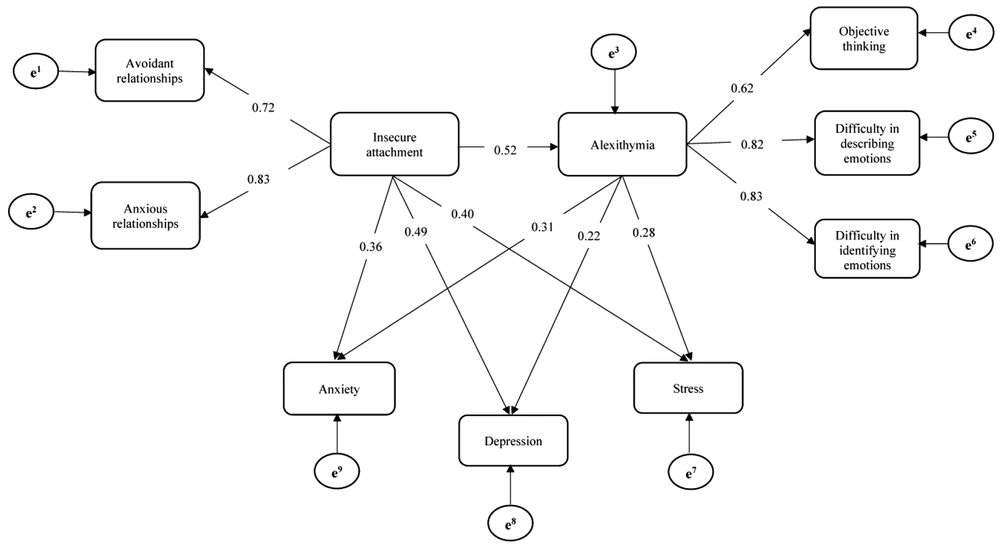
Figure 1.
Proposed model for examining the mediating role of alexithymia between psychological distress and insecure attachment among university students
The direct and indirect path coefficients of the model are presented in Tables 3 and 4 considering the proper goodness of fit. Table 3 shows that insecure attachment directly affected anxiety (β = 0.36, P < 0.001), depression (β = 0.49, P < 0.001), and stress (β = 0.40, P < 0.001). A significant positive effect of alexithymia was also observed on anxiety (β = 0.30, P < 0.001), depression (β = 0.22, P < 0.001), and stress (β = 0.28, P < 0.001).
Table 3.Direct Effects of Research Variables in the Proposed Model
| Direct Path | b | β | SE | P |
|---|---|---|---|---|
| Insecure attachment to anxiety | 0.08 | 0.36 | 0.013 | 0.001 |
| Insecure attachment to depression | 0.16 | 0.49 | 0.017 | 0.001 |
| Insecure attachment to stress | 0.11 | 0.40 | 0.016 | 0.001 |
| Alexithymia to anxiety | 0.21 | 0.30 | 0.038 | 0.001 |
| Alexithymia to depression | 0.21 | 0.22 | 0.049 | 0.001 |
| Alexithymia to stress | 0.23 | 0.28 | 0.046 | 0.001 |
Table 4.Analysis of Indirect and Intermediary Paths in the Proposed Model
| Indirect Path Mediated by Alexithymia | b | β | SE | P |
|---|---|---|---|---|
| Insecure attachment to anxiety | 0.03 | 0.15 | 0.045 | 0.001 |
| Insecure attachment to depression | 0.03 | 0.11 | 0.036 | 0.001 |
| Insecure attachment to stress | 0.04 | 0.15 | 0.059 | 0.001 |
As shown in Table 4, insecure attachment significantly, indirectly, and positively affected anxiety, depression, and stress with the mediating role of alexithymia.
5. Discussion
The present study aimed to investigate the relationship between psychological distress and insecure attachment in university students by mediating alexithymia. The results revealed that the path coefficient of insecure attachment to anxiety, depression, and stress was significant. This finding is consistent with that of Handelzalts et al. (7) and Dagnino et al. (23).
Attachment style is significantly correlated to depression, and this type of attachment style is one of the predictors of students' depression (9, 24). People with avoidant attachment styles may experience mood swings due to unstable access to the primary caregiver. The instability that prevails in this attachment style evokes a kind of unpredictability and uncontrollability, which contributes to pessimism about the future as one of the three angles of depression. According to cognitive theory, disorders like depression are derived from spontaneous thoughts, derived from mother-child schemas. Consequently, these breakdowns lead to the creation of schemas that will cause psychological disorders such as depression because of the destabilization of these relationships (25).
In addition, insecure primary relationship in individuals is provokes a distancing pattern from problems, feelings, and people to avoid the recurrence of negative feelings because of predicting such feelings in relationships based on their previous experiences. Avoidance resulting from insecure and avoidant attachment can prevent individuals from reacting reasonably to some life stresses due to the lack of trust. In other words, they attempt to solve their problems by avoiding others instead of seeking their help. As a result, the development of appropriate social and communication skills and problem-solving strategies is hindered, which indicates their vulnerability to anxiety (9).
Attachment (emotional connection) to a particular person is a prerequisite for healthy human development. Experiencing secure attachment in childhood will be the foundation for healthy mental functioning and performance in adulthood. On the other hand, insecure attachment causes distrust, dissatisfaction, problems empathizing with others, and emotional expressiveness. Therefore, attachment style explains various dynamics of adulthood, one of which is the amount of stress experienced in individuals' activities and life. In other words, attachment in stressful situations, such as sickness, tiredness, or scaredness, provokes worries, anxiety, and psychological stress in its most potent form. Individuals with an insecure attachment style feel these troubles more deeply than those with a secure attachment style because they communicate their problem with others and gain their support. Thus, they experience more stress than those with a secure attachment style (9).
The results indicated an indirect path coefficient between insecure attachment and anxiety, stress, and depression. This finding is consistent with that of Boisjoli et al. (26) and Taylor (27).
Individuals follow various coping strategies when facing stressful events or negative moods according to the activity of their attachment system. The insecure attachment of individuals might make them less able to deal with stressful situations, because they have a negative expectation of their ability to control their environment. The insecure attachment is partly a result of expectations about the reliability and trustworthiness of others. Therefore, individuals with insecure attachment styles are not able to use adequate personal and interpersonal resources to regulate their emotions in stressful and threatening situations (24).
Those with a negative model toward others (active avoidant attachment) tend to have rumination, which eases the symptoms of depression. The prevalence and symptoms of depression increase by avoiding attachment accompanying alexithymia, given its impact on individuals with alexithymia with difficulty distinguishing, describing, and regulating emotions and failing to recognize their negative emotions, underlying symptoms such as depression (23).
In addition, individuals with an avoidant attachment style in childhood experience rejection through face attachment, so they deny attachment to protect themselves from further rejection. On the other hand, avoidant individuals are pessimistic and excessively self-reliant. Therefore, they become deprived of emotional-social relationships and support when facing some stress in life and fail to use positive methods and constructive strategies. Additionally, a lack of trust in others and disordered exploratory behavior significantly reduces active and normal proximity seeking in avoidant individuals. The lack of social and communication skills, as well as the ineffective problem-solving strategies, explains their greater vulnerability to anxiety symptoms. Due to the diminished ability to manage and regulate emotions following alexithymia, individuals are less likely to be able to accept emotions and lose their ability to use appropriate coping, prohibition, and repression strategies, all of which contribute to anxiety and stress (5).
One of the limitations of our study was that the statistical population was limited to Islamic Azad Universities in Tehran. Therefore, caution should be exercised when interpreting and generalizing the results. The second limitation was the cross-sectional method of the study, which investigated participants in a specific period, which limited general conclusions.
5.1. Conclusions
According to the results of this study, insecure attachment could predict depression, anxiety, and stress in students with the mediating role of alexithymia. Therefore, students with insecure attachments and alexithymia were more likely to suffer from depression, stress, and anxiety. Attachment styles are rooted in primary family relations, which significantly affect future relations of individuals and their disorders such as depression, stress, and anxiety, counselors. Therefore, therapists are suggested to provide preventive education programs to make parents aware of this important variable.

