


1. Background
2. Objectives
3. Methods
3.1. Study Design
3.2. Data Analysis
4. Results
| CTS Per 100,000 Population | MRI Per 100,000 Population | |
|---|---|---|
| Before the pandemic | 376.1 ± 74.3 | 6.3 ± 0.7 |
| After the pandemic | 628.4 ± 240.3 | 3.1 ± 2.2 |
| % change | +67.1 | -50.8 |
a Values are expressed as mean ± SD.
| Variables | Coefficient | SE | P-Value | Confidence Interval (CI 95%) | |
|---|---|---|---|---|---|
| Lower | Upper | ||||
| Intercept, | 312.90 | 18.37 | < 0.001 | 276.07 | 349.73 |
| Pre-intervention slope, | 3.49 | 0.76 | < 0.001 | 1.95 | 5.02 |
| Change in slope, | -44.90 | 67.99 | 0.512 | -181.23 | 91.42 |
| Change in trend, | 16.90 | 7.61 | 0.031 | 1.63 | 32.16 |
| Post-intervention linear trend a | |||||
| Linear trend, | 20.39 | 7.56 | 0.009 | 5.21 | 35.56 |
Abbreviation: SE, standard errors.
a This obtained from the following time trend equation: Yt = β0 + β1 ∗ timet + ϵt; where Yt is the value of utilization of CTS at time t after the intervention and timet is the time trend variable.
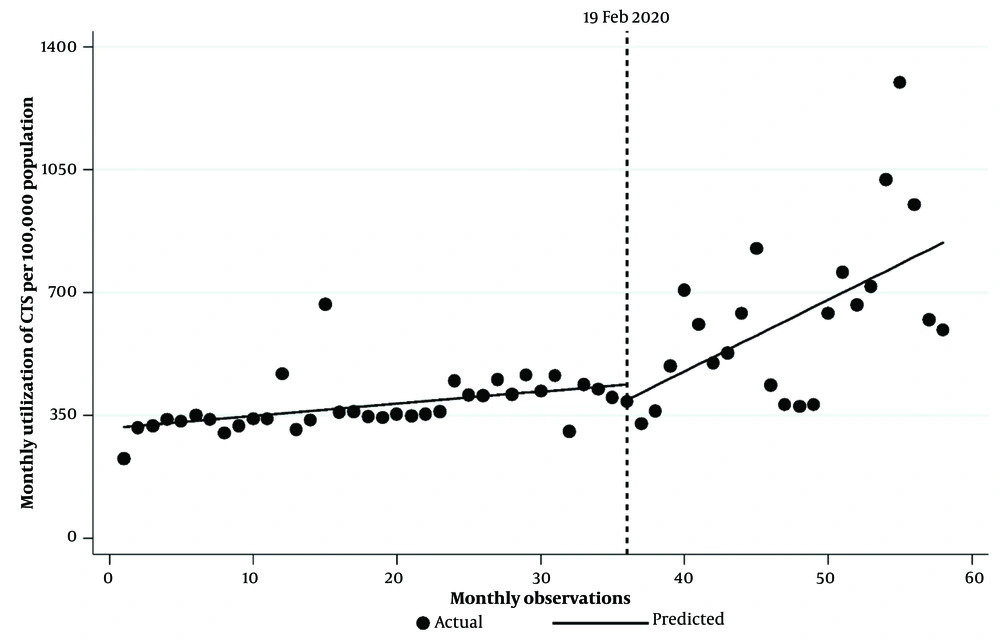
Interrupted time series analysis for CTS utilization per 100,000 population (with Newey–West standard errors and two lags). Note: The COVID-19 pandemic was started in 19 Feb 2020.
| Variables | Coefficient | SE | P-Value | Confidence Interval (CI 95%) | |
|---|---|---|---|---|---|
| Lower | Upper | ||||
| Intercept, | 6.52 | 0.15 | < 0.001 | 6.22 | 6.82 |
| Pre-intervention slope, | -0.01 | 0.01 | 0.308 | -0.03 | 0.01 |
| Change in slope, | -5.22 | 1.35 | < 0.001 | -7.94 | -2.49 |
| Change in trend, | 0.22 | 0.10 | 0.033 | 0.02 | 0.41 |
| Post-Intervention Linear Trend a | |||||
| Linear trend, | 0.21 | 0.09 | 0.031 | 0.09 | 0.39 |
Abbreviation: SE, standard errors.
a This obtained from the following time trend equation: Yt = β0 + β1 ∗ timet + ϵt; where Yt is the value of utilization of MRI at time t after the intervention and timet is the time trend variable.
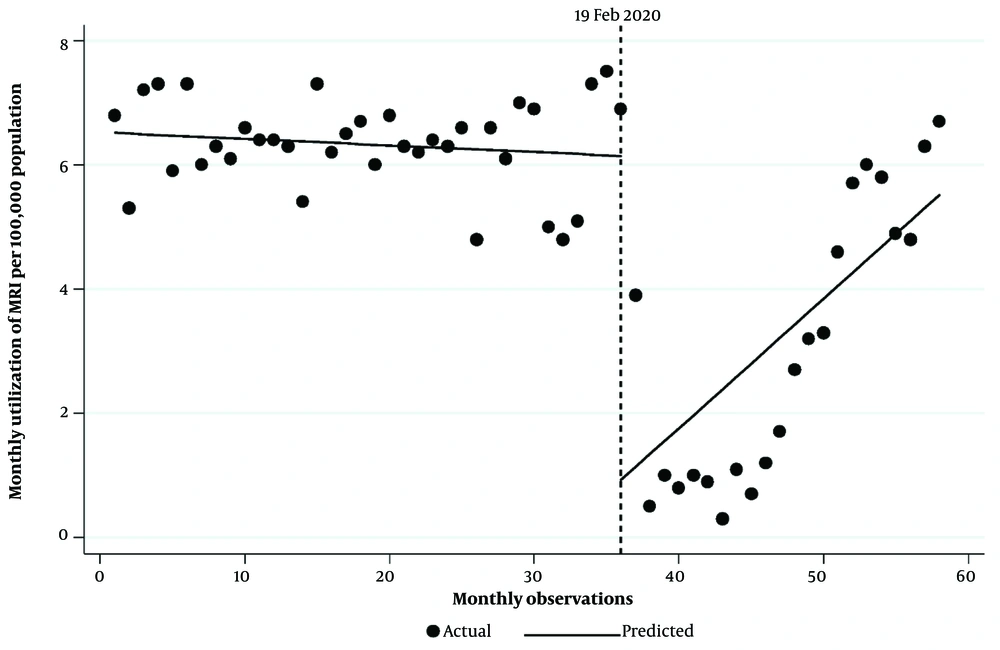
Interrupted time series analysis for MRI utilization per 100,000 population (with Newey–West standard errors and two lags). Note: The COVID-19 pandemic was started in 19 Feb 2020.


