


1. Background
Today, the global prevalence of violent behaviors has attracted the attention of communities, governments and researchers. Although bullying can occur in different environments, bullying at school is the most important, and generally refers to recurrent aggressiveness against those with less power in dealing with a bully or bullies (1). The Swedish National Psychological Association defines bullying as a form of invasive or violent behavior in terms of repetitive negative actions that seriously attack people or attempt to injure or harass them (2).
Callous-unemotional traits normally appear in children and adolescents as a reaction to aggression and bullying, and this relationship has been investigated and confirmed by many researchers (3-8). Callous-unemotional traits increase the risk of bullying actions, and to a lesser degree, empathy, and self-reproach cause diminished and superficial emotions.
The lack of equanimity and poor empathy are the factors contributing to high degrees of callous-unemotional traits (9, 10). The young with callous-unemotional traits experience significant emotional disorders, including impaired processing of emotional stimuli (11) and lack of empathy (12, 13).
Jones et al. (13) found individuals with callous-unemotional traits to be less able to empathize with victims of violence compared to those lacking these traits. People committing bullying have too little empathy with their victims and are usually self-oriented. According to Williford et al. (14), low levels of empathy and high levels of anti-social behaviors are the key features distinguishing bullying people from others. Empathy refers to an attribute that helps determine whether or not children avoid bullying during their transition to puberty or become involved in it. Failing to empathize with others suffering unpleasant situations is a strong factor in enjoying bullying and harassing others. People presenting inappropriate social behaviors, including demeaning and bullying behaviors, are unable to properly recite the mental states of their interlocutor, and their understanding can be biased and disabled (15). According to Swearer et al. (16), a prevalence of 13% - 75% and its long-term effects on the mental and physical health of the victims have caused researchers to focus on the subject of bullying. The negative effects of bullying on health include low self-esteem, depression, anxiety, suicidal ideation and behavior and social isolation. Bullying acts as a predictor of criminal behaviors, crime, aggression and other anti-social behaviors in adolescents and adults (2).
2. Objectives
According to Figure 1, the present research was performed to determine whether empathy plays the role of a mediator between callous-unemotional traits and bullying.
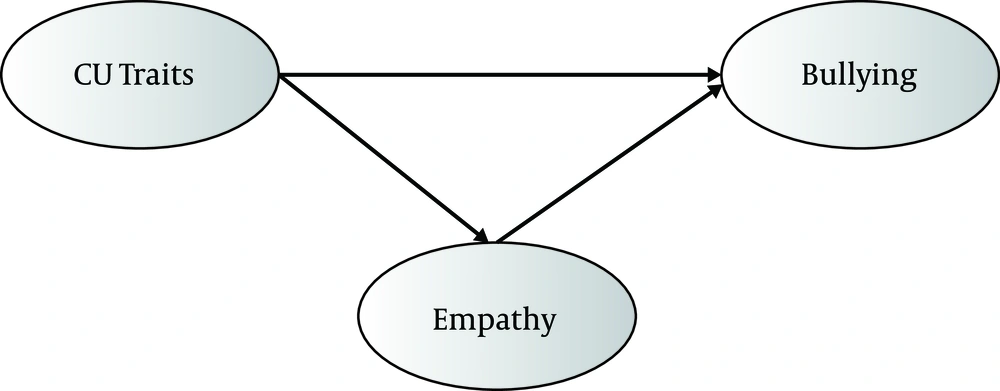
Figure 1.
The proposed model for the direct and indirect effects of callous-unemotional traits on bullying
3. Methods
The present applied descriptive research used correlations and structural equation modeling to examine non-experimental causal relationships.
3.1. Community, Samples and Sampling Method
The statistical population comprised all the high school students in the 14th district of Tehran. Stratified random sampling was used to select 250 students from 10 randomly-selected high schools out of 35. Data collection tools consisted of the Illinois bully scale (IBS), the inventory of callous-unemotional traits (ICUT) and the empathy scale.
3.2. Research Instruments
3.2.1. IBS
This 18-item scale consists of three subscales, namely bullying, fighting, and victimization. The items are scored on a five-point Likert scale ranging from 1: never to 5: at least 7 times. The higher the score obtained in a subscale, the higher the incidence of the associated behavior in the subject. Espelage and Holt (17) confirmed the reliability and validity of this scale. Holt et al. (18) also calculated a Cronbach’s alpha of 0.86 for the whole scale. The present study calculated a reliability coefficient of 0.78 using the Spearman-Brown prediction formula, and a Cronbach’s alpha of 0.84 for the whole scale, 0.77 for the bullying subscale, 0.80 for the fighting and 0.69 for the victimization.
3.2.2. Empathy Scale
The 28-item interpersonal reactivity index (IRI) was used as a self-report instrument to measure empathy. IRI contains four sub-scales, namely perspective taking, fantasy, empathic concern and personal distress, each evaluating one dimension of the overall empathy (19). Perspective taking measures individuals’ efforts to adopt the perspective of others and watch affairs from their perspective. The fantasy subscale measures the tendency to imaginatively transpose oneself into characters in novels, movies, plays and other dummy situations. Empathic concern measures individuals’ feelings of warmth, compassion and respect for others. Personal distress measures the feelings of anxiety and discomfort caused by observing other people’s negative experiences. Each subscale in this test has 7 items. The subjects can specify the extent to which each sentence matches their status on five-point spectrum of 0: does not apply to me to 4: perfectly applies to me. Laurent and Hodges (20) calculated a Cronbach’s alpha of 0.69 - 0.80 for these subscales. A Cronbach’s alpha of 0.69 was obtained for the whole questionnaire, and a reliability coefficient of 0.72 using the Spearman-Brown prediction formula. The Cronbach’s alpha obtained for perspective taking was 0.60, fantasy 0.58, empathic concern 0.43 and personal distress 0.54.
3.2.3. ICUT
The 20-item ICUT is a copyright-protected self-assessment questionnaire designed by Frick et al. (21) in 2003 to provide a comprehensive assessment of callous and unemotional traits. The ICUT comprises three subscales, namely callousness (8 items), uncaring (7 items) and unemotional (5 items). This questionnaire has been validated in 13 - 18 year olds. Feelings about oneself or others are expressed on a four-point Likert scale ranging from zero to three. Paliziyan et al. (22) confirmed the validity and reliability of this tool. Kimonis et al. (23) measured a reliability coefficient of 0.74 for this questionnaire. In terms of concurrent reliability, Paliziyan et al. (22) obtained significant correlations (P < 0.01) between this questionnaire and the questionnaire of “tendency towards vandalism behavior”. The present study also confirmed the reliability of this questionnaire by calculating a Cronbach’s alpha of 0.740.
4. Results
The results of the descriptive analysis of the data were presented as descriptive statistics, including mean, standard deviation and the Pearson correlation coefficient for the study variables. The mean score of bullying was found to be 29.19 ± 9.60, that of empathy 76.05 ± 5.68 and that of callous-unemotional traits 20.99 ± 5.68. Table 1 presents the correlation coefficients.
Table 1.Correlation Coefficients of the Study Variables
| Variable | 1 | 2 | 3 | 4 | 5 | 6 | 7 | 8 | 9 | 10 | 11 | 12 | 13 |
|---|---|---|---|---|---|---|---|---|---|---|---|---|---|
| 1. Bullying | 1 | ||||||||||||
| 2. Bullying | 0.91** | ||||||||||||
| 3. Fight | 0.83** | 0.64** | |||||||||||
| 4. Victim | 0.35** | 0.12* | 0.06 | ||||||||||
| 5. Empathy | 0.03 | 0.04 | -0.05 | 0.23** | |||||||||
| 6. Perspective taking | -0.24** | -0.25** | -0.18** | -0.04 | 0.47** | ||||||||
| 7. Fantasy | 0.14* | 0.11 | 0.01 | 0.25** | 0.66** | 0.03 | |||||||
| 8. Emotional concern | 0.08 | 0.04 | 0.001 | 0.20** | 0.68** | 0.13* | 0.21** | ||||||
| 9. Personal distress | 0.10 | 0.09 | 0.01 | 0.15* | 0.63** | 0.01 | 0.25** | 0.39** | |||||
| 10. ICU | 0.24** | 0.25** | 0.21** | 0.02 | -0.32** | -0.42** | -0.02 | -0.31** | 0.08 | ||||
| 11. Callous | 0.22** | 0.22** | 0.17** | 0.06 | -0.25** | -0.39** | -0.01 | -0.21** | -0.01 | 0.78** | |||
| 12. Uncaring | 0.25** | 0.24** | 0.21** | 0.05 | -0.30** | -0.38** | -0.01 | -0.26** | -0.11 | 0.80** | 0.45** | ||
| 13. Unemotional | 0.03 | 0.03 | 0.04 | -0.02 | -0.01 | -0.009 | 0.04 | -0.07 | 0.006 | 0.43** | 0.05 | 0.14* | 1 |
According to Figure 1, the fit indices of the structural equation analysis suggest the general fit of the model. The indicators used to examine the fit of the intermediate model included the chi-square, degree of freedom, significance level, normed chi-square measure, root mean square error of approximation (RMSEA), goodness of fit index (GFI), adjusted goodness of fit index (AGFI), normed fit index (NFI), comparative fit index and incremental fit index (IFI).
According to Table 2, a degree of freedom of 3 obtained from the chi-square test suggests the fit of the model. The other fit indices, which including the codes, equaled 0.08, GFI equaled 0.95 and NFI 0.80, suggesting the appropriateness of the desired intermediate model. Figure 2 shows the diagram of path coefficients.
Table 2.Indicators of the Fit of the Model
| Hypothesized, Modified and Final SEM Model Fit Based on Fit Indicators | ||||||||||
|---|---|---|---|---|---|---|---|---|---|---|
| Fit indicators | χ2 | df | χ2/df | GFI | AGFI | IFI | TLI | CFI | NFI | RMSEA |
| Hypothesized model | 109.196 | 31 | 3522 | 0.95 | 0.90 | 0.85 | 0.80 | 0.85 | 0.80 | 0.08 |
Abbreviations: AGFI, adjusted goodness of fit index; GFI, goodness of fit index; IFI, incremental fit index; NFI, normed fit index; RMSEA, root mean square error of approximation.
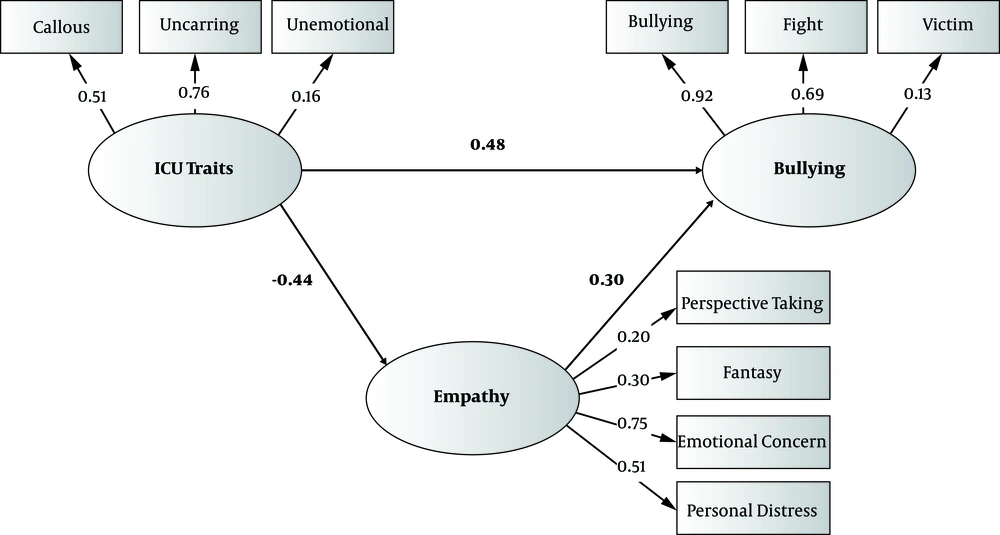
Figure 2.
The results of assessing the model proposed for the relationship between callous-unemotional traits and bullying with empathy as the mediator
Table 3 presents the patch coefficients and their significance levels. The bootstrap method was used to investigate the potential mediating role of empathy in the relationship between callous-unemotional traits and bullying. With the upper and lower limits of this test being either positive or negative, and zero outside the interval between the two limits, the indirect causal path will be significant. Table 4 presents the results of this test.
Table 3.Results Associated with Path Coefficients and Their Significance in the Intermediate Model
| β | P Value | β | P Value | β | P Value | β | P Value | ||||
|---|---|---|---|---|---|---|---|---|---|---|---|
| ICU to bullying | 0.005 | 0.48 | ICU to callous | 0.51 | 0.001 | Empathy to perspective taking | 0.20 | 0.002 | Bullying to bullying | 0.92 | 0.001 |
| ICU to empathy | 0.026 | -0.44 | ICU to uncaring | 0.76 | 0.04 | Empathy to fantasy | 0.30 | 0.042 | Bullying to fight | 0.69 | 0.001 |
| Empathy to bullying | 0.001 | 0.30 | ICU to unemotional | 0.16 | 0.04 | Empathy to emotional concern | 0.75 | 0.042 | Bullying to victim | 0.13 | 0.05 |
| Variable to variable | Callous-unemotional traits | Empathy to personal distress | 0.51 | 0.002 | Bullying | ||||||
Table 4.Bootstrap Test Results for the Indirect Effects
| Independent | Mediator | Dependent | About Bootstrap | Standard Error | Effect Size | P Value | |
|---|---|---|---|---|---|---|---|
| Lower Bounds | Upper Bounds | ||||||
| ICU | Empathy | Bullying | -0.38 | -0.04 | 0.49 | -0.13 | 0.01 |
According to Table 4, the mediating effect of empathy on the relationship between callous-unemotional traits and bullying is statistically significant given that the upper and lower limits of bootstrap are both negative, while zero does not lie between these two limits.
5. Discussion
The present study was conducted to investigate the role of empathy in mediating between callous-unemotional traits and bullying based on four hypotheses, including three direct effects and one indirect path. The first hypothesis, which was approved, suggested that the components of callous-unemotional traits directly affect bullying, which is consistent with studies by Wang et al. (24), Thornberg and Jungert (2), Ansel et al. (3) and Ciucci (6).
This hypothesis can be explained by the fact that teenagers with callous-unemotional traits tend to resolve disputes in social situations with aggression to gain rewards or master the environment; nevertheless, these children fail to pay close attention to the negative consequences of aggressive actions, including punishment and harm to others (25).
The second hypothesis, which was approved, suggested that callous-unemotional traits directly affect empathy, which is consistent with the findings of Lethbridge et al. (26), Edens et al. (27), Ciucci and Baroncelli (6). This hypothesis can be explained by the fact that children with callous-unemotional traits are less likely to be distressed and saddened by the negative effects of their behaviors on others. Moral reasoning and empathy with others are indeed poor in these individuals (28). In addition, they are less likely to detect the appearance of grief in others’ face and voice. A lack of concern over repentance and regret as well as others’ emotions and performance in their major activities are frequently observed in people with callous-unemotional traits, and they fail to express emotions in a formal and superficial manner (10, 29).
The third hypothesis, which was approved, suggested that empathy significantly affects the variable of bullying, which is consistent with studies by Topcu and Erdur-Baker (30), Stavrinides et al. (31) and Del Rey et al. (32). The majority of individuals perpetrating bullying do not feel ashamed and do not experience the emotional effects of their behavior on the victims. This suggests the defective ability of bullying people to understand the emotional experience of others, as they fail to realize that their behaviors cause problems and inconvenience in the victims. Although this hypothesis was expected to yield a significantly negative effect, the present study found a significanty positive effect, which is recommended to be further examined given that adolescents as the research samples were resistant to expressing their emotional excitement and their actual emotions.
The fourth hypothesis suggested that bullying is coordinated with the mediator of empathy and with the data obtained based on callous-unemotional traits. Calculating the fit indices of the measurement model attributed a desired level of fit to this model, and empathy can therefore play the role of a mediator between these two variables. This hypothesis can be explained by the fact that callous children do not empathize with their victims, and do not feel regretful for their bullying behaviors (33). Given the obtained results and that callous-unemotional traits and empathy are respectively associated with the effective factors in bullying directly and indirectly, the organizations involved are recommended to take the necessary measures and instruments, including holding workshops and providing training packages, to enhance empathy and reduce the incidence of bullying behaviors.
The present study limitations comprised the limited statistical population in terms of gender. Future studies are therefore recommended to be conducted on both genders to improve the research validity.


