
1. Background
Callous-unemotional traits (CU traits) is defined with a collection of traits such as lack of guilt, absence of empathy, and callous and superficial sensation (1, 2). A severe pattern of callous-unemotional traits is associated with low levels of empathy, and empathy is feeling the same emotion that someone else is involved in, and finally helps the person and has sympathy with that person (3). A recent study by Lui and et al (4) has proven that a severe pattern of callous-unemotional traits is associated with low levels of empathy (5). Adolescents with CU traits have less physiological reactions and responses to others’ emotions, which leads to failure in sharing feelings with others (6). This adolescent indicated the lack of emotional processing, including recognizing the human face (7) and deciding about shapes and learning that rely on positive and negative feedback (8). These behavioral characteristics are connected with disorders in Amygdala function in emotional learning and the Gutted lateral cortex’s function that represents the emotional outcomes (9).
The callous-unemotional trait is an element for suggesting bullying in children. Bullying is an abusive behavior committed by a person or group of persons and is included in the imbalance of powers. The imbalance of power can be physiologic, in this kind of imbalance of power bully is more humble from the victim (10, 11). As Viding (12) in Britain did, there is a positive association between the features of CU and bullying in pre-school children. Other studies (13, 14) are also in line with the Viding study. The mood style of people with CU traits is associated with the lack of guilt and a low level of anxiety, which in turn leads to behaviors such as disregard, disobedience, and violence. Two distinct types of antisocial traits can be classified according to the levels of anxiety. Early anti-socialism with normal and low anxiety levels, that indicating an inherent impair in the individual’s ability to experience the feelings, secondary anti-socialism (which is an attribute of CU traits) with sever levels of anxiety that reflects the person’s reaction to traumatic events and excessive anxiety environments (15). Investigating these traits can provide useful information to prevent high-risk behaviors in at-risk children, early intervention, and choosing appropriate treatment. Children with CU traits have more serious behavior problems, more confrontations with the police, and usually have a history (background) of antisocial behavior in their families(16).
2. Objectives
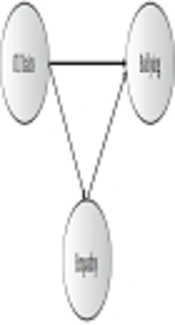
The current study aimed to answer the question of whether empathy, bullying, and social anxiety could predict the CU traits in boys.
3. Methods
3.1. Participants
The statistical population of this research was the high school male students in 14 districts of Tehran in the third and fourth high school year for the 2017 - 18 academic year. Participants were selected using the multi-stage cluster sampling method. Initially, out of 32 high schools, 12 were selected. Then, from each high school, two classes (a third grade and a fourth-grade class), and finally, in each class, about half of the students were randomly assigned to answer the inventory. The inventory of callous-unemotional traits (ICUT) Illinois bullying scale (IBS), empathy questionnaire, and Social Phobic Inventory (SPI) were used to collect data. In total, 240 questionnaires were fully completed and analyzed. The mean age of participants was 14.6 ± 0.75, with an age range of 15 to 18 years.
3.2. Research Instrument
3.2.1. Inventory of Callous-Unemotional Traits
The Inventory of Callous-Unemotional Traits (ICUT) is a copyright-protected self-assessment 20-item questionnaire designed to provide a comprehensive assessment of callous and unemotional traits. This questionnaire was designed by Frick in 2003. The ICU has three subscales, including callousness (8 items), uncaring (7 items), and unemotional (5 items). The questionnaire has been validated on 13 to 18 years old youth (17). Subjects should rank their feelings about themselves or others on a 4-point Likert scale (zero to three). The validity and reliability of this method are approved by Paliziyan et al. (18). In the study of Kimonis et al. (19) reliability of this questionnaire is reported as 0.74. To examine the simultaneous reliability, Paliziyan et al. (20) used simultaneous implementation of this questionnaire with the “Questionnaire of Vandalism,” which resulted in a meaningful correlation: (P < 0.01). In the current study, a Cronbach’s alpha of 0.70 is reported.
3.2.2. Empathy Questionnaire
To measure empathy, the Interpersonal reactivity index (IRI) was used, which is a measure of dispositional empathy. IRI uses the notion of empathy as its starting point, which consists of a set of separate but related constructs (21). These subscales are named as: (1) perspective taking; (2) fantasy; (3) empathic concern; and (4) personal distress. Each subscale has 7 sentences. Subjects must specify the extent to which each sentence describes their status, in a range from “1-Does not describe me well” to “4- Describe me very well”. From 1980 to 1994, Davis also accounted for the Cronbach’s coefficient alpha between 0.71 to 0.77 for all four subscales. He also, after 4 weeks, accounted for the reliability of test-retest between 0.80 and 0.62 (22). In the present study, Cranach’s coefficient alpha for the whole questionnaire was obtained as 0.70 and the Spearman and Brown prediction formula was 0.72.
3.2.3. Illinois Bullying Scale
The Illinois bullying scale (IBS) is an 18 item, self-report measure that contains three subscales for measuring the frequency of fighting, peer victimization, and bully behavior. Scoring is based on a Five-degree Liker-type indicator, which ranges from one (never) to five (seven times and more). Espelage and Holt (23) have reported good validity and reliability for this scale. In the present study, Cranach’s Alpha was obtained as 0.84 and Spearman-brown’s prediction formula was 0.78.
3.2.4. Social Phobia Inventory
Social phobia inventory (SPI) is a self-assessment scale consisting of 17 items, which includes three sub-scales: fear (6 items), avoidance (7 items), and physiological discomfort (4 matter). Scoring of this scale is based on a five-point Likert scale, and the rating of each option is as follows: (0 = never, 1 = low, 2 = somewhat, 3 = much, and 4 = too much). According to the results obtained by the interpretation of the scores, the cut-off point was considered as 40. This questionnaire has high validity and reliability. Besides, its validity is confirmed using the test-retest method among participants with a diagnosis of social anxiety disorder (0.78 to 0.89), and its internal consistency coefficient (Cronbach’s alpha) was calculated as 0.94 on a normal group. Also, for sub-scales of fear, avoidance, and physiological discomfort, the internal consistency was 0.89, 0.91, and 0.80, respectively. In the current study, Cronbach’s alpha’s was 0.83, and the Spearman-brown prediction formula was 0.83.
4. Results
In total, 240 students with an age range of 15 to 18 were investigated. Mean and standard deviation, as well as the correlation of the variables, are presented in Table 1.
Table 1.
Participant Characteristics and Descriptive Statistics on Main Study Variables
| Variable | Range | Full Sample (N = 240) | 2st Grade (N = 94) | 3rd Grade (N = 90) | 4rd Grade (N = 55) | ||||
|---|---|---|---|---|---|---|---|---|---|
| M | SD | M | SD | M | SD | M | SD | ||
| Age, y | 15 - 18 | 17.1 | 0.79 | 15.35 | 3.57 | 16.64 | 2.07 | 15.81 | 3.11 |
| CGPA | 9 - 20 | 17.62 | 1.70 | 17.78 | 1.82 | 17.19 | 1.62 | 18.14 | 1.47 |
| ICUT | 8 - 41 | 20.99 | 5.68 | 20.92 | 5.75 | 21.69 | 5.80 | 19.81 | 5.29 |
| Callous | 3 - 19 | 9.54 | 3.37 | 9.68 | 3.43 | 9.64 | 3.05 | 9.10 | 3.83 |
| Uncaring | 0 - 17 | 4.84 | 3.16 | 4.64 | 3.02 | 5.28 | 3.55 | 4.34 | 2.53 |
| Unemotional | 3 - 13 | 7.71 | 1.90 | 7.77 | 1.89 | 7.78 | 1.98 | 7.47 | 1.78 |
| Empathy | 48 - 100 | 76.05 | 8.31 | 76.10 | 7.90 | 75.06 | 7.91 | 77.85 | 9.50 |
| Perspective taking | 9 - 27 | 18.48 | 3.29 | 18.55 | 3.45 | 18.38 | 2.96 | 18.57 | 3.64 |
| Fantasy | 7 - 28 | 18.17 | 3.97 | 18.99 | 3.54 | 19.12 | 4.39 | 19.62 | 3.90 |
| Emotional Concern | 9 - 25 | 16.69 | 2.95 | 16.77 | 2.94 | 16.32 | 2.86 | 17.23 | 3.11 |
| Personal Distress | 12 - 28 | 21.70 | 3.23 | 21.77 | 3.25 | 21.22 | 2.94 | 22.41 | 3.60 |
| Bullying | 8 - 60 | 29.19 | 9.60 | 29.49 | 9.38 | 28.31 | 9.30 | 30 | 10.44 |
| Bullying | 4 - 33 | 14.81 | 5.73 | 14.94 | 5.47 | 14.10 | 5.55 | 15.62 | 6.18 |
| 1 - 25 | 8.78 | 4.20 | 8.76 | 4.43 | 8.80 | 4.11 | 8.77 | 4.07 | |
| Victim | 3 - 16 | 5.59 | 2.42 | 5.78 | 2.35 | 5.40 | 2.61 | 5.60 | 2.21 |
| SAD | 0 - 49 | 18.69 | 9.83 | 18.35 | 9.36 | 18.06 | 10.56 | 20.43 | 9.29 |
| Fear | 0 - 18 | 5.91 | 3.92 | 5.94 | 3.75 | 5.45 | 4.14 | 6.72 | 3.79 |
| Avoidance | 0 - 22 | 7.90 | 4.39 | 7.70 | 4.47 | 7.87 | 4.58 | 8.31 | 3.98 |
| Physiological discomfort | 0 - 15 | 4.87 | 3..18 | 4.69 | 2.84 | 4.74 | 3.19 | 5.39 | 3.67 |
Abbreviations: CGPA, cumulative grade point average; ICU, inventory callous unemotional traits; SAD, social anxiety disorder; y, years
As shown in Table 1, according to the descriptive statistics, the mean (standard deviation) of the callous-unemotional traits, empathy, bullying, and social anxiety disorder are 20.99 (5.68), 76.05 (8.31), 29.19 (9.60), and 18.69 (9.83) respectively.
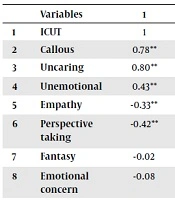
Pearson correlation coefficient was computed to investigate the association between callous-unemotional traits with empathy, bullying, and social anxiety. As illustrated in Table 2, while there is a significant negative correlation between callous-unemotional trait and empathy and social anxiety, we observed a notable positive relationship between bullying and callous-unemotional trait. To determine the role of empathy, bullying, and social anxiety in predicting the callous-unemotional trait, multiple regression analysis was used (the results are presented in Table 3). One of the main hypotheses of multiple regression analysis is the independence of independent variables, so the Durbin-Watson statistic was used to test the presence of autocorrelation in the errors of a regression model, which resulted in 1.92 that proved the independence of observation.
Table 2.
Pearson Correlation Coefficient on Main Study Variables
| Variables | 1 | 2 | 3 | 4 | 5 | 6 | 7 | 8 | 9 | 10 | 11 | 12 | 13 | 14 | |
|---|---|---|---|---|---|---|---|---|---|---|---|---|---|---|---|
| 1 | ICUT | 1 | |||||||||||||
| 2 | Callous | 0.78** | |||||||||||||
| 3 | Uncaring | 0.80** | 0.45** | ||||||||||||
| 4 | Unemotional | 0.43** | 0.05 | 0.14* | |||||||||||
| 5 | Empathy | -0.33** | -0.25** | -0.30** | -0.01 | ||||||||||
| 6 | Perspective taking | -0.42** | -0.39** | -0.38** | -0.009 | 0.47** | |||||||||
| 7 | Fantasy | -0.02 | -0.01 | -0.01 | 0.04 | 0.66** | 0.03 | ||||||||
| 8 | Emotional concern | -0.08 | -0.01 | -0.11 | 0.006 | 0.63** | 0.01 | 0.25** | |||||||
| 9 | Personal distress | -0.31** | -0.21** | -0.26** | -0.07 | 0.68** | 0.13** | 0.21** | 0.40** | ||||||
| 10 | Bullying | 0.24** | 0.22** | 0.25** | 0.03 | 0.03 | -0.24** | 0.14* | 0.10 | 0.08 | |||||
| 11 | Bullying | 0.25** | 0.22** | 0.24** | 0.03 | 0.004 | -0.25** | 0.11 | 0.09 | 0.04 | 0.91** | ||||
| 12 | 0.21** | 0.17** | 0.21** | 0.04 | -0.05 | -0.18** | 0.01 | 0.01 | 0.001 | 0.83** | 0.64** | ||||
| 13 | Victim | 0.02 | 0.06 | 0.05 | -0.02 | 0.23** | -0.04 | 0.25** | 0.15** | 0.35** | 0.12** | 0.12** | 0.06 | ||
| 14 | SAD | 0.17** | 0.15* | 0.12 | 0.19** | 0.23** | -0.15** | 0.20** | 0.41** | -0.04 | -0.07 | -0.07 | -0.16** | 0.28** | 1 |
Table 3.
Multiple Regression Analysis to Prediction the Variable of Callous-Unemotional Traits
| Dependent Variable/ Model | Index | R | R2 | F (P Value) | R Square Change | F Change | Regression Coefficients | ||
|---|---|---|---|---|---|---|---|---|---|
| Predictive Variable | 1 | 2 | 3 | ||||||
| Callous-unemotional traits | |||||||||
| 1 | Empathy | 0.33 | 0.11 | 34.80 (< 0.001) | 0.11 | 34.8 | β = -0.31; t = -5.89; < 0.001 | ||
| 2 | Empathy and bullying | 0.41 | 0.17 | 30.90 (< 0.001) | 0.06 | 24.47 | β = -0.31; t = -6.15; < 0.001 | β =0.25, t =4.94, < 0.001 | |
| 3 | Empathy, bullying, and social anxiety | 0.5 | 0.25 | 31.70 (< 0.001) | 0.08 | 28.08 | β =-0.37, t = -7.40, < 0.001 | β =0.26, t =5.32, < 0.001 | β =0.26, t =5. 29, < 0.001 |
As shown in Table 3, in the process of hypothesis testing, regression analysis was used in a step-by-step procedure. This method introduces variables into the model one by one, that is, first selecting the variable that has the highest correlation with the dependent variable. The increase is determined by the value of the coefficient. Finding may reflect that empathy, bullying, and social anxiety variables predict the callous-unemotional trait (F = 31.70, P < 0.001). According to the results, in the first step, the empathy variable entered into the equation and could predict the 0.11 variance of the callous-unemotional trait (R2 = 0.11). In the second step, the bullying variable entered into the equation and followed by the bullying variable predicted 0.17 variance of the callous-unemotional trait. in the third step, the social anxiety variable was entered into the equation and followed by the bullying and empathy variables predicted 0.25 variance of the callous-unemotional trait. By way of explanation, CU traits could be predicted by empathy (P < 0.001, F = 34.80), bullying (P < 0.001, F = 30.90), and social anxiety (P < 0.001, F = 31.70). This result suggests that, in the event of receiving more bullying and less empathy and social anxiety, it will be more likely to gain a greater score in the CU traits scale.
5. Discussion
The current study aimed to predict students’ CU traits based on empathy, bullying, and social anxiety behaviors. The findings demonstrated that CU trait has a negative and significant association with empathy. This finding is consistent with the results of Lui, Barry, & Sacco (4), and Schwenck et al. (24). To interpret this hypothesis, it could be said that CU traits emerge with the lack of empathy and the absence of emotion about others. In comparison with others, adolescents with the CU traits, when observing the damaging and adverse effects of their behaviors on others, are less distressed and disturbed and in moral reasoning and sympathy are in weaker positions (25). While simultaneously they have less ability to perceive and detect the grief in the face and voice of other people, this concept can literary explain the deficiency of empathy in these individuals.
The second hypothesis is based on the positive and significant association between CU traits and bullying, this finding is similar to the conclusion in the prior research conducted by Thornberg and Jungert (26), Kahn et al. (15), Munoz et al. (27), which explained that imbalance in the use of physical violence might be due to the CU traits, and the victim must be injured, hated, and threatened to meet the needs of the brutal bully (27).
The third hypothesis is about the negative association between CU traits and social anxiety disorder, which is consistent with Kahn et al. (15), Kimonis et al. (28), Frick and Ellis (29). In the interpretation of this hypothesis, we should refer to the social anxiety disorder, while the main feature of to the social anxiety disorder, in DSM-5 (30), is an intense, persistent fear of being watched and judged by others and fear of social situations that involve interaction with other people. CU traits are distinguished by a persistent pattern of behavior that reflects the disregard for others, and also the lack of empathy and generally deficient affect, and consistent lack of empathy, guilt, and shallow effect (28). As another explanation, it can be stated that in development theories, it is mentioned that socializing the ethics and internalization of parental and community norms depends on the negative arousal of potential punishment of the malpractice (31), which in turn leads to the development of conscience. Individuals with CU traits classically present with low reactivity to a neutral stimulus, and this feature leads to impair conscience development. Lack of empathy and guilt and low levels of anxiety in adolescents with CU traits, which in turn leads to disregarding the other people’s emotions, they do any sort of malpractice like; fluttering, disputing with the elderly, doing actions freely in trying to achieve their goals. And with this evidence, it is not surprising that there is a negative association between CU traits and social anxiety.
Like other researches, the current study also had limitations. This is because the present research was performed only students of the third and fourth grades of secondary education, so the results cannot be generalized to other age groups or those with academic grades. The results of this study are beneficial to examine these traits in at-risk children for prevention, early intervention, and selecting appropriate treatment.