
1. Background
Diabetes can affect people’s physical, mental, social, communication performance and causes despair (depression) that leads to threatening conditions and their disability and imposes a lot of stress and anxiety on them. People with diabetes are anxious about social interactions due to constant life changes, fear of high blood sugar, and understanding how they differ from others (1). Accordingly, studies show the occurrence of such long-term complications as cardiac, ocular, renal, psychological, personal, family, and social relationships in these patients (2), as well as psychological disorders, hurting patient’s ability to perform and continue medical care (3). Additionally, stress is a psychological problem that diabetics face. It has feelings of sadness, mental pressure, and anxiety that cause fatigue, concentration lack, irritability, and damage to health (4). High perception of stress has many adverse physical, psychological, and social effects, and the more severe the perceived stress, the greater risk (5).
Besides, content and style of thinking are important factors in the emergence and persistence of mental disorders among damage-experienced persons. From metacognitive perspective, a mental disease is caused by activating a specific and poisonous thinking style, called cognitive attentional syndrome (CAS), which is defined as a repetitive thinking style manifesting itself in thinking with worries, considerable attention to threat, and dysfunctional coping mechanisms (6). This syndrome preserves threat-based processing or being locked in traumatic events. Worrying and pensiveness activate and perpetuate threat-feeling, turning anxiety and depression into permanent states (7). Many studies confirm the role of components of CAS in psychological disorders development (8). According to the literature, diabetics’ stress and depression are associated with poor control of blood sugar and higher glycosylated hemoglobin (HBA1C), decreased physical functioning, more physical complications of diabetes, and increased health care costs (9). An appropriate, relevant treatment is acceptance and commitment therapy (ACT), that is known as the third wave of cognitive-behavioral therapies, where it is tried to increase psychological connection with thoughts and feelings (10). The ACT uses direct dependencies and indirect verbal processes in therapeutic communication to create a meta-empirical sense of self through acceptance of experience, diffusion, or disintegration of thoughts, providing more psychological flexibility in the person (11). Also, the desired outcome of ACT is not to reduce symptoms but is to increase psychological flexibility (12).
The ACT could effectively reduce the severity of depressive symptoms among male military personnel with type II diabetes (13). ACT effectively reduces depression scores of patients with type II diabetes (14). A significant difference was between experimental and control groups in overall scores of depression and anxiety, stress, and coping styles among such patients (15). Also, there was no significant difference between the groups in terms of LDL, HDL, TG, TC, and blood sugar levels before the intervention (16). Due to diabetes’ chronic, non-contagious and costly nature and creating an enormous financial burden, paying serious attention to diabetes and its consequences is necessary. Treating type II diabetes is actually a challenge (17). Besides, as a basic treatment for chronic diseases’ control, training plays an increasing role in restoring patients’ health and recovery in present era (18). Empirical evidence for ACT’s effectiveness on multiple disorders increases (19).
2. Objectives
Theoretically, the present study aimed to recognize the role of stress and CAS in diabetic patients. Finally, our findings obtained help determine and evaluate ways to prevent, control, and treat patients with type II diabetes, assisting in planning and evaluating overall programs to improve the living standards of families both at local (provincial) and domestic levels.
3. Methods
3.1. Study Design
The present study is a quasi-experimental intervention with pre-test and post-test design.
3.2. Sample
The statistical population included all patients with type II diabetes referred to Birjand Diabetes Clinic in 2019 with a number of 105. Through minimization method and simple random assignment, 40 patients were divided into experimental and control groups as volunteers considering inclusion (reading-writing ability, age of 30 - 60, definitive diagnosis of type II diabetes) and exclusion criteria (absence of more than two sessions, occurrence of great stress and unwillingness to continue cooperation). The sampling process was performed for forty days, and intervention process was performed for eight weeks.
3.3. Data Collection
As these instruments are general scales available for every researcher, and while we had no access to the developers, we found no need to get permission from authors. The data collection tools were as follows:
Depression, anxiety, and stress scale (DASS-42), developed by Lovibond and Lovibond in 1995, contains 42 items about three components of stress, anxiety, and depression. Here, 14 statements related to the stress were applied. Scoring is based on a 4-point Likert scale. The questionnaire validation was undertaken in (2), where Cronbach's alpha was calculated to be 0.77, 0.76, and 0.66 for depression, stress, and anxiety, respectively. Its reliability was corroborated via Cronbach's alpha of 0.92 for stress.
Sixteen-item CAS questionnaire was designed by Wells in 2009, where the first two questions measure respondents' frequency of anxiety and attention to the threatening stimuli. The following six questions assess frequency of strategies employed by respondents in dealing with negative emotions and thoughts. The following eight questions measure individual's faith in each metacognitive belief about CAS symptoms. This questionnaire is scored based on an 8-point Likert scale. The reliability of the CAS was confirmed in the studies of Fergus et al. (8) and, Salmani and Hasani (21) using Cronbach's alpha of 0.78 and 0.85, respectively. Here, the reliability was found to be 0.71 by Cronbach’s alpha.
FBS test: Blood samples were collected from patients followed by about 8 to 12 hours of fasting to measure their FBS and glycosylated hemoglobin indices, measured by MINDRAY BS38 auto-analyzer. It is noteworthy to mention that FBS is a conventional test, which can be conducted at any medical laboratory approved by Iranian Ministry of Health.
3.4. Intervention
Blood glucose indices were measured, and stress and cognitive syndrome questionnaires were completed by participants. The researcher with psychological expertise held the sessions, followed by obtaining written consent from participants. For experimental group members, ACT sessions were held in eight weekly 90-min sessions, which were conducted by a clinical psychologist and a senior counselor with a history of ACT. Controls received no psychological intervention. Ultimately, all participants completed research tools again. A summary of treatment plan and its content is provided in Table 1.
Table 1.
Summary of Topics Covered in ACT
| Session | Topic | Content | Practice |
|---|---|---|---|
| 1 | Expressing treatment sessions goals and conducting pre-tests, awareness training (using body as a center) | Introducing instructor, making members familiar with each other and establishing a therapeutic relationship, introducing ACT approach and its main goals and axes, explaining rules governing treatment sessions, resting and catering, assigning homework. | Eating raisins |
| 2 | Facing obstacles, being aware of pleasant events | Reviewing previous session experiences, checking individual willingness to change, examining clients’ expectations of ACT training, summarizing discussions, assigning homework. | Body inspection |
| 3 | Mindfulness, sitting meditation, mind wandering | Identifying ineffective control strategies, explaining acceptance concept and its difference with the concepts of failure, despair, denial, resistance, etc., defining effective and ineffective coping strategies, checking next session's exercise, assigning homework. | Seeing or hearing |
| 4 | Staying in the moment, experience discovery | Explaining behavioral homework and commitment, introducing and understanding the self-conceptualized integration, describing the application of ACT in the performance of problem-making chains of language and metaphors, summarizing the discussions in session, reviewing next session practice, assigning homework. | Meditation/yoga |
| 5 | Creating a different relationship with experience, deliberately bringing to mind difficulties and problems | Demonstrating separation between oneself, inner experiences, and behavior, viewing oneself as context, checking next session practice, assigning homework. | 3-minute breathing |
| 6 | Dealing with thoughts in mindfulness approach, seeing bar in the mind | Identifying patients’ life values and specifying and highlighting these values and paying attention to their choice, using mindfulness techniques with an emphasis, checking next session’s practice, assigning homework. | Standing behind the waterfall |
| 7 | Stress prevention programs | Examining values of each individual and deepening previous concepts, explaining differences between values, goals, and common mistakes in choosing values | Seeing relationship between activity and mood |
| 8 | Mindfulness, future, closing and summarizing, running post-test | Identifying behavioral plans by values and creating obligations to work on them, making commitment for action, Explaining about the concept of recurrence and readiness to deal with it, reviewing assignments and summarizing sessions, sharing experiences, achievements, and expectations of group members with each other | Body inspection and reviewing the assignments |
At the intervention end, patients' blood glucose indices were measured again in both groups, and they completed the stress and cognitive syndrome questionnaires.
3.5. Data Analysis
Data were analyzed using SPSS Ver.22 software. For statistical tests, the mean and standard deviation (SD) were used in the descriptive part, and univariate and multivariate analysis of covariance were used in the inferential part with a significance level of α = 0.05.
4. Results
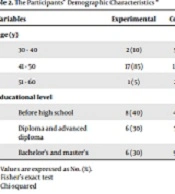
Most of the patients (85% in the experimental group and 65% in the control group) were aged 41 - 50 years. A major of the patients in the experimental group had not finished high school, while most of the controls (45%) had bachelor's and master's degrees (Table 2).
Table 2.
The Participants’ Demographic Characteristics a
| Variables | Experimental | Control | P-Value |
|---|---|---|---|
| Age (y) | 0.41 b | ||
| 30 - 40 | 2 (10) | 5 (25) | |
| 41 - 50 | 17 (85) | 13 (65) | |
| 51 - 60 | 1 (5) | 2 (10) | |
| Educational level | 0.37 c | ||
| Before high school | 8 (40) | 4 (20) | |
| Diploma and advanced diploma | 6 (30) | 7 (35) | |
| Bachelor’s and master’s | 6 (30) | 9 (45) |
a Values are expressed as No. (%).
b Fisher's exact test
c Chi-squared
In order to eliminate the score’s distorting effect before the intervention, the analysis of covariance was used to compare the variables’ mean values between the two groups. The level of significance for all variables was calculated to be more than 0.05 by Kolmogorov-Smirnov test, so normal distribution was confirmed. Based on the Box test result, which was not significant for any of the variables, the condition of homogeneity of variance/covariance matrices was correctly satisfied (P = 0.08). Additionally, based on Levene’s test and its non-significance for all variables, the condition of equality of variance was satisfied (P > 0.05) (Table 3).
Table 3.
Results of Analysis of Covariance for Comparison of Post-test Scores Between Groups a
| Source | Sum of Squares | df | Mean Square | F | Partial Eta Squared | P-Value |
|---|---|---|---|---|---|---|
| CAS | ||||||
| Corrected model | 4828.891 | 1 | 4828.891 | 1393.170 | 0.974 | 0.001 |
| Group | 58.290 | 1 | - | - | - | |
| Error | 128.246 | 37 | 58.290 | 16.817 | 0.312 | 0.001 |
| Total | 5024.478 | 40 | 128.246 | - | - | |
| Stress | ||||||
| Corrected model | 1802.776 | 2 | 1802.776 | 53.934 | 0.593 | 0.001 |
| Group | 369.768 | 1 | 369.768 | 11.063 | 0.230 | 0.002 |
| Error | 1236.734 | 37 | 1236.734 | - | - | |
| Total | 3224.400 | 40 | - | - | - | |
| HBA1C | ||||||
| Corrected model | 193.202 | 2 | 193.202 | 42.231 | 0.540 | 0.001 |
| Group | 1.658 | 1 | 1.658 | 21.848 | 0.128 | 0.001 |
| Error | 2.732 | 37 | 2.732 | - | - | |
| Total | 197.592 | 40 | - | - | - | |
| FBS | ||||||
| Corrected model | 5623.010 | 1 | 5623.010 | 42.234 | 0.540 | 0.001 |
| Group | 42.234 | 1 | 42.234 | 21.851 | 0.269 | 0.001 |
| Error | 4.292 | 37 | 4.292 | - | - | |
| Total | 5669.536 | 39 | - | - | - |
a Computed based on alpha = 0.05
The results of the analysis of covariance showed that the mean score of stress, CAS, and blood sugar indices (FBS and glycosylated hemoglobin) after the intervention in the experimental group was significantly lower than that of the controls (P < 0.01). In other words, it can be concluded that ACT has been effective in reducing stress, CAS, and blood sugar indices among patients with type II diabetes (P < 0.01). The ETA coefficient for the variables of pressure, CAS, FBS, and glycosylated hemoglobin was 0.23, 0.31, 0.38, and 0.54, respectively, which indicates the effect of ACT on reducing these variables among the studied variables patients (Table 3).
5. Discussion
The present study evaluated the effectiveness of ACT on Stress, CAS, and blood sugar indices in patients with type II diabetes. Our results established the effectiveness of ACT on reducing stress, CAS, and blood sugar indices among patients with type II diabetes. Alongside our findings, some studies also report the significant effect of ACT on stress reduction among patients with type II diabetes (22-24). Accordingly, ACT improves the perception of life challenges by providing clients with acceptance techniques, inviting people to experience unpleasant feelings without trying to control them and helping them face the personal, family, and social life challenges. Thus, clients' feelings of avoidance, anxiety, fear of challenges, and stress are reduced (25). At high levels of acceptance, people can notice psychological stimuli of their thoughts and feelings without attempting to control or avoid them (13).
Consequently, the impact of these thoughts and feelings is reduced on their performance. At low levels of acceptance, people engage in control strategies to revise their thoughts and feelings, leading to degradation of their performance and behavior. Therefore, people with type II diabetes who apply these methods evaluate their thoughts and feelings appropriately in stressful events due to their non-judgmental acceptance and commitment (26). Therefore, ACT reduced the perception of stress in diabetic people.
Regarding CAS reduction among patients with type II diabetes, a research reported that metacognitive therapy significantly reduced CAS (27), which was indirectly in line with our results. Since people with diabetes have difficulty thinking about the future and its problems, practicing diffusion techniques in ACT helps them deal with disturbing schemas. Clients learn to separate themselves from their thoughts and see the problem as a small part of themselves by self-observation techniques (28). Such patients cannot tolerate the process of threat-related perceptions. In other words, since they avoid all risk-related negative emotions, they will never be able to work on their problems and find a solution for them. The effect of ACT can be explained by its governing processes. Thus, the component of desire and acceptance allows to accept unpleasant inner experiences without trying to control them, and doing so makes those experiences seem less threatening and having less impact on the person’s life (29).
Regarding FBS, it was shown that the mean blood sugar level after ACT intervention in patients in the experimental group was significantly lower than the controls (30). Also, ACT health lifestyle therapy increased self-care ability and decreased glycosylated hemoglobin in patients with type II diabetes (10). Furthermore, ACT can significantly reduce HBA1C (16). Increased adherence in diabetic patients leads them to pay more attention to themselves and their health, and to perform better and more self-care behaviors, that is, taking prescribed medications and insulin on time, following the recommended diet, exercising more, and measuring their daily blood sugar (31).
5.1. Conclusions
The findings of the present study showed that ACT had a significant effect on stress, CAS, and FBS indices in patients with type II diabetes. Therefore, the therapists are proposed to take advantage of this approach to enhance clinical conditions of their clients. We faced some limitations, including a lack of follow-up period and absence of sufficient background in research variables, particularly CAS. Besides, the following suggestions are offered: (1) Designing a remarkable ACT plan for diabetic patients and formal integration of this training in their care programs. (2) Holding workshops with the present method to increase the structure of thinking and problem-solving and ultimately increase the patient’s abilities, thereby improving the health.