
1. Background
Suicide, as a social phenomenon, is one of the leading causes of death worldwide (1). The World Health Organization estimates show that about 800,000 people die from suicide annually (2), and that about two-thirds of all people think about suicide at least once before they die (3). According to the Iranian Ministry of Health and Medical Education, in 2004, at least 11 suicide cases per day were reported among Iranians, six times larger than in the past 20 years (4). The world's population is moving toward aging as the world's population aged 60 years and above has doubled since 1980, and this population is estimated to reach 2 billion by 2050 (5). Studies in this field in Iran have revealed that suicide and its prevalence rates in the elderly in Iran, like many other countries, are rising due to conflicts and problems such as disability and physical illnesses, loneliness, lack of attention, anxiety about the inability to live independently, separation, cultural change of society, and others. In recent years, there has been rising concerns about increasing suicide rates among this age group in Iran (6-9).
It should be noted that among the available symptoms, depression has been reported in above 40% of the cases with suicide, attempted suicide, or suicidal thoughts (10). As depression is a highly challenging disease with a high incidence rate in the elderly and leads to the highest levels of disability among mental and behavioral illnesses, it can be highly destructive, if not treated (11). According to the literature, the elderly with depression have reported more suicidal thoughts (12); those with depression consider suicidal thoughts as the last available solution because their ability to improve their living conditions is decreased (13). According to the findings, the best way to reduce the risk of suicide is to treat the underlying psychiatric illnesses (12, 14). Moreover, the detection of the risk factors for suicide among the elderly contributes to developing prevention strategies (15).
Reminiscence can be considered a useful, safe, and affordable treatment for individuals with suicidal thoughts (11). Hashemi Aliabadi et al. examined the effect of group reminiscence on suicide attempters’ hope and resilience in Kermanshah, Iran. In this study, 57 suicide attempters were assigned to two intervention (n = 28) and control (n = 29) groups. The intervention group participated in 60 - 90 minute group reminiscence sessions. The participants’ hope and resilience were measured before, immediately after, and four weeks after the intervention using Schneider's Hope Scale and Connor and Davidson's Resilience Scale. Their findings revealed that group reminiscence positively affects the hope and resilience of those attempting suicide (16). As a process, reminiscence helps older people retrieve life events; hence, they are placed in a new psychological structure through which they can develop their understanding of the meaning of life. According to previous studies, this process can improve people's understanding of their current situation, improve their self-esteem, and decrease the symptoms of depression, hopelessness, and anxiety (5). According to some scientific research, psychological problems, especially depression, play a critical role in the formation of suicidal ideation and attempted suicide in the elderly (17). On the other hand, reminiscence by reviewing the elderly's previous life experiences, reformatting them, and reconstructing cognitive events has positive effects on the emotions, feelings, behaviors, and cognition of the elderly with mental problems (18), especially those suffering from depression (19, 20); hence, participation in group reminiscence sessions can have positive effects in alleviating depression symptoms in these individuals (21). Accordingly, the following research question was posed: Does group reminiscence therapy play a protective role in elderly’s suicidal ideation by decreasing depression symptoms?
2. Objectives
Given that depression is a risk factor for suicide in the elderly and that the suicide rate is high among these individuals, the researchers conducted this study to determine the effect of reminiscence as a preventive and therapeutic strategy on the risk factors of suicidal ideation in the elderly.
3. Methods
3.1. Study Plan
In this clinical trial study, the research population consisted of the elderly people with suicidal ideation residing in a nursing home, who met the inclusion criteria.
3.2. Sample Size
Thirty elderly people who met the inclusion criteria were selected using the simple random sampling method and then assigned to two intervention and control groups (n = 15 per group). According to the following formula and similar studies (22), the sample size was determined to be 15 for each group.
where,
d: Acceptable error, which is equal to the mean difference in the two previous study groups = 2.63
3.3. Sampling and Blinding Method
The research population consisted of elderly people with suicidal ideation residing in Lar nursing home, who were selected regarding the inclusion criteria. The researcher referred to the nursing home for the elderly in Lar and first selected 30 eligible elderly persons using the convenience sampling method. In the next step, using the random sampling method (using envelopes A & B) and, the researchers asked them to select one of the envelopes. If envelope A was selected, the elderly could enter the intervention group, and if envelope B was selected, the elderly would enter the control group. The selected samples were randomly divided into the intervention (n = 15) and control (n = 15) groups.
In the present study, the one-way blind method was also used. The research assistant in charge of the random allocation was blinded to the group type of envelopes A and B.
3.4. Inclusion Criteria
(1) Willingness to participate in the study;
(2) Age range of at least 60 years;
(3) Acceptable hearing and speaking ability;
(4) Familiarity with the Persian language;
(5) Scores 5 - 11 from the Elderly Depression Questionnaire before the intervention;
(6) A moderate cognitive status (obtaining a minimum score of 21 in the short examination of the psychological state);
(7) A minimum score of 6 from the Suicide Ideation Questionnaire; and
(8) Non participation in other treatment groups.
3.5. Exclusion Criteria
(1) Occurrence of any severe social or familial crises during the study (e.g., bereavement in the last six months);
(2) Hospitalization or illness interfering with the research objectives;
(3) Physical defects seriously impeding participation in group therapy sessions; and
(4) Being absent for more than one session of the intervention.
3.6. Data Collection Tools
3.6.1. Geriatric Depression Scale
This questionnaire was developed by Yesavage et al. (23) and is widely used in clinical trials and screening. Its short form consisted of 15 Yes/No questions, with 1 for Yes and 0 for No. Items 1, 5, 7, 11, and 13 are reversely scored. This questionnaire has been translated and validated in various languages. Scores 0 - 4, 5 - 8, 9 - 11, and 12 - 15 show normal, mild, moderate, and severe levels of depression, respectively. Malakouti et al. (24) standardized this questionnaire in Iran and reported its acceptable validity and reliability.
3.6.2. Beck Scale for Suicide Ideation
This questionnaire was developed by Aaron Beck to survey suicidal thoughts (25). It contains 19 questions, each ranging from 0 to 2, the scores of the questionnaire also range from 0 to 38. In this questionnaire, the first five questions are for screening; hence, if the respondent receives a zero score for the first five questions, he/she has no suicidal ideation. Scores 1 - 5 indicates suicidal thoughts, 6 - 19 show readiness to commit suicide, and 20 - 38 represents the intention to commit suicide. Researchers showed the cut-off point of 6 on this scale (26). This scale has high validity and reliability to investigate suicidal thoughts, and several surveys have also confirmed the reliability and validity of this scale in Iran (27).
3.6.3. Mini-mental Status Examination
This tool was developed by Folstein et al. (28) for cognitive screening. It consists of 30 items in six cognitive domains: Orientation to time and place, registration, attention and calculation, reminders, language proficiency test, and compilation. This is a paper-based test with a maximum of 30 points, with lower scores indicating more severe cognitive problems. The cutoff point for this test shows normal cognitive performance and usually is 24; however, it can be anywhere from 1 to 30. In a study in Iran, its open validity showed to be 0.73. The results also showed that with a sensitivity of 0.95 and a feature of 0.97, it could differentiate patients with dementia from individuals with no mental problems (29).
3.7. Intervention
3.7.1. Group-Structured Reminiscence Protocol
This protocol was developed by Stinson and Kirk (30) and translated and used for the first time in Iran by Majzoobi et al. (31). In this program, twelve persons are engaged in discussions for 12 half-an-hour sessions (one to one). In each session, different stimuli are used to remind the memories related to the subject matter, including photos, work tools, childhood toys, and others. The researchers themselves implemented the protocol.
According to a previous study (32), some meetings were merged in the present study, thereby decreasing to eight sessions. To determine the depression variations, the participants were asked to complete a questionnaire before, immediately, and one month after the intervention.
After obtaining the necessary permits from the nursing home authorities, all elderly persons were included in the study voluntarily, and their informed consent was obtained. The participants completed the Geriatric Depression Scale (GDS-15), Beck Scale for Suicide Ideation (BSSI), and Mini-mental Status Examination (MMSE), and their scores were considered a pre-test. In the intervention group, eight group reminiscence sessions were held twice a week for four weeks, and a psychiatric nurse (Ph.D.) led the sessions. The content of the sessions included childhood, youth, and education memories, family formation and marriage, children’s birth, work experiences and achievements, trips and celebrations, and special and important events in the past lives of the elderly, a summary of which is presented in Table 1. During the study, the control group used only the regular programs of the elderly center. Finally, following the completion of the reminiscence intervention, the research tools were completed once more by the intervention and control groups, and their scores were considered a post-test.
Table 1.
Content of Group Reminiscing Sessions
| Sessions | Contents |
|---|---|
| 1 | Explaining the procedures and the goals of the group and introducing the elderly to each other |
| 2 | Retelling childhood memories by the elderly |
| 3 | Talk about the memories of youth and achievements |
| 4 | Recalling memories of marriage and birth of children |
| 5 | Telling about memories, work experiences, and achievements of that period |
| 6 | Recalling memories of celebrations and trips in previous life periods |
| 7 | Presenting some memories of special and important events in life |
| 8 | Summarizing and concluding the sessions |
3.8. Data Analysis
Descriptive statistics, chi-squared, Mann-Whitney, and Friedman tests were used to analyze the data. In this study, P < 0.05 was set as the significance level. The data were analyzed with SPSS software version 25.
3.9. Ethical Considerations
This study was approved by the Ethics Committee of the Larestan University of Medical Sciences (Code: IR.LARUMS.REC.1397.001) and registered at the Clinical Practice Registration Center (No. IRCT20090304001742N3). The researchers explained the objectives, significance, and procedure of the study, and written consent was obtained from all participants. After assigning individuals to the groups, a pre-test was conducted using questionnaires before the intervention.
4. Results
Each of the intervention and control groups encompassed 15 participants. Eligible members were randomly divided into two control and intervention groups (Figure 1). Table 2 displays the demographic features of the participants. According to Table 3, the mean and standard deviation of age in the intervention and control groups are 67.93 ± 6.14 and 69 ± 5.49, respectively. Moreover, mean and standard deviation of suicidal ideation are 10.40 ± 4.35 in the intervention group and 9.66 ± 2.74 in the control group. Furthermore, the mean and standard deviation of the cognitive status were 26 ± 1.95 in the intervention group and 25.93 ± 1.09 in the control group. The two groups were similar in terms of their mean age, suicidal ideation, and cognitive status (P > 0.05). Table 2 shows the homogeneity of the two groups in terms of marital status, level of education, and gender (P > 0.05). Table 3 compares the mean scores of depression between the intervention and control groups before, immediately after, and one month after the intervention. According to this table, the comparison of the mean scores in the control group revealed no significant difference (P > 0.05); however, the comparison of the mean scores showed a significant difference in the intervention group (P < 0.05).
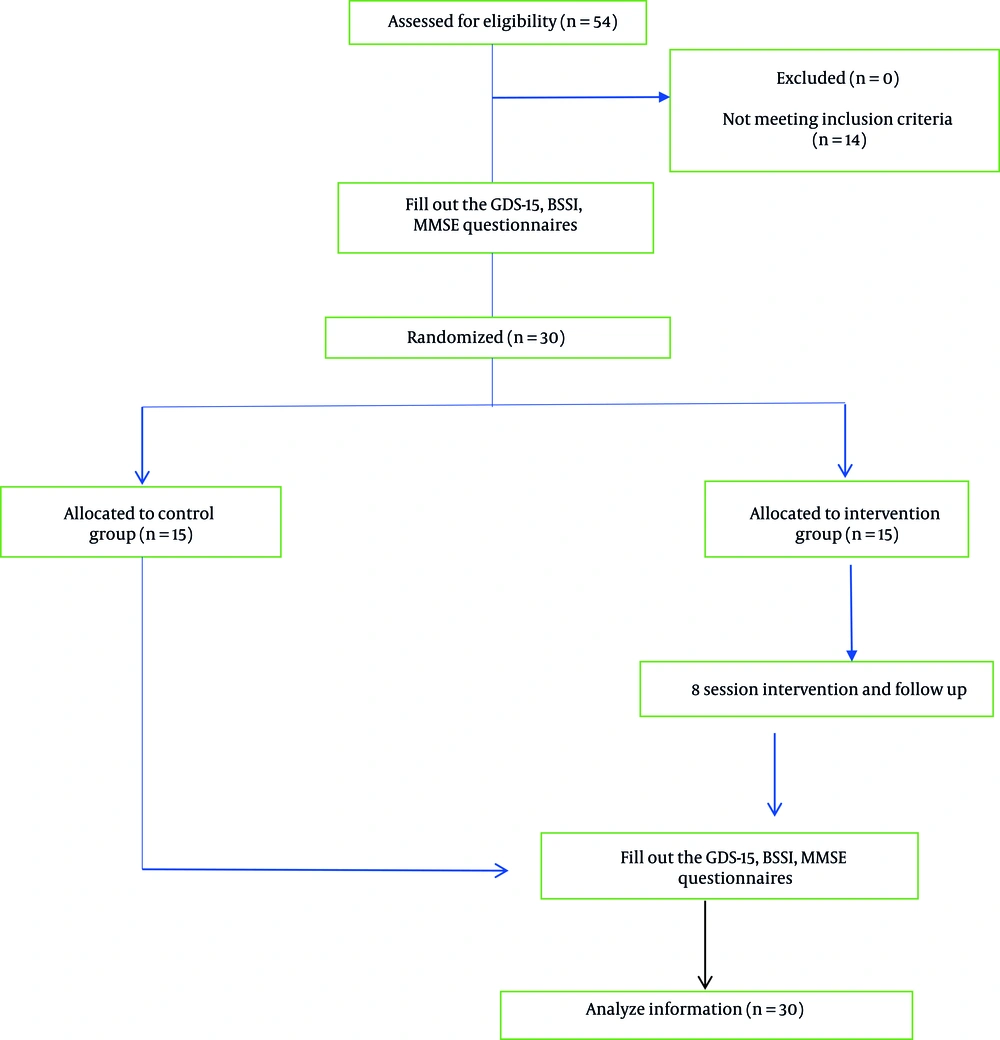
Figure 1.
CONSOERT flow chart of research
Table 2.
Comparison of Demographic Characteristics in Intervention and Control Groups a
| Variables | Intervention Group | Control Group | P-Value |
|---|---|---|---|
| Age | 67.93 ± 6.14 | 69 ± 5.49 | 0.618 b |
| Suicidal ideation | 10.40 ± 4.35 | 9.66 ± 2.74 | 0.834 b |
| MMSE | 26 ± 1.95 | 25.93 ± 1.09 | 0.877 b |
| Gender | 0.642 c | ||
| Male | 8 (26.7) | 8 (26.7) | |
| Female | 7 (23.3) | 7 (23.3) | |
| Level of education | 0.483 c | ||
| Illiterate | 2 (6.7) | 0 (0) | |
| Reading literacy | 13 (43.3) | 15 (50) | |
| Marital status | 0.390 c | ||
| Married | 2 (6.7) | 5 (16.7) | |
| Widow | 13 (43.3) | 10 (33.3) |
a Values are expressed as mean ± SD or No. (%).
b Results of Mann-Whitney U
c Results of the χ2 test
Table 3.
Comparison of Mean Scores of Depression Between Intervention and Control Groups in Tests Before, Immediately After, and One Month After Intervention
| Time 1 | Time 2 | Time 3 | P-Value a | |
|---|---|---|---|---|
| Depression | ||||
| Intervention | 8.33 ± 1.54 | 7 ± 1.64 | 7.20 ± 1.61 | < 0.001 |
| Control | 8.40 ± 1.95 | 8.40 ± 1.63 | 8.67 ± 1.71 | 0.395 |
| P-value b | 0.899 | 0.037 | 0.030 |
a Friedman Test
b Mann-Whitney U
5. Discussion
The results of this study showed that depression reduced immediately after and one month after the intervention in the intervention group compared to the control group. Regarding the effectiveness of reminiscence in reducing depression in the intervention group, it can be concluded that economic and financial problems are caused by the lack of financial independence, chronic physical diseases, and cognitive problems arousing depression in the elderly (33). Following depression, the elderly are often isolated and feel lonely; therefore, many depressed elderly people are reluctant to talk about their feelings or ask someone for help (34), which gradually arouses negative thoughts such as suicide in these individuals. Accordingly, the use of group reminiscence leads the elderly to play an active role in retelling and reminding their memories among their counterparts, thereby increasing their interpersonal interactions and decreasing their social isolation. Participation in groups also arouses happiness and a sense of belonging, improves mental health, and promotes self-esteem, thereby reducing depression in the elderly in the intervention group. Duru Asiret used the reminiscence therapy for women's adjustment to the middle age and observed that the reminiscence therapy held individually for eight weeks (one session per week) improved the older women’s recognition and enhanced their adaptability and acceptance of mid-life changes and problems (35). In the present study, we used photographs and external and objective tools as a reminder for the participants to talk about their memories. Onieva-Zafra and Hanaoka used olfaction and hearing stimuli, such as music and familiar smells, to attract the elderly participants’ attention. They concluded that these interventions could reduce depression, promote cognitive impairment in the elderly, and ultimately improve the quality of their lives (36, 37).
This study showed that reminiscence therapy with 6 - 12 weekly sessions could reduce the total depression score immediately after the intervention (38-40). Inel Manav and Simsek reviewed the use of online structured reminiscence therapy and then held a group discussion on the cognitive and apathy status of the seniors for three months. Their findings showed that the long-term intervention over three months improved the cognitive status of the elderly and decreased the scores of apathy as the result of depression and also aggravated depression in the elderly (41). Regarding the one-month period of the group reminiscence therapy in this study, Chiang et al. in their study addressed the effect of group reminiscence intervention on depression and showed that the effect of such an intervention continued even up to three months after the intervention (42, 43). However, this intervention was not effective after six months among the elderly (14). Djukanovic et al. combined the structured reminiscence therapy and a problem-centered approach. They focused on past experiences while considering the present and future efforts to prevent the symptoms of depression in the elderly. The findings indicated that this study had a positive effect on reducing the symptoms of depression in the elderly, and that Although, after one year of follow up, the symptoms of depression decreased, the difference was not significant. In this study, it was revealed that structural reminiscence, not only reduced depression but also improved autonomy and self-rated health, thereby effectively reducing the risk of negative thoughts such as suicide (44). Reminiscence is a combination of positive memorization types in which the reminiscence that causes a focus on negative thoughts, such as obsessive and escapist ones, is not used (34). In contrast, with the present findings, Chao et al. and Stinson and Kirk aimed to determine the impact of group structured reminiscence on depression in the elderly. They found no significant difference in terms of depression reduction (30, 45). This might have been caused by the differences in measurement tools, sample size, characteristics of the studied community, and the skills of those managing reminiscence sessions.
When involving the elderly living in a nursing home in reminiscence sessions, we allow them to make new friends and have deeper relationships and eventually enable them to communicate. Moreover, such an intervention reduces loneliness through interpersonal interactions and social support on the part of the group members, which is offered by expressing empathy. Furthermore, attendance in the group arouses more memories and a deeper understanding of life situations. It also increases the power of adaptation and compatibility, which can reduce the risk of negative thoughts as suicide among the elderly since the repeated episodes of negative thoughts can be considered as a factor inducing and reinforcing anxiety. Further, high anxiety levels can set the stage for depression and intensify its severity (33, 40).
Elderly people may be devalued by their families and others, resulting in the isolation of the elderly. Losing decision-making power in personal activities such as eating, sleeping, dressing, and bathing sometimes reduces individuals’ senile self-esteem. Under such a condition, reminiscence helps the elderly accept their lives and share their experiences, accept many of their shortcomings and deficiencies, understand their abilities, experience a sense of usefulness, and hold a positive attitude towards themselves. With the reminiscence of their self-esteem and social intimacy, the elderly are influenced by the renewal of past experiences. Looking back at their memories, they try to identify their individual identity, feel happy and joyful, eliminate sadness, anxiety, and guilt feeling, create a sense of respect, and sometimes give rise to a new understanding of elderliness (34). Consistent with the findings of this study, Chiang et al. showed that the mean scores of life satisfaction and self-esteem were higher following the reminiscence therapy compared to the pre-intervention phase (46). Zhou reviewed the effects of group reminiscence on community-dwelling elderly people’s depression, self-esteem, and balance. He concluded that the six-week intervention affected the participants’ depression and balance (47). Short and temporary reminiscence may not change individuals’ attitudes towards themselves. Accordingly, it is suggested that structured group reminiscence should be used in long-term and continuous programs for the elderly living in nursing homes.
According to many studies, depression leads to disabilities in the elderly and is caused by many factors, such as the loss of the spouse and living alone for a long time at home or in the nursing home (48). In the present study the control and intervention groups were homogenous in terms of gender, age, marital status, level of education, and cognitive status. However, there was a significant difference in the dependent variables in the intervention group before and after the intervention, which was caused by the positive effect of the group therapy using the reminiscence method. The lack of enough time to follow the results in the long term was one of the limitations of this study.
5.1. Conclusions
Reminiscence as a kind of memorization is recommended to be taken into account since identifying specific topics and structures to review memories can help the individuals avoid negative memories, obsessive compulsion, or the avoidance types of reminiscence. Moreover, for the elderly residing in nursing homes with suicidal thoughts, it is a low-cost and feasible psychosocial approach to be adopted by nurses independently.