
1. Background
Diabetes mellitus is a group of metabolic diseases identified by chronic hyperglycemia, resulting from a defect in insulin secretion, action, or both (1). Type II diabetes is the most common metabolic disease (2). Type II diabetes accounts for 90% - 95% of all diabetic cases (3).
In 2013, 382 million persons worldwide, and more than 8% in Iran, had diabetes. Further, the number of people with diabetes is projected to reach 592 million in 2035 (4). The global burden of diabetes is increasing dramatically and will make up 60% of the total disease burden in 2020 (5). Moreover, 16% of hospital costs in Iran are associated with diabetes patients (6).
This disease is the cause of many problems in all aspects of patients’ daily lives (7, 8). Studies have shown that diabetes is associated with an increased risk of psychological disorders and symptoms (7, 9, 10). Many studies have shown that depression occurs in up to 18% of patients and can be caused by deficiencies in self-care behaviors (11-13), including compliance with the treatment regimen, exercise, and blood sugar control (14-17). Depression is a risk factor for diabetes and diabetes increases the risk of the onset of depression (18-20). The rate of depression among diabetes patients has been reported to be more than that in the normal population (21-24), and that among women (28%) is significantly higher than that among men (18%) (25).
Psychotherapy is a means of minimizing mental health problems such as depression, and of enhancing adherence to diabetes treatment. Group reminiscence therapy is the type of group therapy in which self-esteem and social intimacy is improved through the review of past experiences. According to the nursing interventions classification system, reminiscence therapy is an intervention that uses the recall of past events, feelings, and thoughts to facilitate pleasure, quality of life, or adaption to the present (26). Reminiscence can take place in pairs or groups. The nurse leading such a group assumes a multi-faceted role. The associated functions include keeping the group intact, preventing attrition, skillfully monitoring group processes, protecting the weakest members of the group, and concurrently using group process skills and implementing the best thereof (13). Reminiscence therapy aims to review and analyze patients’ memories of their personal lives, as the main essence of treatment; evidence has shown that it is effective in reducing the symptoms of depression (27).
Reminiscence therapy is an independent nursing intervention in which repressed or painful topics are reviewed. One’s personal life and certain traumatic experiences from the past are reviewed and healing is achieved through changes in one’s perception of the past. In fact, reminiscence affects the recall of past memories and experiences and, thus, has a positive effect on emotions of people. Increasing life expectancy, reducing the symptoms of depression, increasing life satisfaction, and improving self-care, and assisting people to deal with crises and losses are some of the positive effects of reminiscence therapy among the elderly (28).
Meacham and Perrota (1981) demonstrated that reminiscence therapy would be effective as a short-term intervention for improving self-esteem and reducing depression (29). Further, in his study, Youssef showed that group reminiscence reduced depression among the elderly (30). In their study, Jonsdottir et al. concluded that group reminiscence would neither decrease depression nor increase self-confidence among the elderly, but would increase the sense of recovery, pleasure, well-being, intimacy, self-assurance, and assurance in relation to others (13). In Iran, Otaghi concluded that group reminiscence reduced depression among elderly women (14).
2. Objectives
Given that group reminiscence is discussed as an independent and low-cost intervention in nursing, and because depression is quite prevalent among diabetes patients, the researcher, as a psychiatric nurse, resolved to design and conduct a study determining the effect of group reminiscence therapy on depression among women with type II diabetes.
3. Patients and Methods
This research was a clinical trial study investigating the effect of group reminiscence therapy on depression among women with type II diabetes. The population under study included all female patients with type II diabetes, who were referring to Golestan hospital in Ahvaz, Iran, with medical records. The study’s inclusion criteria were as follows: having had diabetes for at least one year, treatment with oral drugs only, aged 50 years or older, lack of chronic and other debilitating diseases and cognitive diseases such as dementia, no use of psychiatric drugs, residing at the study site, able to communicate in Persian, being married, and obtaining a score of 11 or higher on the Beck depression inventory (slightly depressed). The study’s exclusion criteria were as follows: the occurrence of any social family crisis, hospitalization, or any other acute or chronic disease during the study period. Based on Equation 1, the number of individuals per group was determined to be 12.
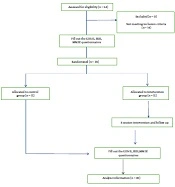
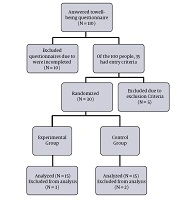
Within the research population, 24 patients meeting the inclusion criteria were selected with simple random sampling. Then, the subjects were randomly assigned to two groups (12 subjects in the experimental group and 12 in the control group). Then, the researcher explained the objectives and importance of the study to the subjects.
Data were collected in the form of a questionnaire and an interview. The questionnaire included questions relating to demographic information and the Beck depression inventory. The demographic data included age, education, and marital status. The Beck depression inventory is standard and its validity and reliability have previously been tested (31, 32). The interview was set up so as to enhance questionnaire completion.
3.1. Ethical Considerations
The researcher considered the ethical aspects of the study, demonstrated by the explanation of the goals of the study and voluntary participation to Participants, and assurance about the confidentiality of the collected data. Finally, The researchers asked the participants to read and sign the informed consent form. This study was approved by the ethics committee of Ahvaz Jundishapur University of Medical Sciences (ethical clearance code REC - 1392, 47).
Before the intervention, the researcher took a course comprising several sessions in reminiscence therapy under the supervision of the supervisor. Eight biweekly reminiscence sessions were held for the experimental group and each session lasted 90 minutes. The first session comprised orientation and a statement of the aims of group reminiscence therapy and the eighth session was the concluding session and comprised a statements of feelings regarding the group tasks. The reminiscence group therapy was led by the researcher and sessions 2 to 7 were structured as follows:
1- Warm up; 2- Introduction of the session’s theme; 3- Presentation of relevant visual aids as memory-makers (i.e., photographic images relevant to the session theme); 4- Encouraging imagery for the recall of past experiences and memories; 5- Taking turns to share memories; 6- Linking the there-and-then to the here-and-now; 7- Discussing commonalities and differences between members; and 8- A summary of the session’s main issues, highlights of positive aspects of the past, and summing up. The contents of sessions 2 to 7, respectively, were as follows: place of birth and childhood, going to school, life achievements, marriage, places of interest, holidays and meetings, and family and religious ceremonies.
After the sessions, both the experimental and the control group completed the Beck Depression Inventory. In order to ensure the long-term effect of the intervention, the Beck Depression Inventory was completed again after one month and the results of the two tests were compared. Descriptive statistics were used to analyze the demographic data and the results were displayed as frequency tables and percentages. The Mann-Whitney and Friedman tests were used to compare the mean scores of depression in both the control and the experimental group, and the Chi-Square test was used to compare the qualitative data, such as the literacy levels of the two groups.
4. Results
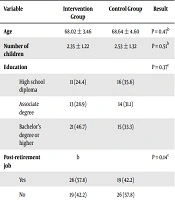
As shown in Table 1, the majority of the participants in the experimental group were aged 50 - 60 years (75%) and that of participants in the control group were aged more than 60 years (58.3%). The Mann-Whitney test showed no significant difference between the two groups in terms of the mean age (P = 0.669). The most common literacy level in both the experimental and the control group was Guidance education (50%). There was no significant difference between the two groups in terms of education level and the two groups were identical in this regard (P = 0.842).
Table 1.
Frequencies and Percentage Distributions of the Demographic Characteristics of Subjects in Both the Intervention and Control Groups
| Variable | Intervention Group | Control Group | P Value |
|---|---|---|---|
| Age, y | 0.669 | ||
| 50 - 60 | 9 (75) | 5 (41.7) | |
| Above 60 | 3 (25) | 7 (58.3) | |
| mean ± SD | 56.25 ± 2.09 | 55.83 ± 2.58 | |
| Education level | 0.842 | ||
| Primary school | 3 (25) | 2 (16.7) | |
| Primary high school | 6 (50) | 6 (50) | |
| Diploma | 3 (25) | 4 (33.3) | |
| Total number | 12 | 12 |
As shown in Table 2, the mean scores obtained by the experimental group for depression was 18.33 ± 3.25 before the intervention, and that obtained by the control group was 18.41 ± 4.39. The Mann-Whitney test showed no significant difference between the two groups with regard to the rating obtained for depression before the reminiscence intervention; the two groups were identical in this regard (P = 0.907). Before the intervention, the highest rating obtained by the experimental group for depression was “need to consult” (50%). After the group reminiscence therapy, this group’s highest rating for depression was “without depression” (50%); one month after the intervention, the highest rating was “low level” (50%).
Table 2.
Frequency Distributions and Percentages of Mean Depression Scores in the Experimental and Control Groups Before, After, and One Month After the Interventiona
| Rating for Depression | Before the Intervention | After the Intervention | One Month After the Intervention | |||
|---|---|---|---|---|---|---|
| Experimental | Control | Experimental | Control | Experimental | Control | |
| Without depression | 0 | 0 | 6 (50) | 0 | 4 (33.3) | 0 |
| Slightly depressed | 3 (25) | 4 (33.3) | 4 (33.3) | 6 (50) | 7 (58.3) | 5 (41.7) |
| Need to consult | 6 (50) | 4 (33.3) | 2 (16.7) | 3 (25) | 1 (8.4) | 3 (25) |
| Relatively depressed | 3 (25) | 4 (33.3) | 0 | 3 (25) | 0 | 4 (33.3) |
| Total | 12 (100) | 12 (100) | 12 (100) | 12 (100) | 12 (100) | 12 (100) |
| SD ± mean | 18.33 ± 3.25 | 18.41 ± 4.39 | 10.83 ± 4.04 | 18.16 ± 4.76 | 12 ± 3.54 | 19 ± 4.49 |
| P value | 0.907 | 0.001 | 0.001 | |||
aData are presented as No. (%).
Before the intervention, the ratings obtained by the control group for depression across all three levels of depression rating were equal (33.33%). After the intervention, the highest rating obtained for depression was “low level” (50%). Similarly, one month after the intervention, the highest rating obtained was “low level” (41.7%). The Mann-Whitney test shows that after the intervention and one month after the intervention, there was a significant difference between the experimental and control groups (P = 0.001).
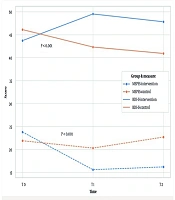
As shown in Table 3, the Friedman test showed that the mean score obtained by the experimental group on depression decreased significantly after the intervention (P = 0.001). However, for the control group, there were no significant differences in the depression mean scores before, after, and one month after the intervention (P = 0.368).
Table 3.
Comparisons of the Means and Standard Deviations of the Depression Scores of the Two Groups Before, After, and One Month After the Interventiona
| Study Group | Before Intervention | One Month After Intervention | After Intervention | P Value |
|---|---|---|---|---|
| Experimental | 18.33 ± 3.25 | 12 ± 3.54 | 10.83 ± 4.04 | .001 |
| Control | 18.41 ± 4.39 | 19 ± 4.49 | 18.16 ± 4.76 | .368 |
aData are presented as mean ± SD.
5. Discussion
This study aimed to determine the effect of group reminiscence therapy on depression among women with type II diabetes. During reminiscence therapy, some variables, such as age and education level, influenced the recall and statement of memories (33). In this study, the compatibility of these two variables was checked. The results showed that the experimental and control group subjects no statistically significant difference in terms of age (P = 0.669) and education level (P = 0.842). Therefore, the effects of age and education level on the study results were controlled for.
The aim of the reminiscence intervention was to lessen emotional difficulties.
Regarding the effect of the intervention on depression among the subjects, the findings showed that the ratings for depression, as obtained by the two groups, was identical before the intervention (P = 0.907). The ratings for depression in the experimental group decreased significantly after the group reminiscence therapy (before group reminiscence therapy: 18.33 ± 3.25, after group reminiscence therapy: 10.83 ± 4.04). The results indicate the positive effect of group reminiscence therapy on the reduction of depression among women with type II diabetes. This finding is consistent with the results of a study by Jones, demonstrating the effectiveness of reminiscence therapy in reducing the symptoms of depression among elderly women (34); it is also consistent with the results of studies by Moradinejad et al. (2010) and HSU and Wang (2009), who showed that reminiscence therapy significantly decreased depression scores among the elderly (16, 17).
In this study, the subjects were women with type II diabetes. Women are more prone to low self-esteem and depression; moreover, depression has a direct relationship with low self-esteem (35-37). In group reminiscence therapy sessions, self-esteem and social intimacy are expected to improve through the review of past experiences (26). Subsequently, emotional symptoms including depression are expected to be alleviated. Hence, it can be said that the feelings and self-esteem levels of participants improve following participation in group reminiscence therapy, and the review of past experiences and conversations with other members.
Reminiscence can help people cope with personal loss, mourning, and depression (38). Reminiscence is an activity-based framework and provides some opportunities for self-actualization and better perception of the self through interactions (39). Hence, it can be said that patients’ past memories were reviewed through reminiscence and emphasis on their positive aspects in groups and that this was followed by an increased sense of self-esteem and a decrease in depressed mood. Recalling the past helped patients adjust to life’s changes and, thus, provided a sense of continuity, integrity, and purpose within their current life contexts.
The results obtained after one month also reflect the long-term effect of reminiscence on the reduction of depression among women with diabetes. However, the impact of the length of reminiscence therapy on depression remains ambiguous (40). In various studies, reminiscence therapy lasted 3 to 16 consecutive weeks (13, 14, 26, 34). An increase in the length of reminiscence therapy does not increase its effectiveness on depression among older adults. Shorter or longer reminiscence therapy demonstrated no significant effects (40).
Reminiscence therapy would be successful if it stimulated past memories and conversation among group members (34) on whom, according to the results, the intervention was properly carried out, and if the investigation has been successful in achieving its aims.
Some of the limitations of the study are as follows: the psychological and emotional status of the participants, which may affect the mindfulness of the participants during group reminiscence sessions; and the number of subjects in the experimental group (i.e., 12 patients), because in group reminiscence, the number of members ranges from 8 to 12 persons.
Depression is a common psychological symptom among patients with diabetes and is more prevalent in women. The results demonstrate the positive effect of group reminiscence therapy on the reduction of depression among diabetic female patients. The results showed the long-term effect of reminiscence on the reduction of depression among women with diabetes after one month; thus, reminiscence sessions would minimize the costs of treating of diabetes and its complications.
The results of this study could enable the development of new research ideas by researchers. Further studies on reminiscence therapy by nurses will help determine its efficacy in preventing and resolving problems among various elderly populations in a variety of care settings. Nurses can enhance the uses of this study through replication. Further studies on reminiscence therapy should include elderly men, elderly adults who are experiencing cognitive decline, and elderly adults from numerous ethnic and cultural backgrounds. Further research on larger samples is also required.
The growing population of elderly persons necessitates interventions that are cost-effective, non-pharmaceutical, and easy to perform in long-term care settings. The provision of reminiscence therapy by nurses has the potential to greatly improve the quality of life of elderly diabetic clients. Therefore, through the necessary training in this respect, and effective application thereof in clinical settings, it is possible to take some steps to change the care process from the traditional method to patient-centered care.