
1. Background
The acquired immunodeficiency syndrome (AIDS) is a devastating infection caused by the human immunodeficiency virus (HIV) (1). Emerging as an HIV infection, AIDS has been introduced as the second most important fatal infection worldwide. Within a short period of emergence, this disease has become a pandemic threatening the world community. In many countries, AIDS is caused by the injection of addictive drugs and unprotected sexual contact (2, 3). The HIV-caused disease has three main stages, in the first of which (i.e., acute infection) a patient may experience a condition similar to influenza. Therefore, patients usually manifest no symptoms for some time, a period which is referred to as the incubation period (4). As the disease progresses, it involves the immune system further and causes patients to experience different infections and potential cancers. However, these conditions do not appear in patients whose immune systems operate properly (5, 6).
In these cases, patients often experience the death anxiety. Nobody in the world is immune to death, and everyone will inevitably face the fact that death will arrive sooner or later (7). Hence, this notion can lead to nerve-racking anxiety. A human being experiences different degrees of death anxiety in a lifetime (8, 9). The degrees are naturally higher in patients with incurable or hard-to-treat conditions. In fact, death anxiety is defined as a negative feeling that a person experiences with regard to death (10). Krause et al. (11) defined death anxiety as the type of anxiety that people usually experience in the prediction of a nonexistent condition. The reminders of death are classified into three overlapping categories, the first of which includes stressful environments such as wars or unpredictable experiences. The second category is the diagnosis of a life-threatening disease or accident. Finally, the third category includes death-related experiences (12).
Various factors, such as social support, can affect death anxiety in HIV-positive cases. In fact, social support is defined as an extensive series of supportive factors leading to social relationships and interactions (13). Social support has also been described as networks of communication providing intimacy, cooperation, and emotional enhancement and facilitating health promotion behaviors (14). Family is known as a major source of social support and interpersonal relationships. It mainly refers to the help provided by the important individuals in a person’s life with critical conditions. Generally, these important individuals provide emotional and instrumental help, which can be discussed in different dimensions (15, 16). There are six types of social support: consultation, emotional help, services, financial help, information, and socialization or companionship (17).
Death anxiety can be affected by distress tolerance, which is a typical construct for research on emotional entropy. Ellis et al. (18) defined distress tolerance as a person’s ability to experience and tolerate negative emotions. Referring to the capacity to experience and withstand emotional discomfort, this construct is a variable of personal differences. Distress tolerance has increasingly been used as an important construct to develop a novel insight into the onset and persistence of psychological traumas as well as prevention and treatment (19). According to research findings, individuals with low degrees of distress tolerance are entangled with emotional entropy in the futile effort to cope with their negative emotions. They adopt destructive behaviors in a bid to alleviate their emotional pain (20, 21). Identifying factors related to death anxiety, including social support and distress tolerance in patients with HIV can be useful in planning and implementing therapeutic interventions. Prediction of death anxiety in patients with HIV based on social support and distress tolerance using an artificial neural network was one of the most important innovations of this study.
2. Objectives
Considering the importance of social support and distress tolerance in patients with HIV, and concerning the mentioned materials, the present research investigated the relationship between social support and distress tolerance with death anxiety using artificial neural network (ANN) in HIV-positive cases.
3. Methods
The research method was descriptive-correlational. The statistical population included all HIV-positive cases referred to the Behavioral Disorder Consultation Center of Ahvaz in 2021. The convenience sampling technique was adopted to select 91 individuals as the research sample. The inclusion criteria were as follows: giving consent to participate in the study and responding to all items, being aged 20 - 50 years old, and having at least the junior high school education. The exclusion criterion was the refusal or inability to respond to all questionnaire items. According to Thompson’s (22) model (10 to 15 participants for each observed variable) and six observable variables in this study, a total of 100 questionnaires were distributed among the participants, and finally, by removing the incomplete questionnaires, 91 participants were included in the study. For compliance with ethical considerations, the participants were ensured that their personal information would be kept confidential and used anonymously. The results were set to be reported within a general framework in order to keep personal information confidential and avoid violating the privacy of participants. The following tools were used for data collection.
3.1. Instruments
3.1.1. Death Anxiety Scale
Developed by Templer in 1970, the Death Anxiety Scale (DAS) consists of 15 yes/no questions covering the range of death variations (23). The total score of the questionnaire is in the range of 0 to 15, where a higher score indicates more anxiety. Warren and Chopra (24) used this scale to evaluate Australian university students. They obtained three factors, i.e., death anxiety, general factor, and fear of pain or surgery, which would explain 38% of the total variance. Abdel-Khalek (25) analyzed an Arabic edition of the DAS on Egyptian university students. They found five factors that would explain 53.7% of variance for men and 52.9% of variance for women. The resultant factors were identified as death-related thoughts, preoccupation with death, life shortness, and worries about the future. These studies indicate that the DAS is apparently a multidimensional tool. According to analyses on the DAS reliability, this scale is sufficiently reliable. Templer (23) reported the retest coefficient of the DAS at 0.83, and its Cronbach’s alpha was determined 0.86 by Kianpour Barjoee et al. (26).
3.1.2. Social Support Survey
The Social Support Survey (SSS) was designed by Sherbourne and Stewart (27) and consisted of 19 functional support items measured in four dimensions to evaluate a respondent’s perceived social support. The four dimensions are tangible support, emotional support/informational support, affection, and positive social interaction. Scoring is based on a five-point Likert scale (ranging from one for “never” to five for “always”). The responses to all items are aggregated to determine the total score; hence, the lowest and highest scores will be 19 and 95, respectively. Sherbourne and Stewart (27) confirmed the presence of fivefold dimensions in this test through the confirmatory factor analysis. The values of Cronbach’s alpha were obtained at 0.96, 0.92, 0.94, and 0.91 for the subscales of social/informational support, tangible support, positive social interaction, and affection, respectively. This value was reported as 0.97 for the total scale (27).
3.1.3. Distress Tolerance Scale
The Distress Tolerance Scale (DTS) is a self-evaluation index of distress tolerance developed by Simons and Gaher (28). The items of this scale measure distress tolerance based on a respondent’s capabilities for emotional distress tolerance, mental evaluation of confusion, attention to negative emotions, and regulatory measures for the alleviation of confusion. This 15-item scale is scored on a five-point Likert scale ranging from one to five. The total score of the scale is in the range of 15 to 75. Scores > 45 indicate high distress tolerance, and scores < 45 indicate low distress tolerance. Cronbach’s alpha of this scale was reported as 0.82 by its developers (28).
3.2. Statistical Analyses
The mean and the standard deviation were used for descriptive analysis, whereas the Pearson correlation coefficient, the simultaneous regression, and ANN were employed for inferential analysis to predict death anxiety based on social support and distress tolerance. The ANN is an idea for information processing that is inspired by the biological nervous system and processes information like the brain. The key element of this idea is the new structure of the information processing system. This system consists of a large number of highly interconnected processing elements called neurons that work together to solve a problem. Artificial neural networks, with their remarkable ability to find meaning from complex or ambiguous data, can be used to extract patterns and identify methods that are too complex and difficult for humans and other computer techniques to understand (29). Data were analyzed with SPSS 27 and MATLAB 2019.
4. Results
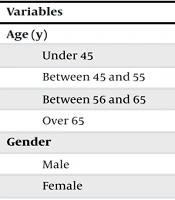
The descriptive findings indicated that 85% and 15% of the respondents were male and female, respectively. Demographic variables of AIDS patients were presented in Table 1. Table 2 indicates the mean ± standard deviation and Pearson correlation coefficients of the research variables.
Table 1.
Demographic Variables of Patients
| Demographic Variables | No. (%) |
|---|---|
| Age (y) | |
| 20 - 30 | 23 (25.27) |
| 30 - 40 | 48 (52.75) |
| 40 - 50 | 20 (21.98) |
| Gender | |
| Male | 77 (84.62) |
| Female | 14 (15.38) |
| Education | |
| Middle school | 63 (69.23) |
| High school | 23 (25.27) |
| College education | 5 (5.50) |
Table 2.
Mean ± Standard Deviation and Pearson Correlation Coefficients of the Research Variables
| Variables | Mean ± Standard Deviation | Pearson Correlation Coefficients |
|---|---|---|
| Death anxiety | 9.07 ± 2.76 | 1 |
| Social support | 63.78 ± 18.05 | -0.506 a |
| Distress tolerance | 37.49 ± 12.91 | -0.645 a |
a P < 0.01
Table 2 reports the correlation coefficients of the research variables. According to the results, social support had a significant negative correlation with death anxiety (r = -0.506). Likewise, distress tolerance had a significant negative correlation with death anxiety (r = -0.645). Furthermore, the simultaneous regression analysis was conducted to determine which research variables had more effective roles in the prediction of death anxiety. For this purpose, social support and distress tolerance were used as predictor variables in the equation, whereas death anxiety was used as a criterion variable (Table 3). According to Table 3, the simultaneous regression analysis results indicate that social support and distress tolerance had multiple significant correlations with death anxiety (R = 0.71, P < 0.001). Moreover, social support (β = -0.31, P < 0.001) and distress tolerance (β = -0.53, P < 0.001) had significant relationships with death anxiety.
Table 3.
Results of Simultaneous Regression Analysis
| Predictor Variables | R | R2 | F | P | B | β | P |
|---|---|---|---|---|---|---|---|
| Social support | 0.71 | 0.50 | 44.15 | 0.001 | -0.05 | -0.31 | 0.001 |
| Distress tolerance | -0.11 | -0.53 | 0.001 | ||||
| Constant | 16.39 | - | 0.001 |
In this study, a neural network was designed and developed in MATLAB. The research question was to what extent death anxiety is predicted by social support and distress tolerance in HIV patients. The data were first divided into a training set (70%), an evaluation set (15%), and a test set (15%) to enter the network. Two inputs and one output were given to the network in an Excel file and a matrix. The best result was obtained from two hidden layers, the first of which contained seven neurons, whereas the second one had one neuron. Figure 1 demonstrates the ANN structure with the best possible estimate.

Figure 1.
The structure of the artificial neural network (ANN) with the best possible estimate
Since the optimal number of training attempts was unclear, the early stopping method was employed to present the evaluation data to the network to only obtain estimates in addition to presenting training data and optimizing the network weights. The training attempts would be made until the error rate reached a small value. Finally, the best iteration rate would be confirmed and selected concerning the minimum value of total training data. Figure 2 depicts the process of training the neural network through the input data. Based on the applied settings, the network stopped after three consecutive attempts were made in the evaluation set error. The network stopped in the 9th iteration. According to Figure 2, the following conclusions can be made:
(1) The final mean square error rate is low.
(2) The test set error rate and the evaluation set error rate share nearly similar characteristics.
(3) No overfitting occurred before the 4th iteration (when the evaluation set had the highest efficiency).
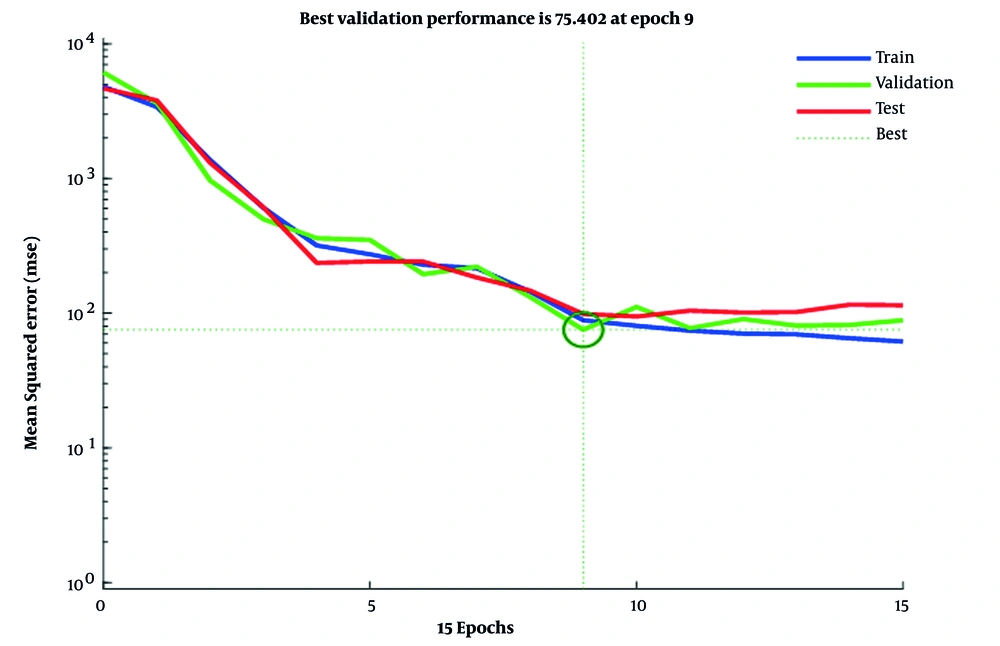
Figure 2.
The process of training the neural network through the input data
Figure 3 demonstrates the diagrams regarding prediction equations in training, evaluation, test, and overall stages. The results indicate the network accuracy in death anxiety prediction presented in the training, evaluation, test, and overall sections. This figure indicates the proximity of the network outputs to the real values. The closer the points to the diagonal axis of the diagram, the closer the outputs to the real values. According to Figure 3, the neural network managed to predict death anxiety with an accuracy of 0.69 in the training stage, where the prediction equation was as below:
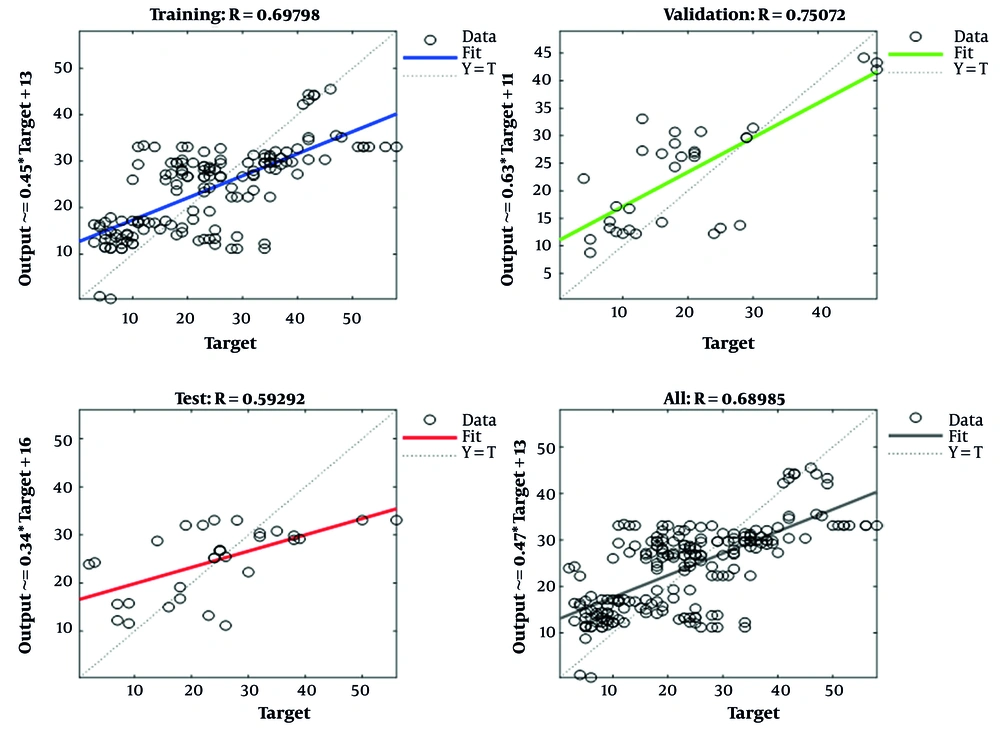
Figure 3.
The regression equation between the mean values of death anxiety and the estimated amount
Moreover, the neural network succeeded in predicting death anxiety with an accuracy of 0.75 in the evaluation stage, where the prediction equation was as below:
Furthermore, the neural network managed to predict death anxiety with an accuracy of 0.59 in the test stage, where the prediction equation was as below:
Overall, the neural network predicted death anxiety with an accuracy of 0.68 through the following prediction equation:
5. Discussion
The present study aimed to investigate the relationship between social support and distress tolerance with death anxiety patients with HIV. According to the first research finding, there was a significant negative relationship between social support and death anxiety in HIV-positive cases. This finding was consistent with the findings of the previous studies (30, 31). Poordad and Momeni (30) reported that perceived social support is negatively related to death anxiety in older adults. Moreover, Bibi and Khalid (31) showed that death anxiety was negatively associated with social support in patients with breast cancer. To explain this finding, we can say that social support is considered an effective factor in people’s mental well-being. Social support is a kind of two-sided help leading to a positive self-image, self-acceptance, self-love, and self-value, all of which can provide an individual with an opportunity for self-actualization and growth. Therefore, patients with further supporters will benefit from higher levels of psychological well-being and experience better quality of life; as a result, their death anxiety decreases (30). Generally, people can enhance their capabilities as values, norms, and social ties in social interactions when they benefit from higher degrees of social support. In this case, they gain control over their lives and enjoy the social support of their communication network. Thus, their psychological well-being will increase (31). Social support is thought to mitigate psychological pressure and minimize the complications of an unpleasant experience by improving the correct perception of stressful events. In addition, social support causes mutual commitments in which individuals feel loved, cared for, self-esteemed, and valued. These feelings directly correlate with the results of psychological well-being and death anxiety reduction.
Another research finding indicated that there was a significant negative relationship between distress tolerance and death anxiety in HIV-positive cases. This finding was consistent with the findings of the previous studies (32-34). Nikcevic et al. (32) reported that five personality factors, consistency and psychological distress had significant relationships with COVID-19 anxiety, death anxiety, and depression in adults. Bala and Maheshwari (33) concluded that death anxiety would exacerbate depression and that psychological well-being would adversely affect distress tolerance and quality of life in the elderly. Ghanbarpoor Ganjari et al. (19) reported that distress tolerance was associated with death anxiety in women with hypertension. To explain this finding, it can be stated that death anxiety is predictable through distress tolerance. The ability to tolerate distress enables people to control their emotions and withstand psychological pressure and confusion in crises; therefore, they can cope with and solve problems. In other words, people with emotional distress are unable to properly control their emotions in traumatic life situations (e.g., HIV contraction) and solve the resultant complications, something which worsens death anxiety. An individual’s tendency to consider the distressful dimensions of a situation (tendency towards proximity or avoidance), to change the meaning of a situation (through overestimation or underestimation), and to try to manipulate the situation (through confrontation) can affect the emergence of distress and enhance or decline distress tolerance. People with low levels of distress tolerance evaluate stressful situations negatively, and their death anxiety worsens because they are unable to tolerate distress (34).
Patients with low levels of distress tolerance do not pursuit specific life goals and have not found substantial meaning in life. They fall apart at the sight of any difficulties and become discouraged. Inflexible to changes in life, they always live in fear which they cannot confront. Hence, they have no resilience in threatening conditions and situations. These people are very vulnerable to problems. They fall apart quickly. In fact, they fail to control and manage their emotions and feelings properly. In critical situations, they feel stressed out and consider themselves disabled victims who cannot reach reliable solutions through problem-solving techniques. In other words, they experience death anxiety (33). Generally, a person experiences various degrees of death anxiety in a lifetime. This kind of experience is naturally more intense in people with incurable or heart-to-treat diseases. Moreover, death anxiety denotes a negative feeling that a person experiences about death and dying. The proposed neural network was evaluated in the training, evaluation, and test stages. According to the results, social support and distress tolerance are considered major factors affecting the prediction of death anxiety, and the proposed neural network managed to properly predict death anxiety in HIV-positive cases.
In this study, a research limitation was the use of convenience sampling. Hence, it was difficult to access sufficient participants due to the COVID-19 pandemic. Various personality traits, personal-familial differences of participants, and their different levels of knowledge and attitudes towards the research variables may have affected the results. Data collection might have been biased. Since the research sample included HIV-positive cases, it is difficult to generalize the results to other groups and populations. Therefore, further studies should be conducted on other samples to generalize the results.
5.1. Conclusions
The research results indicated that social support and distress tolerance had significant relationships with death anxiety in HIV-positive cases. Given the roles of social support and distress tolerance in death anxiety, it is recommended to develop training plans and workshops based on stress alleviation and distress tolerance enhancement to help patients mitigate their death anxiety. The results of this study should also be employed to arrange training courses to help HIV-positive cases know more about AIDS and improve both distress tolerance and social support. According to the findings, responsible institutions should develop necessary plans and platforms for proper access to social support in a bid to better manage and control the disease and create a supportively empowering environment for HIV-positive cases and their families.