
1. Background
Chronic kidney disease (CKD) is a progressive and irreversible decline in renal function (1). Worldwide, the prevalence of CKD is estimated at 242 per one million people, with an annual increase of about 8% (2). In Iran, Dehghani et al. found that among 9781 participants aged 30 to 73 years old, the prevalence of CKD was 27.5% (3). Hemodialysis stands as the most common form of kidney replacement therapy globally (4). Approximately 90% of patients with CKD rely on dialysis to sustain life (5). The dialysis process significantly impacts patients' physical and psychological well-being and daily functioning (6). Happiness appears to play a key role in managing the complications of chronic illnesses (7).
Happiness, a crucial aspect of mental health, significantly influences personality development (8). It encompasses a range of emotions and cognitive assessments of life, reflecting the extent to which an individual views their quality of life positively (9). Happiness is vital for effectively dealing with daily challenges and has numerous benefits (10), including a positive outlook on life, enhanced self-concept, increased vitality, psychological well-being, and improved social and physical performance (11).
Hemodialysis patients often face various physical and psychological challenges in their daily lives (12). Previous research has shown positive associations between higher levels of subjective happiness and increased life satisfaction, a sense of humor, and reduced depression among these patients (13). Mehrabi and Ghazavi noted a significant influence of happiness on stress, anxiety, and depression in hemodialysis patients (14). Furthermore, studies have indicated that individuals with higher happiness levels tend to display greater creativity, adaptability, and hopefulness (15, 16).
Hope plays a crucial role in helping patients with chronic diseases adapt and persevere (17). It acts as a buffer, mitigating the impact of psychological difficulties on quality of life, with more hopeful individuals experiencing less anxiety and a better quality of life (18). For patients undergoing hemodialysis, hope for the future can improve various aspects of their quality of life (19). Snyder highlighted that fostering hope is an effective strategy for improving the quality of life of those living with chronic illnesses (20). Hope motivates patients to adhere to their treatment plans, including invasive procedures, lifestyle changes, and ongoing painful therapies (21).
Previous studies examining the factors correlated with happiness among hemodialysis patients have yielded contradictory findings. While some research has indicated no significant associations between happiness and clinical or sociodemographic variables, other studies have identified significant relationships between happiness and factors such as age, clinical work experience, gender, and marital status (17, 22).
2. Objectives
Given the disparity and mixed outcomes in existing literature, this study was initiated to uncover predictors of happiness in this patient demographic, aiming to illuminate an area in need of further exploration.
3. Methods
3.1. Study Design
This descriptive and cross-sectional study was conducted to identify predictive factors of happiness among hemodialysis patients.
3.2. Study Setting
The study took place in the dialysis department of Bu-Ali Sinai Hospital in Qazvin, located in the northern part of Iran. As the largest referral center in the province, this dialysis center has 40 active beds and serves 846 hemodialysis patients of all ages from various parts of Qazvin province.
3.3. Participants
Two hundred patients from the dialysis department of Bu-Ali Sinai Hospital were selected via a census sampling method based on specific inclusion and exclusion criteria. Participants were required to be willing to participate, aged over 18 years, and have been undergoing hemodialysis for a minimum of six months. Patients with psychological issues, as noted in their medical records, were excluded.
3.4. Sample Size
With a type I error of 0.05 (confidence level of 95%) and a type II error of 0.1, the sample size was determined using the following formula, and accounting for a potential non-response rate of 10%, the final sample size was established at 200.
3.5. Instruments
Data collection employed a demographic and clinical characteristics questionnaire, the Oxford Happiness Questionnaire, and Snyder’s Hope Scale. The demographic and clinical characteristics checklist covered variables such as age, gender, living arrangement, educational level, marital status, employment status, financial status, frequency of dialysis per week, KT/V (dialysis adequacy), and history of hypertension, diabetes mellitus, and kidney transplantation. This questionnaire was developed based on existing literature. Face and content validity were assessed by 12 academic members from the critical care department of Qazvin University of Medical Sciences.
The parameter Kt/V measures the efficacy of a hemodialysis session (dialysis adequacy) by identifying the effective removal of a specific solute (clearance K) resulting from a given treatment (characterized by time t) in a patient (with a specific volume of distribution V for the solute). The Daugirdas formula was employed for Kt/V calculation in this research (23).
The Oxford Happiness Questionnaire, developed by Hills and Argyle (24), assesses an individual's happiness through 29 items. Responses are provided on a four-point Likert scale, ranging from a (0) to d (25), with the total score on the questionnaire ranging from 0 to 87. Scores between 40 and 42 are considered indicative of happiness. The psychometric properties of this questionnaire have been validated in a previous study in Iran (26).
Snyder's Hope Scale, developed by Snyder et al. in 1991 (27), evaluates hope in individuals aged over 15 years. It includes 12 items, answered on a five-point Likert scale from totally disagree to totally agree. The scale has two subscales: Agency (items 2, 9, 10, and 12) and pathway (items 1, 4, 7, and 8) thinking. Items 3, 5, 7, and 11 serve as distractors to obscure the scale's content. Scores range from 8 to 64, with higher scores indicating greater levels of hope. The scale has been validated for use in Persian (28).
3.6. Data Collection
Data were collected from April to May 2021. The main researcher, along with two trained assistants, distributed questionnaires among eligible patients across all weekdays and different shifts, during hemodialysis sessions. Researchers answered any questions from patients at the time of completing the questionnaires, which were then collected.
3.7. Statistical Analysis
Data analysis was conducted using SPSS 20.0. Descriptive statistics, including means and standard deviations (SD) for quantitative data and frequencies and percentages for qualitative data, were utilized. The Pearson correlation coefficient and Spearman's correlation were used to identify variables associated with happiness for continuous and categorical variables, respectively. Univariate regression models were initially run to determine predictor factors of happiness and significant variables were subsequently included in a multivariate regression model. The significance level was set at P < 0.05.
3.8. Ethical Considerations
After discussing the study's aims and sampling methods with the nurse managers of the selected hospital, the necessary permissions were obtained. Sampling permission was given to the head nurse, along with the required explanations. Ethical approval was granted by the Ethics Committee of Qazvin University of Medical Sciences (IR.QUMS.REC.1399.516).
4. Results
In this study, the average age of participants was 59.23 years, with a standard deviation of 14.43, and ages ranged from 18 to 86 years. The majority of participants were male (n = 122, 61.0%) and married (n = 134, 67.0%). Over one-third of the participants were illiterate (n = 72, 36.5%), and more than half reported having a low financial status (n = 105, 52.5%). Hypertension was prevalent among the majority (n = 164, 82.0%), and 60.5% (n = 121) did not achieve satisfactory hemodialysis adequacy. The participants’ demographic characteristics are detailed in Table 1.
Table 1.
Participants' Demographic Characteristics
| Variables and Categories | Values a |
|---|---|
| Sex | |
| Female | 78 (39.0) |
| Male | 122 (61.0) |
| Living arrangement | |
| Alone | 20 (10.0) |
| With family | 180 (90.0) |
| Educational level | |
| Illiterate | 72 (36.5) |
| Under diploma | 77 (38.5) |
| Diploma and higher | 50 (25.0) |
| Financial status | |
| Poor | 105 (52.5) |
| Average | 66 (33.0) |
| Good | 29 (14.5) |
| Employment status | |
| Unemployed | 51 (25.5) |
| Employed | 9 (4.5) |
| Retired | 42 (21.0) |
| Housewife | 61 (30.5) |
| Nongovernmental | 37 (18.5) |
| Marital status | |
| Single | 18 (9.0) |
| Married | 134 (67.0) |
| Widowed | 48 (24.0) |
| Number of dialysis (per week) | |
| Twice | 10 (5.0) |
| Three times | 190 (95.0) |
| Hypertension | |
| No | 36 (18.0) |
| Yes | 164 (82.0) |
| Diabetes mellitus | |
| No | 83 (51.5) |
| Yes | 117 (58.5) |
| Kt/V | |
| No | 121 (60.5) |
| Yes | 79 (39.5) |
a Values are expressed as No (%).
According to the findings, most respondents had moderate levels of happiness (n = 138, 69%), while only 18.5% (n = 37) experienced high or very high levels of happiness. Additionally, 12.5% (n = 25) of the patients reported low levels of happiness. The average happiness score was 33.16, with a standard deviation of 10.64.
4.1. Correlated Factors of Happiness
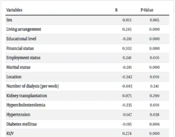
To examine the relationships between variables, both Pearson correlation coefficient and Spearman's correlation analyses were conducted. The results of these analyses are presented in Table 2.
Table 2.
Associations of Happiness with Other Variables in This Study
| Variables | R | P-Value |
|---|---|---|
| Sex | 0.012 | 0.865 |
| Living arrangement | 0.245 | 0.000 |
| Educational level | -0.281 | 0.000 |
| Financial status | 0.302 | 0.000 |
| Employment status | 0.241 | 0.001 |
| Marital status | -0.281 | 0.000 |
| Location | -0.242 | 0.001 |
| Number of dialysis (per week) | -0.083 | 0.241 |
| Kidney transplantation | 0.075 | 0.290 |
| Hypercholesterolemia | -0.235 | 0.001 |
| Hypertension | -0.147 | 0.038 |
| Diabetes mellitus | -0.195 | 0.006 |
| Kt/V | 0.274 | 0.000 |
| Hope | 0.388 | 0.000 |
4.2. Predictors of Happiness
The multivariate analysis model indicated that marital status, educational level, Kt/V, and hope were significant predictors of happiness (Table 3). Participants living alone reported lower levels of happiness compared to those living with their families. Additionally, participants with educational achievements (under diploma, diploma, and higher degrees) were happier than illiterate participants. Those with satisfactory hemodialysis adequacy also reported higher levels of happiness compared to their counterparts. Furthermore, higher levels of hope (β = 0.231, 95% CI = 0.24 to 0.78, P ≤ 0.001) and higher Kt/V (β = 0.268, 95% CI = 3.38 to 8.26, P ≤ 0.001) were associated with increased happiness. Ultimately, these variables explained 47.2% of the variance in happiness among hemodialysis patients.
Table 3.
Predictors for Happiness Among Patients Undergoing Hemodialysis
| Variables | Mean ± SD | Adjusted β | Adjusted P-Value (95% CI) |
|---|---|---|---|
| Marital status | |||
| Single | 30.67 ± 7.95 | -0.268 | 0.000 (-14.61, -5.29) |
| Married | 36.17 ± 10.28 | - | - |
| Widow | 25.71 ± 8.53 | -0.144 | 0.050 (-7.16, -0.001) |
| Employment status | |||
| Unemployed | 28.70 ± 12.32 | - | - |
| Employed | 37.11 ± 8.62 | 0.029 | 0.697 (-5.49, 8.19) |
| Housewife | 32.38 ± 8.65 | 0.069 | 0.351 (-1.76, 4.93) |
| Retired | 32.88 ± 9.80 | 0.104 | 0.332 (-2.79, 8.19) |
| Nongovernmental | 39.81 ± 9.34 | 0.182 | 0.093 (-0.84, 10.78) |
| Educational level | |||
| Illiterate | 26.79 ± 9.43 | - | - |
| Under diploma | 35.10 ± 8.96 | 0.167 | 0.029 (0.37, 6.93) |
| Diploma and higher | 39.46 ± 9.91 | 0.248 | 0.010 (1.45, 10.73) |
| Financial status | |||
| Low | 30.25 ± 9.66 | - | - |
| Middle | 35.86 ± 11.58 | -0.034 | 0.749 (-5.44,3.92) |
| High | 37.55 ± 8.82 | -0.089 | 0.38 (-8.70, 3.35) |
| Living arrangement | |||
| Alone | 25.40 ± 7.92 | 0.005 | 0.934 (-4.34, 4.73) |
| With family | 34.02 ± 10.52 | - | - |
| Location | |||
| City | 34.50 ± 10.33 | - | - |
| Village | 28.11 ± 10.40 | -0.062 | 0.329 (-4.85, 1.63) |
| Hypertension | |||
| No | 37.58 ± 12.97 | - | - |
| Yes | 32.19 ± 9.83 | -0.080 | 0.188 (-5.53, 1.09) |
| Diabetes mellitus | |||
| No | 35.71 ± 11.53 | - | - |
| Yes | 31.35 ± 9.61 | -0.047 | 0.46 (-3.73, 1.72) |
| Hypercholesterolemia | |||
| No | 34.97 ± 10.51 | - | - |
| Yes | 29.48 ± 10.01 | -0.055 | 0.413 (-4.21, 1.73) |
| Kt/V | |||
| No | 30.79 ± 10.18 | 0.268 | 0.000 (3.38, 8.26) |
| Yes | 36.80 ± 10.37 | 10.37 | |
| Age (range: 18 – 86 years) | 59.23 ± 14.43 | -0.098 | 0.255 (-0.97, 0.05) |
| Hope (range: 31 - 64) | 46.43 ± 4.81 | 0.231 | 0.000 (0.24, 0.78) |
5. Discussion
This study aimed to identify the predictors of happiness among hemodialysis patients. A significant portion of the patients (69%, n = 138) reported a moderate level of happiness. Moreover, the findings indicated that educational level, marital status, hemodialysis adequacy, and hope were significant predictors of happiness in this patient group.
The majority of patients expressed low to moderate levels of happiness (81.5%, n = 163), potentially due to the challenges of undergoing dialysis several times a week, consuming large quantities of medication, facing economic burdens, and experiencing reduced social interactions. These factors align with previous research highlighting the impact of hemodialysis on patients' lives and psychological stressors that may diminish well-being and quality of life (13, 29). Bautovich et al. also noted that depression is a common issue among CDK patients and is associated with a significant risk of adverse outcomes (30).
Marital status emerged as a significant happiness predictor among hemodialysis patients. Studies by Strobel et al. and Stack and Eshleman suggest that married individuals report higher happiness levels (31, 32), whereas Sheikhmoonesi et al. (33) found no significant correlation between happiness and marital status among medical students. The positive effect of marriage on happiness could be attributed to the sense of belonging and emotional support that married individuals experience, potentially leading to a depression-free state and improved quality of life (34, 35). Moreover, married individuals may face less life pressure than their single or widowed counterparts (36). It's important to note that marriage's impact on quality of life can vary across different societies, influenced by cultural and social conditions.
Educational level played a significant role in predicting happiness, with higher education levels associated with increased happiness, whereas lower education levels, especially among illiterate individuals, corresponded with reduced happiness levels. This is consistent with findings from Saavedra and Azizi et al. (37, 38), which showed a significant association between happiness and educational level. Higher education fosters a unique mental capability that helps individuals better manage concerns related to hemodialysis, thereby enhancing their happiness.
Hope was identified as a strong predictor of happiness among hemodialysis patients, with studies by Farnia et al. (39), Billington et al. (40), and Rahimipour et al. (41) highlighting hope's role as a protective factor against anxiety and depression. Higher hope levels contribute to improved mood and mental well-being, helping hemodialysis patients cope with existential challenges and distress by fostering optimism about the future. Hopeful patients are more likely to employ problem-solving skills effectively (42, 43). Pasyar et al. further confirmed hope as a powerful coping strategy in patients with chronic diseases, enabling them to navigate the challenges associated with their condition effectively (44).
Based on the findings of this study, hemodialysis adequacy emerged as another predictor of happiness. Hasani et al. observed that patients with higher dialysis adequacy exhibited better psychological conditions compared to their counterparts (45). Al Awwa and Jallad also noted a significant inverse relationship between depression and hemodialysis adequacy (46). Optimal hemodialysis adequacy, leading to reduced accumulation of metabolites in the body and improved electrolyte balance, may contribute to more stable moods in patients.
One limitation of this study is its cross-sectional design, which constrains our ability to establish causal relationships between variables. Despite the study being conducted entirely on a voluntary basis with assurances of confidentiality, there remains a possibility that participants' responses could be biased, especially when providing sensitive information about their conditions. This is a common limitation of self-report questionnaires, where there might be a risk of receiving inaccurate responses.
5.1. Conclusions
The study found that most hemodialysis patients in Iran experience a moderate level of happiness. It also identified several factors that influence happiness among hemodialysis patients, including marital status, education level, hope, and hemodialysis adequacy, as significant predictors. These findings offer valuable insights for policy-makers and health managers to enhance the happiness of this patient group. Future research should aim to develop effective interventions to promote the mental health and happiness of hemodialysis patients.