
1. Background
Today, with the development of technology and communication, the mobile phone has become one of the most widely used tools in the world of technology. This tool, which is used intensively and in every age group, has become a necessity and a habit in the daily life of humans (1). Mobile phones have advantages, such as ease of accessibility, increased social communication, messaging, online games, and access to the Internet and social networks (2). However, in addition to these advantages, the excessive use of mobile phones causes problems, such as tension and fatigue (3), sleep disorders, irritability, auditory hallucinations, anxiety, depression, decreased emotions, and other physical and mental health problems (4-6).
Despite the advantages of mobile phones, the long-term use of them has led to dependence on them and addiction to using them, which is one of the most common issues related to mobile phones (2). Mobile phone addiction is a type of addiction to technology that a person has no control over and uses indiscriminately and is associated with symptoms, such as lack of control over emotions, anxiety, and inability to stay away and not use the phone (6).
The prevalence of mobile phone addiction among students has varied from 16.5% to 62.6%. Due to the high number of mobile phone addiction and the serious adverse consequences resulting from it, this issue has become a global problem (7-9). One of the most important risk factors for mobile phone addiction in medical students is being female, living in the city, having a romantic relationship, and multiple use of chat and conversation programs (7).
Numerous studies have demonstrated the serious negative effects of cell phone addiction, which include issues with sleep, relationships with others, psychological issues, and physical issues (5, 10, 11) because these individuals are more likely to conceal their genuine emotions and rely more heavily on media, such as cell phones. The theory of compensation (reward) states that individuals who are experiencing difficult circumstances might turn more to online contact as a coping mechanism (12). Addiction to mobile phones in students affects even their academic performance and causes them to drop academically (13) and is associated with many mental disorders, such as alexithymia, depression, stress, and anxiety, in the long term (14).
Alexithymia, as a cognitive-emotional phenomenon, refers to a specific disorder in psychological functioning and regulation of individual emotions and feelings, which occurs as a result of the process of automatic inhibition of information and emotional feelings (15, 16). Individuals suffering from alexithymia are anxious, have stereotyped thoughts, are inflexible and withdrawn, often have a formal face, have difficulty identifying emotions from other individuals’ faces, and have a weak ability for empathy and self-awareness (16). Additionally, according to some researchers, alexithymia causes many problems, such as depression, anxiety, and stress, in a person (15, 17, 18).
According to the findings of a study on the connection between emotional inadequacy and negative emotions, adolescents with varying degrees of emotional inadequacy exhibit significantly different depression symptoms. As emotional inadequacy symptoms increase, the individuals’ negative emotions increase (19). Ivanova et al.'s study, which looked at the connection between students' levels of depression and mobile phone addiction, discovered that the more the addiction, the higher the depression (20). Furthermore, alexithymia is a significant predictor of anxiety, and reducing it can reduce anxiety symptoms (21-23). In this regard, based on research, anxiety is also related to mobile addiction. A study of 269 Taiwanese students showed that anxiety has a positive relationship with mobile phone addiction (21).
Various studies showed the correlation between alexithymia, depression, stress, and mobile phone addiction. Moreover, depression and anxiety play a role as mediators between alexithymia and mobile phone addiction. Individuals with symptoms of depression and alexithymia have problems identifying and describing their feelings. They have a poor ability to deal with stressful situations and have a greater tendency to use mobile phones in an unusual way (9, 14, 24, 25). On the other hand, in another study conducted by Gao et al., it was shown that alexithymia is considered a predictor of mobile phone addiction, although it does not directly cause it. However, mediators, such as depression, anxiety, and stress, cause this connection (14).
Few studies have been conducted on the connection between emotional dysfunction and cell phone addiction, as well as the function of stress, anxiety, and depression (26, 27). However, in the studies conducted, there is a correlation and relationship between the stated variables (14, 25). However, it has not been investigated in medical students in Iran.
2. Objectives
Due to the increase in mobile phone addiction and the aforementioned complications caused by it and its relationship with some mental health problems, the researchers decided to conduct a study to determine the relationship between alexithymia, depression, anxiety, and stress with mobile phone addiction in operating rooms, nursing and midwifery students in Ahvaz city, Iran.
3. Methods
3.1. Population and Sampling
This was a cross-sectional and correlational study, and the convenience sampling method was carried out on 412 undergraduate students of the School of Nursing and Midwifery of Jundishapur University of Medical Sciences, Ahvaz, Iran, in 2 months (from the beginning of November to the beginning of December), in 2019. After obtaining the code of ethics from Jundishapur University of Medical Sciences, the researcher distributed the relevant questionnaires to the students through advertisements and visiting the classrooms in person, and the questionnaires were completed by the students in the classroom. Before distributing the questionnaire to the students, the necessary explanations about the study, how to answer the questions, voluntary participation in the study, and obtaining informed consent from the research subjects were done by the researcher. The response time for each person was 40 minutes. After the student completed each questionnaire, the researcher examined the questionnaires in terms of defects in answering, and if the questionnaire was incomplete, the individual's questionnaire was removed from the study. Finally, to compensate the students for wasting their time in completing the questionnaires, the research team gave a small gift to the students.
3.2. Designing Models and Evaluating
To evaluate the effect of mediating variables, three conditions must be met as follows:
(1) The independent variable must have a significant effect on the dependent variable.
(2) The independent variable must be effective on the mediating variables.
(3) Mediating variables must be effective on the dependent variable.
In this study, the variables of anxiety, depression, and stress were considered mediating variables. To investigate the indirect effects of the independent variable (alexithymia) on the dependent variable (cell phone addiction), mediating variables and whether the variables considered mediating play the role of a complete or partial mediating variable. Path analysis and structural equation modeling were used for this purpose. Based on Gao's study, three hypothetical models were designed using Amos software (version 16) and then evaluated using the path analysis method based on multivariate regression analysis.
The first model: The independent variable (alexithymia) is significantly effective on the dependent variable (cell phone addiction).
The second model: The independent variable (alexithymia) is significantly related to the mediating variables, i.e., depression, anxiety, and stress.
The third model: Mediating variables (i.e., depression, anxiety, and stress) are significantly effective on mobile phone addiction. Then, the models were tested.
3.3. Measurements
The demographic questionnaire included age, gender, academic semester, father's occupation, place of residence (dormitory/native), last semester's grade point average (GPA), and marital status, the validity and reliability of which were confirmed by professors.
3.3.1. Toronto Alexithymia Scale (TAS-20)
The initial form of this scale has 26 items that were created in 1985 by Taylor, Raine, and Bagby (28) and revised in 1994 by Bagby, Taylor, and Parker and turned into a 20-item form (29). The Toronto scale of emotional dyslexia has 20 items, and its scoring is based on a five-point Likert scale (from 1 for "completely disagree" to 5 for "completely agree"). In this scale, by summing the scores of 20 items, a total score for the emotional dyslexia scale is obtained. The minimum and maximum scores for this scale are 20 and 100, respectively. The scale of emotional dyslexia has three subscales: Difficulty identifying feeling (DIF), difficulty describing feeling (DDF), and externally oriented thinking (EOT). Ghasminejad also used this scale during research (78 individuals) on patients with asthma and compared it to normal individuals. Moreover, its reliability was determined using Cronbach's alpha method for the total scale score of 0.71, 0.60 for difficulty in describing emotions, 0.72 for difficulty in recognizing emotions, and 0.51 for objective thinking (30).
3.3.2. Depression, Anxiety, Stress Scale
The Depression, Anxiety, Stress Scale (DASS-21) contains 21 items that are related to the symptoms of negative emotions (i.e., depression, anxiety, and stress). Each of the DASS-21 subscales consists of 7 items, the final score of each of which is obtained through the sum of the scores of the related questions. Each item ranges from 0 (does not apply to me at all) to 3 (completely applies to me) and is graded (31). In Nikazin and Nayinian's study, Cronbach's alpha coefficients for the dimensions of depression, anxiety, and stress were 70%, 84%, and 82%, respectively, and the retest coefficients for the mentioned dimensions were 79%, 67%, and 64%, respectively, which is acceptable (32).
3.3.3. Mobile Phone Addiction Index
It is a 17-item self-report instrument that was first developed by Long (2007). The Mobile Phone Addiction Index (MPAI) is a 5-point Likert scale, which is evaluated in 4 areas with the titles of inability to control desires with 7 test items, anxiety and lostness with 5 test items, and withdrawal or escape with 3 test items, and loss of creativity with 2 test items (33). The scoring method in this questionnaire is based on the Likert scale from never (score 1) to always (score 5) (8). This tool was translated into Farsi. The correlation coefficient (r = 0.30, P < 0.04) and the internal consistency reliability for the aforementioned subscales were 0.83, 0.80, and 0.62, respectively, and for the whole test was 0.9. (33). In addition, Long reported its reliability as 0.83 using the internal consistency method (34).
3.4. Data Analysis
Pearson's correlation coefficient test and linear regression were used to describe the collected data. In this study, a path analysis model was fitted to the data to determine the relationship between the variables of alexithymia, stress anxiety, depression, and cell phone addiction. In path analysis, a theoretical model is put to the test, and finally, with the implementation of the analysis, this theoretical model leads to an experimental model. As a result, building causal relationships between variables in the experimental model derived from path analysis is normal. The concept that emerges from the theoretical framework is distinct, along with the theoretical model. When the path analysis is applied, variables whose beta value is not significantly less than 0.05 are typically eliminated from the model (35). In the path analysis, both cause and effect variables can be measured. The correlation coefficient of each cause-and-effect variable is divided into two parts, including direct and indirect effects. It is for this reason that the correlation coefficient should not be the basis of judgment alone. Additionally, the existence of a correlation between two variables might be due to the existence of another variable that has affected both variables and caused a correlation between two variables, and there is no cause-and-effect relationship between those two variables (36). Considering that alexithymia and mobile phone addiction are multidimensional factors and each of these dimensions affects the other, to investigate the direct and indirect effects of alexithymia on cell phone addiction with the mediation of stress, depression, and structural equation models (14) and path analysis method were used for anxiety. Statistical analysis was performed using SPSS software (version 22) and Amos software (version 16). A significance level of less than 0.05 was considered statistically significant.
4. Results
Among the 412 students who participated in the research, most of them were female (n = 354, 85.9%), single (n = 360, 87.4%), and lived in a dormitory (n=348, 84.5%). The samples were between 21 and 32 years old (21.30 ± 1.74). Almost half of the subjects were studying nursing (n = 205, 49.8%) and were in their second year (n = 183, 44.4%). Additional information and other demographic characteristics can be observed in Table 1.
Table 1.
Demographic Variables of Students
| Variables | No. (%) |
|---|---|
| Gender | |
| Male | 58 (14.1) |
| Female | 354 (85.9) |
| Academic (y) | |
| One | 6 (1.5) |
| Two | 183 (44.4) |
| Three | 154 (37.4) |
| Four | 69 (16.7) |
| Father's job | |
| Self-employment | 160 (38.8) |
| Employee | 180 (43.7) |
| Retired | 61 (14.8) |
| Unemployed | 11 (2.7) |
| Residence | |
| Dorm | 348 (84.5) |
| Private house | 64 (15.5) |
| Grade point average | |
| Less than 14 | 50 (12.1) |
| Between 14 and 15.99 | 125 (30.3) |
| Between 16 and 17 | 169 (41.0) |
| More than 17 | 68 (16.5) |
| Field under study | |
| Nursing | 205 (49.8) |
| Midwife | 115 (27.9) |
| Operation room (surgical technologist) | 92 (22.3) |
| Marital status | |
| Single | 361 (87.4) |
| Married | 51 (12.6) |
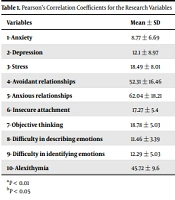
Based on the results of the Pearson correlation test, all variables were related (P < 0.05) (Table 2).
Table 2.
Mean, Standard Deviation, and Pearson Correlation Matrix Between Study Variables
| Variables | 1 | 2 | 3 | 4 | 5 | 6 | 7 | 8 | 9 | 10 |
|---|---|---|---|---|---|---|---|---|---|---|
| 1. Difficulty in identifying feelings | 1 | |||||||||
| 2. Difficulty in describing feelings | 0.60 a | 1 | ||||||||
| 3. Externally oriented thinking | 0.48 a | 0.42 a | 1 | |||||||
| 4. Depression | 0.18 a | 0.11 a | 0.02 a | 1 | ||||||
| 5. Anxiety | 0.30 a | -0.007 a | 0.12 a | 0.01 a | 1 | |||||
| 6. Stress | 0.36 a | 0.36 a | 0.39 a | -0.04 a | 0.01 a | 1 | ||||
| 7. Inability to control craving | -0.64 a | -0.48 a | -0.52 a | -0.15 a | -0.05 a | -0.44 a | 1 | |||
| 8. Feeling anxious and lost | -0.54 a | -0.47 a | -0.52 a | -0.05 a | -0.36 a | -0.36 a | 0.647 a | 1 | ||
| 9. Withdrawal or escape | -0.43 a | -0.35 a | -0.33 a | -0.07 a | -0.30 a | -0.30 a | 0.51 a | 0.44 a | 1 | |
| 10. Productivity loss | -0.56 a | -0.45 a | -0.45 a | -0.16 a | -0.36 a | -0.36 a | 0.671 a | 0.63 a | 0.50 a | 1 |
a P < 0.01.
In this way, alexithymia, depression, anxiety, and stress were considered the independent and predictor variables, and cell phone addiction subscales were considered the dependent variables. Based on the results, alexithymia, depression, anxiety, and stress significantly predicted the subscales of mobile phone addiction (Table 3).
Table 3.
Relationship Between Alexithymia, Depression, Anxiety, and Stress as Predictive Variables of Cell Phone Addiction Using Linear Regression
| Predictors and Dependent Variables | B | β | t |
|---|---|---|---|
| Inability to control craving | |||
| Alexithymia | 0.39 | 0.58 | 14.672 a |
| Depression | 0.46 | 0.38 | 12.750 a |
| Anxiety | 0.45 | 0.34 | 12.895 a |
| Stress | 0.50 | 0.39 | 15.034 a |
| Feeling anxious and lost | |||
| Alexithymia | 0.33 | 0.58 | 13.723 a |
| Depression | 0.37 | 0.25 | 11.405 a |
| Anxiety | 0.43 | 0.32 | 12.104 a |
| Stress | 0.40 | 0.31 | 11.280 a |
| Withdrawal or escape | |||
| Alexithymia | 0.13 | 0.40 | 8.116 a |
| Depression | 0.20 | 0.24 | 9.203 a |
| Anxiety | 0.22 | 0.25 | 9.508 a |
| Stress | 0.11 | 0.15 | 6.842 a |
| Productivity loss | |||
| Alexithymia | 0.10 | 0.04 | 10.390 a |
| Depression | 0.22 | 0.36 | 11.220 a |
| Anxiety | 0.10 | 0.22 | 11.194 a |
| Stress | 0.24 | 0.39 | 12.930 a |
a P < 0.001.
The results showed that in the first model, alexithymia was significantly effective in mobile phone addiction (β = 0.360, P < 0.001β).). Anxiety (β = 0.500, P < 0.001β), and stress (β = 0.53, P < 0.001) were effective, and in the third model, mediating variables (i.e., depression, anxiety, and stress) were significantly effective in mobile phone addiction (depression: β = 0.452, P < 0.001, anxiety: β = 0.408, P < 0.001, stress: β = 0.460, P < 0.001). It should be noted that following the inclusion of depression, anxiety, and stress in the model, the rate of cell phone addiction increased from 10.6% to 18%, 21%, and 22.3%, respectively. Therefore, the mediating role of these three variables was confirmed. In examining the mediating effect of mediating variables, it should be mentioned that the effect of depression was 67.8% = 0.540 × 0.452/0.36, the effect of anxiety was 56.66% = 0.500 × 0.408/0.36, and the effect of stress was 0.530 × 0.460/0.36 = 67.72%. Moreover, the mediating variables increased the rate of cell phone addiction. Although the standard regression coefficient of alexithymia on mobile phone addiction in the presence of mediating variables decreased from 0.36 to 0.135, 0.128, and 0.170, respectively, it was still significant. Therefore, it can be concluded that the aforementioned mediating variables had a relative mediating role; nevertheless, if mediating variables were included, the effect of the independent variable on the dependent variable would become insignificant. Then, these variables played the role of full mediating variables. Goodness of fit indices were performed for all models, and as shown in Table 4, they were suitable for all models. Additionally, mediation models are shown in Figures 1 to 3.
Table 4.
Goodness Indicators of the Research Model
| Model | χ2/df | NFI | TAG | CFI | RMSEA | Interpretation |
|---|---|---|---|---|---|---|
| Model 1 | 2.78 | 0.98 | 0.98 | 0.98 | 0.03 | Acceptable fit |
| Model 2 | 2.72 | 0.97 | 0.97 | 0.98 | 0.04 | Acceptable fit |
| Model 3 | 2.10 | 0.97 | 0.99 | 0.97 | 0.03 | Acceptable fit |
Abbreviations: NFI, normed fit index; CFI, comparative fit index; RMSEA, root mean squared error of approximation; TAG, Tucker-Lewis index.
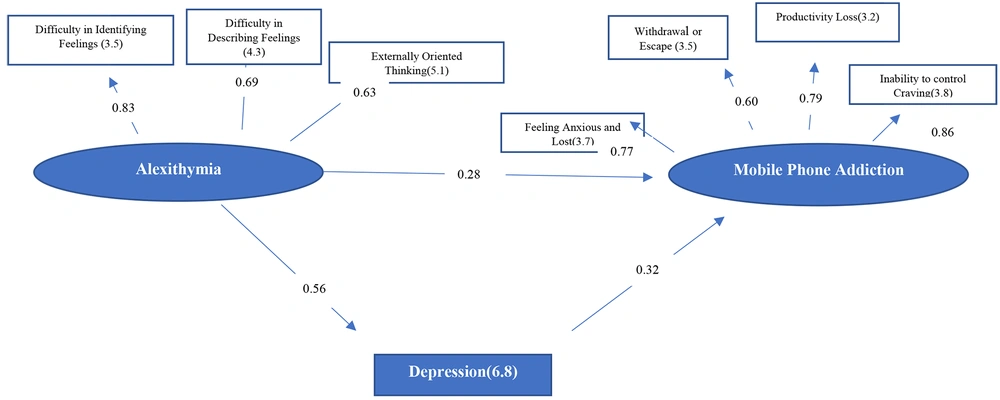
Figure 1.
The indirect effect of alexithymia on cell phone addiction through depression based on Gao's model.
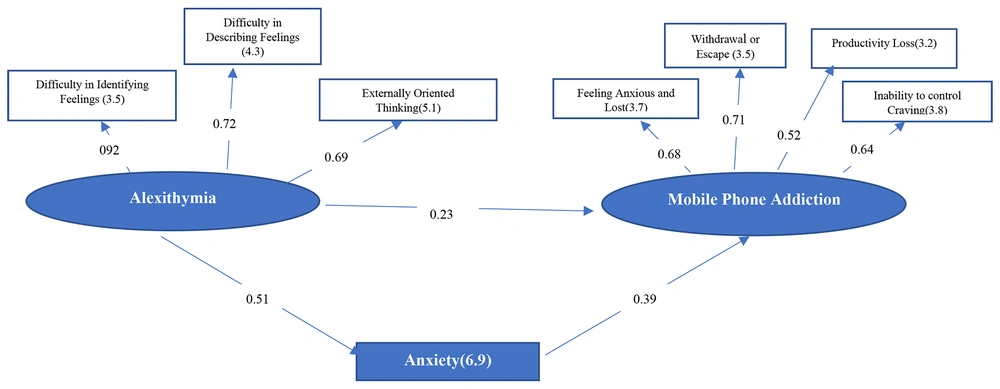
Figure 2.
The indirect effect of alexithymia on cell phone addiction through anxiety based on Gao's model.
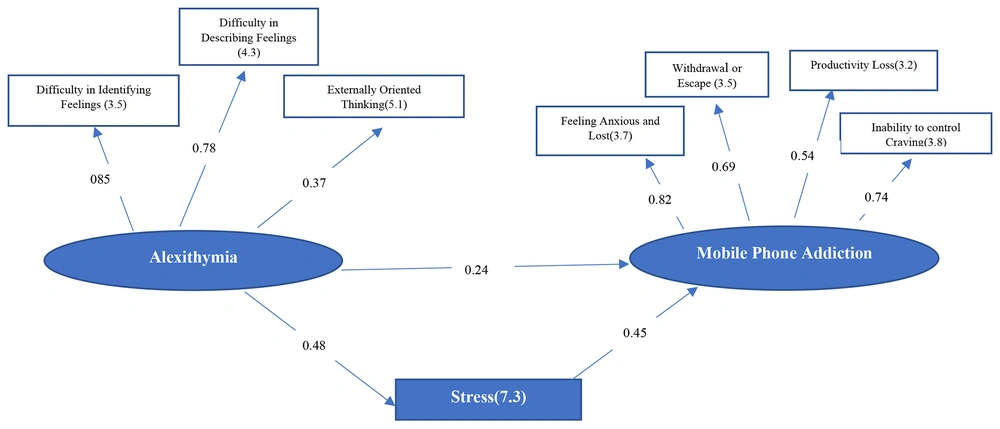
Figure 3.
The indirect effect of alexithymia on cell phone addiction through stress based on Gao's model.
5. Discussion
The results of the present study showed that alexithymia has a direct and positive effect on Internet addiction. Individuals who have alexithymia have problems in describing and recognizing their own emotions and recognizing emotions in others’ faces and somehow have problems in face-to-face communication with others (16). Furthermore, as previous studies have confirmed, it can be expected that communicating with others in virtual space is a refuge (17, 37, 38).
Alexithymia was also related to variables, such as depression, anxiety, and stress. The results of a study showed that there is a significant difference in depression symptoms in teenagers with different levels of alexithymia; with the increase in emotional distress symptoms, individuals showed more negative emotions (19). Individuals suffering from alexithymia are anxious, have stereotyped thoughts, are inflexible and withdrawn, and have a weak talent for empathy and self-awareness, and because these individuals are more willing to cover and hide their true feelings. According to compensation (reward) theory, negative life circumstances can increase the turn to online communication to reduce negative emotions. Similar studies confirm the aforementioned result (15, 17, 18).
The results of the present study also showed a significant relationship between depression, anxiety, and stress with cell phone addiction. This is similar to the results of other studies in this field, which showed that individuals who have depression, anxiety, or stress are more likely to be addicted to mobile phones than others (39, 40). In addition, alexithymia, depression, anxiety, and stress have a significant predictive effect on the inability to control desires, anxiety and confusion, withdrawal or escape loss of creativity, and finally, addiction to the whole phone; therefore, they lead the person to addiction to the mobile phone. This result is consistent with the results of Gao et al. 's study (14). In other words, if the students have alexithymia, this inability to understand the feelings and recognize the emotions of others, as well as the inability to empathize with others, causes the communication between the student and the individuals around him to become less and less over time, and to compensate for this deficiency, they use mobile phones and the Internet. However, this type of communication is not only not as effective as communication in the real world; nevertheless, it only causes addiction to mobile phones, creates a vicious cycle, and can worsen alexithymia due to more withdrawal from communication in the real world due to Internet addiction.
Based on the results of the present study, depression, anxiety, and stress play the role of a relative mediating variable between alexithymia and cell phone addiction because, with the inclusion of these variables, the standard regression coefficient between alexithymia and mobile phone addiction decreased but remained significant, which is similar to the results obtained from Gao et al. 's study (14) with the difference that in the mentioned study the mediating effect of stress and then anxiety and finally depression was greater; nevertheless, in the present study, the mediating effect of depression was greater than the other two variables and anxiety and stress were close to were also most of the participants in this study were dormitory students , and these students might experience more depression due to being away from their family and place of residence.
In addition, in a study by Dalbudak et al., who investigated the relationship between depression and Internet addiction, alexithymia has been considered a mediating variable between depression and Internet addiction. Dalbudak et al. reported that students are more likely to become addicted to the Internet if they have more symptoms of alexithymia and depression (41). Determining the role of variables and determining the cause-and-effect relationship between them has always been challenging in studies related to Internet addiction. For example, Internet addiction causes depression or vice versa; the necessity of conducting further studies using longitudinal studies can help clarify the severity of this issue. Therefore, considering the increase in Internet addiction, especially among students who are considered to be the generation of the future, and the destructive effect that Internet addiction has on their academic performance, to reduce and prevent Internet addiction instead of focusing on reducing the use of mobile phones and limiting the time of use and access to it, it seems that the main focus should be on serious investigation of alexithymia, depression, anxiety and stress in students and the way solutions help reduce these factors. For example, the psychological assessment of students upon entering the university, considering regular counseling for them during their studies, especially for students who live in the dormitory, and solving such problems in time can help prevent mobile phone addiction.
5.1. Conclusions
Alexithymia is a predictor variable for mobile phone addiction. Moreover, variables such as depression, anxiety, and stress play the role of mediating variables between these two variables. Paying attention to alexithymia among students is an important issue that should be considered by health professionals and university managers due to the increase in Internet addiction among them.