
1. Background
Autism spectrum disorder (ASD) is a neurodevelopmental disorder characterized by core clinical features, including difficulties in social communication, restricted interests, and repetitive behaviors (1). These symptoms often emerge early in development (2). ASD has adverse effects on families, including high levels of anxiety, stress, uncertainty, and social isolation among parents and siblings of affected children (3). According to reports, the prevalence of ASD among children in the United States in 2023 was estimated at 1 in 36 births (4). Recent studies have shown that the prevalence of ASD among 8-year-old children in the United States is approximately 1 in 31, with prevalence being more than three times higher in boys than in girls (5). To date, no population-based study has reported the prevalence of ASD among children in Pakistan.
Within Maslow’s hierarchy of needs, sleep is one of the most fundamental human needs, including for children, and plays a critical role in growth hormone secretion, physical growth, and weight gain (6). Reports indicate that 80% of children with ASD experience sleep problems, whereas this figure decreases to 20% - 40% among typically developing children (7). Sleep problems in children with autism are often severe and include difficulties in falling asleep, maintaining sleep throughout the night, frequent nighttime awakenings, early morning awakening, irregular sleep patterns, and nocturnal enuresis, which may persist into adolescence and adulthood. Furthermore, a child’s sleep disturbances can negatively affect the sleep of other family members, leading to increased stress and irritability (8).
Depending on the age of the individual with ASD, various approaches have been developed to reduce symptoms and improve functioning. One such approach is music therapy, which helps individuals with various challenges achieve mental and physical well-being (9). Music therapy is a complementary treatment method that addresses cognitive, emotional, and social needs. It promotes relaxation, joy, and healing, thereby reducing maladaptive behaviors and enhancing health and adaptive behaviors (10). Music strengthens memory through mental imagery and, because of its inherent energy, movement, and appeal, captures attention, making it a useful tool in psychotherapeutic interventions (11).
Evidence suggests that music therapy can reduce difficulties faced by children with ASD through mirror neurons (12, 13). Musical activities can enhance reciprocal and conscious responses in children with autism, such as increasing verbal communication, improving social and interpersonal skills, promoting eye contact, facilitating oral responses, enhancing environmental awareness, and encouraging appropriate social behaviors (14).
Given the lack of local and applied research on the effectiveness of music therapy on sleep in children with ASD in Pakistan, conducting this study can serve as an important step toward developing complementary therapies, improving the quality of life of these children, and reducing the psychological burden on their families. Additionally, the findings of this study can inform policymakers, therapists, and specialized treatment centers in designing targeted intervention programs.
2. Objectives
This study aimed to determine the effect of music therapy on sleep quality in children aged 4 - 12 years with autism in Pakistan.
3. Methods
This study was a quasi-experimental design with a pretest-posttest control group, conducted to examine the effect of music therapy on sleep quality in children aged 4 - 12 years with autism spectrum disorder. The study population included all eligible children aged 4 - 12 years with ASD who were referred to autism centers in Lahore, Pakistan, in 2026. The sample size was calculated using the following formula: n = (Nz²pq) / (Nd² + z²pq). z is the standard normal deviate corresponding to a 95% confidence level (z = 1.96), p is the estimated proportion of the attribute (p = 0.5), q = 1 − p (q = 0.5), and d is the margin of error (d = 0.05). Based on this calculation, the final sample size was estimated to be 80 participants.
A total of 80 eligible children were recruited using a convenience sampling method. After confirming eligibility, participants were assigned to either the intervention group (n = 40) or the control group (n = 40) using a simple lottery method. Specifically, equal numbers of cards labeled intervention and control were placed in a container, and each participant drew one card to determine group assignment. The allocation process was conducted by a research assistant who was not involved in outcome assessment. Due to the nature of the study design, allocation concealment was not feasible; however, assignment was performed only after enrollment to minimize selection bias. Baseline characteristics of the two groups were compared to assess their initial comparability.
Inclusion criteria were a confirmed diagnosis of autism for at least one year based on medical records, presence of sleep disturbances as determined by the score on the Children’s Sleep Habits Questionnaire, ability to understand and follow simple instructions, and absence of conditions such as blindness or deafness. Exclusion criteria included unwillingness to continue participation or the emergence of new physical or psychological problems during the study period.
Of the 80 eligible children, all were assigned to the intervention group (n = 40) or control group (n = 40). No participants withdrew or were excluded after allocation during the intervention, post-test, or follow-up assessments. Therefore, the analyzed sample was identical to the enrolled sample at all stages.
Data were collected using a demographic questionnaire (age, birth order, gender, mother’s age, father’s age, mother’s education, father’s education, mother’s occupation, father’s occupation, and number of children in the family) and the Children’s Sleep Habits Questionnaire developed by Owens, Spirito, and colleagues (2000). This questionnaire contains 33 items scored on a 3-point Likert scale, with total scores ranging from 33 to 99.
Content validity was reviewed by 10 experts in nursing, pediatrics, and psychology, and their recommendations were incorporated. Face validity was assessed by 12 parents of children to ensure that the items were understandable, and necessary adjustments were made. The reliability of the questionnaire was calculated using Cronbach’s alpha, yielding a coefficient of 0.88. The validity and reliability of this questionnaire have been confirmed in multiple studies conducted in Iran.
The study procedure involved parents completing the Children’s Sleep Habits Questionnaire for both the intervention and control groups before the intervention. In the intervention group, three instrumental music pieces were used: Beethoven’s Piano Sonata No. 14 in C-sharp minor, Op. 27 (Moonlight), 1st Movement, performed by Daniel Barenboim; Claude Debussy’s “Clair de Lune,” performed by Maria Pierre; and Arvo Pärt’s “Spiegel im Spiegel,” performed by Jürgen Kreuz (piano) and Benjamin Hudson (viola). These pieces were chosen for their calming and relaxing effects on children and were approved by a musician and music instructor.
The three selected pieces were played each night, in the specified order, for 20 consecutive nights, 30 minutes before the child’s bedtime, by the parents in the child’s bedroom at a low volume. One parent remained present in the room during this time. The researcher provided the music files to parents via mobile phone. Parents were trained by the researcher to play the music 30 minutes before bedtime, placing the phone approximately 30 cm from the child, setting the volume to a moderate level to avoid discomfort, enabling airplane mode to prevent interruptions, controlling the room lighting to ensure comfort, and minimizing external noises so the child’s attention would focus solely on the music. Each child in the intervention group listened to a total of 437 minutes and 20 seconds of the three music pieces over the course of the intervention.
Adherence was monitored through daily parental logs, which were reviewed by the research team at each session. All children completed the intended number of sessions; missed sessions, if any, were rescheduled within the study period. Intervention fidelity was ensured by providing parents with standardized instructions, and a research assistant periodically observed sessions to confirm correct implementation. This monitoring ensured that the planned intervention dose was consistently delivered across participants.
The control group received no intervention during this period but continued their routine occupational therapy as previously conducted. After the intervention and one month later (for follow-up), the Children’s Sleep Habits Questionnaire was completed again for both groups.
Both the intervention and control groups continued to receive routine occupational therapy and other standard care as prescribed by their treating clinics. The frequency, duration, and type of these background therapies were monitored and recorded for both groups to ensure comparability. No additional therapies beyond the usual care were introduced for either group during the study period. This approach minimized potential confounding by co-interventions and ensured that observed effects could be attributed to the music therapy intervention.
Statistical analyses were conducted using Statistical Package for the Social Sciences (SPSS) version 26. Paired t-tests were used to assess within-group changes from pre- to post-intervention. Independent t-tests were applied to compare groups at each time point. To control for baseline differences, ANCOVA was employed for the primary outcome (post-intervention sleep quality), with baseline scores as covariates. Assumptions of normality and homogeneity of variance were checked using Shapiro-Wilk and Levene’s tests, respectively. Repeated measures over follow-up were analyzed as secondary outcomes to evaluate the persistence of intervention effects. A significance level of P < 0.05 was applied for all tests.
This study protocol was assessed and approved by the Institutional Research Ethics Board of the University of Lahore (UOL/IREB/26/17/03/06). Prior to the study, the research objectives were explained to parents, and written informed consent was obtained. Participation was entirely voluntary, and participants could withdraw at any stage without any negative consequences. Parents were assured that children’s personal information and responses would remain confidential and used solely for research purposes.
4. Results
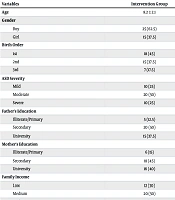
The demographic characteristics showed no statistically significant differences between the intervention and control groups (P > 0.05), indicating that the two groups were homogeneous and comparable at baseline. Other demographic and clinical information are presented in Table 1. There was no statistically significant difference in baseline sleep quality scores between the intervention and control groups, indicating that the two groups were comparable prior to the intervention.
Table 1.
Demographic Data of Intervention and Control Groups a
| Variables | Intervention Group | Control Group | P-Value |
|---|---|---|---|
| Age | 8.2 ± 2.1 | 8.0 ± 2.0 | 0.72 |
| Gender | 0.54 | ||
| Boy | 25 (62.5) | 22 (55) | |
| Girl | 15 (37.5) | 18 (45) | |
| Birth Order | 0.81 | ||
| 1st | 18 (45) | 20 (50) | |
| 2nd | 15 (37.5) | 14 (35) | |
| 3rd | 7 (17.5) | 6 (15) | |
| ASD Severity | 0.88 | ||
| Mild | 10 (25) | 12 (30) | |
| Moderate | 20 (50) | 18 (45) | |
| Severe | 10 (25) | 10 (25) | |
| Father's Education | 0.90 | ||
| Illiterate/Primary | 5 (12.5) | 6 (15) | |
| Secondary | 20 (50) | 18 (45) | |
| University | 15 (37.5) | 16 (40) | |
| Mother's Education | 0.95 | ||
| Illiterate/Primary | 6 (15) | 7 (17.5) | |
| Secondary | 18 (45) | 19 (47.5) | |
| University | 16 (40) | 14 (35) | |
| Family Income | 0.83 | ||
| Low | 12 (30) | 14 (35) | |
| Medium | 20 (50) | 18 (45) | |
| High | 8 (20) | 8 (20) | |
| Sleep Quality (Baseline) | 52.3 ± 6.8 | 51.7 ± 7.1 | 0.68 |
Abbreviation: ASD, autism spectrum disorder.
a Values are presented as No. (%) unless otherwise indicated.
Table 2.
Comparison of Children’s Sleep Quality in the Intervention Group Before and After the Intervention and at Follow-up
| Variables | Mean Difference ± Standard Deviation | Lower Limit to Upper Limit | P-Value |
|---|---|---|---|
| Before and After Intervention | -4.88 ± 2.33 | -5.60 to -4.16 | 0.001 |
| Before Intervention and Follow-up | -2.02 ± 1.66 | 1.50 to 2.53 | 0.001 |
| After Intervention and Follow-up | 2.86 ± 1.59 | 2.36 to 3.35 | 0.001 |
As shown in Table 2, the paired t-test revealed a statistically significant difference between pre- and post-intervention scores, indicating that the intervention improved children’s sleep quality. Furthermore, the comparison of sleep quality before the intervention and at the follow-up stage indicates a positive and sustained effect of the intervention.
Table 3.
Comparison of Children’s Sleep Quality in the Control Group Before and After the Intervention and at Follow-up
| Variables | Mean Difference ± Standard Deviation | Lower Limit to Upper Limit | P-Value |
|---|---|---|---|
| Before and After Intervention | 0.28 ± 1.84 | -1.12 to 0.55 | 0.48 |
| Before Intervention and Follow-up | 0.90 ± 0.80 | -0.50 to 1.30 | 0.001 |
| After Intervention and Follow-up | -0.61 ± 1.90 | -1.48 to 0.26 | 0.15 |
Table 3 presents the results of the paired t-test. The difference between the first measurement and the follow-up was statistically significant, whereas no significant differences were observed between the first and second measurements or between the second measurement and the follow-up.
Table 4.
Results of Analysis Controlling for the Pre-intervention Score
| Source of Variation | Sum of Squares | df | Mean Square | F | P | Partial Effect Size |
|---|---|---|---|---|---|---|
| Pre-intervention (Covariate) | 2072.796 | 1 | 2072.796 | 424.678 | 0.001 | 0.876 |
| Group | 10.181 | 1 | 10.181 | 2.086 | 0.154 | 0.034 |
| Group × Pre-intervention Interaction | 0.903 | 1 | 0.903 | 0.185 | 0.669 | 0.003 |
| Error | 292.852 | 60 | 4.881 | - | - | - |
| Corrected Total | 3505.359 | 63 | - | - | - | - |
| Levene's Test | - | 1, 60 | - | 0.185 | 0.669 | - |
Based on the results presented in Table 4, Levene’s test was used to examine the assumption of homogeneity of variances. The results indicated that there was no significant difference between the variances of the intervention and control groups. Therefore, the assumption of homogeneity of variances was met, and the use of analysis of covariance was considered appropriate. After confirming this assumption, analysis of covariance (ANCOVA) was conducted to compare post-test sleep quality scores between the intervention and control groups while controlling for the effect of pre-intervention scores. In addition, the assumption of homogeneity of regression slopes was examined. The results showed that the interaction effect between group and pre-intervention scores was not significant, indicating that this assumption was also satisfied.
The results of ANCOVA indicated that the pre-intervention scores had a significant and substantial effect on the post-intervention scores. However, after controlling for the effect of the pre-intervention scores, no significant difference was observed between the intervention and control groups in the post-intervention scores. This finding suggests that the implemented intervention, after adjusting for baseline differences, did not have a significant effect on sleep quality.
5. Discussion
In the present study, the sleep quality of children aged 4 to 12 years with autism significantly improved immediately after music therapy in the intervention group. This finding aligns with a meta-analysis of 10 randomized trials, which indicated that music interventions can significantly enhance sleep quality (15). Another systematic review reported that music therapy reduces sleep onset latency and promotes nighttime relaxation, particularly in individuals experiencing pre-sleep anxiety or tension (16).
Since children with ASD often experience sensory over-arousal, nighttime anxiety, and difficulties in emotional regulation, it is plausible that the mechanism of music’s effect in this study involved reducing arousal and increasing relaxation of the nervous system, as supported in the literature (17).
In contrast, the control group, which did not receive any intervention, showed no significant change in sleep quality between the two assessment points. This finding is consistent with trials in the autism sleep domain reporting that sleep problems in these children are typically persistent and chronic, and without active intervention, spontaneous improvement is unlikely (18).
For example, in a randomized controlled trial, music therapy in children with ASD had significant positive effects on social skills; however, physiological outcomes or secondary measures, including non-behavioral domains, did not show significant differences between groups. This is important because it suggests that music therapy in autism can produce within-group effects but does not always generate large between-group differences, particularly for outcomes such as sleep that are less directly targeted (19).
Baseline comparisons of sleep quality between the intervention and control groups showed no significant difference. This result confirms the homogeneity of the two groups at study onset and aligns with Cochrane guidelines, which recommend that baseline status should be controlled and comparable in autism studies for accurate interpretation of intervention effects (20).
Between-group comparisons immediately post-intervention and at the one-month follow-up revealed no statistically significant differences, even after adjusting for pre-test scores using ANCOVA. This finding is similar to recent meta-analyses of music therapy in children with ASD, which reported that although these interventions may reduce overall symptom severity and improve quality of life, the certainty of evidence for specific measurable between-group outcomes is low to moderate (21).
Furthermore, a recent meta-review in psychiatry reported that the effects of music therapy are heterogeneous across studies and vary depending on outcome type, population, duration, and session structure. In the present study, the effect of music was likely more individual-level, lacking sufficient power to produce large between-group statistical differences after adjusting for baseline, a pattern observed in similar research (22).
It should be noted that although a significant improvement was observed within the intervention group, no statistically significant differences were found between groups after adjusting for baseline values. This inconsistency suggests that the observed changes should be interpreted with caution. Factors such as limited sample size, baseline variability, and insufficient statistical power may have contributed to the lack of between-group significance.
Limitations of this study include the relatively small sample size, the restriction of the study to autism centers in Lahore, and incomplete control over environmental factors affecting children’s sleep. Additionally, variations in children’s interest and response to different types of music, as well as parental involvement in implementing music therapy sessions, could have influenced the results. Future research should consider larger samples, more diverse geographical areas, and objective tools for assessing sleep quality.
This study was conducted in autism centers in Lahore using convenience sampling, which may limit the generalizability of the findings. Participants may not be fully representative of children with ASD in other regions, different socioeconomic contexts, or home-care settings. Additionally, care practices and parental involvement may vary across centers and countries, potentially influencing intervention effects. Therefore, while the results provide valuable insights into the effectiveness of music therapy in this context, caution should be exercised when extrapolating findings to broader populations or different healthcare systems. Future studies with randomized sampling and multicenter designs across diverse settings are recommended to enhance external validity.
5.1. Conclusion
The findings of this study suggest that music therapy may improve sleep quality in children with autism spectrum disorder. However, since no significant between-group differences were observed after adjusting for baseline values, the effectiveness of the intervention cannot be conclusively established. Further studies with larger sample sizes are recommended. Regular use of age-appropriate and child-preferred relaxing music may reduce anxiety, promote mental relaxation, and help regulate sleep patterns. Therefore, it is recommended that therapists and parents incorporate music therapy as a complementary approach in rehabilitation and care programs for children with autism spectrum disorder.