
1. Background
Nowadays, patterns of diseases in the world have changed from contagious and infectious diseases to non-communicable diseases, which are caused by several factors, including culture, machine life, nutrition, industrialization, and, in general, lifestyle changes (1). In addition to physiological factors, psychological causes, especially in the form of people’s personality traits, contribute to the incidence of such diseases (2). Although evidence has suggested that physical factors can predict up to 50% of these diseases, they are not able to explain the incidence and persistence of these diseases by themselves. Recent advances in behavioral medicine have attracted health psychologists’ attentions to key roles that non-biological factors play in the development of these diseases. Research on such diseases has long focused on psychological and psychosocial factors (3). Moreover, stroke (4), heart attack (5), and dialysis (6) patients experience some sort of cognitive disorders. In the current study, we aimed to evaluate personality types, everyday memory, and rumination among stroke, heart attack, and dialysis patients. Furthermore, we discussed each of them in the following section.
Stimulants and stressors in everyday life lead to psychological stress and emotional distress. There are some factors that make differences in responding to stressors. Among these factors, people’s personality types and levels of exposure to stressful life events can be mentioned. Due to personal differences, some emotions caused by changes in these people affect their immune system and show themselves as psychosomatic diseases (7). A five-factor model has been introduced by many contemporary trait theorists as the basis for presenting a personality structure. This personality model, also applied as a questionnaire, has many potential applications for guiding and choosing professional backgrounds, health, longevity, personality detection, pathology, and decision making regarding carrying out psychological and psychotherapy treatments (8). According to this model, an interpersonal variance in personality traits can be explained by 5 significant personality dimensions, namely, extroversion, conscientiousness, agreeableness, neuroticism, and openness (9). Khoosfi et al. (10), in a study entitled “A Comparative Study of Personality Factors, Stressful Life Events, and Social Support in 150 Coronary Heart Patients and 150 Non-Patients” figured out that people with coronary heart diseases experienced more stressful events compared to non-patients. Hence, it seems that people with a neuroticism personality trait benefit from less mental health compared to others. Furthermore, results of a study conducted by Shafiei et al. (11) showed that there were significant differences in personality traits among cardiovascular patients, renal patients, and normal individuals.
The next variable is everyday memory, which refers to a daily use of multiple aspects of a memory system such as training and recognition (12). Examples of everyday memory problems and cognitive impairments may include forgetting the location of familiar objects in the house, forgetting to take essential things when leaving the house/office, not recognizing acquaintances, or forgetting important events that occurred in the previous day (13). The prevalence of moderate to severe cognitive impairments among dialysis patients is twice as much as that in the general population. Although the risk of dealing with severe cognitive impairments is higher among stroke patients compared to hemodialysis patients (6), cognitive functioning plays an important role in the treatment of dialysis (14, 15). When examining cognitive disorders among patients with chronic renal diseases and brain diseases, researchers indicated that the prevalence of cognitive disorders was higher among the renal patients compared to that in the other group (16).
Rumination is another variable of this study. These thoughts are conscious and sustained cognitive functions in which a person focuses on negative aspects of himself/herself and the surrounding world and has difficulties in controlling these thoughts (17-19). Rumination can act as an effective factor in developing psychological issues such as depression, anxiety, and long-term health outcomes, including cardiovascular diseases and other chronic conditions (20). Researchers believe that rumination is a long lasting phenomenon accompanied with serious clinical consequences (21, 22), which lead to the formation and continuation of many mental disorders (23, 24). Cognitive and perceptual damages can influence people’s ability to take part in everyday life activities. Therefore, identifying and solving their cognitive issues is of significant importance (25).
2. Objectives
Due to the lack of research in this area, the study aimed to compare personality types, everyday memory, and rumination among stroke, heart attack, and dialysis patients. This study can provide useful information on these diseases and the patients’ needs in this area.
3. Methods
This study was casual-comparative. The current study had a statistical population constituting of all stroke, heart attack, and dialysis patients referred to healthcare centers in Zahedan to be examined and to undergo required treatments in 2016 - 2017. In the present study, given the limited statistical population, among all patients referred to these centers, a sample of 90 patients (30 stroke patients, 30 heart attack patients, and 30 dialysis patients) was selected and tested using the convenience sampling method. This study was conducted after obtaining an informed consent from all subjects participating. Patients with acute conditions and those who were not able to fill out questionnaires were not considered in the research sample.
In this study, 3 questionnaires were used, which are as follows:
1. NEO Personality Types Inventory: This inventory was designed by McCrae and Costa in 1985 based on a factor analysis. It has 2 forms (a long form that includes 240 items and a short form, which contains 60 items). In the current study, the short form of this inventory was applied to evaluate 5 main domains of neuroticism (N), extraversion (E), openness (O), agreeableness (A), and conscientiousness (C). The items are scored based on a 5-point Likert-type scale, i.e. totally disagree (0) to totally agree (4). Some items are scored diversely. McCrae and Costa demonstrated that its alpha coefficient ranged from 0.74 to 0.89 with a mean of 0.81. In the present study, using a Cronbach’s alpha coefficient, the validity of each of these 5 factors, i.e. neuroticism, extraversion, openness, agreeableness, and conscientiousness, was 0.74, 0.64, 0.41, 0.59, and 0.83, respectively.
2. Everyday Memory Scale: This scale was developed by Sunderland et al. (1983) to assess everyday memory. This scale includes 28 items. The items are scored based on a Likert-type scale ranging from 1 to 9 (1 = not at all during the past 6 months to 9 = more than once a day). A total score in the range of 28 to 58 indicates that a person has a good memory. A score in the range of 58 to 116 shows a moderate memory and a score in the range of 116 to 243 demonstrated a lower than moderate memory. The content validity of this scale was confirmed by university professors and a number of experts. In a study conducted by Barghi Irani (2013), using a Cronbach’s alpha coefficient, the reliability of this scale was 0.85. In this study, using a Cronbach’s alpha coefficient, the reliability of this scale was 0.84.
3. Rumination-Reflection Questionnaire: This questionnaire was introduced by Ghorbani et al. (2008). It includes 24 items and constitutes of 2 subscales of rumination and reflection. The items are scored based on a 5-point Likert-type scale (1 = totally disagree, 2 = somehow disagree, 3 = neither agree nor disagree, 4 = somehow agree, and 5 = totally agree). A total score is obtained by summing up scores on these 24 items. A minimum score is 24 and a maximum score is 120. The validity of this questionnaires was confirmed in a study carried out by Ghorbani et al. (2008). Additionally, using a Cronbach’s alpha coefficient, the reliability of this questionnaire was obtained greater than 80%. In this study, using a Cronbach’s alpha coefficient, the reliability of this questionnaire was 0.70.
First, after referring to the Vice-Chancellor of Research and Technology of Zahedan University of Medical Sciences and Health Services, This study was approved by the Ethics Committee. After getting the code (IR.ZAUMS.OTH.REC.1395.3) to collect data, the authors referred to clinics and healthcare centers in Zahedan. After getting required permissions, the sample was selected among the patients referred to these centers. Then, the main objectives of carrying out this study were explained to the participants and the NEO Personality Types Inventory, the Everyday Memory Scale, and the Rumination-Reflection Questionnaire were respectively distributed among them. The participants were asked to fill out these questionnaires precisely, select their answers according to their characteristics, and do not leave any questions unanswered. Carrying out this study took 9 months and the questionnaires were completed individually in the clinics and healthcare centers. Whenever a question seemed vague, some additional explanations were also provided. It should be noted that these explanations were provided to avoid any kinds of ambiguity and/or bias.
Data were analyzed using descriptive statistics, such as standard deviations and means, as well as statistical methods, including multivariate analyses of variance (MANOVA) and one-way analyses of variance (ANOVA), via SPSS23.
4. Results
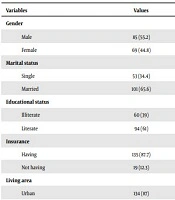
Based on demographic results obtained from these 90 subjects (30 stroke patients, 30 heart attack patients, and 30 dialysis patients), the subjects’ age ranged from 20 to 85 years. 44.4% of the subjects were female and 55.6% of them were male. 93.3% of these subjects were married and 72.2% of them did not return to their jobs after developing their diseases.
In Table 1 the means and standard deviations of the variables are presented separately for each group (stroke, heart attack, and dialysis).
Table 1.
The Means and (Standard Deviations) of the Variables Presented Separately for Each Group
| Variable | Subscale | Stroke | MI | Dialysis | Total |
|---|---|---|---|---|---|
| Personality traits | Neuroticism | 26.33 (46.6) | 23.27 (8.83) | 22.97 (6.08) | 24.19 (7.31) |
| Extraversion | 24.70 (4.93) | 27.33 (7.95) | 28.20 (4.36) | 26.74 (6.08) | |
| Openness | 25.67 (4.03) | 25.00 (4.87) | 22.63 (4.52) | 24.43 (4.63) | |
| Agreeableness | 28.90 (5.96) | 30.53 (5.42) | 28.83 (5.07) | 29.42 (5.49) | |
| Conscientiousness | 30.80 (7.23) | 34.70 (8.00) | 33.37 (5.87) | 32.96 (7.19) | |
| Rumination | Rumination | 44.40 (5.22) | 39.30 (6.99) | 43.73 (4.12) | 42.48 (7.19) |
| Everyday memory | Everyday memory | 124.37 (19.95) | 102.10 (28.94) | 123.97 (24.49) | 116.81 (26.60) |
To examine differences in personality types of these 3 groups, the multivariate analysis of variance was used. The effect of the group on the linear combination of the dependent variables is significant (F = 2.47, P < 0.009, Eta = 0.13). The eta-squared coefficient shows that the group variable is able to determine 13% of the group of the variance of the linear combination of the dependent variables. To evaluate whether the effect of the group on each of the dependent variables is significant or not, the multivariate analysis of variance was applied, the results of which are presented in Table 2.
Table 2 presents the results of examining the effects among the subjects (groups). These results indicate that there are no significant differences in the observed F values for neuroticism (1.992), extraversion (2.801), agreeableness (0.919), and conscientiousness (2.344). However, there is a significant difference among these 3 groups with regard to openness (F = 3.773, P = 0.027 < 0.05). To determine differences among these groups, a Tukey’s post hoc test was used. Given the results of the Tukey’s test, the difference between the means on openness obtained by the stroke and dialysis groups is significant (P = 0.028 < 0.05). The mean score obtained by the stroke group is higher than that of the other group.
Table 2.
Results of the Multivariate Analysis of Variance
| Source | Dependent Variable | Sum of Squares | Df | Mean Square | F | Sig | Partial Eta Squared |
|---|---|---|---|---|---|---|---|
| Groups | Neuroticism | 208.289 | 2 | 104.144 | 1.992 | 0.143 | 0.044 |
| Extraversion | 199.356 | 2 | 99.678 | 2.801 | 0.066 | 0.061 | |
| Openness | 152.467 | 2 | 76.233 | 3.773 | 0.027 | 0.080 | |
| Agreeableness | 55.622 | 2 | 27.811 | 0.919 | 0.403 | 0.021 | |
| Conscientiousness | 235.756 | 2 | 117.878 | 2.344 | 0.102 | 0.051 | |
| Error | Neuroticism | 4549.500 | 87 | 52.293 | |||
| Extraversion | 3095.767 | 87 | 35.584 | ||||
| Openness | 1757.633 | 87 | 20.203 | ||||
| Agreeableness | 2632.333 | 87 | 30.257 | ||||
| Conscientiousness | 4376.067 | 87 | 50.300 |
To assess differences among these 3 groups in rumination, the one-way analysis of covariance was used.
The results presented in Table 3 show that there is a significant difference in rumination among the stroke, heart attack, and dialysis patients (F = 7.414, P < 0.05). To determine differences among these groups, the Tukey’s post hoc test was used. According to the results of the Tukey’s test, the stroke group obtained the highest mean score on rumination as well as the dialysis and heart attack groups respectively obtained the 2nd and 3rd highest mean scores on rumination. In fact, the mean score obtained by the stroke group is higher than that of the dialysis group but the difference between them is not significant.
To investigate differences among these 3 groups in everyday memory, the one-way analysis of covariance was used.
Table 3.
Results of the One-Way Analysis of Covariance
| Variable | Source of Change | Sum of Squares | Df | Mean Square | F | Sig | Groups | |||||
|---|---|---|---|---|---|---|---|---|---|---|---|---|
| 1 | 2 | 1 | 3 | 2 | 3 | |||||||
| Rumination | Between | 461.089 | 2 | 230.544 | 7.414 | 0.001 | 0.002* | 0.889 | 0.008* | |||
| Within | 2705.367 | 87 | 31.096 | 0.002* | 0.889 | 0.008* | ||||||
| Total | 3166.456 | 89 | 0.002* | 0.889 | 0.008* | |||||||
The results presented in Table 4 show that there is a significant difference in everyday memory among the stroke, heart attack, and dialysis patients (F = 7.957, P < 0.05). To determine differences among these groups, the Tukey’s post hoc test was used. According to the results of the Tukey’s test, the stroke group obtained the highest mean score on everyday memory and the dialysis and heart attack groups respectively obtained the 2nd and 3rd highest mean scores on everyday memory. In fact, the mean score obtained by the stroke group is higher than that of the dialysis group, however the difference between them is not significant.
Table 4.
Results of the One-Way Analysis of Covariance
| Variable | Source of Change | Sum of Squares | Df | Mean Square | F | Sig | Groups | |||||
|---|---|---|---|---|---|---|---|---|---|---|---|---|
| 1 | 2 | 1 | 3 | 2 | 3 | |||||||
| Everyday Memory | Between | 9741.156 | 2 | 4870.578 | 7.957 | 0.001 | 0.002* | 0.998 | 0.003* | |||
| Within | 53256.633 | 87 | 612.145 | 0.002* | 0.998 | 0.003* | ||||||
| Total | 62997.789 | 89 | 0.002* | 0.998 | 0.003* | |||||||
5. Discussion
The objective of this study was to compare personality types, everyday memory, and rumination among the stroke, heart attack, and dialysis patients. The results of the current study showed that there was a significant difference between the stroke and dialysis groups in terms of openness; however, no significant differences were found among the stroke, heart attack, and dialysis patients with regard to neuroticism, extraversion, agreeableness, and conscientiousness. These findings are not in line with the results of Khoosfi et al. (10) and Shafiei et al. (11). However, they are consistent with results of Tabaka et al. (26), who demonstrated that there was a significant difference in openness among chronic patients. However, it should be noted that chronic and serious diseases, like cancer, stroke, and heart diseases, have long-term consequences on personality traits. As a result, understanding and evaluating environmental characteristics are inherently related to sustainable and transferable personality traits. Hence, mental, psychological, and psychiatric measurements should be taken into consideration to improve these patients’ quality of life.
Other results of this study indicated that there were differences among the stroke, heart attack, and dialysis patients with regard to the mean scores on rumination. Although there was a difference between the mean scores of the stroke and dialysis groups on rumination, this difference was not significant. In spite of the fact that all available databases and sources of information were searched, no previously carried out studies, which compared rumination among stroke, heart attack, and dialysis patients were found. However, since rumination is a cognitive mechanism (27), results of a study conducted by Anstey, Mack, and Von Sanden (28) are in line with the results of this study. These researchers figured out that cognitive functions and cognitive impairments played less important roles in the mortality of patients with cardiovascular diseases compared to roles they played in the mortality of stroke and cancer patients. Cognitive disorders occur at all stages of vascular diseases and are likely to have significant effects on the patients’ health. These disorders potentially impact various aspects of taking care of a patient including his/her consent to treatment programs and quality of life (29, 30). Despite multiple causes of vascular diseases, especially brain diseases, cognitive disorders play key roles particularly in executive cognitive performance (31-33).
Another finding of the present study was that the mean score on everyday memory obtained by the stroke group was higher than that obtained by the other 2 groups. Although there was a difference in everyday memory between stroke and dialysis patients, this difference was not significant. This finding is not consistent with results of a study conducted by Murray (6) and Davey (16). To explain this finding, it can be stated that in addition to physical issues, cognitive disorders, including memory impairments, can be mentioned among issues with which stroke patients have to deal (34). Memory impairments are among the most debilitating and weakening cognitive impairments, which can occur following a brain damage. Furthermore, they usually prevent patients from returning to their jobs and have independent lives (35). As long as a person’s cognitive system is involved with stressful events related to a trauma, his/her memory structure has a low performance (36), which decreases adherence and response to rehabilitation (37) as well as affects the person’s quality of life and improvement of his/her performance (38). On the other hand, the better memory a person has, the more he/she follows a treatment (39).
5.1. Conclusion
Since rumination and everyday memory can be problematic issues for patients and make their conditions worse than they already are, it is necessary to think about rumination. Owing to the fact that rumination is likely to increase symptoms of anxiety and depression and it affects everyday memory, an empirical suggestion, which can be proposed based on the results of this study is that a number of programs aimed at changing and controlling negative thoughts should be implemented in order to lead to rumination. It is also recommended that in case of having such thoughts, cognitive-behavioral treatments be applied in the procedure of treating these patients. Enhancing physician’s awareness of the effects of cognitive disorders on daily functioning, quality of life, keeping a diet, and taking a medication is essential. This will improve the physician’s knowledge about cognitive disorders and aids patients and their families to decide whether to start or terminate a treatment. Therefore, it is recommended that examining cognitive functioning be considered in all periodic examinations. In this regard, early diagnosis can be made and proper treatments can be provided. Since proper cognitive functioning is a critical factor for promoting and maintaining mental health and quality of life of dialysis patients, conducting cognitive rehabilitation programs for these patients is highly suggested.
The current study faced a number of limitations; hence, caution should be exercised when generalizing these findings. Among the limitations of the present study, the limited number of the participants and problems in accessing the sample can be mentioned. There is definitely a need for carrying out other studies to be able to generalize the obtained results. In this study, personality types, everyday memory, and rumination were only considered. However, it seems that there is a number of other effective variables. Moreover, taking medications by these patients might have influenced the results of this study. It is suggested that future studies examine the issue more precisely and determine the type of relationships among these variables to be able to generalize the results and reach a richness of information.