To date, various animal models have been developed to understand the molecular mechanisms involved in the pathogenesis of depression and PTSD (
27,
48). Daily repeated MS is one of the most commonly used experimental procedures in depression studies (
45,
47). Both human and animal studies have shown that MS increases the tendency toward depression- and anxiety-like behaviors in adulthood (
7,
56-
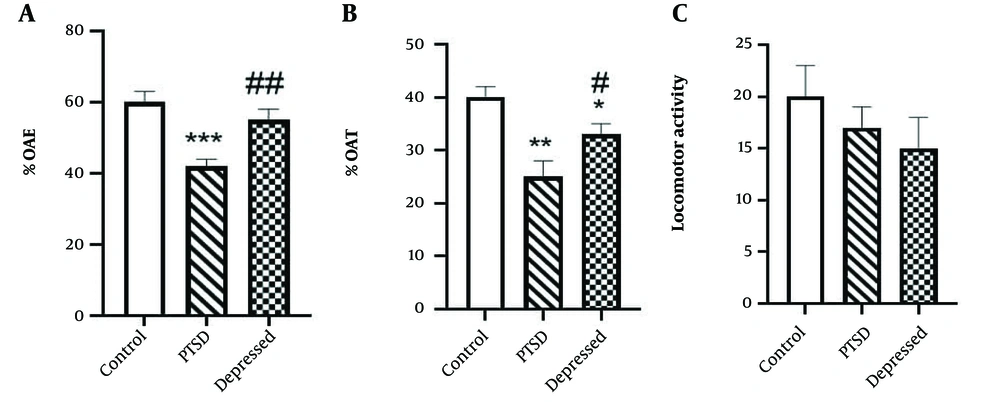
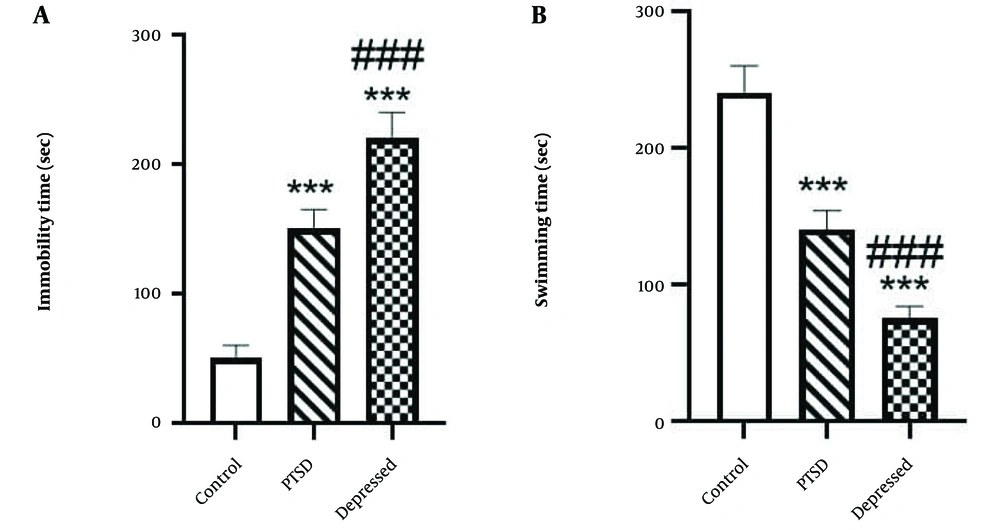
60). Consistent with these findings, our study demonstrated that postnatal maternal separation induced anxiety- and depressive-like behaviors in adult animals. Specifically, we found that rats subjected to maternal separation stress spent less time in the open arms of the EPM task compared to the control group, without any changes in locomotor activity, reflecting anxiety-like behavior. Additionally, in the FST, maternal separation increased immobility time while reducing swimming time compared to the control group, correlating with depressive-like behaviors.
In PTSD animals, we observed elevated levels of anxiety and depression in both EPM and FST tasks compared to the control group, aligning with previous studies (
44,
46,
48,
49). The behavioral results from our study support the co-occurrence of anxiety and depression under stress conditions (
61). Notably, PTSD rats exhibited greater anxiety behavior on the EPM compared to the depressed group, while both groups displayed similar behaviors in the FST.
It is well-established that under anxious or depressive conditions, autophagic mechanisms are impaired in the hippocampus (
8,
62,
63). This impairment may stem from the parallel roles of the hippocampus and autophagy in the stress response. Autophagy serves as a major stress response in the central nervous system (
64), and the hippocampus is central to processing stress responses (as reviewed in the introduction). Interestingly, pharmacotherapies that reduce depression-like symptoms often affect the autophagy-lysosomal pathway (
65).
TFEB is a transcriptional regulator of autophagy, and upon activation, it enhances autophagosome formation, lysosome function, and autophagic flux (
66). Recently, TFEB overexpression has been proposed as a therapeutic intervention for neurodegenerative diseases (
15,
67,
68). Our previous study revealed that TFEB signaling in the amygdala and medial prefrontal cortex (PFC) plays a pivotal role in processing anxiety and depression (
69). However, to our knowledge, changes in hippocampal TFEB protein levels in PTSD or depression have not been studied.
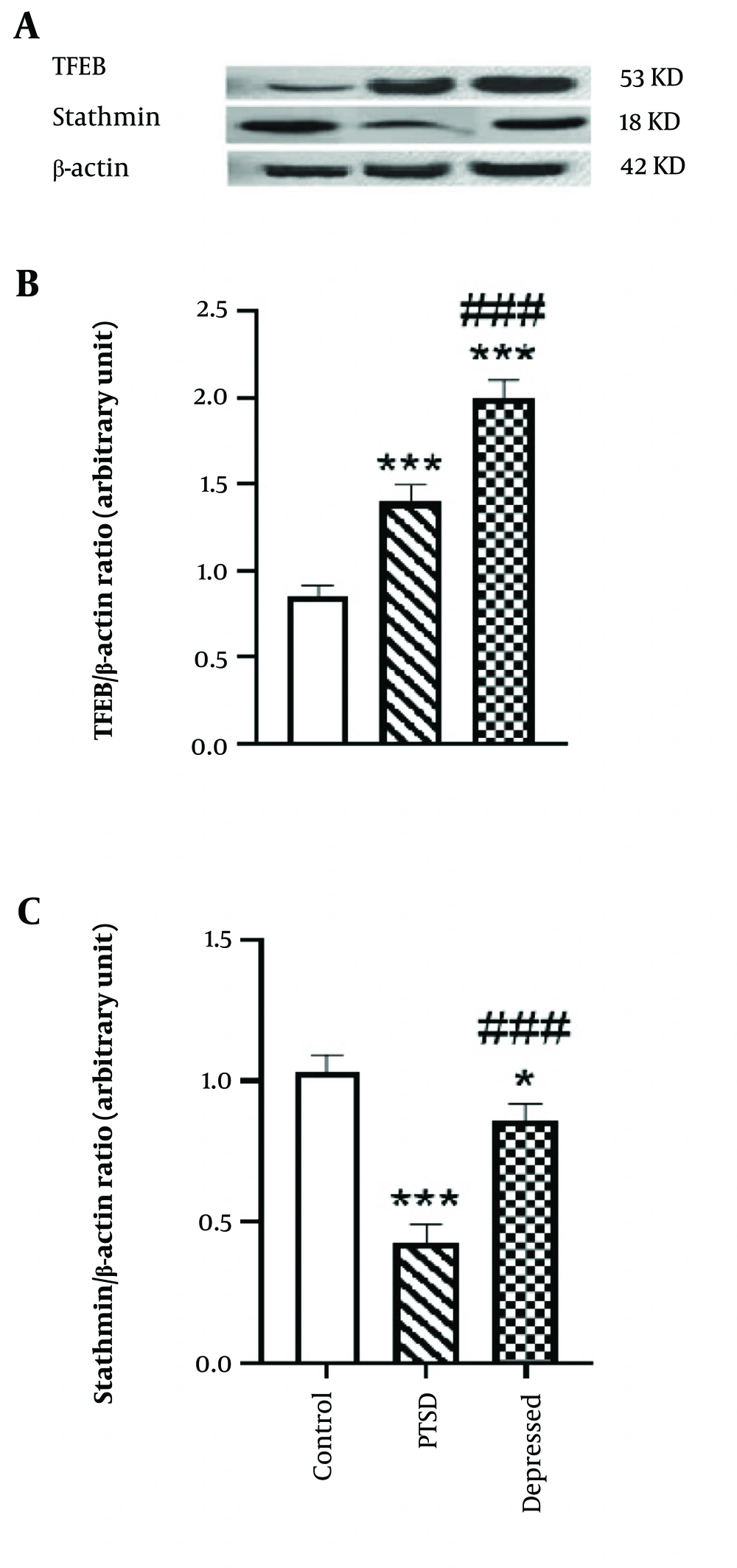
Our results showed that PTSD or depressed rats exhibited an increase in the hippocampal level of TFEB. These findings align with the study by Wan et al., which reported an increase in hippocampal autophagosomes in SPS-exposed rats (
70). However, they contrast with our previous study that observed decreased TFEB mRNA levels in the amygdala or PFC regions (
69). Previous studies have also demonstrated a decrease in hippocampal mammalian target of rapamycin (mTOR), an inhibitor of TFEB, in maternally separated mice and in major depressive disorder (
71). When mTOR is inhibited, TFEB is activated and translocates to the nucleus, triggering the expression of its target genes (
68). Interestingly, TFEB can increase its own expression by binding to its promoter (
26).
In contrast, Zhang et al. reported an increase in mTOR levels in the hippocampus of stressed mice in the chronic restraint stress model of depression (
72). Furthermore, Liu et al. showed region-dependent changes in autophagic marker expression in MS-treated animals (
7). These findings suggest that the TFEB response during anxiety or depression is complex. Given that TFEB expression correlates with autophagy enhancement, we propose that the upregulation of autophagy following TFEB expression in this study contributed to the observed anxiety and depression behaviors.
There is considerable evidence demonstrating that alterations in synaptic plasticity mediated by the cytoskeletal microtubular system play a crucial role in the pathogenesis of PTSD and depression (
35,
73,
74). Stathmin, a negative regulator of microtubule stability, is present in dendritic spines (
75,
76) and modulates synaptic plasticity by regulating the dendritic localization of the GluA2 subunit of AMPA-type glutamate receptors (AMPARs) (
31). Moreover, mice lacking stathmin display impaired long-term potentiation (LTP) in their cortico-amygdala and thalamo-amygdala pathways and exhibit deficits in learned conditioning (
76). Several studies support the role of stathmin in anxiety, social behavior, depression, and fear (
34,
77,
78).
In the present study, our data revealed a reduction in hippocampal stathmin protein levels in both PTSD and depressed rats compared to the control group. This finding is consistent with the study by Han et al., which showed that SPS or immobilization stress-induced a reduction in stathmin expression in the hippocampal area (
79).
We also compared hippocampal TFEB and stathmin protein expression levels between PTSD and depressed rats. The results revealed differences in their expression levels. The reduction of stathmin in the PTSD group was greater than in the depressed animals, while the enhancement of TFEB expression in depressed rats was significantly higher than in PTSD rats.
5.1. Conclusions
In summary, the findings of this study suggest that autophagy is upregulated in both anxiety and depression. However, based on the differing levels of TFEB in PTSD and depressed rats, we conclude that depression is more closely linked with autophagy dysfunction. Conversely, considering the expression of stathmin, anxiety appears to be more associated with microtubule alterations. Despite the overlapping features between anxiety and depression, these results indicate that there are anxiety-specific and depression-specific neuroplasticity changes that should be taken into account for future treatment strategies.