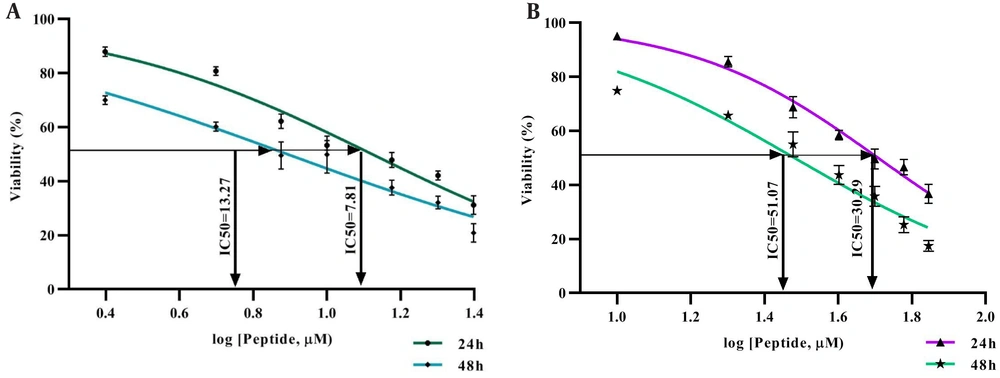
The HL-10 peptide demonstrated a significant cytotoxic effect against SiHa cancer cells compared to the standard drug, carboplatin. Notably, the HL-10 peptide exhibited greater cytotoxicity than carboplatin.
The peptides TsAP-1 and TsAP-2, which lack disulfide bridges and are extracted from the Brazilian scorpion
Tityus serrulatus, have been proven to possess both anti-cancer and anti-microbial activities. Synthetic analogs of these peptides exhibit anti-cancer activity against various cell lines, including H157 (oral cancer), H838 (lung cancer), PC3 (prostate cancer), U251-MG (glioma cancer), and MCF-7 (breast cancer) (
17).
The mechanisms of action of anti-cancer peptides may include plasma membrane destruction, mitochondrial membrane destruction (
18), apoptosis, necrosis (
19), indirect immunity (
20), involvement of membrane receptors (
21,
22), anti-angiogenic effects, and the inhibition of DNA synthesis (
23). Wang et al. showed that the HNP-1 peptide (human neutrophil defensins) elicited an immune response against tumors by inducing and utilizing dendritic cells in breast and colon cancer models (
24). Additionally, it has been reported that the cell-permeable peptide CR1166, through protein-protein interaction and inhibition of GIPC, decreases proliferation, increases cytotoxicity, and induces apoptosis in pancreatic and breast tumors (
22). The paradoxin peptide, extracted from marine fish, promotes apoptosis via caspase-3 activation. Additionally, it disturbs the cell cycle at the G2/M phase, which results in the inhibition of cell proliferation in SCC-4 cells (
23). The melittin peptide, extracted from bee venom, induces apoptosis through activating several pathways, including protein kinase Ca
2+/calmodulin, transforming growth factor β-activated kinase, and the JNK/P38 MAPK pathway (
24).
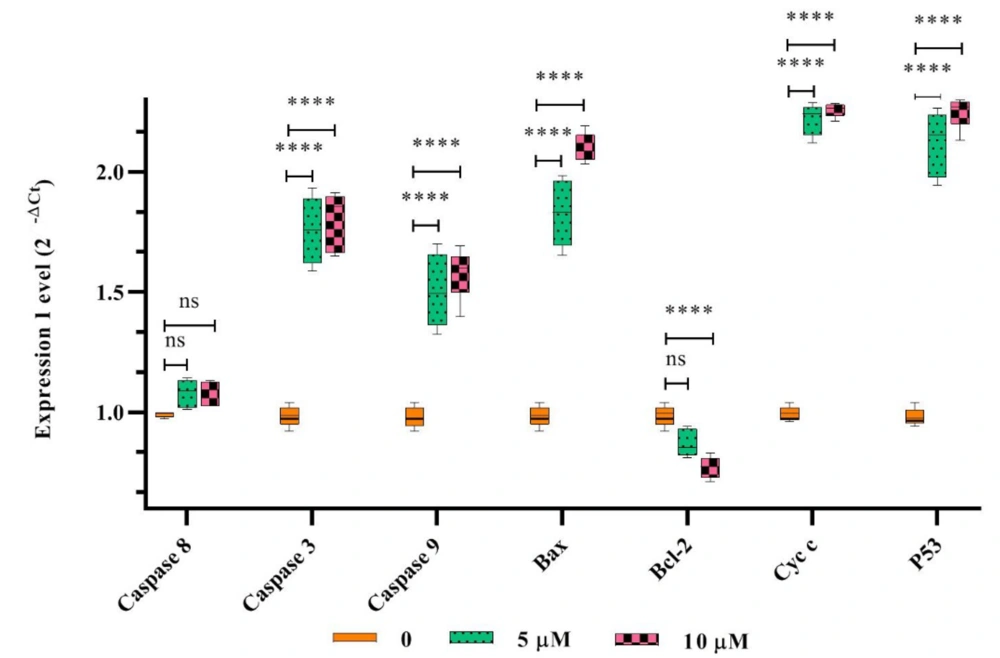
This study focused on evaluating the expression of several key genes involved in programmed cell death, including bcl-2, bax, p53, cyt c, and caspase-3, -9, and -8, in SiHa cancer cells following treatment with the HL-10 peptide. The expression levels of cyt c, bax, and p53, as well as caspases 3 and 9, increased significantly with higher concentrations of the HL-10 peptide. In contrast, a notable decrease was observed in the expression of the bcl-2 gene.
Moreover, the caspase-8 gene expression remained relatively unchanged in cells exposed to the HL-10 peptide. Kong et al. analyzed the impact of the melittin peptide on the growth rate of SGC-7901 cancer cells using various methods. Their results demonstrated a dose- and time-dependent reduction in cancer cell growth and survival. Additionally, morphological changes in SGC-7901 cells treated with melittin indicated the induction of apoptosis. The activity of caspase-3 in cancer cells treated with melittin was significantly higher than in the control, but the activity of caspase-3 in the non-tumor cell line L-O2 was not affected. The results demonstrated that melittin induces apoptosis in SGC-7901 cancer cells via mitochondrial pathways, aligning with the findings of Kong et al. (
25). Furthermore, Tu et al. reported that melittin can induce apoptosis in melanoma cells through the calcium signaling pathway (
26). It was also shown that the melittin peptide induces death receptors and inhibits the JAK2/STAT3 pathway in ovarian cancer cells (
27).
In the present study, caspase-8 gene expression was not affected, while the growth of SiHa cancer cells was inhibited by the HL-10 peptide. Therefore, the HL-10 peptide stimulated apoptosis through the mitochondrial intrinsic pathway and did not affect the FAS/FASL extrinsic pathway.
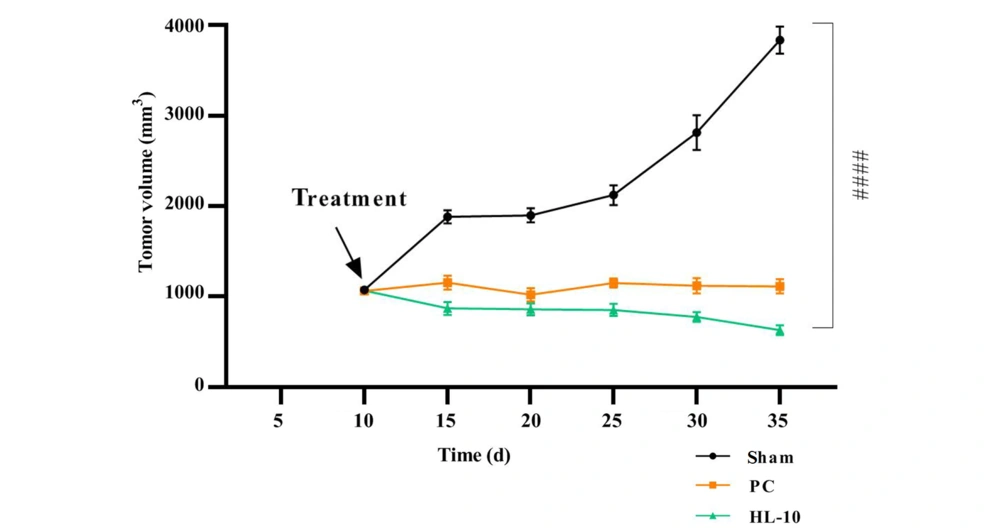
After 10 days of injecting SiHa cells into BALB/c mice, two groups of cancer mice (PC and HL-10) were treated. Treatment of cancer mice with carboplatin and HL-10 peptide caused a significant decline in tumor volume in comparison to the group of cancer mice without treatment (P < 0.05). The gonearrestide peptide has been identified as an anti-cancer peptide extracted from scorpion venom. This peptide exhibited no toxicity towards red blood cells and effectively reduced solid tumor volume by arresting the cell cycle in the G1 phase. It also increased the expression of cell cycle regulators, including P27 and P21, in a concentration-dependent manner (
28).
Aspartate aminotransferase and ALT enzyme concentrations were measured in serum to evaluate the peptide's influence on liver function in the current research. Our findings indicated a marked elevation in serum ALT and AST levels in the carboplatin group. In contrast, the levels of these enzymes in the HL-10 group of the tumor xenograft model did not exhibit a substantial elevation in comparison to untreated cancer mice. Therefore, our data indicate that treatment with the HL-10 peptide did not result in a significant difference in serum levels of AST and ALT enzymes compared to the control group. Liver toxicity was comparable to that observed in the PC group in the xenograft mice model with SiHa cells, suggesting that HL-10 peptide treatment did not induce additional liver injury.
Rather than directly targeting cancer cells, immunotherapy works by enhancing the host's immune response, thereby facilitating the elimination of malignant cells. This approach is critical in cancer treatment, as it has the potential to prevent tumor progression and metastasis (
29). Our results demonstrated that the administration of carboplatin and HL-10 peptide led to the upregulation of IL-1β, TNF-α, and IFN-γ. Studies have demonstrated that TNF-α and IL-1β, while playing crucial roles in the inflammatory process through the recruitment of neutrophils, also have the capacity to induce anti-tumor responses. Research has shown that engineered tumor cells capable of producing TNF-α can inhibit tumor growth in three different mouse models (
30).
The present study aligns with research on the modulatory effects of
Montivipera bornmuelleri venom on the immune system. In that study, intraperitoneal injection of multiple doses of the venom resulted in measurable changes in the levels of various cytokines, including TNF-α, IFN-γ, IL-1β, IL-10, IL-4, and IL-17, indicating its impact on immune modulation in vivo (
31). In another study, exposure to
Tityus serrulatus venom resulted in increased levels of IL-6, IL-8, TNF-α, IL-10, and IL-1β in the supernatant of macrophages isolated from mice. This suggests that key toxins in the venom play a significant role in modulating the immune response, particularly within macrophages (
11). Several studies have demonstrated the involvement of scorpion venom and its peptide components in the regulation of the immune system (
12,
32,
33). Parabutoporin and Opistoporin, two NDBPs present in scorpion venom, have been shown to possess immune-modulating, anti-microbial, and anti-fungal properties, according to the literature. Research has indicated that these peptides can decrease granulocyte superoxide generation, trigger exocytosis, and improve chemotaxis at micromolar levels (
33). The findings in this study indicate that HL-10 peptide treatment modulates the immune system by shifting it from a pro-inflammatory Th1/Th17 response towards a more anti-inflammatory Th2/Treg response.
The results obtained from the MTT assay demonstrated that the administration of the HL-10 peptide increased toxicity and decreased cell viability in a dose-dependent fashion. Similar growth inhibitory effects were observed with the HL-7 peptide in MCF-7 and A549 cancer cells, while showing no significant anti-proliferative effect on human peripheral blood mononuclear cells (PBMCs) (
15,
28).


![Carboplatin and HL-10 peptide treatments influenced the levels of inflammatory markers, including IFN-γ, IL-1β, TNF-α, IL-4, and IL-6 in tumor tissues. The experimental groups were as follows: Sham (mice with cancer tumors without treatment), [positive control (PC): Mice bearing cancerous tissues treated with carboplatin at a dose of 5 mg/kg], and HL-10 (mice bearing cancer cells treated with 5 mg/kg HL-10 peptide). Independent values (ng/g) are presented as means ± standard deviation from six experiments, illustrated in dot plots. **** P < 0.0001.](https://brieflands.com/journals/jjcmb/articles/157039/figures/jjcmb-157039-i004-F4-preview.webp "Carboplatin and HL-10 peptide treatments influenced the levels of inflammatory markers, including IFN-γ, IL-1β, TNF-α, IL-4, and IL-6 in tumor tissues. The experimental groups were as follows: Sham (mice with cancer tumors without treatment), [positive control (PC): Mice bearing cancerous tissues treated with carboplatin at a dose of 5 mg/kg], and HL-10 (mice bearing cancer cells treated with 5 mg/kg HL-10 peptide). Independent values (ng/g) are presented as means ± standard deviation from six experiments, illustrated in dot plots. **** P < 0.0001.")
![Carboplatin and HL-10 peptide treatments altered the levels of IL-4, IFN-γ, TNF-α, IL-1β, and IL-6 in tumor tissues. The experimental groups included sham (mice with cancer tumors without treatment), [positive control (PC): Mice with cancer tumors treated with 5 mg/kg carboplatin], and HL-10 (mice with cancer tumors treated with 5 mg/kg HL-10 peptide). Independent values (ng/g) are presented as means ± standard deviation from six experiments and are depicted in dot plots. **** P < 0.0001.](https://brieflands.com/journals/jjcmb/articles/157039/figures/jjcmb-157039-i005-F5-preview.webp "Carboplatin and HL-10 peptide treatments altered the levels of IL-4, IFN-γ, TNF-α, IL-1β, and IL-6 in tumor tissues. The experimental groups included sham (mice with cancer tumors without treatment), [positive control (PC): Mice with cancer tumors treated with 5 mg/kg carboplatin], and HL-10 (mice with cancer tumors treated with 5 mg/kg HL-10 peptide). Independent values (ng/g) are presented as means ± standard deviation from six experiments and are depicted in dot plots. **** P < 0.0001.")


