1. Background
Helicobacter pylori is a Gram-negative, microaerophilic bacterium that is commonly found in the stomach. It is found in approximately half of the world’s population (1). The infection is mostly acquired earlier in life and is common in less developed countries. There is a positive correlation between H. pylori and peptic ulcers. In some patients, the disease progresses to intestinal metaplasia, dysplasia, and carcinoma (2). Helicobacter pylori infection can be diagnosed by different techniques, including invasive techniques, requiring endoscopy and biopsy (e.g., histological examination) and non-invasive techniques, such as serology, urea breath test, urine/blood test, or the detection of H. pylori antigen in stool specimens (3).
Stool antigen tests were introduced after the urea breath test. Early stool antigen tests used an Enzyme Immunoassay (EIA) based on polyclonal antibodies. Although this test provides reliable results in the diagnosis of H. pylori infection, there are some controversial results in the post-eradication assessment because of false-positive results. Stool antigen tests based on monoclonal antibodies have been developed and showed to be more accurate and reliable than those using polyclonal antibodies. A meta-analysis also showed that the specificity of stool antigen tests based on monoclonal antibodies was 97%. European and Japanese guidelines have indicated stool antigen tests using monoclonal antibodies to be useful for primary diagnosis and assessment of eradication therapy (4).
The worldwide prevalence of H. pylori infection varies according to socioeconomic factors and levels of hygiene. According to a meta-analysis of 184 studies conducted from 1970 to 2016 to find out H. pylori infection in 62 countries at different time frames, it was concluded that more than half of the world’s population were infected with H. pylori. Whereas the U.S. and Australia have a low prevalence of H. pylori, their indigenous populations have a high prevalence. The regions with the highest prevalence were Africa, Nigeria, Portugal, Estonia, South America, and Western Asia, while those with the lowest prevalence were Switzerland, Denmark, New Zealand, Oceana, Western Europe, and North America. Helicobacter pylori was estimated to infect 4.4 billion people in 2015 (5). The H. pylori prevalence in Pakistan is at an alarming level. According to a study, 85% of chronic gastritis patients and about 100% of duodenal ulcer and duodenitis patients show evidence of infection with H. pylori. Most of the patients were male and relatively young (6). Another study showed a prevalence of 74.4%, with 73.5% in males and 75.4% in females. The infection increased with age, and adults were mostly affected (7).
2. Objectives
There are studies regarding H. pylori infection in Khyber Pakhtunkhwa. However, district Buner is far away, and most people have the least access to more developed techniques for the diagnosis of different diseases; in the same way, people have no concept of research due to the lack of education. Therefore, data are needed to highlight the prevalence of H. pylori infection in patients in this district.
3. Methods
A cross-sectional study was conducted from February 2018 to November 30, 2019, at Bilal Medical Trust Hospital, Buner. The consent forms were signed by all patients. The method for identifying patients depended on the consultant in the OPD. The inclusion/exclusion criteria included patients who presented to Medical OPD with upper gastrointestinal symptoms, i.e., epigastric pain, dyspepsia, heartburn, burping, blotting, nausea, and vomiting while those patients were excluded who were already diagnosed with H. pylori and were on eradication therapy but still presented with upper gastrointestinal symptoms.
3.1. Test and Procedure
We used a non-invasive method that did not involve radioactive isotopes. The assay was easy and did not require professional training. It provided a rapid result with high sensitivity and specificity. The test used for the detection of H. pylori was the “One Step Rapid HP Ag Test” (Healgen, USA), which detects antigens specific to H. pylori infection in stool samples. Simply, one drop of the stool sample was diluted in buffer and put on strip. After incubation for 10 minutes, the bands on the device were noted. For a valid test, both control and T lines were noted. In the case of positive tests, both lines were prominent, and in the case of negative tests, only the control line was prominent.
4. Results and Discussion
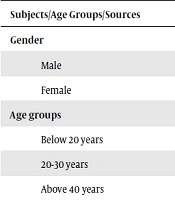
There were 52 (46.84%) males and 59 (53.15%) females among 111 patients. The total number of patients with positive stool antigen tests was 74 (66.66%), of whom females had a higher ratio (54.05%) than males (45.94%) (Table 1). The mean age of H. pylori-infected patients was found to be 35 years, and the prevalence was higher in the age group of 20 - 30 years (43.67%). It was found to be lower in the age group of lower than 20 years (8.55%) and more than 40 years (17.81%). We also found that people who used uncooked milk had a higher positivity rate (52.54%) than those who used powdered milk/packed milk (15.25%). The infection with H. pylori was found related to the source of water in the patient group. It was found more in patients using water from water wells (72.87%) than those who used water from tube wells (27.11%) (Table 1).
Table 1.
Subjects and Their Positivity Rate
| Subjects/Age Groups/Sources | Percent of Positivity |
|---|---|
| Gender | |
| Male | 45.94 |
| Female | 54.05 |
| Age groups | |
| Below 20 years | 8.55 |
| 20-30 years | 43.67 |
| Above 40 years | 17.81 |
| Milk source | |
| Fresh milk/uncooked | 52.54 |
| Packed Milk/Powdered Milk | 15.25 |
| Water source | |
| Water wells | 72.87 |
| Tube wells | 27.11 |
The various prevalence rates among the residents of different countries (8) advocate that different parameters play important roles in the prevalence of H. pylori. These parameters include socioeconomic status, sanitation conditions, demographics, and environmental conditions. There is a high prevalence rate of H. pylori infection in different regions in Pakistan. A study was conducted in the rural areas of Islamabad in asymptomatic patients, which showed a prevalence rate of 74.4% (9). Similarly, a study in the southern region of Pakistan (Karachi) showed a prevalence of 45% (10). These studies are in line with our study, which showed a high prevalence rate of 66.66%. Around 36.44% of symptomatic patients were negative on the stool antigen test. The high proportion of symptomatic patients reporting negative for H. pylori suggests other reasons for the symptoms. The other relevant factors, as suggested by Levenstein et al. (11), can be stress, socioeconomic status, smoking, and over-the-counter use of Non-steroidal Anti-inflammatory Drugs (NSAIDs) by patients with upper gastrointestinal symptoms in our community. These factors might be the roots of dyspeptic symptoms among more than half of these patients, and this might not be just due to the H. pylori infection. The male-to-female ratio in our study showed that females had a higher prevalence rate than males (53.15% vs. 46.84%) (Table 1).
A meta-analysis conducted in 2006 contradicts our study, which showed that men predominated in H. pylori infection globally (12). Similarly, another study obtained the same results as ours and showed the prevalence was more in women than in men (13). The mean age of prevalence was found in patients in the age group of 20 - 30 years (Table 1). According to a study conducted in 2000 and 2005 (13, 14), the prevalence of H. pylori increased with increasing age. The results of these studies are in line with ours and strengthen the results of our research. There seemed to be an increased incidence of H. pylori in people consuming fresh milk (52.54%) than in people consuming powered/packed milk (15.25%) (Table 1). There have been several studies conducted around the world that prove the transmission of H. pylori from the milk of livestock as one of the sources of disease transmission (15).
Patients who consumed water from water wells had a higher infection rate than those who used water from tube wells (72.87% vs. 27.11%) (Table 1). The infection rate of H. pylori in great part is related to the water source used by the populous for drinking and other daily activities, e.g., washing fruits, etc. According to the conclusion of a study conducted by Santiago et al., H. pylori can survive in water and can be very infective in drinking water; thus, it proves that water distribution systems can be a source of spread of H. pylori (16). Some studies conducted in Pakistan showed that samples collected from different water sources around major cities of Pakistan were infected with H. pylori (17, 18).
Like other studies, the present study had some limitations. Our main limitation was the study setting, as there were limited patients in our setting compared to other tertiary care hospitals. It also did not properly harbor the socioeconomic status of patients and the residence of individual patients. Thus, this study lacks to determine the prevalence of the whole region. For future studies, H. pylori can be correlated to the socioeconomic status, as well as the locality of patients, to determine the high-prevalence areas of the region. Further research can be done on the water supply of many sectors of this region to determine the infected sources of drinking water.
4.1. Conclusions
The present study revealed a higher prevalence of H. pylori in females than in males. The maximum prevalence was in the age group of 20 - 30-years-old. This study also showed that H. pylori is transmitted from consuming fresh milk and water from contaminated sources.