
1. Background
Coronaviruses are a family of single-stranded ribonucleic acid viruses (1). The severe acute respiratory syndrome coronavirus 2 (SARS-CoV-2) led to the coronavirus (COVID-19) pandemic. The first cases were observed in Wuhan, China, in late 2019, and the disease spread to other regions rapidly (2). As of 20 May 2022, 521,920,560 confirmed cases of COVID-19 were reported worldwide, leading to 6,274,323 deaths (3). In the Middle East, SARS-CoV-2 was first reported in Iran (4). COVID-19 patients may present with different symptoms; however, the respiratory system is mainly involved. Respiratory presentations of COVID-19 may vary from mild symptoms to acute respiratory distress syndrome (5). Reverse transcription polymerase chain reaction (RT–PCR) on samples collected via nasopharyngeal and oropharyngeal swabs is the ideal diagnostic test. Laboratory and radiographic studies have also been widely used (6). In a fraction of patients, COVID-19 leads to systemic disease identified by multisystem organ damage. Various factors such as advanced age, male gender, lymphopenia, and increased cytokine levels have been attributed to a worse prognosis in patients (7, 8). Furthermore, several underlying diseases are associated with a poorer prognosis, including hypertension, diabetes, malignancy, cardiovascular disease (CVD), chronic obstructive pulmonary disease (COPD), and chronic liver disease (9, 10).
2. Objectives
Given the high burden of COVID-19 in Iran and the importance of recognizing prognostic factors in patients, this study was conducted to evaluate the effect of underlying diseases on mortality in COVID-19 patients admitted to the Shahid Rahimi and Sohada-ye Ashayer teaching hospitals in Khorramabad, Iran, from 2019 to 2021.
3. Methods
3.1. Study Design and Participants
This was a retrospective cohort conducted in the Shahid Rahimi and Sohada-ye Ashayer teaching hospitals in Khorramabad, Iran. Inclusion criteria were all patients admitted to inpatient wards of the mentioned hospitals from the beginning of the pandemic in Iran to 21 May 2021 with a diagnosis of COVID-19 that was confirmed either with a positive RT–PCR or clinical symptoms and paraclinical evidence in favor of COVID-19 diagnosis, i.e., pulmonary ground glass opacities on chest computed tomography scan and reduced oxygen saturation. The patients were selected using the census sampling method. Patients with incomplete medical records were excluded.
3.2. Data Collection
In this study, a researcher-made checklist was used to collect the data. After obtaining written consent, demographic characteristics including age and gender, as well as data related to oxygen saturation on admission, duration of symptoms, time from admission to death, and previous history of hypertension, diabetes, brain diseases, malignancies, asthma, COPD, chronic kidney diseases, and CVD, were registered in the checklist.
3.3. Data Analysis
The collected data were analyzed using the SPSS software version 22. Qualitative indexes were used to describe the data, including frequency, percentage, mean, and standard deviation (SD). Also, chi-square and Fisher's exact tests were used to investigate the relationship between the variables and mortality in patients. The odds ratio (OR) and 95% confidence interval (95% CI) were estimated using logistics regression. The significance level was set at 0.05 for all tests.
4. Results
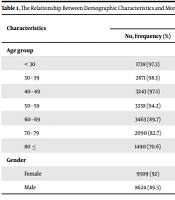
This study included 19985 COVID-19 patients, of whom1852 (9.3%) died from COVID-19, and 18133 (90.7%) survived. The relationship between demographic characteristics and mortality is shown in Table 1. There was a significant relationship between age and death from COVID-19 in patients ≥ 50 years (P < 0.001). Regarding gender, men were at higher mortality risk than women (OR = 1.379; CI = 1.252 - 1.518).
Table 1.
The Relationship Between Demographic Characteristics and Mortality in Patients with COVID-19 in Khorramabad
| Characteristics | Death | OR (95% CI) | P-Value | |
|---|---|---|---|---|
| No, Frequency (%) | Yes, Frequency (%) | |||
| Age group | ||||
| < 30 | 1738 (97.3) | 49 (2.7) | - | - |
| 30 - 39 | 2871 (98.3) | 50 (1.7) | 0.618 (0.415 - 0.920) | 0.018 |
| 40 - 49 | 3243 (97.1) | 96 (2.9) | 1.050 (0.741 - 1.489) | 0.784 |
| 50 - 59 | 3238 (94.2) | 201 (5.8) | 2.202 (1.360 - 3.025) | < 0.001 |
| 60 - 69 | 3463 (89.7) | 398 (10.3) | 4.076 (3.013 - 5.515) | < 0.001 |
| 70 - 79 | 2090 (82.7) | 437 (17.3) | 7.416 (5.483 - 10.032) | < 0.001 |
| 80 ≤ | 1490 (70.6) | 621 (29.4) | 14.783 (10.963 - 19.934) | < 0.001 |
| Gender | ||||
| Female | 9509 (92) | 823 (8) | - | - |
| Male | 8624 (89.3) | 1029 (10.7) | 1.379 (1.252 - 1.518) | < 0.001 |
As shown in Table 2, oxygen saturation < 93 on admission and being symptomatic for ≤ 5 days were associated with higher mortality risk, with an OR (05% CI) of 3.475 (3.067 - 3.937) and 0.794 (0.703 - 0.896), respectively. The relationship between underlying diseases and mortality is shown in Table 3. Patients with chronic kidney diseases had the highest mortality risk due to COVID-19, with an OR (95% CI) of 3.064 (2.285 - 4.108). Also, patients with cancer, COPD, hypertension, CVD, and diabetes were at higher mortality risk than those without these underlying diseases, respectively. However, there was no significant relationship between asthma and mortality (P = 0.241).
Table 2.
The Relationship Between Clinical Variables and Mortality in Patients with COVID-19 in Khorramabad
| Variables | Death | OR (95% CI) | P-Value | |
|---|---|---|---|---|
| No, Frequency (%) | Yes, Frequency (%) | |||
| Oxygen saturation on admission | ||||
| 93 ≤ | 7525 (96) | 314 (4) | - | - |
| < 93 | 10608 (87.3) | 1538 (12.7) | 3.475 (3.067 - 3.937) | < 0.001 |
| Duration of symptoms | ||||
| ≤ 5 | 8164 (90.4) | 866 (9.6) | - | - |
| 5 < | 5046 (92.2) | 425 (7.8) | 0.794 (0.703 - 0.896) | < 0.001 |
Table 3.
The Relationship Between Underlying Diseases and Mortality in Patients with COVID-19 in Khorramabad
| Underlying Disease | Death | OR (95% CI) | P-Value | |
|---|---|---|---|---|
| No, Frequency (%) | Yes, Frequency (%) | |||
| Chronic kidney diseases | ||||
| No | 17937 (90.9) | 1792 (9.1) | - | - |
| Yes | 196 (76.6) | 60 (23.4) | 3.064 (2.285 - 4.108) | < 0.001 |
| Cancer | ||||
| No | 17981 (90.9) | 1807 (9.1) | - | - |
| Yes | 152 (77.2) | 45 (22.8) | 2.946 (2.105 - 4.123) | < 0.001 |
| COPD | ||||
| No | 17879 (90.9) | 1780 (9.1) | - | - |
| Yes | 254 (77.9) | 72 (22.1) | 2.847 (2.182 - 3.716) | < 0.001 |
| Hypertension | ||||
| No | 15310 (92.1) | 1322 (7.9) | - | - |
| Yes | 2823 (84.2) | 530 (15.8) | 2.714 (1.951 - 2.423) | < 0.001 |
| CVD | ||||
| No | 16754 (91.6) | 1537 (8.4) | - | - |
| Yes | 1379 (81.4) | 315 (18.6) | 2.490 (2.180 - 2.844) | < 0.001 |
| Diabetes | ||||
| No | 16290 (91.5) | 1519 (8.5) | - | - |
| Yes | 1843 (84.7) | 333 (15.3) | 1.938 (1.705 - 2.202) | < 0.001 |
| Asthma | ||||
| No | 17942 (90.8) | 1827 (9.2) | - | - |
| Yes | 191 (88.4) | 25 (11.6) | 1.285 (0.845 - 1.956) | 0.241 |
The relationship between medications taken for underlying diseases and mortality in COVID-19 patients was investigated. Table 4 shows a significant relationship between drug history and death due to COVID-19 in patients with CVD, COPD, and chronic kidney diseases (P < 0.05). Anti-coagulants + antianginals had the highest frequency among CVD patients who died from COVID-19, and inhaled beta 2 agonists + corticosteroids had the highest frequency among those with COPD. Also, among 117 patients on dialysis, 44 (37.6%) died from COVID-19.
Table 4.
Analysis of the Relationship Between Drug History and Death in COVID-19 Patients
| Variables | Death | Total | P-Value a | |
|---|---|---|---|---|
| No, Frequency (%) | Yes, Frequency (%) | |||
| Antihypertensive medication | 0.213 | |||
| ACEI/ARB | 1164 (41.2) | 222 (41.9) | 1386 (41.3) | |
| Diuretics | 57 (2) | 12 (2.3) | 69 (2.1) | |
| Ca channel blockers | 369 (13.1) | 81 (15.3) | 450 (13.4) | |
| Beta blockers | 506 (17.9) | 108 (20.4) | 614 (18.3) | |
| ACEI/ARB + Diuretic | 512 (18.1) | 77 (14.5) | 589 (17.6) | |
| ACE/ARB+ Ca channel blockers | 37 (1.3) | 6 (1.1) | 43 (1.3) | |
| Others | 46 (1.6) | 8 (1.5) | 54 (1.6) | |
| No medication | 132 (4.7) | 16 (3) | 148 (4.4) | |
| Diabetes medication | 0.163 | |||
| Metformin | 220 (11.9) | 47 (14.1) | 267 (12.3) | |
| Metformin + glibenclamide/gliclazide | 591 (32.1) | 103 (30.9) | 694 (31.9) | |
| SGLT2 inhibitors | 178 (9.7) | 24 (7.2) | 202 (9.3) | |
| Metformin + SGLT2 inhibitors | 206 (11.2) | 37 (11.1) | 243 (11.2) | |
| DPP-4 inhibitors | 135 (7.3) | 17 (5.1) | 152 (7) | |
| Metformin + DPP-4 inhibitors | 117 (6.3) | 14 (4.2) | 131 (6) | |
| Insulin | 205 (11.1) | 45 (13.5) | 250 (11.5) | |
| Others | 87 (4.7) | 20 (6.0) | 107 (4.9) | |
| No medication | 104 (5.6) | 26 (7.8) | 130 (6) | |
| CVD medication | 0.048 | |||
| Anti-coagulants | 114 (8.3) | 25 (7.9) | 139 (8.2) | |
| Anti-arrhythmics | 87 (6.3) | 17 (5.4) | 104 (6.1) | |
| Antianginals | 273 (19.8) | 53 (16.8) | 326 (19.2) | |
| Digitalis | 96 (7) | 25 (7.9) | 121 (7.1) | |
| Anti-coagulants + antianginals | 524 (38) | 145 (46) | 669 (39.5) | |
| Others | 143 (10.4) | 33 (10.5) | 176 (10.4) | |
| No medication | 142 (10.3) | 17 (5.4) | 159 (9.4) | |
| Asthma medication | 0.236 | |||
| Inhaled beta 2 agonists | 32 (16.8) | 7 (28) | 39 (18.1) | |
| Inhaled beta 2 agonists + corticosteroids | 127 (66.5) | 13 (52) | 140 (64.8) | |
| Leukotriene antagonists + inhaled beta 2 agonists + corticosteroids | 20 (10.5) | 3 (12) | 23 (10.6) | |
| Others | 5 (2.6) | 2 (8) | 7 (3.2) | |
| No medication | 7 (3.7) | 0 (0) | 7 (3.2) | |
| COPD medication | 0.037 | |||
| Inhaled beta 2 agonists + corticosteroid | 193 (76) | 49 (68.1) | 242 (74.2) | |
| Long-acting muscarinic antagonists | 18 (7.1) | 9 (12.5) | 27 (8.3) | |
| Others | 30 (11.8) | 14 (19.4) | 44 (13.5) | |
| No medication | 13 (5.1) | 0 (0) | 13 (4) | |
| Chronic kidney diseases treatment | < 0.001 | |||
| Dialysis | 73 (37.2) | 44 (73.3) | 117 (45.7) | |
| Oral medication | 119 (60.7) | 16 (26.7) | 135 (52.7) | |
| No medication | 4 (2) | 0 (0) | 4 (1.6) | |
Abbreviation: ACEI, angiotensin-converting enzyme inhibitors; ARB, angiotensin receptor blockers; SGLT2, sodium-glucose Cotransporter-2; DPP-4, dipeptidyl peptidase-4.
aChi-square test
As shown in Table 5, a significant association was found between the age group and death due to COVID-19 in COPD patients. The majority of COPD patients (72.2%) who died from COVID-19 were older than 60 years. As shown in Table 6, no significant relationship was observed between the type of cancer and death due to COVID-19 (P = 0.086).
Table 5.
Analysis of the Relationship Between Age Group and Death Due to COVID-19 in COPD Patients
| Variables | Death | Total | P-Value | |
|---|---|---|---|---|
| No, Frequency (%) | Yes, Frequency (%) | |||
| COPD patients’ age group | 0.004 | |||
| < 40 | 5 (2) | 2 (2.8) | 7 (2.1) | |
| 40 - 60 | 119 (46.9) | 18 (25) | 137 (42) | |
| 60 < | 130 (51.2) | 52 (72.2) | 182 (55.8) | |
Table 6.
Analysis of the Relationship Between the Type of Cancer and Death Due to COVID-19 in COPD Patients
| Variables | Death | Total | P-Value | |
|---|---|---|---|---|
| No, Frequency (%) | Yes, Frequency (%) | |||
| Type of cancer | 0.086 | |||
| Breast | 29 (19.1) | 5 (11.1) | 34 (17.3) | |
| Prostate | 15 (9.9) | 5 (11.1) | 20 (10.2) | |
| Lung | 8 (5.3) | 9 (20) | 17 (8.6) | |
| Colorectal | 60 (39.5) | 16 (35.6) | 76 (38.6) | |
| Gastric | 21 (13.8) | 4 (8.9) | 25 (12.7) | |
| Hematological | 5 (3.3) | 2 (4.4) | 7 (3.6) | |
| Others | 14 (9.2) | 4 (8.9) | 18 (9.1) | |
5. Discussion
This study aimed to investigate the effect of underlying diseases on mortality in COVID-19 patients admitted to the Shahid Rahimi and Sohada-ye Ashayer teaching hospitals in Khorramabad, Iran, from 2019 to 2021. Overall, 1852 of 19985 patients included (9.3%) died from COVID-19. Mortality rates due to COVID-19 vary significantly in different regions and countries (11). Economic and social factors affect public health considerably. People in crowded areas can hardly maintain principles of social distancing (12). An overall case fatality rate of 10.05% has been reported in Iran, which is consistent with our findings (13).
Advanced age is assumed to be associated with a higher mortality rate in COVID-19 patients (14, 15). Patients aged ≥ 50 years have been estimated to have a 15.4-folds mortality risk compared with those aged < 50 years (16). The highest mortality rate has been reported in individuals aged ≥ 80 years (17). Similarly, this study showed a significant relationship between age and death from COVID-19 in patients ≥ 50 years. This can be justified by the physiological aging process and accompanying comorbidities in the elderly, which reduce the capacity against infections (17, 18). In the studied population, men were at higher mortality risk than women. The higher mortality rate of COVID-19 observed in men agreed with previous studies (19-21). The effect of gender on immune response against viral infections has been widely studied. Women are less vulnerable to infections because of more intense and prolonged immune responses (22). More angiotensin-converting enzyme 2 (ACE2) receptors, higher smoking rates, and higher prevalence of underlying conditions among men are other possible reasons (23).
In this study, patients with oxygen saturation < 93 on admission or symptomatic for ≤ 5 were at higher mortality risk. In previous studies, oxygen saturation of less than 90% and less than 80% on admission have been suggested as predictors of mortality (24). Clinical mechanisms that lead to acute hypoxemia can also enhance hyperinflammation. Furthermore, hypoxemia is associated with higher mortality due to acute respiratory distress syndrome, a significant complication of COVID-19 (25). The shorter duration of symptoms in patients who died from COVID-19 has been reported in the literature.
Individuals who fail to fight against viral replication in the early stages are more susceptible to developing intense inflammatory responses, which may lead to hospitalization and death (26). This study investigated the relationship between underlying diseases and mortality among patients with COVID-19. We observed that patients with chronic kidney diseases had the highest mortality risk due to COVID-19. Furthermore, those with a history of cancer, COPD, hypertension, CVD, and diabetes were at higher mortality risk than those without these underlying diseases. However, there was no significant relationship between asthma and mortality. These findings are consistent with data from previous studies (10, 27, 28).
Akin to many other patients with chronic conditions, individuals with chronic kidney diseases have an impaired immune system and are more susceptible to upper respiratory tract infections and pneumonia (29). A pooled OR of 5.58 is reported in patients with chronic kidney diseases (30), which almost doubles the OR estimated in the present study. We also found a significant relationship between treatment taken and death due to COVID-19 in these patients. Overall, 37.6% of the patients on dialysis died from COVID-19 infection. This agrees with a study by Valeri et al. (31) who reported a 31% mortality rate due to COVID-19 patients on dialysis.
The suggested mechanism of high mortality in patients with underlying diseases such as hypertension and CVD is the function of ACE2, which plays a significant role in the immune and cardiovascular systems (10). ACE2 is known as the primary host cellular receptor of SARS-CoV-2. Patients with heart diseases may have increased ACE2 expression, which acts as a target of the virus (32). Moreover, infections lead to increased myocardial demand that may cause myocardial injury or infarction (33). Diabetes, another comorbidity associated with increased mortality in COVID-19 patients, may boost infection by increased viral entry into cells and inadequate immune responses (34). Similarly, in cancer patients, the immune system is compromised in various ways, which makes them more vulnerable to viral infections (35). In a study, COVID-19 complications were seen in 55.8% of cancer patients, and 21.2% of them died (36). Although cancer was associated with increased mortality risk due to COVID-19, no significant relationship was observed between the type of cancer and death. However, in a previous study, patients with lung cancer were reported to be at a higher risk of progressing more rapidly with COVID-19 (37).
Due to increased ACE2 in the lungs and impaired immune system, COPD is a significant risk factor for hospitalization, intensive care unit stay, and death in patients with COVID-19 (38). In a systematic review, the pooled OR of COPD for mortality was 1.93 (39). This ratio was 2.847 in the current study. Our findings showed that most COPD patients who died from COVID-19 were older than 60 years. Similarly, Puebla Neira et al. (40) found the highest mortality risk in COPD patients aged 65 to 79. This study showed asthma as the only underlying condition not associated with an increased mortality risk. In this regard, controversial findings have been reported. However, the results of a systematic review on the role of asthma in the COVID-19 course indicate that owing to the presence of asthma as a premorbid condition in only 1.6% of COVID-19 patients, either it does not contribute to the development and progression of COVID-19 or clinicians have been underreporting the premorbidities in patients (41).
A limitation we encountered during this study was the incompleteness of the medical records of some patients, which led to their exclusion from the study. Also, as this was a retrospective study, the patients’ medical history was obtained from their medical files. Hence, there is a possibility that the condition had not been recorded in some patients with mild forms of underlying diseases.
5.1. Conclusions
The presence of underlying diseases such as hypertension, diabetes, cancer, COPD, chronic kidney disease, and CVD, as well as age over 50 years, male gender, oxygen saturation < 93 on admission, and duration of symptoms > 5 days, can increase the mortality risk in COVID-19 patients. Therefore, individuals with underlying diseases should follow health protocols and complete the vaccination series. Furthermore, in hospitalized patients with mentioned risk factors, the healthcare team should be more careful to prevent adverse outcomes.