
1. Background
Yan'an, situated in northern Shaanxi province, holds historical significance as a pivotal site of the Chinese revolution and a bastion of cultural heritage. Its unique geographical landscape and resource-rich environment have fostered the development of iconic regional foods, such as oil-splashed noodles, mutton soup buns, and Ningshan millet, which are celebrated for their artisanal preparation methods and distinctive flavors. However, with the development of the social economy and the improvement of living standards, the public’s concern about food safety has also increased (1, 2). While these special foods help preserve traditional cultural heritage and promote local economic development, they also face considerable food safety challenges. Among these, foodborne pathogens represent a significant threat — not only compromising consumer health but also undermining the credibility of local food brands, thereby potentially impeding social and economic advancement (3). Consequently, the effective surveillance and control of foodborne pathogens have emerged as critical public health priorities in ensuring food safety and protecting population health.
Both domestic and international studies have shown that foodborne pathogens are a leading cause of foodborne illnesses (4). These conditions occur when individuals ingest food contaminated with pathogenic microorganisms, parasites, or toxins, posing a significant threat to public health (5, 6). Globally, an estimated 6 million cases of foodborne illnesses occur annually, resulting in approximately 420,000 deaths, underscoring the profound impact of foodborne pathogens on global health (7, 8). Despite substantial advancements and ongoing efforts to enhance food safety, foodborne diseases continue to represent a major public health concern in China (9). This issue is particularly pronounced with respect to local specialty foods, where food safety hazards may arise throughout the stages of production, processing, and distribution. Contamination with pathogenic bacteria remains a key concern in this context. In regions such as Yan’an, where the production and consumption of traditional specialty foods are frequent, ensuring food safety and preventing foodborne illness constitute urgent priorities for both public health authorities and the local population.
2. Objectives
The main objective of this study is to analyze the distribution of pathogenic bacteria in local specialty foods from Yan'an and assess their potential impact on public health. This study systematically analyzes pathogenic bacteria in Yan'an's local specialty foods to assess their distribution and potential public health impacts. Unlike previous research, which largely overlooked Yan'an's unique cultural and environmental factors and the region's vulnerable populations, this study provides targeted insights into contamination risks associated with traditional local food practices.
3. Methods
3.1. Study Location and Sample Collection
This study was conducted in Yan'an, Shaanxi province, China, a region selected for its distinctive geographical characteristics and the diversity of its local specialty foods. Representative sampling sites included food service establishments, farmers’ markets, supermarkets, and small-scale household production units within Yan’an city. Between June 2023 and June 2024, a stratified random sampling strategy was implemented to collect samples across five major categories of local specialty foods: Grain products, meat and meat products, dairy products, fruit and vegetable products, and prepared foods from catering services. These categories were selected to ensure broad representation and comprehensive coverage of food items commonly consumed in the local population.
3.2. Sample Size Calculation
Determining the appropriate sample size is critical for accurate food safety research. The sample size was calculated using the following formula:
Where:
3.3. Microbial Sampling and Culturing
Sterile sampling bags (3M, St. Paul, MN, USA) and gloves (Ansell, USA) were used to prevent cross-contamination during sample collection (10). All samples were transported to the laboratory under refrigerated conditions at 4°C and subjected to microbiological analysis within 6 hours of collection. The study was conducted in accordance with the "Shaanxi Province Food Safety Risk Hazard Investigation and Management Measures for Food Production Enterprises" and the "National Foodborne Pathogen Monitoring Manual". Pathogenic bacteria were detected using both culture media and molecular biology methods, including but not limited to Escherichia coli, Salmonella spp., Staphylococcus aureus, B. cereus, and Cronobacter spp. Universal and selective culture media, such as blood agar (Oxoid, Wade Road, Basingstoke, UK), MacConkey agar (Oxoid, Wade Road, Basingstoke, UK), and EMB agar (Oxoid, Wade Road, Basingstoke, UK), were used for initial bacterial isolation, and the Analytical Profile Index (API) identification system (bioMérieux, Paris, France) was employed for biochemical identification of suspected pathogenic strains.
3.4. Risk Assessment
Based on pathogen surveillance data and reported foodborne disease cases, a quantitative microbial risk assessment (QMRA) model (11) was applied to evaluate the potential public health impact of pathogens associated with specialty foods in Yan’an. The model incorporated key variables, including pathogen concentrations in food products and the frequency of consumption by the local population, to quantitatively assess the health risks posed by specific foodborne pathogens.
3.5. Data Collection and Analysis
In addition to pathogen surveillance, data on foodborne disease cases reported by sentinel hospitals in Yan'an during the study period were collected for analysis. This dataset included patient demographic and clinical information such as age, gender, occupation, diagnosis time, and symptoms, and was used for epidemiological analysis. Statistical analysis was conducted using Statistical Package for the Social Sciences (SPSS) 22.0 software. Descriptive statistics and χ2 tests were applied to evaluate associations between pathogen monitoring results and foodborne disease case data. A P-value of < 0.05 was considered statistically significant.
4. Results
Between June 2023 and June 2024, a total of 9,125 samples of local specialty foods were collected from diverse sources in Yan’an city, including food service establishments, farmers’ markets, supermarkets, and small-scale household production units. The collected samples were categorized into five primary groups of local specialty foods.
4.1. Basic Information of the Sample
During the study period, the distribution of collected samples was as follows: 3,116 grain product samples (34.15%), 2,118 meat and meat product samples (23.22%), 1,022 dairy product samples (11.20%), 623 fruit and vegetable product samples (6.83%), and 2,243 catering food samples (24.59%, Figure 1).
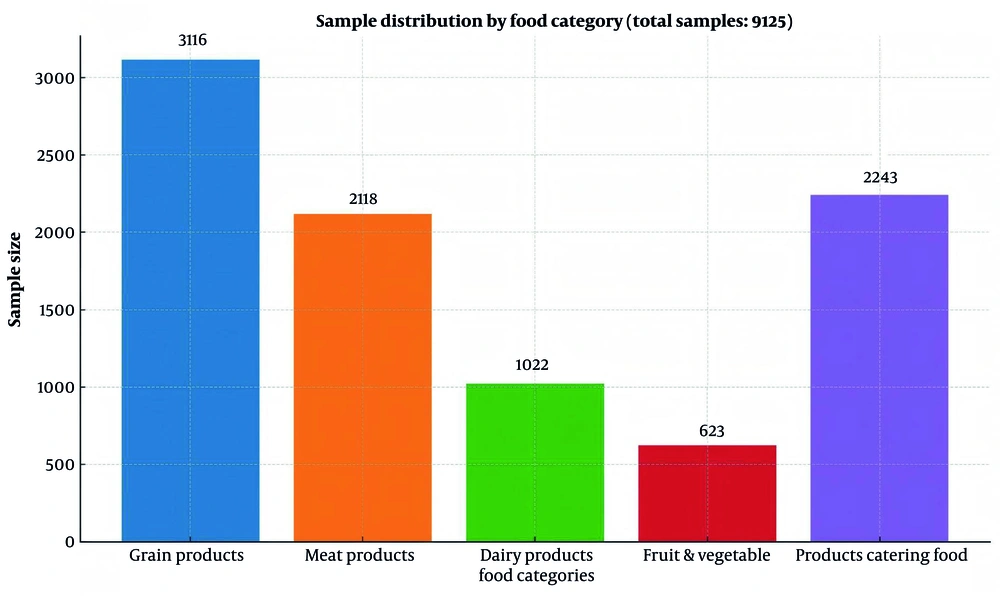
Figure 1.
Basic information of samples
4.2. Distribution of Pathogenic Bacteria
Through the microbiological testing of 9,125 food samples, a total of 546 pathogenic bacteria were identified (Table 1 and Figure 2). The predominant pathogens detected included B. cereus, Cronobacter spp., S. aureus, Salmonella spp., and E. coli. The detection rates and distribution of these pathogens across the different food categories are as follow.
1. Bacillus cereus: 191 strains detected (35.00% of the total pathogenic bacteria), predominantly found in grain products and catering foods.
2. Cronobacter spp.: 130 strains detected (23.85%), primarily concentrated in dairy products.
3. Staphylococcus aureus: 105 strains detected (19.23%), mainly observed in meat and meat products, as well as catering foods.
4. Salmonella spp.: Sixty-nine strains detected (12.69%), primarily found in meat and meat products.
5. Escherichia coli: Fifty-one strains detected (9.23%), mainly present in fruit and vegetable products.
Table 1.
Distribution of Pathogenic Bacteria in Local Specialty Food Samples in Yan'an
| Pathogen Types a | Number of Detected Strains (N) b | Proportion of Total Pathogenic Bacteria (%) c | Main Distribution Food Categories d | Χ2 | P-Value |
|---|---|---|---|---|---|
| Bacillus cereus | 191 | 35.00 | Grain products, catering food | 61.99 | - |
| Cronobacter spp. | 130 | 23.85 | Dairy products | 4.05 | - |
| Staphylococcus aureus | 105 | 19.23 | Meat and meat products, catering food | 0.15 | - |
| Salmonella spp. | 69 | 12.69 | Meat and meat products | 14.68 | - |
| Escherichia coli | 51 | 9.23 | Fruit and vegetable products | 30.86 | - |
| Total | 546 | 100 | NA e | 111.22 | < 0.001 |
a Pathogen types: The types of pathogenic bacteria detected in food samples.
b Number of detected strains (n): The total number of strains of each pathogen detected in the samples.
c Proportion of total pathogenic bacteria (%): The percentage of each pathogen's contribution to the total number of pathogenic bacteria detected in the study.
d Main distribution food categories: The food categories in which each pathogen was most commonly found.
e NA: Not applicable.
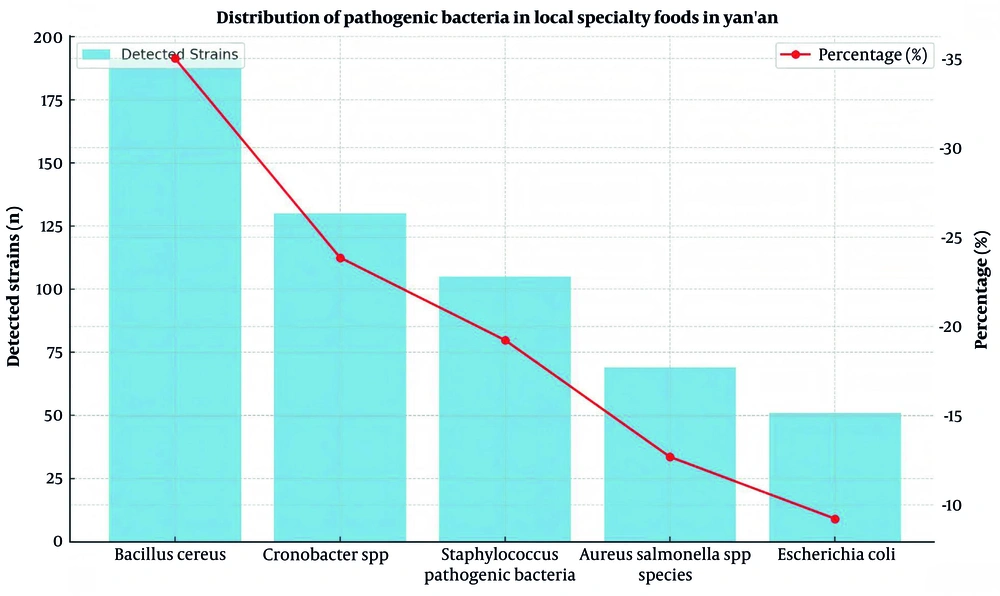
Figure 2.
Distribution of pathogenic bacteria in local specialty food samples in Yan'ans
These findings indicate that grain products, catering foods, dairy products, and meat products are the primary food categories contaminated with pathogenic bacteria, whereas the contamination rate in fruit and vegetable products is comparatively lower. The detection frequencies of the five pathogenic bacteria in this study significantly deviated from a uniform distribution (P < 0.001), indicating substantial differences in their incidence rates. This further confirms the predominant presence of B. cereus and Cronobacter spp. in local specialty foods. Additionally, the prevalence of the five major food-borne pathogens in each food-sample category shows that the prevalence of food-borne pathogens significantly varies across different food categories, with Cronobacter spp. most frequently found in dairy products, Salmonella spp. in meat, and E. coli in fruits and vegetables (Appendix 1 in Supplementary File, all P < 0.001).
4.3. Analysis of Food Categories Contaminated by Pathogenic Bacteria
Grain products and catering foods were found to be the most susceptible to pathogenic bacteria contamination. Among the grain product samples, 176 (5.65%) tested positive for pathogens, while 149 catering food samples (6.63%) were contaminated. The elevated contamination rates in these categories may be attributed to the complexity of their production processes and inadequate storage conditions. In comparison, 124 meat and meat product samples (5.84%) and 99 dairy samples (9.65%) tested positive, with raw milk products showing the highest contamination rates within the dairy category. Additionally, 73 fruit and vegetable product samples (11.78%) were deemed non-compliant with safety standards (Appendix 2 in Supplementary File).
4.4. Pathogen Contamination in Different Sales Locations
During sample collection, particular attention was paid to food safety across various types of retail venues. The results revealed notable levels of contamination in foods sold at convenience stores/retail stores, farmers' markets, and supermarkets. Among the 2,568 samples collected from convenience and retail stores, 302 (11.76%) were deemed non-compliant, with contamination primarily observed in cooked foods and items stored under inadequate refrigeration conditions. In farmers' markets, 2,140 samples were analyzed, of which 252 (11.78%) were unqualified, predominantly originating from home-prepared foods with substandard hygiene practices. Supermarkets exhibited a lower contamination rate of 8.37%, with pathogens detected in 369 out of 4,410 samples. Contamination in this setting was mainly associated with fresh, unpackaged items such as raw meat and fruits/vegetables. Overall, convenience/retail stores and farmers' markets demonstrated higher contamination rates, whereas supermarkets, despite a comparatively lower rate, still posed a potential risk, particularly regarding the safety of fresh food products (Appendix 3 in Supplementary File).
4.5. Epidemiological Characteristics of Foodborne Illness Cases
During the study period, a total of 5,720 cases of foodborne disease were reported in Yan'an, with certain demographic and occupational groups exhibiting higher incidence rates. Children and adolescents (0 - 14 years) accounted for 42.84% of cases (n = 2,450), while older adults (≥ 60 years) represented 27.45% (n = 1,570). Catering industry workers constituted 17.22% (n = 985), and individuals from other occupational groups made up 12.49% (n = 715). The increased risk among these groups is attributed to age-related immunodeficiency in the elderly and inadequate hygiene practices in food production and handling. Children, older adults, and food service workers are thus identified as high-risk populations, emphasizing the need for enhanced food safety education, targeted training, and strengthened regulatory supervision (Appendix 4 in Supplementary File).
4.6. Quantitative Microbial Risk Assessment Model to Evaluate the Impact of Pathogens on Public Health
The potential public health impact of pathogens associated with local specialty foods in Yan’an was assessed using a QMRA model. The model incorporated key parameters, including pathogen concentration, food consumption frequency, population susceptibility, and dietary habits. Bayesian statistical methods were applied to estimate disease incidence and associated health burden. The analysis revealed significant variation in infection risk across different food categories. Bacillus cereus in grain products and catering foods exhibited the highest estimated annual infection risk, at 0.85 cases per 1,000 individuals (95% CI: 0.68 - 1.02). Other notable risks included Cronobacter spp. in dairy products and S. aureus in meat products, with the latter presenting an annual infection risk of 0.56 per 1,000 individuals (95% CI: 0.45 - 0.66; Table 2). The study also found that children (0 - 14 years) and the elderly (≥ 60 years) had significantly higher disease risks, with annual infection rates of 1.56 (95% CI: 1.30 - 1.82) and 1.23 (95% CI: 1.05 - 1.41) per 1,000, respectively (Table 3).
Table 2.
Quantitative Microbial Risk Assessment Model Assessment of Pathogenic Bacteria in Local Specialty Foods in Yan'an city on Public Health
| Pathogen Types | Food Category | Annual Infection Risk (per 1,000 People) a | 95% CI b | Χ2 | P-Value |
|---|---|---|---|---|---|
| Bacillus cereus | Grain products, catering food | 0.85 | 0.68 - 1.02 | 118.94 | - |
| Cronobacter spp. | Dairy products | 0.77 | 0.60 - 0.93 | 57.77 | - |
| Staphylococcus aureus | Meat and meat products | 0.56 | 0.45 - 0.66 | 1.15 | - |
| Viral Salmonella | Meat and meat products | 0.43 | 0.35 - 0.50 | 41.53 | - |
| Escherichia coli | Fruit and vegetable products | 0.32 | 0.27 - 0.37 | 120.74 | - |
| Total | - | - | - | 340.14 (df = 4) | < 0.001 |
Abbreviation: CI, confidence interval.
a Annual infection risk (per 1,000 people): The estimated risk of infection per 1,000 people per year due to consumption of the specific food type contaminated with the corresponding pathogen.
b 95% CI: The statistical range within which the true annual infection risk is expected to fall, with 95% confidence.
Table 3.
Annual Infection Rates of Foodborne Pathogens in Different Populations in Yan'an
| Population Types a | Annual Infection Rate (per 1,000 People) b | 95% CI c | Χ2 | P-Value |
|---|---|---|---|---|
| Children; 0 - 14 (y) | 1.56 | 1.30 - 1.82 | 240.22 | < 0.001 |
| Elderly; ≥ 60 (y) | 1.23 | 1.05 - 1.41 | 8.65 | 0.0033 |
| Catering staff | 0.90 | 0.75 - 1.05 | 56.15 | < 0.001 |
| Other occupations | 0.67 | 0.58 - 0.76 | 208.22 | < 0.001 |
| Total | 0.93 | 0.81 - 1.05 | 513.23 (df = 3) | < 0.001 |
Abbreviation: CI, confidence interval.
a Population types: The different population groups for which infection rates are reported (e.g., children, elderly, catering staff, other occupational groups).
b Annual infection rate (per 1,000 people): The estimated annual infection rate per 1,000 individuals in each population group.
c 95% CI: The range within which the actual infection rate is expected to fall, based on statistical analysis.
5. Discussion
This study revealed that B. cereus, Cronobacter spp., S. aureus, Salmonella spp., and E. coli were the most prevalent pathogens in Yan'an's local specialty foods. Among them, B. cereus was frequently detected in grain and catering foods, particularly in homemade pasta and inadequately heated items. This aligns with previous studies showing its widespread presence in starch-based foods and its ability to survive cooking due to spore formation (12, 13). Bacillus cereus can cause vomiting and diarrhea and, in severe cases, life-threatening conditions (14), underscoring the need for enhanced hygiene and temperature control, especially in small-scale production and catering environments.
Cronobacter spp. was primarily found in dairy products, especially those not properly sterilized or stored. Its pathogenicity to infants and immunocompromised individuals — leading to severe illnesses like meningitis and sepsis (15) — highlights the necessity of stricter quality control in dairy processing. The resistance of B. cereus and Cronobacter spp. to common environmental conditions may explain their prominence in traditional foods, where processing methods may be less rigorous.
Staphylococcus aureus and Salmonella spp. were mainly detected in meat and catering foods. Staphylococcus aureus contamination is often linked to improper handling and cross-contamination (16, 17), while Salmonella is associated with undercooked or improperly stored meat products, particularly poultry (18). These findings suggest food safety risks in the meat supply chain and reinforce the need for standardized hygiene protocols, especially during processing and preparation. Additionally, a study examining bacterial foodborne disease outbreaks in Zhejiang province found that Vibrio parahaemolyticus was the most common pathogen, followed by Salmonella (19). While V. parahaemolyticus was not a significant finding in our study, the detection of Salmonella spp. in our samples is consistent with these results.
Escherichia coli was detected primarily in fruit and vegetable products, particularly raw produce. Inadequately washed or uncooked contaminated produce can lead to intestinal infections, particularly among children and the elderly (20). This indicates a need for public education on proper produce handling and stronger regulatory oversight of the fruit and vegetable supply chain.
Epidemiological analysis of 5,720 reported foodborne illness cases showed that children (0 - 14 years), the elderly (≥ 60), and catering workers were the most affected groups. Children are particularly vulnerable due to their underdeveloped immune systems and limited food safety awareness in school and home settings. The elderly are similarly susceptible due to immunosenescence and comorbidities, especially in households or nursing homes where food may be inadequately stored or reheated (21). Catering workers, accounting for 17.26% of all cases, are both at risk and potential vectors of transmission, given their frequent contact with food (22). Strengthening hygiene training and compliance in this sector is crucial.
Food sold in convenience stores, retail shops, farmers’ markets, and even supermarkets also showed significant contamination. Non-compliance rates in convenience stores and farmers’ markets reached 11.76%, often due to poor storage conditions and lack of regulatory oversight. Although supermarkets generally maintain better hygiene, unpackaged fresh food sections still showed notable contamination, particularly in meat and produce. These findings highlight the importance of reinforcing food safety inspections across all retail settings.
To address pathogenic bacterial contamination in Yan'an's local specialty foods and safeguard public health, this paper proposes the following: (1) Strengthen regulatory supervision across food production, processing, and sales, especially in small-scale and family-run units; (2) promote food safety education targeting high-risk populations, including children, the elderly, and food service workers; (3) improve food processing technology and encourage the adoption of sterilization standards in local food industries; (4) enhance surveillance and research, including molecular identification of key pathogens, to better guide food safety policy. Our study has several limitations: The focus on Yan'an's local specialty foods may limit generalizability to other regions; standard microbiological techniques used might have missed pathogens in low concentrations; the cross-sectional design doesn't capture seasonal variations; and unmeasured factors like handling practices could have influenced results. Besides, in this study, identification of Cronobacter spp. and Salmonella spp. was limited to the genus level based on biochemical profiling. Further molecular characterization is needed to confirm the presence of specific pathogenic species.
5.1. Conclusions
In conclusion, the contamination of local specialty foods with pathogenic bacteria in Yan'an represents a substantial public health concern. Implementing targeted control measures and strengthening food safety oversight will not only enhance the overall safety of food products in Yan’an but also provide a valuable framework for improving food safety management in other regions.