1. Background
Since its emergence, the coronavirus (SARS-CoV-2) has been spreading as an epidemic in Iran (1). The virus primarily infects individuals via the respiratory system. It uses its surface proteins, such as spikes, to adhere to the host cells' surface and penetrate the respiratory cells, leading to varied symptoms among individuals (2). Moreover, it can enter certain tissues through the bloodstream, potentially leading to both acute and chronic inflammation (3). Given that persistent inflammations in the body can potentially lead to cancer, researchers have suggested that SARS-CoV-2 infection might be a risk factor for the onset and progression of certain cancers in those infected (4, 5). Molecules involved in apoptosis and the induction of chronic inflammation may contribute to the development of cancers following SARS-CoV-2 infection (6). However, the molecular drivers of disease severity, particularly the interplay between inflammatory cell death, apoptosis inhibition, and the antioxidant response, remain inadequately defined and are the subject of conflicting reports. This lack of synthesis presents a significant gap in understanding the pathogenesis of severe COVID-19.
Nuclear factor erythroid 2-related factor 2 (NRF2, encoded by the NFE2L2 gene), is a basic leucine zipper (bZIP) protein transcription factor that plays a crucial role in regulating the expression of antioxidant proteins (7). These proteins are essential for protecting cells from oxidative damage triggered by inflammation or injury (7). The NRF2 achieves this by binding to specific DNA sequences known as antioxidant response elements (AREs) in the promoter regions of genes that encode cytoprotective proteins (8). The role of NRF2 in SARS-CoV-2 infection, however, is not clearly established. While some evidence positions NRF2 activation as a protective mechanism against viral-induced oxidative stress (9), other studies suggest its pathway may be suppressed by the virus, contributing to cellular damage (10). This discrepancy highlights a critical unresolved question regarding the host's antioxidant response in severe infection.
Caspase-1 is an enzyme that plays a crucial role in inflammation by activating pro-inflammatory cytokines such as IL-1β and IL-18 and by mediating the induction of apoptosis, a form of inflammatory cell death called pyroptosis. During SARS-CoV-2 infection, caspase-1 is thought to contribute to the disease's progression by enhancing inflammation and inducing cell death (11). Elevated caspase-1 activity is widely reported in severe COVID-19 and is strongly associated with pyroptosis and the cytokine storm (12). However, its relationship with other cell death regulators like survivin in the specific context of early-stage, treatment-naive severe disease is less explored. Additionally, caspase-1 may influence energy metabolism and tissue damage or repair (13).
Survivin, also referred to as BIRC5, is a protein that belongs to the inhibitor of apoptosis protein (IAP) family (14). Survivin plays a critical role in preventing apoptosis, which is the process of programmed cell death. It works by interfering with the function of caspases. Caspases are a family of enzymes that act as the main drivers of apoptosis. They are involved in the execution phase of cell death, where they break down critical cell components, ultimately leading to the cell's dismantling and removal. By inhibiting caspase activity, survivin prevents apoptotic breakdown, effectively blocking the cell from undergoing apoptosis. This protective function is important for cell survival, particularly in the context of cells that might otherwise be stressed or damaged. However, in some diseases, such as cancer, high levels of survivin can contribute to the uncontrolled survival of cancer cells, making it a target of interest for potential therapeutic strategies (15). In the context of SARS-CoV-2 infection, changes in survivin expression levels may be linked to adverse effects of the condition (15). The existing data on survivin expression in COVID-19 is contradictory.
Some studies report the downregulation of survivin, potentially linking it to increased lymphocyte apoptosis and lymphopenia (16), while others have observed its upregulation, possibly as a viral strategy to enhance the survival of infected cells (17). This conflict underscores the need to clarify its expression pattern and interactions in severe cases. This makes survivin a potential target for molecular therapies aimed at treating SARS-CoV-2 complications, given its role in inhibiting cell death and regulating cell division.
While the individual roles of NRF2 (antioxidant response), caspase-1 (pyroptosis/inflammation), and BIRC5 (apoptosis inhibition) in viral infections have been studied separately, their expression patterns and potential interactions in the specific context of severe SARS-CoV-2 infection remain poorly characterized. In particular, there is a lack of data on the coordinated expression of these critical regulators of cell fate — representing oxidative stress (NRF2), inflammatory cell death (caspase-1), and cell survival (BIRC5) in a unified patient cohort. Understanding these interactions is crucial, as the balance between these pathways may determine disease severity, influencing both the inflammatory cascade and tissue damage. Furthermore, no such study has been conducted on the Iranian population, which may have unique genetic or environmental factors affecting these molecular pathways.
2. Objectives
This study aims to fill this gap by simultaneously investigating the expression levels of NRF2, caspase-1, and BIRC5 in Iranian patients with severe SARS-CoV-2 infection to elucidate their correlations and potential collective role in the pathogenesis of the disease.
3. Methods
3.1. Subjects
This cross-sectional study was conducted to compare gene expression levels between patients with severe COVID-19 and healthy controls. While this design identifies associations, it cannot establish causal relationships between gene expression and disease severity. The research evaluated the expression levels of NRF2, caspase-1, and BIRC5 in 100 individuals. This study comprised 70 consecutively recruited hospitalized patients infected with SARS-CoV-2 and 30 individuals who were not infected, serving as the control group, who were randomly selected from volunteers. A formal sample size calculation was not performed; the sample size was based on practical feasibility and availability of patients during the study period. This is a limitation of the study.
All participants were in the initial stages of their illness, within 24 hours of experiencing symptoms, and had not yet received any treatment for SARS-CoV-2. To qualify for the study, participants needed to exhibit COVID-19 symptoms consistent with severe disease (e.g., dyspnea, respiratory frequency ≥ 30/min, blood oxygen saturation ≤ 93%, or lung infiltrates > 50%) and provide a positive PCR test result. Individuals for the study were selected from health centers located in Kerman province, Iran. The control group consisted of people who were healthy, showed no symptoms, and tested negative by nasopharyngeal swab PCR for SARS-CoV-2. To exclude co-infections, routine clinical diagnostics were performed at admission; patients with positive results for other common respiratory pathogens (e.g., influenza, Streptococcus pneumoniae) were excluded from the study.
Prior to starting any SARS-CoV-2 treatment, blood samples were collected in tubes containing anticoagulants from both patients diagnosed with the disease and healthy control subjects. Blood samples were collected in tubes pre-coated with EDTA prior to treatment.
3.2. Extraction of mRNA
To extract total mRNA, a commercial kit (KPG, Iran) was used. The purification process was conducted according to the manufacturer's instructions. The purity and concentration of the extracted RNA were assessed using a NanoDrop spectrophotometer (Thermo Fisher Scientific, USA). All samples had an A260/A280 ratio between 1.8 and 2.1, indicating pure RNA suitable for downstream applications. RNA integrity was confirmed by running a subset of samples on a 1% agarose gel, observing clear 18S and 28S ribosomal RNA bands.
3.3. Synthesis of cDNA
Total mRNA conversion to cDNA was carried out using a cDNA synthesis kit (KPG, Iran), following the manufacturer's instructions. Specifically, 2 μg of purified mRNA, 50 μmol of oligo(dT)-anchor primer, 1 μL of reverse transcriptase (RT), and 5 μL of RT buffer were combined, and the total volume was adjusted to 20 μL with RNase/DNase-free water. The mixture was then incubated at 25°C for 10 minutes, followed by 47°C for 60 minutes, and finally at 95°C for 5 minutes. To control for genomic DNA contamination, a no-reverse transcriptase control (no-RT) was included for each sample by replacing the RT enzyme with nuclease-free water.
3.4. Real-time PCR Conditions
A 20 μL reaction mixture was prepared for real-time PCR, containing 1 μL of cDNA for BIRC5, CASPASE 1, NRF2, and beta-actin, with beta-actin serving as the housekeeping gene. Primers were added at a concentration of 10 μmol/L, as detailed in Table 1. Additionally, 10 μL of SYBR Green Biosystem™ qPCR Master Mix (England) was included, and the final volume was adjusted with nuclease-free water. A no-template control (NTC) with nuclease-free water instead of cDNA was included in each run to check for primer-dimer formation and contamination. The PCR protocol began with an initial denaturation step at 95ºC for 2 minutes, followed by 40 cycles, each consisting of a 10-second denaturation at 95°C and a 30-second annealing at 60°C. A melt curve analysis was conducted with a temperature gradient ranging from 55°C to 95°C to confirm the specificity of amplification and the presence of a single product. The amplification efficiency for each primer pair was determined using a standard curve generated from a serial dilution of a pooled cDNA sample. All primer sets demonstrated efficiencies between 90% and 110% with a correlation coefficient (R2) > 0.98. The experiments were conducted using a Rotor-Gene Q real-time PCR system (Qiagen, USA), and the data were evaluated employing the 2-∆∆Ct method.
Table 1.
Genes and Primer Sequences
| Genes | Sequences (5'-3') |
|---|---|
| BIRC5 | ATTCGTCCGGTTGCGCTTT; TTCTTGGCTCTTTCTCTGTCCA |
| Caspase -1 | AACTGGAGCTGAGGTTGACA; AGTCATGTCCGAAGCAGTGA |
| NRF2 | ATGCCCTCACCTGCTACTTT; AGTGAAATGCCGGAGTCAGA |
| Beta actin | GCATGGGTCAGAAGGATTC; GTCCCAGTTGGTGACGAT |
Abbreviation: NRF2, nuclear factor erythroid 2-related factor 2.
3.5. Statistical Analysis
Data analysis was performed using SPSS version 18. The One-Sample Kolmogorov-Smirnov test was used to evaluate the normality of data distribution. To compare quantitative variables between hospitalized patients infected with SARS-CoV-2 and healthy controls, the Mann-Whitney test, a non-parametric test, was employed. Spearman's correlation analysis was used to analyze correlations between variables. To account for multiple comparisons in the correlation analysis, a Bonferroni correction was applied, resulting in a revised significance level of P < 0.017 (0.05/3 comparisons) for the inter-gene correlations (BIRC5-NRF2, BIRC5-caspase-1, caspase-1-NRF2). Statistical descriptive quartiles were used to report quantitative data, and a significance level of less than 0.05 was used for all tests.
4. Results
The two groups were comparable in terms of demographic characteristics. Data analysis using the chi-square test showed no statistically significant differences between the two groups with respect to sex (P > 0.05). Similarly, the Mann-Whitney U test confirmed no significant difference in age between the groups (P = 0.630). The median relative expression of NRF2 in hospitalized patients infected with SARS-CoV-2 was 0.5982 (interquartile range: 0.1175 - 2.9335), while in healthy controls, it was 0.2184 (interquartile range: 0.1442 - 0.5632). These differences in NRF2 expression between the groups did not reach statistical significance (P = 0.081; Figure 1).
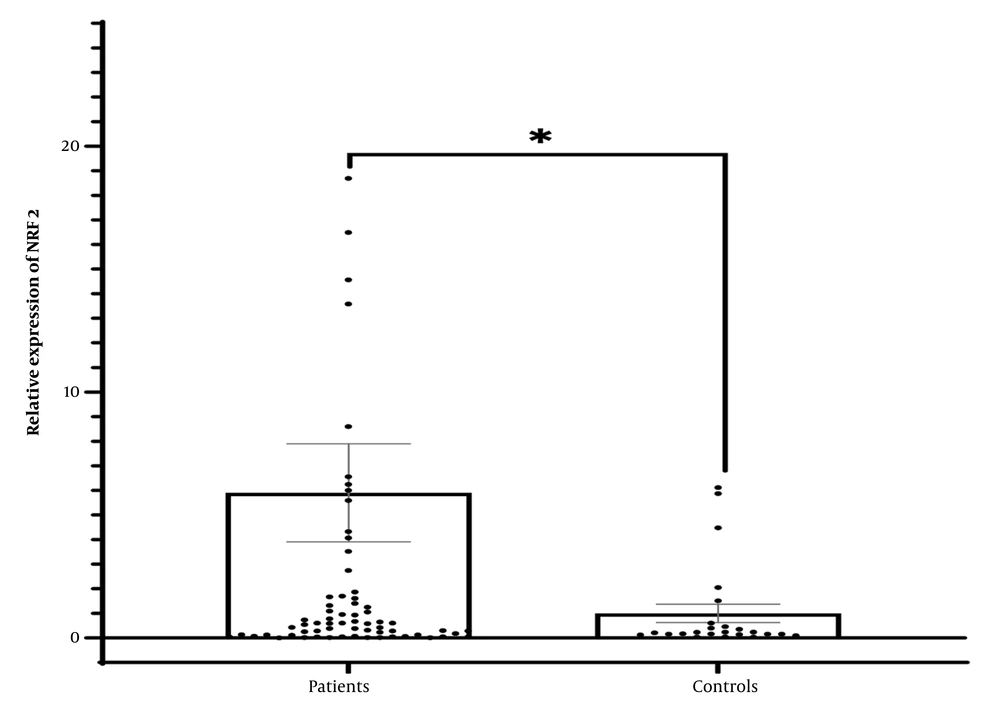
Figure 1.
Relative expression of nuclear factor erythroid 2-related factor 2 (NRF2) in the hospitalized SARS-COV-2 infected patients and healthy controls. The data indicates that NRF2 expression was not significantly different between the patient and control groups. Box plots show the median (central line), interquartile range (box), and range (whiskers; * P = 0.081, Mann-Whitney U test).
In contrast, the median relative expression of caspase-1 was significantly higher in hospitalized patients infected with SARS-CoV-2 (4.1324, interquartile range: 0.3298 - 37.2486) compared to healthy controls (0.6406, interquartile range: 0.1470 - 1.1318; P = 0.008; Figure 2). Conversely, the median relative expression of BIRC5 was significantly lower in the patients (0.1612, interquartile range: 0.0833 - 0.2761) than in healthy controls (0.5258, interquartile range: 0.3924 - 0.8590; P < 0.001; Figure 3).
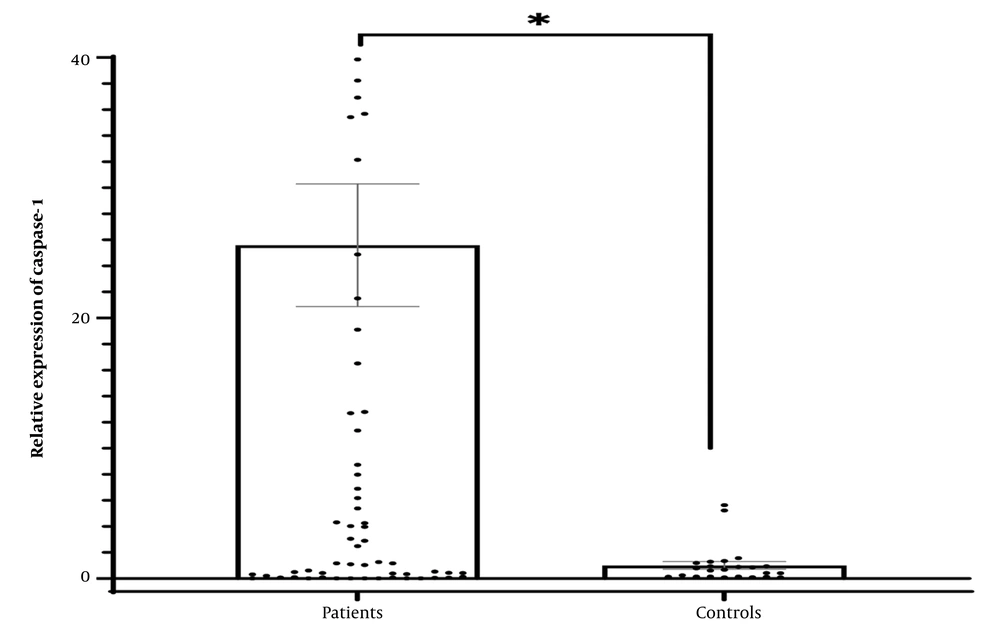
Figure 2.
Relative expression of caspase-1 in the hospitalized SARS-COV-2 infected patients and healthy controls. The data indicates that caspase-1 expression was significantly increased in the patients when compared to controls. Box plots show the median (central line), interquartile range (box), and range (whiskers; * P = 0.008, Mann-Whitney U test).
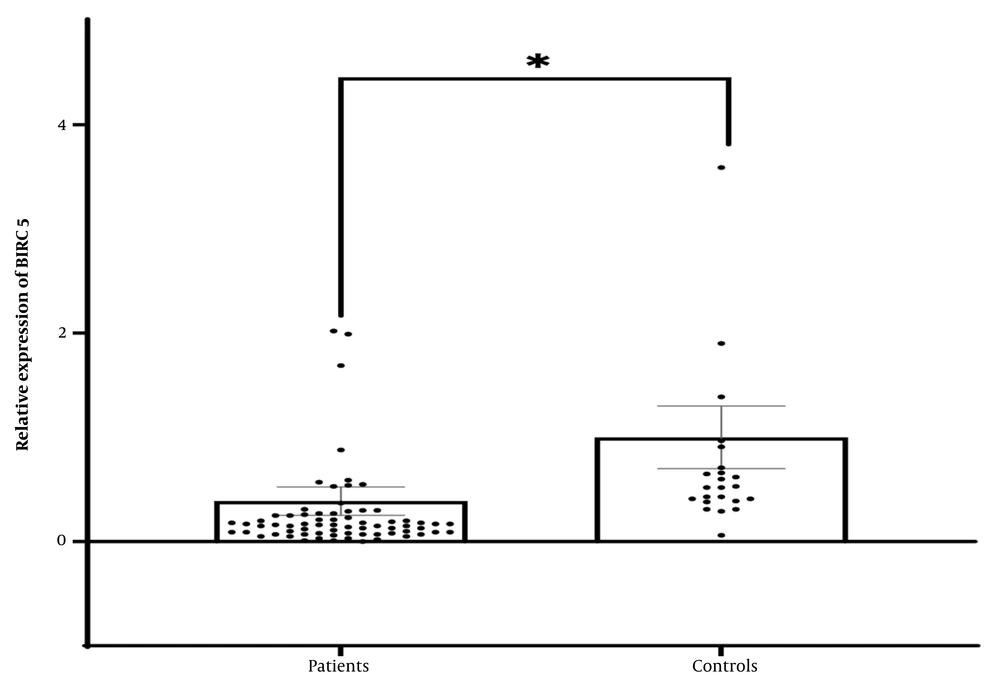
Figure 3.
Relative expression of BIRC5 in the hospitalized SARS-COV-2 infected patients and healthy controls. The data indicates that BIRC5 expression was significantly decreased in the patients when compared to controls. Box plots show the median (central line), interquartile range (box), and range (whiskers; * P < 0.001, Mann-Whitney U test).
Spearman's rank correlation analysis in the patients revealed statistically significant positive associations between BIRC5 and NEF2L2 (rs = 0.585, P < 0.001), BIRC5 and caspase-1 (rs = 0.613, P < 0.001), and caspase-1 and NEF2L2 (rs = 0.618, P < 0.001). All reported correlations remained statistically significant after applying a Bonferroni correction for multiple comparisons (significance threshold set at P < 0.017). In contrast, age did not show any significant correlation with NEF2L2, caspase-1, or BIRC5 levels (Table 2). No significant correlations were observed between these variables in the healthy control group (all P > 0.05; Table 3). Given the limited statistical power of our sample size for subgroup analyses, the planned gender-based comparisons of gene expression levels were not performed.
Table 2.
| Spearman's Rho | Age | BIRC5 | NEF2L2 | Caspase-1 |
|---|---|---|---|---|
| Age | ||||
| Correlation coefficient | 1.000 | -0.051 | -0.174 | 0.024 |
| P-value | - | 0.675 | 0.150 | 0.846 |
| NEF2L2 | ||||
| Correlation coefficient | -0.174 | 0.585 | 1.000 | 0.618 |
| P-value | 0.150 | 0.000 | - | 0.000 |
| Caspase-1 | ||||
| Correlation coefficient | 0.024 | 0.613 | 0.618 | 1.000 |
| P-value | 0.846 | 0.000 | 0.000 | - |
| BIRC5 | ||||
| Correlation coefficient | -0.051 | 1.000 | 0.585 | 0.613 |
| P-value | 0.675 | - | 0.000 | 0.000 |
a Data analysis showed that there were significant positive associations between BIRC5 and NEF2L2, BIRC5 and caspase-1, and caspase-1 and NEF2L2 in hospitalized SARS-CoV-2 infected patients.
b All significant inter-gene correlations remained significant after applying a Bonferroni correction for multiple comparisons (significance threshold set at P < 0.017).
| Spearman's Rho | Age | BIRC5 | NEF2L2 | Caspase-1 |
|---|---|---|---|---|
| Age | ||||
| Correlation coefficient | 1.000 | 0.319 | -0.179 | -0.137 |
| P-value | - | 0.129 | 0.402 | 0.522 |
| NEF2L2 | ||||
| Correlation coefficient | -0.179 | 0.315 | 1.000 | 0.309 |
| P-value | 0.402 | 0.134 | - | 0.142 |
| Caspase-1 | ||||
| Correlation coefficient | -0.137 | 0.312 | 0.309 | 1.000 |
| P-value | 0.522 | 0.138 | 0.142 | - |
| BIRC5 | ||||
| Correlation coefficient | 0.319 | 1.000 | 0.315 | 0.312 |
| P-value | 0.129 | - | 0.134 | 0.138 |
a Data analysis showed that there were not significant associations between the variables.
b All significant inter-gene correlations remained significant after applying a Bonferroni correction for multiple comparisons (significance threshold set at P < 0.017).
5. Discussion
In recent years, research has highlighted the critical role of molecular biomarkers in understanding the pathogenesis of severe SARS-CoV-2 infections. These biomarkers provide valuable insights into the underlying mechanisms of the disease, which can help identify potential therapeutic targets (18). This study investigated the expression levels of NRF2, caspase-1, and BIRC5 in hospitalized patients with severe SARS-CoV-2 infection compared to healthy controls. The findings reveal significant differences in the expression of caspase-1 and BIRC5 between the two groups, while NRF2 expression showed a trend but did not reach statistical significance. Furthermore, significant correlations were observed between the expression of these genes within the patient group, but not in the control group.
The significantly higher expression of caspase-1 in SARS-CoV-2 infected patients compared to healthy controls is consistent with its established role in inflammation and pyroptosis (19). Caspase-1 is a key mediator of the inflammasome complex, responsible for the proteolytic activation of pro-inflammatory cytokines IL-1β and IL-18 (20). Our data aligns with previous studies that have documented elevated caspase-1 activity in severe COVID-19, linking it to the cytokine release syndrome and tissue damage characteristic of advanced disease (21). For instance, Premeaux et al. demonstrated caspase-1-mediated pyroptosis in lung epithelial cells of COVID-19 patients (22). This suggests that the observed upregulation is part of a well-documented hyperinflammatory response, rather than a novel finding, and underscores its value as a biomarker of disease severity.
Conversely, the significantly lower expression of BIRC5 (survivin) in the infected patients is a notable finding. Survivin is a recognized inhibitor of apoptosis, and its downregulation could indicate a shift towards programmed cell death in immune cells, potentially contributing to the lymphopenia observed in severe COVID-19 (16). While our data robustly shows this downregulation and its correlation with other genes, we acknowledge that the functional consequences of this finding remain speculative without experimental validation.
The role of survivin in viral infections is complex and context-dependent. Its downregulation could be a host-driven mechanism to eliminate infected cells via apoptosis, thereby limiting viral replication (23). Alternatively, it could be a virus-induced strategy to cause immune cell death and evade host defenses. This study was not designed to distinguish between these possibilities, and we caution against overinterpreting the mechanistic role of BIRC5 based solely on expression data. Future studies incorporating flow cytometric analysis of apoptosis in specific immune cell subsets (e.g., lymphocytes) alongside survivin expression are necessary to functionally validate this observation.
Although the difference in NRF2 expression between the groups did not reach statistical significance (P = 0.081), the trend towards higher expression in infected patients may suggest a compensatory antioxidant response to virus-induced oxidative stress. This is a plausible interpretation given NRF2's known role in cytoprotection (7). However, the lack of significance, potentially due to sample size or biological variability, means this remains a tentative observation. It is important to note that our study focused on a limited set of genes and did not measure downstream antioxidant proteins (e.g., HO-1, NQO1), oxidative stress markers (e.g., ROS levels, lipid peroxidation), or broader systemic inflammatory cytokines (e.g., IL-6, TNF-α). This omission limits our ability to fully contextualize the NRF2 expression trend within the broader oxidative and inflammatory state of the patients.
The correlation between NRF2 and caspase-1, while statistically significant, should be interpreted as an association rather than a proven functional interaction. The significant positive correlations observed between BIRC5, NRF2, and caspase-1 exclusively in the patient group suggest a coordinated dysregulation of cell death, antioxidant, and inflammatory pathways during SARS-CoV-2 infection. In line with our findings, a study by Ducastel et al. also reported similar correlations between inflammatory markers and antioxidant enzymes in COVID-19 patients, further highlighting the systemic nature of the host's response to the infection (24). This interplay highlights the complexity of the host response. However, these correlations do not imply causation or direct mechanistic links.
Our methodological approach, while effective for identifying expression patterns and associations, does not include regulatory genes or epigenetic factors that might govern these relationships. Furthermore, we did not account for potential confounding environmental factors (e.g., diet, smoking) that can influence NRF2 activity, which is a limitation of our study design. It is critical to acknowledge key methodological limitations. Firstly, the observed associations, while statistically significant, are derived from mRNA expression data alone and lack functional or interventional validation. Therefore, any discussion of therapeutic implications, such as targeting caspase-1 or modulating survivin, is premature and remains entirely hypothetical at this stage. Our study serves to generate hypotheses for future functional research rather than to propose clinical strategies.
Secondly, as noted, our analysis did not include measurements of protein levels, oxidative stress markers, or a broader panel of inflammatory cytokines, which would have provided a more comprehensive mechanistic picture. Finally, the sample was drawn from a specific geographic region (Kerman province, Iran), and the influence of genetic or environmental factors unique to this population cannot be ruled out.
5.1. Conclusions
This study highlights the role of caspase-1, BIRC5 (survivin), and NRF2 in severe SARS-CoV-2 infections. The higher expression of caspase-1 suggests its involvement in inflammation and disease severity, while the downregulation of survivin indicates increased apoptosis, contributing to tissue damage. Although NRF2 expression showed a trend towards higher levels, it was not statistically significant, suggesting a possible compensatory response to oxidative stress. Correlations between these genes in infected patients point to a complex interaction involving inflammation, oxidative stress, and cell death. No significant differences were observed between males and females, indicating that sex may not influence gene expression in this context. Further research with larger, diverse populations is needed to confirm these findings and explore new therapeutic targets for COVID-19.