1. Introduction
Brain abscess is a rare but potentially fatal intracranial infection characterized by a localized collection of purulent material within the brain parenchyma (1, 2). Despite substantial advances in neuroimaging, antimicrobial therapy, and neurosurgical techniques, brain abscess remains associated with considerable morbidity and mortality, particularly when diagnosis is delayed or the source of infection is not identified (3). Survivors often experience long-term neurological sequelae, underscoring the importance of early recognition and appropriate management (4).
Brain abscesses may arise through several pathogenic routes, including contiguous spread from adjacent craniofacial infections, hematogenous dissemination from distant infectious foci, direct inoculation after trauma or neurosurgical procedures, or cryptogenic origins when no primary source is identified (5, 6). Although hematogenous spread is currently considered the most common route, the primary focus of infection remains unidentified in a substantial proportion of cases, complicating etiological diagnosis and targeted therapy.
Odontogenic brain abscess is an uncommon but clinically significant subtype. The oral cavity harbors one of the most complex microbial ecosystems in the human body, with dental plaque containing a high concentration of anaerobic and facultative anaerobic microorganisms (7). Chronic periodontal disease, periapical infections, and dental procedures can facilitate transient or persistent bacteremia, allowing oral pathogens to disseminate to the central nervous system (8, 9). Odontogenic infections are often polymicrobial and predominantly anaerobic, contributing to diagnostic difficulty and therapeutic challenges. Poor oral hygiene and untreated periodontal disease are increasingly recognized as underappreciated risk factors for intracranial infections (10).
The microbiology of brain abscess varies according to the route of infection and host immune status. Polymicrobial infections are common, particularly when abscesses originate from the oral cavity, with anaerobic bacteria playing a major role (11). However, conventional culture techniques often fail to identify causative pathogens, especially in patients who have received prior antibiotic therapy or in infections caused by fastidious anaerobic organisms (12). Consequently, sterile cultures are frequently encountered, delaying pathogen-directed treatment and increasing reliance on empirical antimicrobial regimens (13).
Magnetic resonance imaging (MRI), particularly diffusion-weighted imaging (DWI), is the diagnostic modality of choice for brain abscess and allows differentiation from necrotic tumors and other focal intracranial lesions (14). Nevertheless, neuroimaging alone cannot determine the etiological source or microbial composition of the abscess. Cerebrospinal fluid (CSF) analysis has limited diagnostic yield and is not routinely recommended because of the risk of cerebral herniation in patients with space-occupying lesions, although it may provide useful information in carefully selected cases.
Recent advances in molecular diagnostic techniques, particularly metagenomic next-generation sequencing (mNGS), have substantially improved pathogen detection in central nervous system infections (15). Metagenomic next-generation sequencing enables culture-independent identification of a broad range of microorganisms, including anaerobic and unculturable pathogens, directly from clinical specimens (15). This approach is particularly valuable in suspected odontogenic brain abscesses, for which conventional microbiological methods frequently fail to yield definitive results (16). Given the rarity of odontogenic brain abscess, the frequent absence of positive cultures, and the lack of standardized diagnostic and therapeutic strategies, detailed clinical reports remain essential to improve understanding of disease mechanisms and optimize patient management.
This study retrospectively analyzes a successfully treated case of odontogenic brain abscess to characterize its clinical presentation, neuroimaging features, and microbiological profile. The objectives were to describe the radiological evolution and complications of the abscess, including ventricular involvement; identify the causative pathogens using CSF mNGS; and correlate these findings with oral disease as the presumed source of infection. This case may provide practical diagnostic and management insights to assist clinicians in the early recognition and treatment of high-risk odontogenic brain abscesses.
2. Case Presentation
A 66-year-old man was admitted with progressive dizziness and right-sided limb weakness lasting more than 10 days. Symptoms began on November 23, 2019, with dizziness and headache in the absence of fever, nausea, or vomiting. On December 2, the patient developed facial deviation and worsening right-sided weakness. His condition further deteriorated on December 6, when high fever and somnolence developed, prompting hospital admission.
The patient’s medical history was notable for hypertension for more than 10 years. One week before symptom onset, he had been diagnosed with triple-vessel coronary artery disease and had undergone percutaneous coronary intervention with stent implantation. There was no history of recent head trauma, neurosurgical procedures, or dental intervention.
On admission, neurological examination revealed impaired consciousness, with a Glasgow Coma Scale score of E3V1M4 (total score, 8). The patient was somnolent. Both pupils were equal in size, with a diameter of 3 mm, and exhibited sluggish light reflexes. A shallow right nasolabial fold was observed. Muscle tone was normal in all extremities, without evidence of muscle atrophy. Motor strength on the right side was grade 4−, whereas strength on the left side was normal. Physiological reflexes were preserved, and pathological reflexes were absent. Signs of meningeal irritation were present, including marked nuchal rigidity, with approximately five finger breadths between the chin and chest. Oral examination revealed poor oral hygiene with extensive dental pigmentation and periodontal disease.
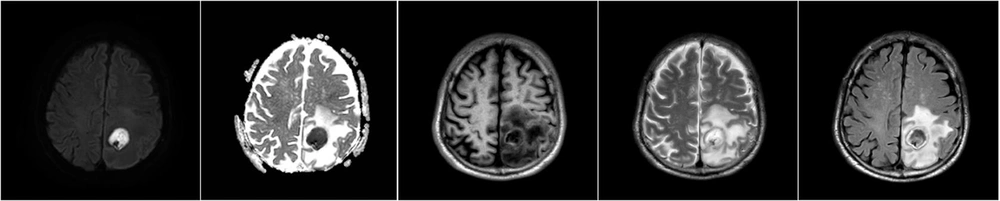
Initial laboratory investigations demonstrated marked leukocytosis (21.28 × 10⁹/L) and a significantly elevated serum procalcitonin level (41.46 ng/mL). Blood cultures obtained before antibiotic administration were negative. Brain MRI revealed a well-circumscribed, round lesion measuring approximately 2.3 × 2.7 cm in the left parietal lobe. The lesion showed an isointense capsule on both T1- and T2-weighted images, with hypointense signal on T1-weighted imaging and hyperintense signal on T2-weighted imaging within the cystic cavity. Prominent surrounding vasogenic edema and mild mass effect were present. Diffusion-weighted imaging demonstrated marked hyperintensity with restricted diffusion, consistent with a diagnosis of brain abscess (Figure 1). Empirical broad-spectrum antimicrobial therapy was initiated.
Brain magnetic resonance imaging (MRI) demonstrates a well-circumscribed round lesion measuring approximately 2.3 × 2.7 cm in the left parietal lobe. A, The lesion shows an isointense capsule on both T1- and T2-weighted images, with hypointense signal on T1-weighted imaging and hyperintense signal on T2-weighted imaging within the cystic cavity. B, Prominent perilesional vasogenic edema with mild mass effect is observed. C, Diffusion-weighted imaging reveals marked hyperintensity with restricted diffusion, consistent with a cerebral abscess.
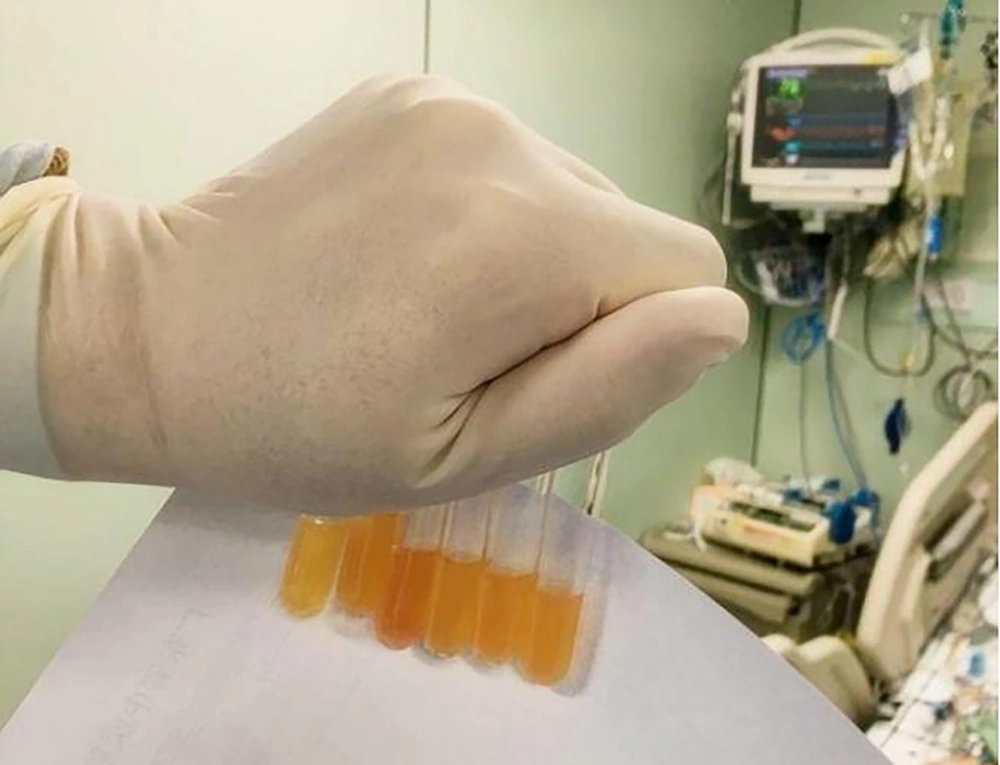
Lumbar puncture yielded turbid yellow CSF (Figure 2), with an opening pressure of 300 mmH2O. Cerebrospinal fluid analysis revealed a markedly elevated leukocyte count (49,500 × 106/L), with neutrophil predominance, severe hypoglycorrhachia (< 1.25 mmol/L), an elevated chloride concentration (108.8 mmol/L), and profound hyperproteinorrhachia (> 3000 mg/L). Routine CSF smear and cultures were negative. Metagenomic next-generation sequencing of CSF detected Porphyromonas gingivalis, Fusobacterium nucleatum, and Actinomyces israelii. In conjunction with oral examination findings (Figure S1 in the Supplementary File), a diagnosis of odontogenic brain abscess complicated by sepsis and respiratory failure was established.
Cerebrospinal fluid (CSF) findings consistent with severe bacterial infection. A, Gross appearance showing yellowish, turbid CSF with markedly elevated opening pressure (> 300 mmH2O). B, Cytological examination demonstrating marked pleocytosis (49,500 × 106/L) with neutrophil predominance. C, Biochemical analysis revealing profound hypoglycorrhachia (< 1.25 mmol/L), elevated chloride concentration (108.8 mmol/L), and severe hyperproteinorrhachia (> 3000 mg/L).
The patient was transferred to the intensive care unit and required mechanical ventilation for respiratory support. Empirical intravenous antimicrobial therapy was initiated with meropenem (2 g every 8 hours) and vancomycin (15 - 20 mg/kg every 8 - 12 hours, dose adjusted according to renal function and serum trough levels) to provide broad coverage against gram-negative and gram-positive pathogens. After pathogen identification, vancomycin was discontinued, and ornidazole (500 mg every 12 hours intravenously) was added to enhance anaerobic coverage.
Despite antimicrobial therapy, no clinical improvement was observed. Follow-up MRI performed on December 12 demonstrated thinning of the abscess wall, with rupture into the left posterior horn of the lateral ventricle (Supplementary Figure S2). Emergency external ventricular drainage was performed, followed by a short course of intraventricular amikacin irrigation (5 - 10 mg once daily) to control ventricular infection.
After 2 weeks of combined antimicrobial therapy and neurosurgical intervention, the patient gradually regained consciousness, achieved hemodynamic stability, and was successfully weaned from mechanical ventilation. Residual symptoms included delayed responsiveness, intermittent low-grade fever, and persistent right-sided weakness.
Repeat cranial computed tomography on December 30 demonstrated a reduction in abscess size with residual intraventricular purulent material (Figure S3 in the Supplementary File), accompanied by normalization of inflammatory markers. The ventricular drain was subsequently removed, and the patient was transferred to a general ward while continuing intravenous meropenem and ornidazole. After clinical stabilization, he was discharged to a secondary hospital to complete antimicrobial therapy, which was discontinued after a total treatment duration of approximately 2 months, followed by rehabilitation. No evidence of recurrence was observed during a 6-month follow-up period.
3. Discussion
Brain abscess is a focal suppurative infection of the brain parenchyma caused by invasion of pyogenic microorganisms, resulting in localized inflammation, tissue necrosis, and abscess formation. Although relatively uncommon, brain abscess remains a serious clinical condition associated with substantial morbidity and mortality. Bacterial pathogens account for more than 85% of cases, whereas infections caused by atypical bacteria, such as Mycobacterium tuberculosis and Nocardia species, as well as fungi and parasites, are less frequent (17, 18). Polymicrobial infections are common, particularly when the source originates from regions colonized by diverse microbial communities, such as the oral cavity (19).
The pathogenesis of brain abscess involves several distinct routes of infection. Contiguous spread from adjacent craniofacial infections, including sinusitis, otitis media, and dental infections, remains a major pathway. Hematogenous dissemination from distant infectious foci is another important mechanism, often resulting in lesions at the gray-white matter junction (20, 21). Less commonly, brain abscess develops after penetrating head trauma or neurosurgical procedures. Despite thorough evaluation, the primary source of infection remains unidentified in approximately 20% - 30% of cases, highlighting the diagnostic challenges associated with this condition.
Clinical manifestations of brain abscess are highly variable and frequently nonspecific, contributing to delayed diagnosis. Symptoms reflect both systemic infection and focal mass effect within the brain. Headache is the most common presenting symptom, whereas fever and focal neurological deficits occur less consistently (22, 23). The classic triad of headache, fever, and focal neurological signs is observed in only a minority of patients. Early-stage disease often presents with nonfocal symptoms, such as headache, nausea, or altered mental status, whereas progressive abscess enlargement may lead to increased intracranial pressure, seizures, and deterioration of consciousness.
Odontogenic brain abscess represents a rare but clinically significant subtype. The oral cavity harbors one of the most complex microbiomes in the human body, and dental plaque contains a high density of anaerobic and facultative anaerobic bacteria (24). Chronic periodontal disease, periapical infections, and poor oral hygiene can promote persistent bacteremia, enabling oral pathogens to disseminate to the central nervous system through hematogenous routes or, less commonly, via contiguous spread (25). Consequently, odontogenic brain abscesses are frequently polymicrobial and dominated by anaerobic organisms, complicating both microbiological diagnosis and antimicrobial selection (26).
The evolution of a brain abscess generally proceeds through distinct pathological stages, although the rate of progression may vary depending on pathogen virulence and host immune status. The early cerebritis or meningitis stage is characterized by localized inflammation, tissue necrosis, leukocyte infiltration, and perilesional edema, without formation of a well-defined purulent cavity (27). Superficial lesions at this stage may provoke meningeal irritation. As inflammation progresses, the suppurative stage develops, marked by coalescence of necrotic tissue and formation of a pus-filled cavity, often with internal septations. The abscess core consists of necrotic debris surrounded by granulation tissue and reactive gliosis, accompanied by substantial surrounding edema. Capsule formation typically begins within 1 - 2 weeks and matures by 3 - 4 weeks into a well-defined three-layered structure comprising an inner granulation layer with macrophages, a collagenous middle layer, and an outer gliotic layer separating the lesion from adjacent brain tissue (28).
Magnetic resonance imaging is the diagnostic modality of choice for brain abscess, and imaging characteristics evolve according to disease stage. In early cerebritis, lesions often appear ill-defined, with irregular signal intensity on both T1- and T2-weighted images (29). Encapsulated abscesses typically demonstrate a hypointense core on T1-weighted images and hyperintensity on T2-weighted images, surrounded by vasogenic edema and a smooth, uniformly enhancing ring (29). Diffusion-weighted imaging is particularly valuable because abscess cavities show restricted diffusion with hyperintense signals and low apparent diffusion coefficient values, a key feature that distinguishes abscesses from necrotic tumors (30). Cerebrospinal fluid findings are variable and often nonspecific, including pleocytosis, elevated protein levels, and hypoglycorrhachia in the early stages. Pathogen identification from CSF is uncommon unless an intraventricular rupture has occurred (31).
Management of brain abscess requires prolonged antimicrobial therapy combined with neurosurgical intervention when indicated. Antimicrobial therapy remains the cornerstone of treatment and must achieve adequate penetration across the blood-brain barrier to reach bactericidal concentrations within the abscess cavity (32). However, intravenous therapy alone may be insufficient in encapsulated lesions or in cases complicated by ventricular involvement. Surgical intervention plays a critical role in selected patients, particularly those with large abscesses, mass effect, poor response to medical therapy, or lesions adjacent to the ventricular system (33). Stereotactic aspiration is commonly used, although repeat procedures may be required because of abscess reaccumulation. For patients managed conservatively or with aspiration, a 6 - 8-week course of intravenous antibiotics is generally recommended, whereas treatment duration may be reduced after complete excision (4).
This patient presented with multiple predisposing factors, including advanced age, recent invasive cardiovascular intervention, and poor oral health, which increased susceptibility to severe infection. Cerebrospinal fluid mNGS identified a polymicrobial anaerobic infection dominated by Porphyromonas gingivalis, accompanied by Fusobacterium nucleatum and Actinomyces israelii. Oral examination revealed extensive dental disease, supporting an odontogenic source. Odontogenic dissemination to the central nervous system is uncommon, and microbiological confirmation is rarely achieved. Porphyromonas gingivalis, a gram-negative obligate anaerobe and keystone pathogen in periodontitis, possesses multiple virulence mechanisms that facilitate immune evasion and systemic dissemination, including potential invasion of the central nervous system (34).
Lumbar puncture is generally not recommended in suspected brain abscess because of its limited diagnostic yield and the risk of cerebral herniation. In this case, lumbar puncture was justified by the presence of meningeal signs and imaging findings indicating a supratentorial, well-encapsulated lesion with minimal mass effect. Early CSF analysis proved critical for pathogen identification and antimicrobial optimization. Lumbar puncture was avoided after intraventricular rupture to prevent further dissemination of infection.
Initial empirical therapy provided broad-spectrum coverage with meropenem and vancomycin. Following mNGS results, ornidazole was added to enhance anaerobic coverage. Despite antimicrobial therapy, the abscess ruptured into the ventricular system, a catastrophic complication historically associated with extremely high mortality. Prompt neurosurgical intervention with ventricular drainage and lavage was essential to reverse clinical deterioration and achieve a favorable outcome, underscoring the importance of timely multidisciplinary management in high-risk brain abscesses. Based on neuroimaging and clinical presentation, the differential diagnoses included necrotic glioblastoma, metastatic brain tumor, and subacute cerebral infarction. These conditions were considered unlikely because of the presence of restricted diffusion on DWI, marked inflammatory CSF findings, rapid clinical progression, and identification of odontogenic anaerobic pathogens by CSF mNGS. Collectively, these findings supported the diagnosis of a pyogenic brain abscess of odontogenic origin.
3.1. Conclusions
This case underscores the persistent diagnostic and therapeutic challenges of brain abscess, particularly when caused by anaerobic odontogenic pathogens. Early microbiological diagnosis using CSF mNGS enabled targeted antimicrobial therapy and guided clinical decision-making. Prompt neurosurgical intervention after ventricular involvement was critical for survival. Coordinated multidisciplinary management remains essential to improving outcomes in severe central nervous system infections.