
1. Background
The increasing incidence of infections caused by multidrug-resistant (MDR) Gram-negative bacteria poses one of the most urgent threats to global health and the economy (1). Klebsiella pneumoniae is the second most common cause of community- and hospital-acquired Gram-negative bacteraemia after Escherichia coli and is a significant pathogen in hospital-acquired infections, particularly in immunocompromised patients (2). Multidrug-resistant K. pneumoniae isolates possessing various beta-lactamase enzymes, particularly carbapenemases, are increasing worldwide and have been identified by the World Health Organization (WHO) as one of the highest priority agents for developing new antimicrobial drugs (1).
Carbapenem resistance spreads rapidly through transferable carbapenemase-encoding genes, causing serious outbreaks and significantly limiting treatment options. Subtypes of carbapenemases include KPC, VIM, IMP, NDM, and OXA-48. When carbapenem resistance is detected, it is crucial to implement strict infection control measures and screen for the presence of carbapenemase-encoding genes (3). Determining carbapenemase enzymes also influences the choice of antibiotic that can be used in treatment. For example, some isolates in which KPC is detected have resistance to ceftazidime/avibactam (CZA) (1). The search for new solutions to treat infections caused by MDR bacteria has begun. One of these solutions is to include the combined use of antibiotics in the treatment protocol. With combined treatments, it is possible to combat bacterial resistance, achieve a broad spectrum of action, and provide a stronger bactericidal or bacteriostatic effect compared to monotherapy (4).
2. Objectives
Despite studies conducted in recent years, there are no definitive treatment regimens for MDR K. pneumoniae infections. Since the antibiotic that can be used in treatment may vary depending on the type of carbapenemase, it is important to monitor regional resistance enzymes. In this study, it was aimed to determine the presence of carbapenemase both phenotypically and genotypically in K. pneumoniae isolates isolated from clinical samples in our hospital and found to be MDR. Additionally, we aimed to evaluate the in-vitro activity of colistin (COL), meropenem (MEM), and CZA binary combinations in MDR K. pneumoniae clinical isolates.
3. Methods
3.1. Determination of Bacterial Isolates
In our study, clinical samples sent to the medical microbiology laboratory from patients hospitalized in various clinical departments of Düzce University Faculty of Medicine Clinical Research and Practice Hospital between January 2022 and November 2023 were examined. Respiratory tract (sputum, deep tracheal aspirate, bronchoalveolar lavage) and soft tissue samples were inoculated onto 5% sheep blood agar (Condalab, Spain), chocolate agar (Condalab, Spain), and Eosin Methylene Blue (EMB) agar (Condalab, Spain). Urine and sterile body fluids (blood, peritoneum) samples were inoculated onto 5% sheep blood agar (Condalab, Spain) and Eosin Methylene Blue (EMB) agar (Condalab, Spain). They were incubated under aerobic conditions at 37°C for 24 hours. Bacterial identification was performed using the VITEK II® (bioMérieux, France) automated system and conventional methods (urease, citrate, indole and motility tests, glucose, sucrose, lactose fermentation). The antibiotic resistance was performed using the VITEK II® (bioMérieux, France) automated system and the Kirby-Bauer disk diffusion method (5). The susceptibility of all antibiotics was evaluated according to the criteria of the European Committee on Antimicrobial Susceptibility Testing (EUCAST), while the susceptibility of tigecycline was evaluated according to the recommendations of the Food and Drug Administration (FDA) (6, 7).
3.2. Phenotypic Determination of Carbapenemase Production
Carbapenem inactivation method (CIM) was used as a phenotypic method in the investigation of carbapenemase production (8).
3.3. Genotypic Determination of Carbapenemase Production
In our study, the real-time PCR method (Carbapenem Resistance qPCR Kit, Bioeksen, Türkiye) was used to detect the carbapenemase genes (KPC, NDM, VIM, IMP, OXA-51, OXA-23, OXA-58, and OXA-48).
3.4. Investigation of Synergy Between Antibiotics (Checkerboard Method)
Meropenem (Cayman Chemicals, Ann Arbor, MI, USA), COL sulfate (Sigma-Aldrich, USA), ceftazidime (Cayman Chemicals, Ann Arbor, MI, USA), and avibactam (Cayman Chemicals, Ann Arbor, MI, USA) powder formulations were used. The minimum inhibitory concentration (MIC) value of each antibiotic was determined using the broth microdilution method. Since the avibactam powder formulation was not available in sufficient quantities to perform combination testing on all isolates, combination tests were performed specifically on isolates with higher CZA MIC values. This was done to generate preliminary data on the efficacy of combinations in cases of high CZA resistance. Additionally, care was taken to ensure that these isolates possessed at least one of the KPC, NDM, and OXA resistance genes.
The effectiveness of the binary combinations of antibiotics was tested using the checkerboard method. The initial stock solutions prepared for each antibiotic were diluted with cation-adjusted Mueller Hinton broth (CAMHB) (Condalab, Spain) in separate sterile tubes, and double-fold serial dilutions were performed. 100 μL of CAMHB medium was pipetted into the medium control well, and 50 μL of CAMHB medium was pipetted into the growth control well. For the first of the two antibiotics in the combination, 8 horizontal rows (A-B-C-D-E-F-G-H) from 1 to 8 (including the 8th well) were used, and for the second antibiotic, 8 vertical rows (1-2-3-4-5-6-7-8) from A to H (including H) were used. In the last stage, when bacteria were added to the wells, dilution was made so that the final concentration of the bacteria would be an average of 5 × 10⁵ CFU/mL. The microplates were incubated at 35 ± 2°C for 16-20 hours (Figure 1). The FIC values of the two drugs were added together to calculate ΣFIC. If ΣFIC ≤ 0.5, it was interpreted as synergistic; if > 0.5 - ≤ 1, it was interpreted as partially synergistic (additive); if > 1 - < 4, it was interpreted as ineffective; and if ≥ 4, it was interpreted as antagonistic (9).
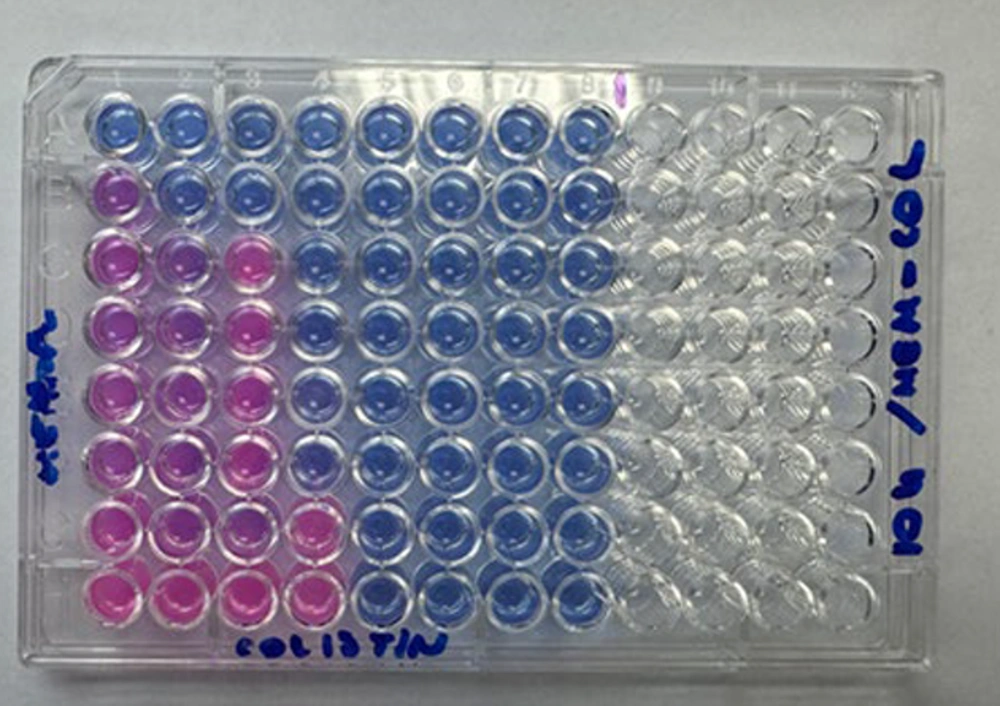
Figure 1.
Checkerboard method
3.5. Statistical Analysis
IBM SPSS 23 software package was used for statistical analysis of the data. The chi-square test was applied to evaluate categorical variables. P-value < 0.05 was considered statistically significant.
4. Results
In the study, 90 isolates isolated from 90 clinical samples were evaluated. The mean age of the patients was found to be 68.28 ± 18.34 (0 - 94). Thirty-one (34%) of the patients were female, and 59 (66%) were male. Fifty-two point two percent of the agents were detected in samples sent from the intensive care unit and were isolated more frequently in respiratory tract samples (46.7%) compared to other samples (Table 1). In the study, the CIM test was positive in 40 of 90 isolates (44%) and negative in 50 (56%). When the presence of carbapenemases was investigated using real-time PCR, 87 isolates (97%) were found to possess the carbapenemase gene. When the real-time PCR was compared with the CIM test, the sensitivity of the CIM test was determined to be 45%, its specificity 100%, its positive predictive value 100%, and its negative predictive value 6%.
Table 1.
Characteristics of the Patients Included in the Study (N = 90)
| Characteristics | No. (%) | P-Value |
|---|---|---|
| Gender | 0.003 | |
| Female | 31 (34.4) | |
| Male | 59 (65.6) | |
| Clinical department | < 0.001 | |
| Polyclinic | 15 (16.7) | |
| Ward | 28 (31.1) | |
| Intensive care | 47 (52.2) | |
| Sample type | < 0.001 | |
| Respiratory | 42 (46.7) | |
| Urine | 22 (24.4) | |
| Sterile body fluid | 14 (15.6) | |
| Wound | 12 (13.3) |
The most frequently detected carbapenemase gene was OXA-48, which was identified in a total of 72 isolates. The KPC gene was seen in 10, the NDM gene in 5, the OXA-23/58 gene in 19, and the OXA-51 gene in 7 isolates. The distribution of the detected carbapenemase genes is shown in Table 2. A synergy test was performed using the checkerboard method with MEM-COL, MEM-CZA, and COL-CZA for 8 isolates selected from among the isolates included in the study that were resistant to at least one of the antibiotics COL, CZA, and MEM. In addition to these 8 isolates, the MEM-COL synergy test was performed using the checkerboard method for 12 isolates resistant to COL. Synergistic effects were detected in 4 isolates (4/8, 50%) with the COL-CZA combination, in 6 isolates (6/8, 75%) with the MEM-CZA combination, and in 9 isolates (9/20, 45%) with the MEM-COL combination. No statistically significant difference was detected between antibiotic combinations in terms of synergistic effect (P = 0.437). Except for 1 isolate in which the COL-CZA antibiotic combination was indifferent effect, synergy or partial synergy was observed in all combinations, and no antagonistic effect was detected (Table 3).
Table 2.
Distribution of Carbapenem Resistance Genes Carbapenem
| Carbapenem Resistance Genes | No. (%) |
|---|---|
| OXA-48 | 56 (62.2) |
| OXA-48 + OXA-23/58 | 11 (12.2) |
| KPC | 7 (7.8) |
| NDM | 2 (2.2) |
| OXA-23/58 + OXA-51 | 2 (2.2) |
| OXA-48 + KPC | 2 (2.2) |
| OXA-51 + OXA-23/58 | 2 (2.2) |
| NDM + OXA-23/58 + OXA-51 | 1 (1.1) |
| NDM + OXA-48 | 1 (1.1) |
| OXA-23/58 + OXA-48 + OXA-51 + NDM | 1 (1.1) |
| OXA-23/58 + OXA-51 + OXA-48 | 1 (1.1) |
| KPC + OXA-23/58 | 1 (1.1) |
| Total | 87 (100) |
Table 3.
Evaluation of the Results of the Synergy Test of Meropenem-Colistin, Meropenem-Ceftazidime-Avibactam and Colistin-Ceftazidime-Avibactam Antibiotic Combinations using the Checkerboard Method
| No. | Resistance Gene | Antibiotic MIC Values | Antimicrobial Interaction | ||||
|---|---|---|---|---|---|---|---|
| MEM | COL | CZA | MEM-COL | MEM-CZA | COL-CZA | ||
| 1 | OXA-23/58, OXA-51 | 128 | 2 | 16 | PS | S | S |
| 2 | NDM, OXA-48 | 16 | 4 | 4 | PS | PS | PS |
| 3 | OXA-48 | 16 | 16 | 1 | S | S | S |
| 4 | NDM, OXA-23/58, OXA-51 | 32 | 2 | 1024 | S | S | PS |
| 5 | NDM | 32 | 1 | 1024 | PS | S | PS |
| 6 | NDM | 16 | 0.5 | 2048 | S | PS | I |
| 7 | OXA-48 | 16 | 8 | 1 | PS | S | S |
| 8 | KPC | 64 | 4 | 4 | S | S | S |
| 9 | OXA-48, OXA-23/58 | 16 | 4 | 0.5 | PS | ||
| 10 | OXA-48 | 16 | 4 | 0.25 | PS | ||
| 11 | OXA-48 | 32 | 8 | 4 | PS | ||
| 12 | OXA-48 | 32 | 4 | 4 | PS | ||
| 13 | OXA-48, OXA-23/58 | 16 | 8 | 1 | S | ||
| 14 | OXA-48 | 32 | 8 | 0.25 | PS | ||
| 15 | OXA-48 | 32 | 8 | 0.25 | S | ||
| 16 | OXA-48 | 16 | 8 | 0.5 | PS | ||
| 17 | OXA-48, OXA-23/58 | 16 | 4 | 0.5 | S | ||
| 18 | OXA-48 | 16 | 4 | 1 | PS | ||
| 19 | OXA-48 | 32 | 8 | 0.5 | PS | ||
| 20 | OXA-23/58, OXA-51, OXA48 | 32 | 8 | 0.5 | S | ||
Abbreviations: MEM, meropenem; COL, colistin; CZA, ceftazidime-avibactam; S, synergy; PS, partial synergy; I, indifferent.
When examining the relationship between antimicrobial combination results and resistance genes detected in bacteria, no statistically significant difference was found; however, it was determined that isolates carrying the NDM resistance gene exhibited greater partial synergistic effect compared to isolates carrying other resistance genes (P > 0.999). Of the MDR K. pneumoniae isolates included in the study, 23 were susceptible to tigecycline, 13 to gentamicin, 7 to amikacin, and 7 to trimethoprim-sulfamethoxazole (TMP-SXT) (Figure 2).
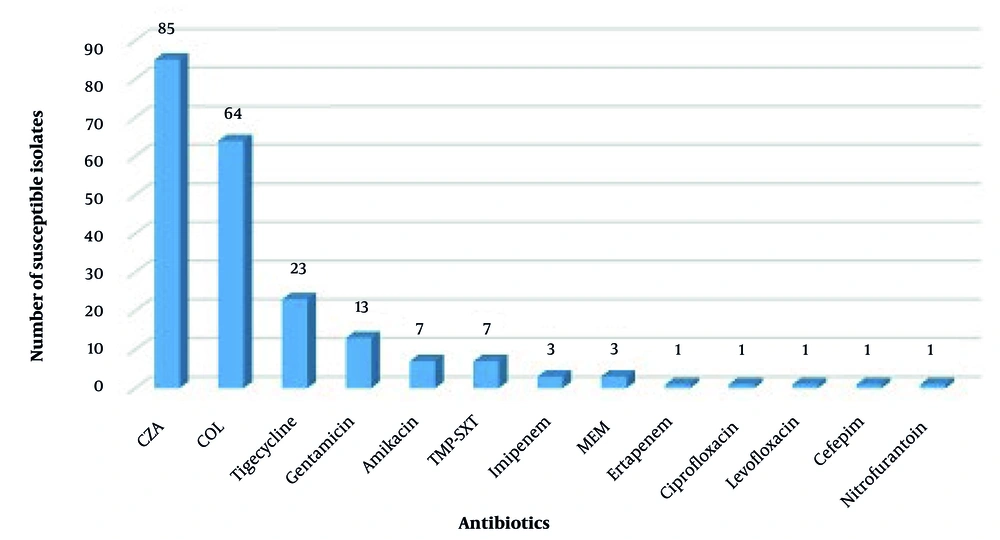
Figure 2.
Antibiotic susceptibilities of isolates
5. Discussion
Klebsiella pneumoniae, belonging to the Enterobacterales order, is one of the infectious agents that is difficult to treat and has limited treatment options due to increasing resistance. Generally, together with ESBL production and loss of porin proteins, molecular class A (KPC), class B (IMP, VIM, and NDM), and class D (OXA-23, OXA-48) carbapenemases that cause resistance are an important problem in the development of antibiotic resistance in K. pneumoniae infections (10). Resistant Klebsiella species should be monitored carefully, especially in intensive care units, as they can cause infections in various systems, ranging from sepsis to respiratory tract infections (11-13).
The CIM is a simple and rapid phenotypic method used to detect the presence of carbapenemases (8). In a study conducted at a hospital in Spain using bacteria belonging to the Enterobacterales family, the sensitivity of the CIM test was found to be 79.3% (14). In our study, the sensitivity of the CIM test was determined to be 45%, while its specificity was 100%. The different sensitivity rates observed in the studies suggest that carbapenemase enzyme positivity detected by the CIM test should be considered a warning sign and that negative results should be investigated using different methods. The value of identifying carbapenemase genes using phenotypic tests with specific inhibitors is limited. Therefore, PCR methods are used to reduce problems associated with phenotypic methods and provide rapid results. In a study conducted at a tertiary hospital in Malaysia, the dominant carbapenemase gene was OXA-48 (63.5%), followed by NDM (36.5%) (15). In a hospital in Egypt, OXA-48 was detected in 15.5% of isolates, VIM in 15%, IMP in 7.5%, KPC in 4%, and NDM in 3.8% (16).
In a study examining 687 carbapenem-resistant bacteria in nine Southern European countries between 2016 and 2018, the KPC-like gene was the most common carbapenemase-encoding gene (46%), while OXA-48 was found in 39% of isolates. Specifically, the KPC-like gene (ST258/512) was found in Greece, Italy, and Spain; the OXA-48 gene (ST101) in Serbia and Romania; the NDM gene (ST11) in Greece; and the OXA-48-like gene (ST14) in Turkey (17). In our study, the OXA-48 gene was the most frequently found gene, while the NDM gene was detected in 5 isolates and the KPC gene in 10 isolates. The emergence of the KPC gene, which was not detected in studies conducted in our country in previous years, serves as a warning that a resistance genotype similar to that in other European countries has developed and that serious measures need to be taken.
Combination therapies can be used to achieve a broad spectrum, prevent the development of resistant mutants, reduce dose-dependent side effects of drugs, and achieve a synergistic effect between two drugs. Gaibani et al. (18) reported a 100% synergistic effect in the MEM-CZA combination. Brennan-Krohn et al. (19) observed a synergistic effect in 41.2% of isolates in the COL-CZA combination. In our study, we observed 75% (6/8) synergistic effect and 25% (2/8) partial synergistic effect in the MEM-CZA combination; while in the COL-CZA combination, 50% (4/8) synergistic effect, 38% (3/8) partial synergistic effect, and 12% (1/8) indifferent effect were observed. The high synergy-partial synergy ratios we observed suggest that COL-CZA and MEM-CZA may be highly effective combinations in-vitro in our region. Kole et al. investigated the relationship between carbapenemase genes and various antimicrobial combinations in CRKp isolates. In the MEM-COL combination, there was 47% synergy, 38% additive interaction, and 15% no effect in OXA-48-positive isolates; 60% synergy, 20% additive interaction, and 20% no effect in OXA-48 and NDM-positive isolates; and 66% synergy and 33% additive interaction in OXA-48 and KPC-positive isolates (20).
In our study, 57% (8/14) partial synergistic and 43% (6/14) synergistic effects were observed in the MEM-COL combination applied to OXA-48-positive isolates. In NDM-positive isolates, the MEM-COL combination produced 50% (2/4) synergistic effect and 50% (2/4) partial synergistic effect, while the COL-CZA combination produced 75% (3/4) partial synergistic effect and 25% (1/4) no effect. The fact that the partial synergistic effect is greater than the synergistic effect in NDM-positive isolates suggests that the efficacy of antibiotic combinations in these isolates may be partially lower than in isolates containing OXA-48 or KPC. The high synergy-partial synergy ratios observed in our study compared to other studies may be due to regional carbapenemase enzyme differences and the small sample size in our study.
Various studies have been conducted on the efficacy of different antibiotics against MDR K. pneumoniae isolates (11, 20). In a study involving 42 CRKp isolates, antibiotic susceptibility testing revealed that 31 were susceptible to tigecycline, 18 to amikacin, 9 to gentamicin, and 9 to TMP-SXT (20). Similarly, in our study, 23 of 90 isolates were found to be susceptible to tigecycline, 13 to gentamicin, 7 to amikacin, and 7 to TMP-SXT. When the susceptibility rates in the studies were examined, it was considered that tigecycline could be an alternative treatment option for MDR bacteria and could be used in combination tests by performing antibiotic susceptibility tests. This study is important in that it contains current and regional data. The inability to perform synergy tests on all isolates included in the study due to budget constraints, and the lack of knowledge about the in-vitro efficacy of combination therapies, are limitations of the study.
5.1. Conclusions
In conclusion, OXA-48 was found to be the most frequently detected carbapenemase gene in MDR K. pneumoniae isolates in our region. KPC and NDM genes were also detected. This study's results on the high in vitro efficacy of the COL-CZA, MEM-COL, and MEM-CZA binary combinations are promising and highlight the importance of conducting larger sample size studies in this area.