
1. Background
Intestinal parasitic infection is highly prevalent throughout the developing countries of the world. High prevalence of parasitic infection is because of poverty, elderly, malnutrition, illiteracy, population density, lack of health equipment that it can be led to financial cost. Annually, 16 million deaths occurs due to the parasitic disease in the world (1, 2). Amoebiasis is caused by the protozoan Entamoeba histolytica worldwide, approximately, 40 to 50 million people develop colitis or extra intestinal disease annually, up to 40000-110000 deaths (2, 3). Amoebiasis has been the cause of death in elderly at general hospital of Mexico in 60 century (4). E.histolytica caused intestinal infection, but extra intestinal amoebiasis such as liver abscess, thoracic, genital amoebiasis, acute appendicitis and brain abscess have also been reported (2, 5-8).
Enterobius vermicularis is one of the most common intestinal parasites found in humans (1, 2). Extra intestinal migration of worms, may lead to severe health disorders or even death (1, 2, 9). Appendicitis, vulvoginitis, endometritis, ear, eye and kidney problems caused of E.vermicularis have been reported (1, 2, 9-11). Autoinfection and re-infection of E.vermicularis is common, especially in population dense areas and instituted (2). The prevalence of intestinal parasites has been reported variable among different groups of people. In Kashan, Iran, about 50% to 70% (12). The prevalence of E.histolytica/E.dispar among the elderly and mentally retarded persons in the world has been reported 19.7% and 1.1-38% respectively (13-15). According to a statistical report in Iran in 1997 at least 6.6% of population up to 60 years are geriatric and it is estimated that it is rising to 10 million persons until 2011 (16). The first step to achieve health of elderly and mentally retarded people is based on the identification of parasitic infection and then, proper treatment and health education for prevention of re-infection.
2. Objectives
Since parasitic disease is one of the major health problems among the elderly and mentally retarded people and little is known about the prevalence of parasitic infection in these groups, this study was carried out in Kashan, Iran.
3. Materials and Methods
In this Cross-sectional study via census method, a total of 243 stool samples, (155 from elderly and 88 from mentally retarded people) and 279 Scotch tapes (165 from elderly and 114 from mentally retarded people), all inhabitant of Golabchi Geriatric Center of Kashan and 54 from official personnel were collected during 2006-2007. Personal data such as age, sex, population density and sings of disease were recorded in questionnaires. Stool samples were sent to the parasitology laboratory of Kashan University of Medical Sciences. Stool samples were examined by three methods; including wet smear, lugol's staining and formalin - ether concentration. Diagnosis of intestinal parasites is confirmed by the recovery of protozoan trophozoites and cysts, eggs and larvae of helminthes. Scotch tape method was used for diagnosis of E.vermicularis (1). The results were recorded in data forms and were analyzed by SPSS software and X2. This study has been approved by Ethic Committee of Kashan University of Medical Sciences.
4. Results
Out of 243 samples, 121 elderly (78.1 %) and 71 mentally retarded persons (80.7 %) were positive for at least one intestinal parasite. The prevalence of pathogenic parasites in elderly and mentally retarded ones has been presented in Figure. The rate of pathogenic parasites among mentally retarded was higher than the elderly (P < 0.001). The prevalence of E.histolytica/E.dispar among elderly was higher than mentally retarded (P > 0.05) (Table 1). The prevalence of other pathogenic protozoa among elderly and mentally retarded people was: Blastocystis hominis 81 (33.3%), Giardia lamblia 11 (4.5%), Dientamoeba fragilis 4 (1.6%). The prevalence of nonpathogenic protozoa was: Entamoeba coli 49.4%, Chilomastix mesnili 23.5%, Entamoeba hartmanni 23.9%, Endolimax nana 11.5%, Iodamoeba butschlii 6.6% respectively. Distribution of E.histolytica/E.dispar according to the sex and age has been presented in Table 2. The prevalence of this parasite among men was higher than women, and among more than 60 years old was lower than the younger, but the difference was non-significant (P > 0.05). Majority of infected people were asymptomatic (73.9%) and 15.7% had diarrhea. The highest clinical signs of E.histoloytica/E.dispar were constipation 23%, abdominal pain 20%, anorexia 17.9%, weight loss 15%, and the lowest was nausea 5%.
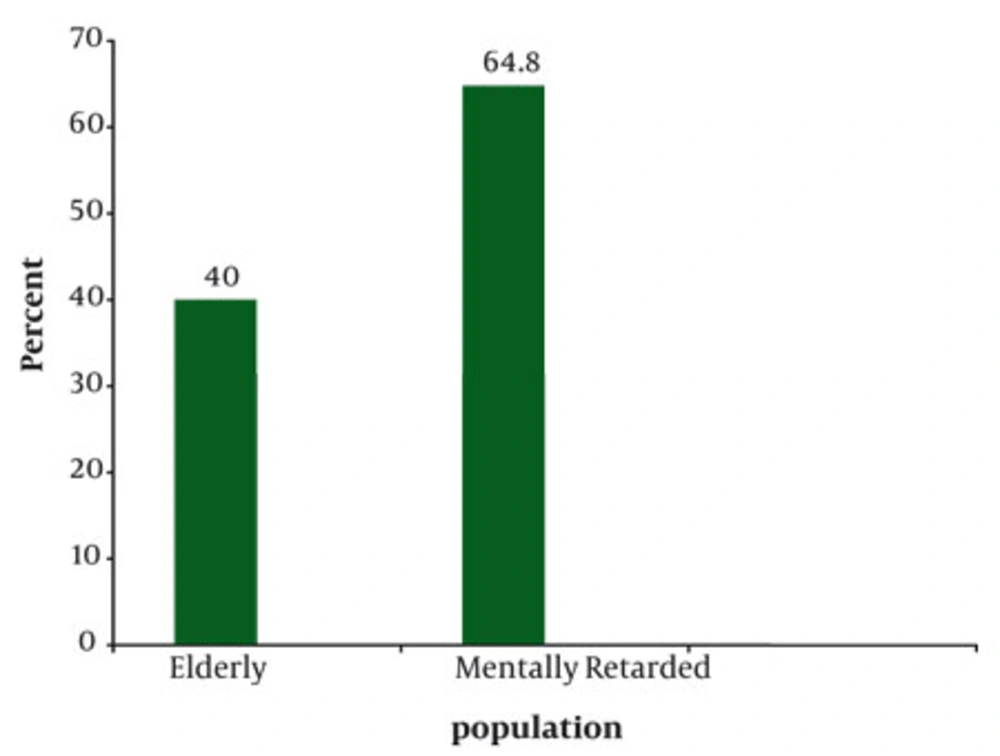
Figure
Distribution of Pathogenic Intestinal Parasites among Elderly and Mentally Retarded People at Geriatric Center in Kashan, Iran, 2006-2007
Table 1
Prevalence of E.histolytica/E.dispar and E.vermicularis Between Elderly and Mentally Retarded Persons at Geriatric Center in Kashan, Iran
| Elderly | Mentally retarded | Elderly | Mentally retarded | ||
| E.histolytica/E.dispar | 155 | 88 | 26 (16.8) | 14 (15.9) | P > 0.05 |
| E.vermicularis | 165 | 114 | 42 (25.5) | 56 (49.1) | P < 0.001 |
Table 2
Prevalence of E.histolytica/E.dispar by to Sex and Age Among Elderly and Mentally Retarded Persons at Geriatric Center in Kashan, Iran
| Sex | Male | 111 | 22 (19.8) | P > 0.05 |
| Female | 132 | 18 (13.6) | ||
| Age Group | 15-39 | 78 | 13 (16.7) | P > 0.05 |
| 40-59 | 78 | 14 (17.9) | ||
| 60-79 | 52 | 8 (15.4) | ||
| 80-110 | 35 | 5 (14.30) | ||
| Total | 243 | 40 (16.5) |
The rate of helminthic infections by formalin ether method were: Taenia spp. 1.6 %, Hymenolepis nana 0.8% and E.vermicularis 1.6%. Rhabditoid larva of Strongyloides stercoralis was observed in an 18 years old woman with the mentally retardation, that immediately treated with Tiabendazole. The overall prevalence of E.vermicularis by Scotch tape was 35.1%, and among elderly and mentally retarded people were 25.5% and 49.1% respectively (P < 0.001). Frequency distribution of E.vermicularis according to the sex and age has been presented in (Table3). The prevalence of E.vermicularis among men was higher than women and in lower than 60 years old group, was higher than elderlies respectively (P < 0.001, P < 0.05). There was significant relation between annual itching and teeth chewing and E.vermicularis infection (P < 0.05). The prevalence of intestinal parasites in official people was 46.3% and no pathogenic protozoan was seen. Prevalence of E.vermicularis was 8.5 %. From 131 infected people, 41 (31.3%) infected to one parasite, 26 (19.8%) two parasites, 34 (26%) three parasites and 30 (22.9%) with up to four parasites.
Table 3
Prevalence of E.vermicularis by Sex and Age Among Elderly and Mentally Retarded Persons at Geriatric Center in Kashan, Iran
| Sex | Male | 141 | 69 (48.9) | P <0.001 |
| Female | 138 | 29 (21.1) | ||
| Age Group | 15-39 | 104 | 55 (52.9) | P <00.5 |
| 40-59 | 79 | 25 (31.6) | ||
| 60-79 | 56 | 15 (26.8) | ||
| 80-110 | 40 | 3 (7.5) | ||
| Total | 279 | 98 (35.1) |
5. Discussion
Parasitic infections especially Amoebiasis remain an important cause of morbidity and mortality in developing countries (2). Our study assessed the high prevalence of intestinal parasites especially E.histolytica/E.dispar and E.vermicularis infections in an under-studied population group in Kashan, Iran. It is important to note that in this study, the prevalence of intestinal parasites among mentally retarded was 80%, which is outside the range of 26.2% and 55.9% among the students of rehabilitation center of Mazandaran and Esfahan, Iran (17, 18) and other countries such as; handicappeds in Korea 35.7% (19). However, other investigators reported a prevalence of 50.8% of intestinal parasites among the elderlies in Nepal (15) and 7.3% among mentally retarded people in the U.S.A respectively (20).
The comparison of the results of intestinal parasites especially E.vermicularis and E.histolytica/E.dispar between investigations was performed in other countries and the present study clearly showed that, intestinal parasites are the major problem in population study and probably related to the life style and sanitary management.
The prevalence of E.histolytica/E.dispar was 16.8 % among elderlies and 15.9 % among mentally retarded people. The results of investigations in Asian countries showed that the prevalence of E.histolytica/E.dispar among handicappeds was 1.8% in Korea (19), in Taiwan 1.1% (13) and in Wayampi Indians from French Guiana 17% (21). 38% of mentally disabled individuals at rehabilitation institutions in Philippines and Japan (14, 22) and 19.7 % of elderlies in Nepal were positive for E.histolytica/E.dispar (15). The prevalence of E.histolytica/E.dispar was 33.7% in mentally retarded people in Italy (23) .The prevalence of E.histolytica/E.dispar in our study was almost similar to that found in French Guiana and Nepal (15, 21), but was higher than the reports from Asia and the U.S.A (13, 19, 20) and lower than what reported in Philippines, Japan, Italy (14, 22, 23). The prevalence of E.vermicularis in our study was twice to that found in Korea 20.6% [19], but was very higher than reported in the U.S.A 4.5% (20). The reasons of high prevalence of E.histolytica/E.dispar and E.vermicularis in geriatric and especially mentally retarded were malnutrition, illiteracy, population density (10 person/room), insufficiency of health equipment and poor sanitary, consumption of untreated water, an immunosuppressive background and simple life cycle, oral–fecal and direct transmitted disease (1, 2, 22). The Prevalence of E.vermicularis in 15-39 years old was higher than the others (P < 0.001).This age group was mentally retarded; due to the poor sanitation, the rate of infection was high. It is consistent with findings of other studies (19, 24). Gender significantly affected the prevalence of intestinal parasitic infections. The rate of E.vermicularis in men was 2.5 times than women (P < 0.0001). According finding of Lee et al. 25.7% of males and 9.6 % of females among handicappeds instituted had been infected with E.vermicularis (19), this is in support of our findings. Majority of infected people with E.histolytica/E.dispar was asymptomatic (carrier) and can transmitted disease to others (1, 2). Annual itching and teeth chewing are more prevalent in Enterobiasis (P < 0.005).This symptoms and behaviors are pathogonomic and can guide for diagnosis of the disease (1, 2). The high prevalence of infection among personnel is referring to the direct contact to inhabitants of this center and lack of knowledge of transmission of diseases. In total, this study showed that intestinal parasitic infections especially E.histolytica/E.dispar and E.vermicularis were high in geriatric and mentally retarded of Kashan Golabchi Center, that represents the lack of personal hygiene. Due to serious complications of these diseases and its spread to the family members of the infected persons, treatment and prevention measurement are necessary for solving the problem (1, 2, 25). High prevalence of pathogenic parasites; E.histolytica/E.dispar and E.vermicularis in the study population must be considered as a major public health problem, therefore planning future research and parasite control strategies especially mass treatment and health education are recommended.