1. Background
Molecular analyses for the presence of human papillomavirus (HPV) nucleic acids have demonstrated a strong association between HPV infection and squamous carcinoma, adenosquamous carcinoma and adenocarcinoma of the lower female genital tract (cervix, vagina and vulva) (1, 2). The risk factors for development of these carcinomas also suggest a role for sexually transmitted agents, e.g., large number of sex partners and early age at first inter-course (3-5). While the occurrence of epithelial ovarian carcinoma has not been associated with such risk factors (6). Ovarian tumor is a common neoplasm of the female genital tract and one of the most lethal gynaecological malignancies (7). The etiology of ovarian cancer remains unclear (8). Malignancy of epithelial origin accounts for 85–90% of the total ovarian tumor morbidity. Therefore, the involvement of HPV infection in epithelial ovarian cancer has been an interesting issue. However, previous studies from different laboratories provided highly controversial results.
2. Objectives
The aim of the present study was to explore HPV type 16 expression in epithelial ovarian tumor tissues.
3. Patients and Methods
This was a retrospective study, which included 61 archived human ovarian samples. Epithelial and functional tumor tissues were embedded in paraffin blocks. The ovarian tumor tissues were divided into four groups according to behavior: 1- Malignant ovarian epithelial tumor group: included 31 cases with invasive surface epithelial ovarian tumors. 2- Borderline epithelial ovarian tumor group: included four cases with borderline intermediate malignancy. 3- Benign epithelial ovarian tumors: included 18 cases with benign epithelial ovarian tumors. 4- Functional ovarian cystic lesions: included eight cases with non-neoplastic functional ovarian cysts.
Specimens belonged to the period from June 2011 to March 2012 and were collected from a private laboratory in Baghdad. The diagnosis of these tissue blocks was based on the obtained pathological records of these cases from laboratory records. Following processing of these tissue blocks, a confirmatory histopathological re-examination of the slides was done by a consultant histopathologist at the Pathology Department of Al-Nahrain University, College of Medicine. Patient's ages, grade and stage of ovarian tumor were recorded on case sheets.
Paraffin-embedded tissue blocks of study groups were collected. New sections were made from each of the paraffin embedded blocks as follows: A) One 4 μm thick section was made on ordinary slides, which was subjected to haematoxylin and eosin staining. This was conducted to confirm diagnosis and tumor grade. B) One 4 μm thick section was made on positively charged slides, and an immunohistochemistry assay was performed to detect HPV 16- E6-oncoprotein on the prepared slides. Briefly, slides were exposed to a retrieval agent, and then washed. The primary antibody (HPV 16- E6-oncoprotein, USBiological, USA) was applied and incubated for two hours and then washed. The secondary antibody was then added and incubated for 30 minutes, followed by another wash. Next, stereptavidin was applied on slides and incubated at 37C° for 30 minutes and was then washed. Tissue sections were treated with diluted liquid 3,3′-diaminobenzidine (DAB) for 20 minutes at room temperature. At last, mounting was done and slides were ready for examination.
3.1. Statistical Analysis
Data were analyzed using the SPSS software version 16 and Microsoft Office Excel 2007. Nominal data were expressed as frequencies and percentages. Numeric data were expressed as mean plus standard error of the mean (Standard error of mean). Chi-square test was used to assess the relationship between nominal data, while ANOVA test and student t-test were used to analyze the difference among the mean of numeric data. P-value (<0.05) was considered significant.
4. Results
Histopathological subtypes were enrolled in the present study. The present study included four major categories: malignant, border-line, benign and non-neoplastic cases. The non-neoplastic cases included four (50%) corpus luteum cysts and four (50%) follicular cysts. As shown in Figure 1.
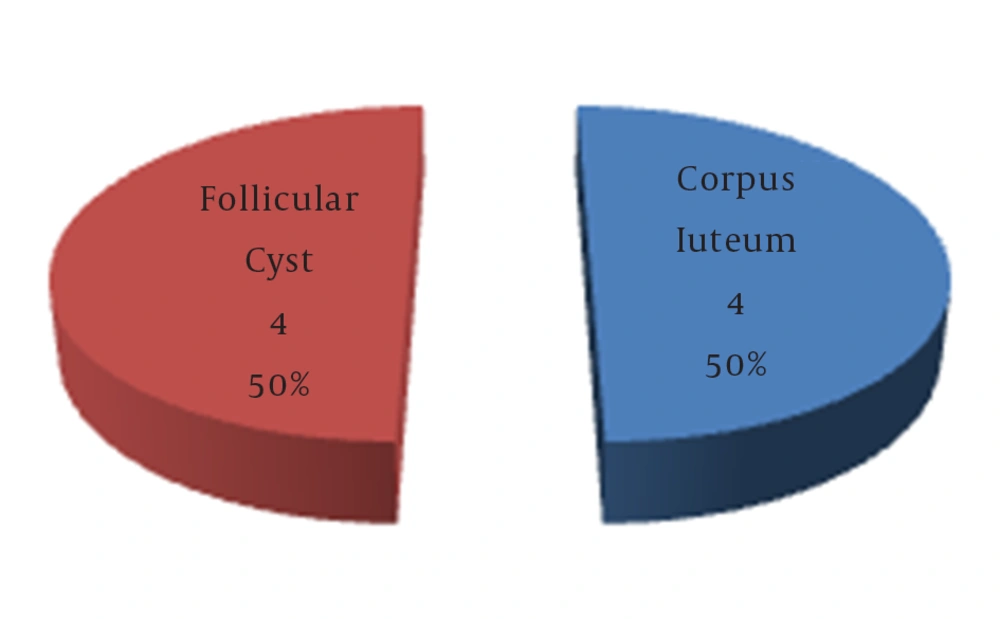
Figure 1.
Functional Ovarian Cyst Cases
The benign cases included: nine (50%) serous adenomas andnine (50%) mucinous adenomas. The borderline cases included: two (50%) serous tumors, one (25%) mucinous tumor and one (25%) endometrioid tumor. The malignant cases included: 26 (83.87%) serous tumors, 2 (6.45%) mucinous tumors and 3 (9.68%) endometrioid tumors. As shown in Table 1.
Table 1.
Types of Epithelial Ovarian Tumor Included in the Study
| Benign | Borderline | Malignant | Total | |
|---|---|---|---|---|
| Serous | 9 (50) | 2 (50) | 26 (83.87) | 37 (69.81) |
| Mucinous | 9 (50) | 1 (25) | 2 (6.45) | 12 (22.64) |
| Endometrioid | 0 (0) | 1 (25) | 3 (9.68) | 4 (7.54) |
| Total | 18 (100) | 4 (100) | 31 (100) | 53 (100) |
The mean age of functional ovarian cyst group was 34.00 + 4.46 years. The mean age of cases with benign tumors was 31.44 + 1.96 years. The mean age of cases with borderline tumors was 51.75 + 4.30 years. The mean age of cases with malignant tumors was 50.06 + 1.86. There was a significant difference in mean age of cases with malignant and borderline tumors in comparison with those with benign and non-neoplastictumors (P < 0.001), as shown in Table 2.
Table 2.
Comparison of Mean Age Among the Neoplastic and Functional Cyst Casesa
| Group | No. | Mean ± SEM |
|---|---|---|
| Functional cysts | 8 | 34.00 ± 4.46 |
| Benign | 18 | 31.44 ± 1.96 |
| Borderline | 4 | 51.75 ± 4.30 |
| Malignant | 31 | 50.06 ± 1.86 |
aP ≤ 0.001.
Out of eight non-neoplastic cases only one case (12.5%) expressed HPV. No HPV expression was seen in benign and borderline cases. Out of 31 malignant surface epithelial ovarian tumor only 3 (9.67%) cases expresses HPV. There was no significant statistical difference in HPV expression among neoplastic and non-neoplastic ovarian tumors included in the present study (P = 0.476), as shown in Table 3.
| Functional cysts | Benign | Borderline | Malignant | |
|---|---|---|---|---|
| Positive HPV | 1 (12.5) | 0 (0) | 0 (0) | 3 (9.67) |
| Negative HPV | 7 (87.5) | 18 (100) | 4 (100) | 28 (90.33) |
| Total | 8 (100) | 18 (100) | 4 (100) | 31 (100) |
aAbbreviation: HPV, human papillomavirus.
bData are presented as No.(%).
cP = 0.476.
The expression of HPV was limited to the serous subtype in which three out of 26 (11.53%) were positive for HPV. Both mucinous and endometrioid type were negative for HPV. Despite this, no significant statistical difference was obtained (P =0.727), as shown in Table 4.
Table 4.
| Endometrioid | Mucinous | Serous | |
|---|---|---|---|
| Positive HPV | 0 (0) | 0 (0) | 3 (11.53) |
| Negative HPV | 3 (100) | 2 (100) | 23 (88.47) |
| Total | 3 (100) | 2 (100) | 26 (100) |
aAbbreviation: HPV, human papillomavirus.
bData are presented as No.(%).
cP=0.727.
The mean age of patients with serous malignant surface epithelial tumors was 50.08 + 2.11 years. The mean age of patients with endometrioid surface epithelial tumors was 53.00 + 6.35 years. The mean age of patients with mucinous surface epithelial tumors was 45.50 + 3.50 years. There was no significant statistical difference in mean age among different histological subtypes of malignant surface epithelial tumors (P = 0.744), as shown in Table 5.
Table 5.
The Relationship between Age and Histological Subtype in Malignant Surface Epithelial Ovarian Tumorsa
| No. | Mean Age ± SEM | |
|---|---|---|
| Serous | 26 | 50.08 ± 2.11 |
| Endometrioid | 3 | 53.00 ± 6.35 |
| Mucinous | 2 | 45.50 ± 3.50 |
aP=0.744.
There was no significant difference between the mean age of HPV positive cases (47.67+4.25 years) and the mean age of HPV negative cases (50.32+2.02 years); (P =0.681), as shown in Table 6.
Table 6.
| No. | Mean Age ± SEM | |
|---|---|---|
| Negative HPV | 28 | 50.32 ± 2.026 |
| Positive HPV | 3 | 47.67 ± 4.256 |
aAbbreviation: HPV, human papillomavirus.
bP=0.681.
A single case out of 13 (stage I) malignant surface epithelial tumors was HPV positive. Two cases out of 10 (stage III) malignant surface epithelial tumors were HPV positive. Stage II and stage IV cases showed negative HPV expression. This difference of expression was not statistically significant (P = 0.545) (see Table 7).
Table 7.
| Stage I | Stage II | Stage III | Stage IV | |
|---|---|---|---|---|
| Positive HPV | 1 (7.69) | 0 (0) | 2 (20) | 0 (0) |
| Negative HPV | 12 (92.31) | 6 (100) | 8 (80) | 2 (100) |
| Total | 13 (100) | 6 (100) | 10 (100) | 2 (100) |
aAbbreviation: HPV, human papillomavirus.
bData are presented as No. (%).
cP = 0.545.
Out of 16 (grade II) cases with malignant surface epithelial ovarian tumors, three cases (18.75%) were positive for HPV. Grade I and Grade III cases were all negative for HPV immunohistochemical expression. No statistical difference was obtained (P =0.212), as shown in Table 8.
Table 8.
| Grade I | Grade II | Grade III | |
|---|---|---|---|
| Positive HPV | 0 (0) | 3 (18.75) | 0 (0) |
| Negative HPV | 11 (100) | 13 (81.25) | 4 (100) |
| Total | 11 (100) | 16 (100) | 4 (100) |
aAbbreviation: HPV, human papillomavirus.
bData are presented as No. (%).
cP = 0.212.
5. Discussion
Human papillomavirus-driven cervical cancer has been proven by many studies, however its link with ovarian cancer is still unclear. During the past two decades, there has been a growing interest in identifying the role of HPV in ovarian cancer. This is due to the fact that ovarian cancer is very hard to detect in its early stages, and when it is detected it becomes widespread and difficult to treat. Most cancerous tumors in the ovaries are found in the epithelium. Since HPV is an oncogenic virus that also thrives in the epithelium, scientists have tried to find out if ovarian tumors may also be caused by HPV. In 1987, the first study on HPV and ovarian cancer was performed, when Kaufman and his colleagues found HPV-6 DNA in 10 out of 12 patients with ovarian cancer (9). Succeeding studies, however, have shown no conclusive link between HPV and tumors in the ovaries. These included studies done by Leake (10), Beckmann (11), McLellan (12) and Trottier (13).
In the present study, out of 31 malignant surface epithelial ovarian tumors only three (9.67%) expressed HPV-16 E6-oncoprotein. The expression of HPV was limited to the serous subtype in all three patients. Both mucinous and endomerioid type were negative for HPV, although the difference was statistically insignificant. Previous studies done in Iraq regarding this association, such as that by Alizi et al., (14) showed that, HPV DNA in the benign group (71%) was higher than that found in the malignant group (64%). HPV 16 was the most predominant type followed by HPV18, 6, and 11. They detected HPV by the in situ hybridization technique. In 1998, a study by a British team led by Manolitsas (15) pointed out a correlation between HPV 16 and ovarian tumors. In 1999, Anttila and colleagues (16) performed a high-sensitivity analysis on 98 epithelial ovarian tumors and reviewed all the previous HPV-ovarian tumor studies done with a total of 175 samples. They concluded that HPV is "highly unlikely" to be the cause of epithelial ovarian cancer.
Research done in the past 10 years has been similarly conflicting. In 2003, a study done in China found that 36% of epithelial ovarian tumors in 50 cases were positive for HPV-16 (17). Another study in 2005 found positive HPV 16 in 60% of ovarian tumors analyzed, but concluded that it was statistically insignificant. Research done by Kuscu from Turkey, postulated that HPV may be the cause of some ovarian tumors by interacting with the tumor suppressing the p53 gene (18). This was further reinforced by another study by Atalay and colleagues (19). Furthermore, it was found that of 94 patients with ovarian cancer, six were positive for HPV-16 and two were positive for HPV-33. It is interesting that in many of the positive reports, specimens of Chinese origin were used (20-22). These independent studies are from three areas of China, Mainland China, Taiwan, and Hong Kong, suggesting that the genetic background may play an important role in susceptibility to HPV infection. Studies on epidemiology of cervical cancers showed that individuals infected with a non-European variant of HPV-16 were associated with increased two to nine-fold risk of cervical cancer (23). Whether this is the case in ovarian cancer needs to be further investigated.
In addition to the genetic variation in the host and pathogen, the difference in the detection methods employed by different studies might also play a role in data discrepancy. In this study, immunohistochemistry was employed to detect HPV-16 E6-oncoprotein expression. Wu et al., (17) who used both in situ hybridization and immunohistochemistry to detect HPV E6-oncoprotein expression suggested that immunohistochemistry is an accurate method but with less sensitivity. There is another question that has to be asked, which is whether HPV in ovarian tumors is actually the cause or the result of cancerous growth or is just a result of some other unknown processes. An article published by Giordano and colleagues in 2008 (24) found that HPV, when present in ovarian growth, may not be the driving cause of tumors. In the same year Ronnett et al., (25) and her team confirmed that cancerous cervical tumors may travel or metastasize to the ovaries. This means that HPV-positive ovarian tumors may have possibly come from similar growths in the cervix. A study published in 2011 (26) further confirmed this, as it reported a case of ovarian squamous cell carcinoma that metastasized eight years after hysterectomy of a woman because of cervical tumors. This study concluded that HPV type 16 E6-oncoprotein was detected in only 9.67% of malignant epithelial tumors. It appears that HPV infection plays a relatively minor role in the pathogenesis of ovarian carcinomas.