1. Background
Quinolones, especially novel quinolones (6-fluoroquinolones), are synthetic broad-spectrum antibacterial agents that compete with beta-lactam. Macrolide antibacterial agents have been used to treat serious infections (1). Since the detection of plasmid-mediated quinolone resistance (PMQR) in Klebsiella pneumoniae strains isolated from clinical specimens from the USA in the late 1990s (2, 3), three PMQR mechanisms have been discovered. One PMQR mechanism has been reported worldwide in various enterobacterial species in the presence of the qnr genes (4). Another mechanism is related to the AAC (6´)-Ib-cr gene, which is responsible for decreasing susceptibility to quinolones by N-acetylation of a piperazinyl amine substituent of some fluoroquinolones (5). A third PMQR mechanism, which is based on a quinolone efflux pump protein, QepA, has been reported recently (6).
Qnr is a member of the pentapeptide repeat family that protects DNA gyrase and topoisomerase IV from quinolone inhibition (7). Extended-spectrum beta lactamase (ESBL) strains are often plasmid-mediated, and most of these enzymes belong to the TEM or SHV families (8) that have been reported in many countries (9). In recent studies, a significant relationship was observed between quinolone resistance and the latest cephalosporin antibacterial agents (10-13). The association of qnr and ESBL production genes or AmpC-type β lactamase has been observed (14). Furthermore, many studies have demonstrated that plasmids harboring qnr may also carry other genes that respond to ESBL-producing strains (15, 16).
2. Objectives
Considering the worldwide spread of the qnr gene, especially in hospitalized patients, and the fact that few studies have focused on qnr genes in ESBL-producing Escherichia coli isolates in Iran, the aim of this study was to determine the frequency of three qnr gene types in ESBL-producing and non-ESBL-producing E. coli clinical isolates at the Imam Reza Hospital in Mashhad, Iran.
3. Materials and Methods
3.1. Bacterial Isolates
The descriptive cross-sectional study included 200 E. coli clinical isolates collected from outpatients and hospitalized patients in Imam Reza Hospital from May 2011 to July 2012. We classified the patients as hospitalized if they were admitted to the hospital and stayed for a minimum of 24 hours. We classified the patients as outpatients if they were not hospitalized for more than 24 hours but visited a hospital, clinic, or associated facility for diagnosis or treatment (17). The sample size was calculated based on level of confidence, expected prevalence, and precision (corresponding to effect size) (18). The research was approved by the ethics committee of the faculty of medicine in Mashhad. Clinical samples, including urine, blood, wound cultures, and CSF, were processed in this study. Specimens were collected by a laboratory technician and immediately transferred to the microbiology department of Mashhad University of Medical Sciences in sterile screw cap tubes containing 5 mL of tryptic soy broth (Sigma; USA). Prior to specimen collection, criteria such as previous antimicrobial therapy, immune suppression, and presence of bacteremia because of other pathogens before and after colonization by E. coli were taken into consideration. Standard biochemical tests were used to detect E. coli strains (19).
3.2. Antimicrobial Susceptibility Testing
Susceptibility tests for ciprofloxacin, ceftazidime, cefotaxime, and cefpodoxime were performed for ESBL- and non-ESBL-producing E. coli by using the standard disc diffusion test according to the clinical and laboratory standards institute guidelines (20). Isolated E. coli were cultured on Muller-Hinton agar. Ciprofloxacin (5 µg), ceftazidime (30 µg), cefotaxime (30 µg), and cefpodoxime (10 µg) disks (Mast, UK) were placed on the inoculated plate and incubated at 35°C for 16 - 20 h. Drug resistance was recognized according to their zone sizes compared with the break point announced by the clinical and laboratory standards institute for Enterobacteriaceae (20).
3.3. Phenotypic Confirmatory Test
The combination disc method was used for detecting ESBL strains. Bacteria were cultured on a Muller-Hinton agar plate, and ceftazidime (30 μg) versus ceftazidime/clavulanate (30/10 μg), cefotaxime (30 μg) versus cefotaxime/clavulanate (30/10 μg), and cefpodoxime (10 μg) versus cefpodoxime/clavulanate (30/10 μg) (Mast Diagnostics, UK) were tested. Antibiotic disks were placed in media at a distance of 20 - 30 mm from other disks. After 18 - 24 hours incubation at 37°C, ESBL-producing organisms were detected by observation of a zone diameter increase of at least 5 mm around antibacterial agents in combination with clavulanic acid (20). The reference strain Klebsiella pneumonia ATCC 700603 was used as an ESBL-positive control (10).
3.4. Multiplex PCR for TEM and SHV Genes
Escherichia coli isolate DNA was extracted by the simple boiling method. E. coli isolates were cultured on MacConkey agar (Merck, Germany) and incubated at 37°C. After 24 hours, 1 - 5 colonies were suspended in TE buffer, and suspensions were boiled for 10 minutes (21). PCR was performed using gene-specific primers to detect two ESBL-encoding gene types (blaSHV and blaTEM) (21). The following conditions were used: 2 minutes at 95°C, followed by 35 cycles of 1 minute at 91°C, 30 seconds at 52°C, and 45 seconds at 72°C, and 1 minute at 72°C and 5 minutes at 72°C for the final extension (19). Each 25 µL of reaction mixture contained 2.5 µL of 10 × PCR Buffer, 1.5 mM MgCl2 (25 mM), 320 µM dNTPs (10 mM), 500 nM of each primer (10 pm/µL), 50 ng template DNA, and 0.5 U/µl Taq DNA polymerase (CinnaGen, Iran). Pure water was added for a final volume of 25 µl. K. pneumoniae ATCC 7881 containing the blaSHV and blaTEM genes (Pasteur Institute of Iran, Tehran) was used as a positive control.
3.5. PCR for qnr Genes
The PCR method was performed for three qnr gene types (qnrA, qnrB, and qnrS) under the following conditions: 5 minutes at 94°C, followed by 35 cycles of 30 seconds at 94°C, 45 seconds at 50°C, and 45 seconds at 72°C and 5 minutes at 72°C for the final extension. Primers specific to qnr genes were used in this study (12). PCR was performed in 25 µL volumes, with each reaction mixture containing 2.5 µL of 10 × PCR Buffer, 1.5 mM MgCl2 (25 mM), 200 µM dNTPs (10 mM), 0.5 µM of each primer (10 pm/µL), 50 ng template DNA, and 1 U/µL of Taq DNA polymerase. Pure water was added for a final volume of 25 µL. All PCR amplifications were performed in duplicate. Standard positive strains for the qnrA, qnrB, and qnrS genes were not available in this study; therefore, in addition to checking the size of the amplicons, negative strains were repeated twice for accuracy. Additionally, PCR products were sequenced (one isolate for each gene) and analyzed with the basic local alignment search tool algorithm (http://blast.ncbi.nlm.nih.gov/Blast.cgi).
3.6. Statistical Analysis
The Chi-square test was performed to compare variables. A P value ≤ 0.05 was considered significant.
4. Results
Two hundred E. coli isolates were tested from 84 outpatients and 116 hospitalized patients at the Imam Reza Hospital in Mashhad, Iran from May 2011 to July 2012. Overall, 61% of the hospitalized patients were male and 39% were female. The average age of the patients was 55 years ± 0.8 years. The phenotypic confirmatory test identified 85 (42.5%) isolates as ESBL-producing E. coli. The greatest proportion [72.9% (62 of 85)] of ESBL-producing isolates was isolated from urine samples, followed by 8.23% (7 of 85) from wound samples, 8.23% (7 of 85) from blood samples, 3.52 (3 of 85) from ascitic fluid samples, and 2.35% (2 of 85) from secretion samples. The remaining 4.7% (4 of 85) of isolates were isolated from CSF, pleural fluid, ear, and nose secretion samples.
blaTEM was present in 65 (76.47%) of 85 phenotypic ESBL-producing isolates, while 23 (27%) ESBL-producing isolates were positive for the blaSHV gene. Some ESBL-producing isolates possessed both the blaTEM and blaSHV genes. PCR amplification results of the SHV and TEM genes are displayed in Figure 1. qnrA, qnrB, and qnrS genes were prevalent in 31.5% (63 of 200), 17% (34 of 200), and 7% (14 of 200) of E. coli isolates, respectively. PCR amplification results of the qnr genes are displayed in Figure 2. The results are summarized in Table 1.
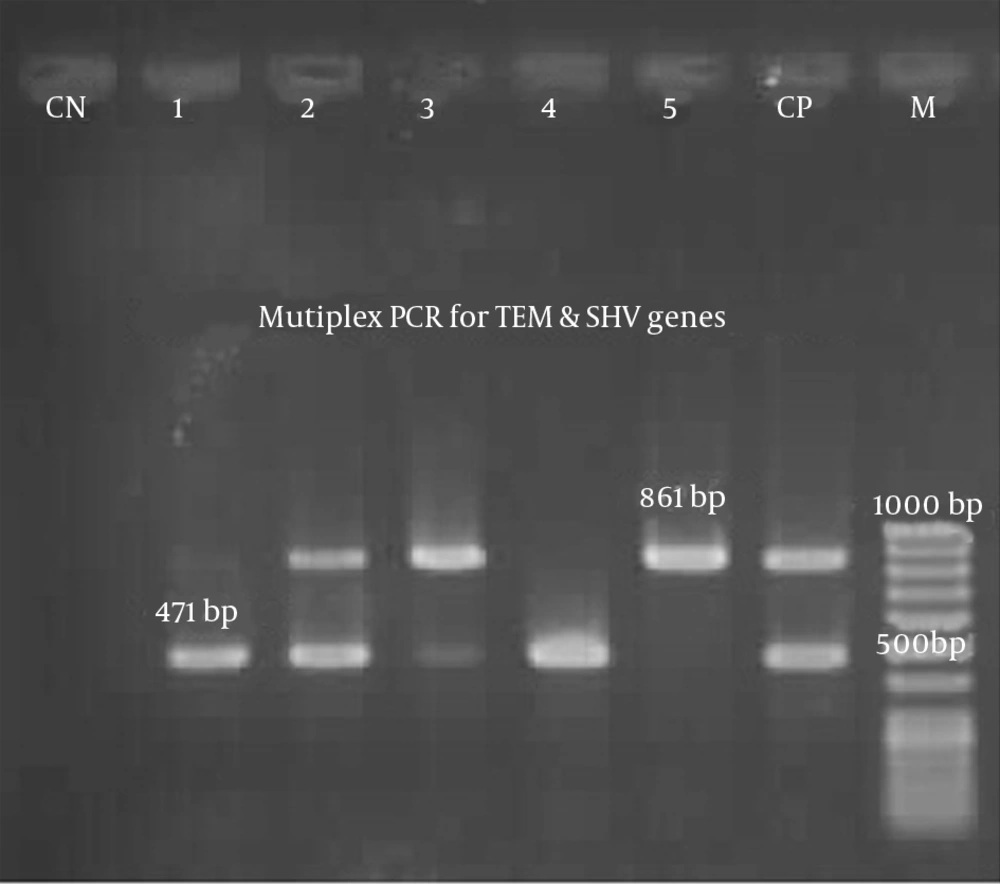
Figure 1.
Lane 1 displays a 471 bp fragment of the SHV gene. Lane 5 displays an 861 bp fragment of the TEM gene. Lanes 2 and 3 are positive for SHV and TEM. Lane M represents the 100 bp DNA ladder. Lane NC: negative control. Lane PC: positive control.
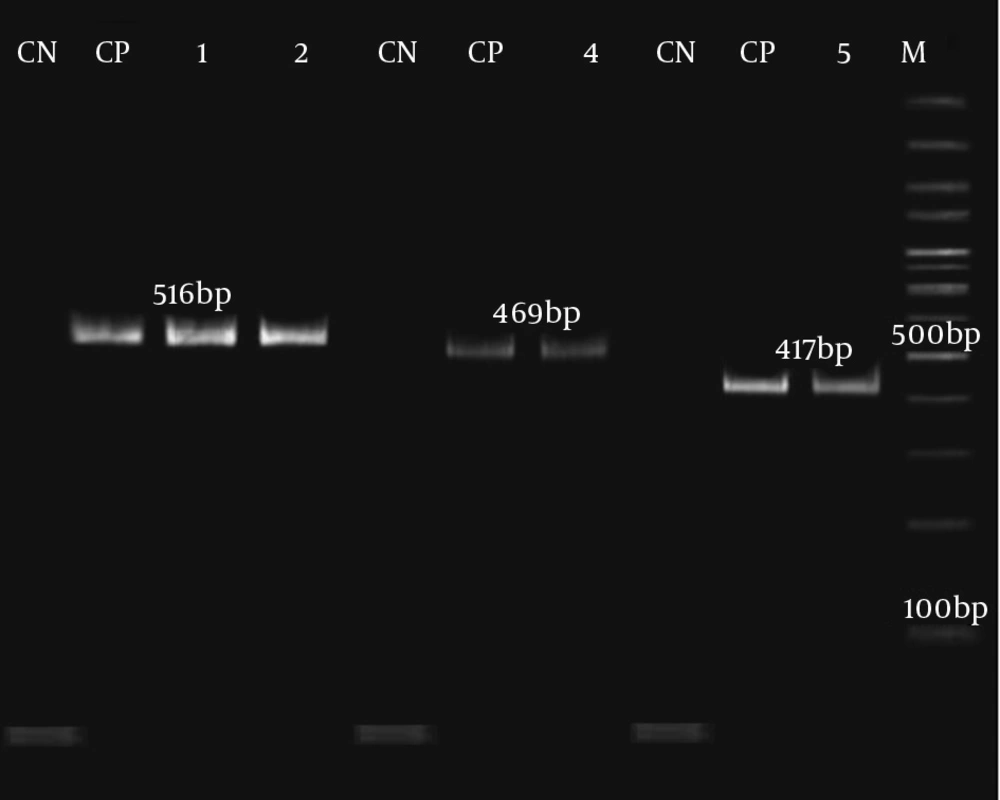
Figure 2.
Lanes 1 and 2 display a 516 bp fragment of the qnrA gene. Lane 4 displays a 469 bp fragment of the qnrB gene. Lane 5 displays a 417 bp fragment of the qnrS gene. Lane M represents the 100 bp DNA ladder. Lane NC: negative control. Lane PC: positive control.
Table 1.
qnrA, qnrB, and qnrS Gene Frequencies in Isolated E. colia
| qnr | ESBL | |
|---|---|---|
| ESBL-Producing E. coli | Non-ESBL-Producing E. coli | |
| qnrA | 29 (34.1) | 34 (29.6) |
| qnrB | 15 (17.6) | 19 (16.5) |
| qnrS | 9 (10.6) | 5 (4.3) |
aValues are presented as No. (%).
In one of the isolates, both qnr genes (qnrA and qnrS) and both ESBL genes (blaTEM and blaSHV) were detected, while 32 isolates contained at least one ESBL and one qnr gene. The disk diffusion method indicated that 86 (43%) isolates were resistant to ciprofloxacin. Additionally, 93 (46.5%), 104 (52%), and 105 (52.5%) isolates were resistant to ceftazidime, cefotaxime, and cefpodoxime, respectively. Sixty-eight (34%) isolates were resistant to ciprofloxacin and produced ESBL. ESBL strain frequencies in hospitalized patients and outpatients were 70.6% and 29.4%, respectively. blaTEM and blaSHV gene frequencies were 68.2% and 66.7%, respectively, in hospitalized patients. qnrA, qnrB, and qnrS gene frequencies were 63 (31%), 34 (17%), and 14 (7%), respectively. qnr (A, B, S) frequencies in hospitalized patients and outpatients are summarized in Figure 3.
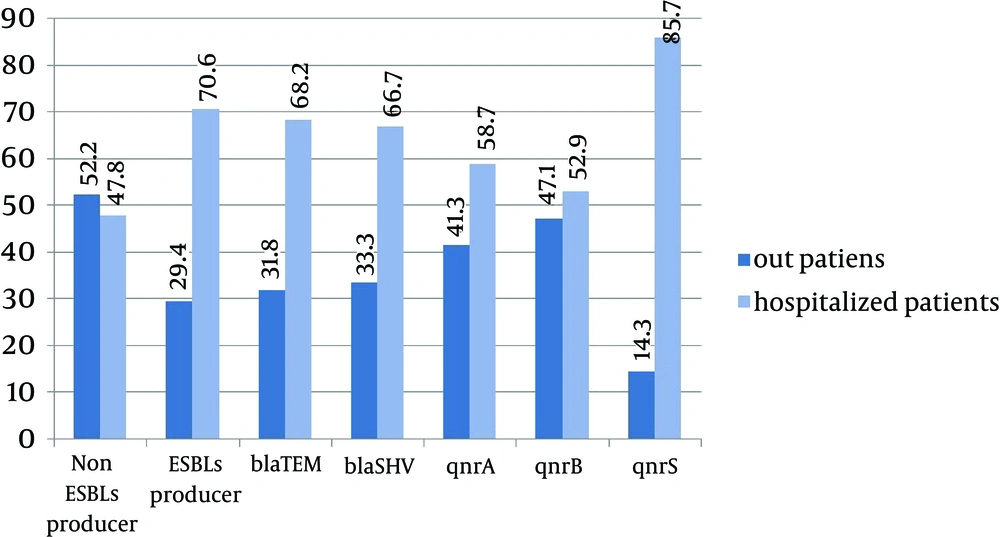
Figure 3.
The distribution of Non-ESBL- and ESBL-Producers and blaTEM, blaSHV, qnrA,qnrB, and qnrS Frequencies in E. coli Strains Isolated From Outpatients and Hospitalized Patients
5. Discussion
Plasmid-mediated genes, such as qnr, may facilitate the spread and increase the prevalence of quinolone-resistant strains. To date, qnr genes have been widely detected in Southern and Eastern Asia, North and South America, and Europe. The present study demonstrated a high prevalence of qnr genes among ESBL-producing E. coli isolates collected from the Imam Reza hospital in Mashhad, Iran. The high prevalence of qnr genes among ESBL-producing enterobacterial species has been previously reported. Our study revealed that the qnr gene could co-exist with the blaTEM and blaSHV alleles. PMQR strains, which carry the qnr gene, can transfer low-level quinolone resistance (22). Various studies have indicated that most enzymes from ESBL-producing organisms can be horizontally transmitted by the same plasmids harboring qnr genes (22, 23).
In this study, 85 (42.5%) of 200 isolates were recognized as ESBL-producing E. coli. Furthermore, the prevalence of ESBL-producing E. coli was high, especially in hospitalized patients. More than 70% of ESBL-producing organisms were blaTEM- and/or blaSHV-positive. In a study conducted in Mashhad, Iran, the prevalence of ESBL-producing E. coli and K. pneumoniae were 15.62% and 20%, respectively (21). In contrast, our results suggested that there is evidence of a higher prevalence of ESBL-producers. In 2007, in a study in Mashhad, the rate of ESBL-producing E. coli was reported to be 57.5%, which was higher than the rate of ESBL-producers in our study (24). Our molecular findings indicated that blaTEM was more prevalent than blaSHV. This molecular pattern was similar to previous studies by Pakzad et al. and Masjedian Jazi et al. (10, 25). In contrast, a study investigating the molecular pattern of ESBL-producing K. pneumoniae in Kashan reported that SHV1 was the most frequent genotype (26).
In the present study, the most prevalent gene among all isolates was qnrA, followed by qnrB and qnrS. In a similar study in Iran, qnrA and qnrB were recognized as the dominant genes. This finding is in agreement with our results (10). To our knowledge, there have not been any previous reports of the qnrS gene in ESBL-producing organisms in Iran. qnr gene frequency in ESBL-producing E. coli varies by country. In Egypt, qnrB1, qnrA1, and qnrS were reported in 23.3%, 16.6%, and 16.6%, respectively, of 30 ESBL-producing E. coli isolates (27). In Morocco, among 39 ESBL-producing Enterobacteriaceae isolates, 14 (36%) were positive for qnr (qnrA: 10%; qnrB: 23%; and qnrS: 3%) (28). In a study in Kuwait, low prevalence was reported for qnr determinants in ESBL-producing enterobacterial isolates. In this study, among 64 ESBL-producing Enterobacteriaceae, only two Enterobacter cloacae and one Citrobacter freundii isolates were positive for the qnrB-like gene, whereas no qnrA-like or qnrS-like genes were detected (29). In the USA, among 313 ceftazidime-resistant Enterobacteriaceae isolates, 23% were positive for either qnrA or qnrB, while qnrS was absent (12).
We found that in some of our isolates both qnr and ESBL genes were detected. There are many reports on qnr and ESBL gene insertion into the same plasmid that are consistent with our findings (15, 30). In Korea, qnrB (subtype B4), SHV12, and DHA-1 were the most frequent genes in K. pneumoniae. Korean researchers found that SHV-12 and DHA-1 were co-produced with qnrA1 and qnrB4 (31). In a Taiwanese hospital, all qnr-positive ESBL-producing E. cloacae isolates possessed the bla SHV-12 and qnrB2-like genes (32). In this study, we found that TEM was the most prevalent ESBL gene and was co-produced with qnrA as dominant qnr determinants. Our findings revealed that some ciprofloxacin-resistant isolates did not have qnr genes. Resistance in these isolates could be caused by other resistance mechanisms, which are noted in previous studies (33).
In our study, some E. coli isolates possessed both ESBL and qnr genes. This could occur because of insertion into the same plasmid, which can be easily transmitted to other organisms and increase the number of multidrug-resistant isolates. The high prevalence of quinolone-resistant genes at Imam Reza Hospital of Mashhad indicates antibiotic resistance, which is a major concern. Hence, the antibiotics prescription policy should be revised, and infection control measures should be improved.