1. Background
Syphilis, a sexually transmitted infection, is caused by the spirochete bacterium Treponema pallidum (TP) subspecies palladium, which is strongly contagious and capable of infecting multiple tissues and organs (1). Since the year 2000, the incidence of syphilis has been increasing in the USA, Canada, the UK, Australia, and Europe, and it has a mortality of 8% to 58%, with a greater death rate in males (2). In sub-Saharan Africa, syphilis contributes to approximately 20% of perinatal deaths (3). During 2010, it caused about 113,000 deaths, with more than 90% of the cases in developing countries (4).
Syphilis has complex clinical manifestations and TP cannot be cultured in vitro; therefore, serological tests for syphilis are key elements of the current diagnostic and therapeutic monitoring (5). Serological testing for syphilis can be divided into two categories: the TP antigen serological test and the non-TP antigen serological test (6).
Specific antibodies against TP are first detected during the incubation period of syphilis infection and the positive response remains high for an extended period after the cure, sometimes even for the lifetime of the patient (7). The live or dead TP or its ingredients are used as the antigen in laboratory tests, with the common tests being the TP enzyme-linked immunosorbent assay (TP-ELISA), the TP hemagglutination test (TPHA), the TP particle agglutination test (TPPA), the fluorescent treponemal antibody absorption test (FTA-ABS), the 19S-IgM TP hemagglutination test (19S-IgM), and the TP hemagglutination test (MHA-TP) (8).
The non-treponemal antigen serum tests, which include the venereal disease research laboratory test (VDRL), the unheated serum reagin test (USR), the syphilis rapid plasma reagin test (RPR), and the toluidine red unheated serum test (TRUST), use a cardiolipin antigen to detect serum anti-cardiolipin antibodies. A quantitative non-treponemal test of antibody titers is also important because antibody titers usually correlate with disease activity and show responses to treatment (9). After proper treatment, the antibody level (titer) decreases in the serum, so the titer can be used as a marker of the treatment efficacy or reinfection.
2. Objectives
In recent years, the articles on serologic testing for syphilis in hospitalized patients have focused on the TP antibody positive rate. However, syphilis serological titer distributions are rarely reported. Therefore, in our study, we analyzed the TP-ELISA results obtained for inpatients in Wenzhou central hospital from January 2010 to December 2012 and the distribution of TRUST titers among the TP-antibody-positive patients.
3. Patients and Methods
3.1. Patients
The study was approved by the ethics committee of Wenzhou central hospital, Wenzhou, China. Verbal informed consent was obtained from all patients before enrollment. The syphilis test results were collected for inpatients (34,165 males and 47,781 females) treated in our hospital from January 2010 to December 2012. All patient information was kept confidential (Table 1).
Table 1.
The Gender/Age Distribution of Hospitalized Patients From 2010 to 2012
| Year | Cases | Gendera | Age, ya | |||||
|---|---|---|---|---|---|---|---|---|
| Male | Female | ≤ 19 | 20 - 39 | 40 - 59 | 60 - 79 | ≥ 80 | ||
| 2010 | 24920 | 10612 (42.6) | 14308 (58.4) | 2568 (10.3) | 8260 (33.1) | 5972 (24.0) | 6160 (24.8) | 1960 (7.8) |
| 2011 | 29077 | 11903 (40.9) | 17174 (59.1) | 2451 (8.4) | 10098 (34.7) | 7121 (24.5) | 7175 (24.7) | 2232 (7.7) |
| 2012 | 27949 | 11650 (41.7) | 6299 (58.3) | 2111 (7.5) | 9295 (33.3) | 6845 (24.5) | 7302 (26.1) | 2396 (8.6) |
| Total | 81946 | 34165 (41.7) | 47781 (58.3) | 7130 (8.7) | 27653 (33.8) | 19938 (24.3) | 20637 (25.2) | 6588 (8.0) |
aValues are expressed as No. (%).
3.2. Detection of TP Antibodies With TP Enzyme-Linked Immunosorbent Assay (TP-ELISA)
The TP-ELISA was performed with a TP-ELISA kit (Livzon Diagnostics, Inc., Zhuhai, China) according to the manufacturer’s instructions. Diluted sample (50 µL) was added to each well of 96 well plates and incubated for 1 hour at 37°C. The TP antigen (50 µL), conjugated with horseradish peroxidase (HRP), was then added to each well and incubated for 1 hour at 37°C. The wells were then washed with PBS, and 50 µL of reagent A and B were added to each well and incubated in the dark for 30 minutes. The absorbance was then measured at 450 nm.
3.3. TP Particle Agglutination Test (TPPA)
The positivity of the TP-antibody-positive patients was reaffirmed with a TPPA test (Fujirebio Diagnostics Inc., Tokyo, Japan) based on the agglutination of colored gelatin particle carriers sensitized with TP (Nichols Strain) antigen. Tests were performed qualitatively using 1:40 and 1:80 dilutions. Particles sensitized by TP antigen and nonsensitized particles were added (25 μL) to 50 μL of the 1:80 and 1:40 dilutions, respectively. The mixtures were oscillated for 30 seconds, incubated at room temperature for 2 hours, and then each well was examined for agglutination. The particle agglutination that appeared polygonal, coarse, and macrocyclic in the 1:80 dilution and small, circular, and smooth in the 1:40 dilution were designated as positive, while the particle agglutination that appeared as small, circular, and smooth in the 1:80 dilution was designated as negative.
3.4. Toluidine Red Unheated Serum Test (TRUST)
Serum samples (50 μL) were dropped onto paper cards and 20 μL TRUST reagent (Rongsheng Biological Pharmaceutical Co., Ltd., Shanghai, China) was added to the serum. The samples were shaken at 100 rpm for 8 minutes and then examined for agglutination. If the result was positive, the test sera were serially diluted with saline and re-tested as described above. The highest dilution of clear serum agglutination was considered as the agglutination titer.
3.5. Statistical Analysis
All statistical analyses were performed with SPSS version 11.0 software (10). The differences in TP-positive rate and TRUST titer < 1:8 rate between different years, genders, and age groups were analyzed by the Chi-square test. A value of P < 0.05 for the difference was considered statistically significant.
4. Results
4.1. The General TP-ELISA Results
The gender/age distributions of hospitalized patients from 2010 to 2012 are shown in Table 1. A total of 81,946 inpatients, with slightly more female than male patients, agreed to serological testing for syphilis. Patients aged 20 - 39 years accounted for the largest proportion (33.8%), while patients older than 80 made up the smallest proportion (8%). Of the 81,946 inpatients, 1618 (1.97%) patients were identified as TP antibody-positive (Table 2). Among these TP-positive patients, 549 had early primary syphilis, 130 had late syphilis, and 939 had latent syphilis. About 2.27% of the cases (566/24920) in 2010, 1.58% cases (460/29077) in 2011, and 2.11% cases (592/27949) in 2012 were identified as positive. A significant difference was observed in the positive rate between 2011 and 2010 (χ2 = 34.20, P < 0.01), as well as between 2011 and 2012 (χ2 = 22.62, P < 0.01). However, no significant difference was noted between 2010 and 2012 (χ2 = 1.442, P = 0.23).
Table 2.
The Gender/Age Distribution of TP Antibody Positive Patients From 2010 to 2012
| Year | Total | Gender | Age, y | |||||
|---|---|---|---|---|---|---|---|---|
| Male | Female | ≤ 19 | 20 - 39 | 40 - 59 | 60 - 79 | ≥ 80 | ||
| 2010 | ||||||||
| Total cases | 24920 | 10612 | 14308 | 2568 | 8260 | 5972 | 6160 | 1960 |
| Positive case, No. (%) | 566 (2.27) | 245 (2.31) | 243 (1.70) | 76 (2.96) | 97 (1.17) | 138 (2.31) | 164 (2.67) | 91 (4.64) |
| 2011 | / | |||||||
| Total cases | 29077 | 11903 | 17174 | 2451 | 10098 | 7121 | 7175 | 2232 |
| Posetive case, No. (%) | 460 (1.58) | 287 (2.41) | 286 (1.67) | 77 (3.14) | 83 (0.82) | 125 (1.76) | 124 (1.73) | 51 (2.28) |
| 2012 | ||||||||
| Total cases | 27949 | 11650 | 16299 | 2111 | 9295 | 6845 | 7302 | 2396 |
| Posetive case, No. (%) | 592 (2.12) | 280 (2.40) | 277 (1.70) | 49 (2.32) | 125 (0.87) | 163 (2.38) | 202 (2.77) | 97 (4.05) |
| Overall positive cases | ||||||||
| Total cases | 81946 | 34165 | 47781 | 7130 | 27653 | 19938 | 20637 | 6588 |
| Posetive case, No. (%) | 1618 (1.97) | 812 (2.38) | 806 (1.69) | 202 (2.83) | 261 (0.94) | 426 (2.14) | 490 (2.38) | 239 (3.63) |
Across the three years, the TP antibody positive rate was lower in female than in male patients. Among the total 34165 male inpatients, 812 cases were TP antibody positive, whereas 806 of the 47781 female inpatients were TP antibody positive. The positive rate was higher among male inpatients (2.37%) than among female inpatients (1.68%) (χ2 = 48.97, P < 0.01). Patients older than 80 years showed the highest positive rate in 2010 and 2012, whereas the positive rate was the lowest among patients aged 20 - 39 years across all 3 years. In total, the positive rate for the group aged ≥ 80 years (3.63%) was the highest, followed by the groups aged ≤ 19 years (2.83%), 60 - 79 years (2.38%), 40 - 59 years (2.14%), and 20 - 39 years (0.94%), in decreasing order. The group aged 60 - 79 years had the greatest number of positive cases, whereas the group aged ≤ 19 years had the fewest cases. Among the positive male patients, the group aged 60 - 79 years had the highest positive rate (35.96%), while the group aged 20 - 39 years had the lowest rate (6.77%). In contrast, the female group aged 40 - 59 years had the highest positive rate (26.30%) and the female group aged ≤ 19 years had the lowest positive rate (10.30%) (Table 3).
Table 3.
The Age Distribution of TP Antibody Positive Patients in Different Gender Groups
| Gender | Total Positive Cases | Age, ya | ||||
|---|---|---|---|---|---|---|
| ≤ 19 | 20 - 39 | 40 - 59 | 60 - 79 | ≥ 80 | ||
| Male | 812 | 119 (14.66) | 55 (6.77) | 214 (26.35) | 292 (35.96) | 132 (16.26) |
| Female | 806 | 83 (10.30) | 206 (25.56) | 212 (26.30) | 198 (24.57) | 107 (13.28) |
| Total | 1618 | 202 (12.48) | 261 (16.13) | 426 (26.33) | 490 (30.28) | 239 (14.77) |
aValues are expressed as No. (%).
4.2. The Changes and Distribution of the Serum TRUST Titer Among TP Antibody-Positive Patients
In the 1618 TP antibody-positive patients, a total of 1395 were diagnosed as TRUST positive. The number of TRUST positive cases was lower in 2012 than in 2010 and 2012 (Table 4 and Figure 1). The main TRUST titers across all patients were 1:1 and 1:2. The proportions of patients with TRUST titers of 1:8 or less in 2010, 2011, and 2012 were 81.45%, 79.78%, and 89.53%, respectively, and the differences were statistically significant between 2012 and 2010, as well as between 2012 and 2011 (χ2 = 15.30, P < 0.01; χ2 = 19.56, P < 0.01, respectively).
Table 4.
The TRUST Titer of TP Antibody Positive Serum for Different Years, Genders, and Ages
| Group | TP Antibody | Serum TRUST Titer (1:X) | |||||||||
|---|---|---|---|---|---|---|---|---|---|---|---|
| Positive | Negative | 1 | 2 | 4 | 8 | 16 | 32 | 64 | ≥ 128 | < 1:8a,b | |
| Year | |||||||||||
| 2010 | 566 | 22 | 151 | 183 | 105 | 43 | 29 | 14 | 8 | 11 | 461 (81.45) |
| 2011 | 460 | 11 | 198 | 96 | 62 | 37 | 22 | 16 | 12 | 6 | 367 (79.78) |
| 2012 | 592 | 190 | 215 | 86 | 39 | 24 | 18 | 7 | 7 | 6 | 530 (89.53)* |
| Gender | |||||||||||
| Male | 812 | 117 | 260 | 181 | 118 | 49 | 39 | 20 | 14 | 14 | 676 (83.25) |
| Female | 806 | 106 | 304 | 184 | 88 | 55 | 30 | 17 | 13 | 9 | 682 (84.62) |
| Age, y | |||||||||||
| ≤ 19 | 202 | 5 | 79 | 56 | 31 | 9 | 6 | 4 | 6 | 6 | 171 (84.65) |
| 20 - 39 | 261 | 37 | 97 | 46 | 28 | 19 | 17 | 9 | 6 | 2 | 208 (79.69) |
| 40 - 59 | 426 | 60 | 147 | 92 | 49 | 31 | 12 | 19 | 6 | 10 | 348 (81.69) |
| 60 - 79 | 490 | 83 | 162 | 117 | 60 | 23 | 27 | 4 | 9 | 5 | 422 (86.12) |
| ≥ 80 | 239 | 38 | 79 | 54 | 38 | 22 | 7 | 1 | 0 | 0 | 209 (87.45)# |
aCompared with 2010, 2011, P < 0.01*; compared with the 20 - 39 group, P < 0.01#.
bValues are expressed as No. (%).
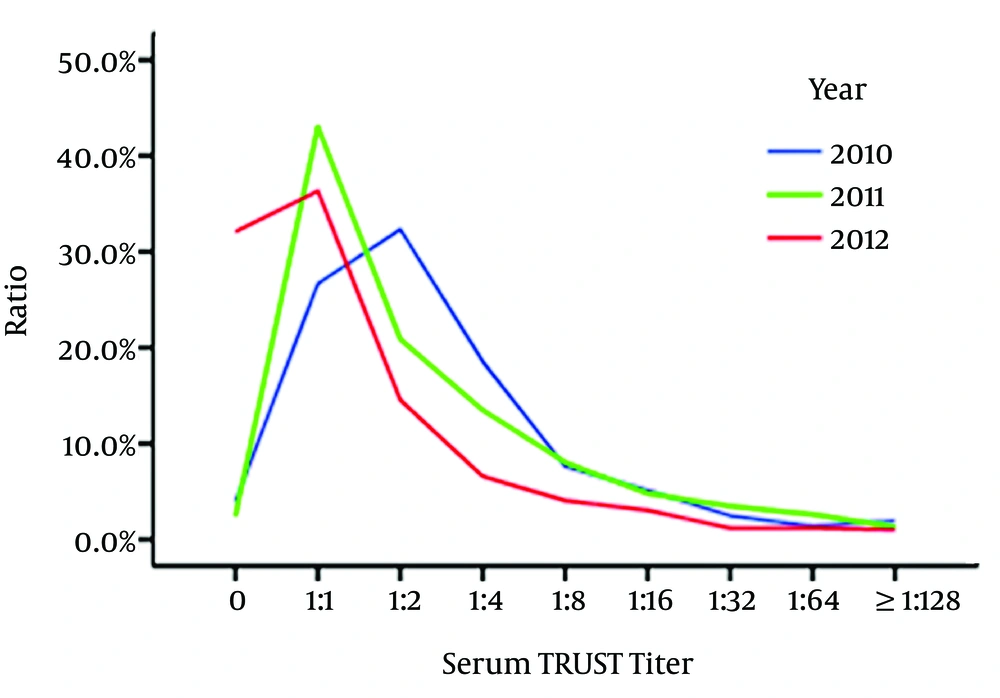
Figure 1.
TRUST Titer of TP Antibody Positive Sera Obtained in Different Years
No statistical significance was observed for the changes in or the distribution of the serum TRUST titers between male and female TP antibody positive patients (χ2 = 11.23, P = 0.19) (Table 4 and Figure 2). The proportion of low serum titers (< 1:8) in men was 83.25% and in women was 84.62%, and this difference was not statistically significant (χ2 = 0.55, P = 0.45).
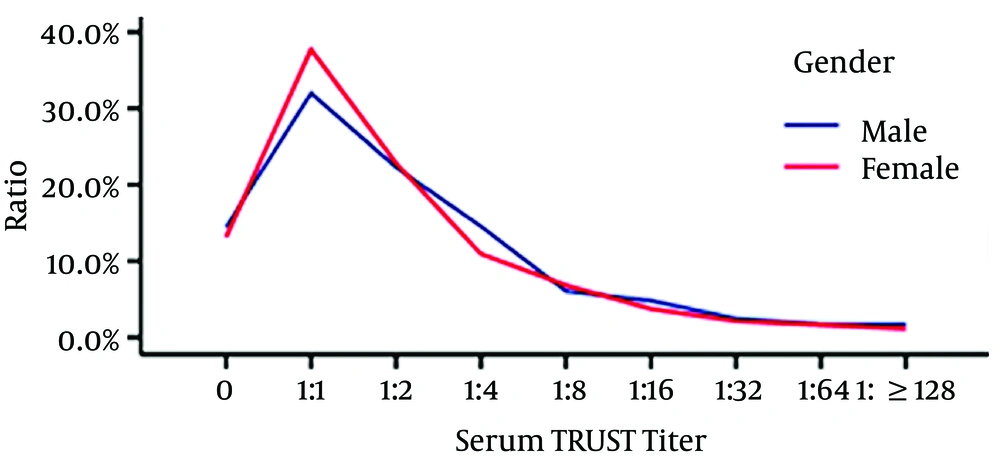
Figure 2.
TRUST Titer of TP Antibody Positive Sera for Different Genders
The proportion of TRUST serum titers of 1:8 or less for the group aged ≥ 80 years was the highest (87.45%), followed by the group aged 60 - 79 years (86.12%), the group aged ≤ 19 years (84.65%), the group aged 40 - 59 year (81.69%), and the group aged 20 - 39 years (79.69%, Figure 3). A statistically significant difference was determined between the group aged ≥ 80 years and the group aged 20 - 39 years (χ2 = 5.418, P = 0.02).
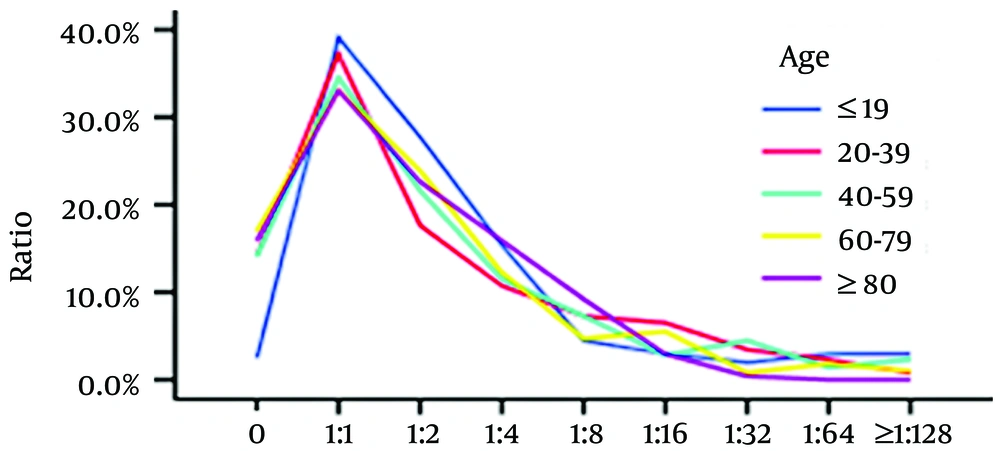
Figure 3.
TRUST Titer of TP Antibody Positive Sera From Patients of Different Ages
5. Discussion
The TP antibody positive rate among the inpatients was statistically the highest (2.27%) in 2010, and it dropped to 1.58% in 2011, followed by a tendency toward an increase in 2012. The total TP antibody positive rate was lower than that reported by Ganesan et al. (11). The number of TP antibody positive patients with serum TRUST titers was significantly increased in 2012 compared to 2010 and 2011. The serological characteristics of syphilis varied among the patients of different genders and ages.
The TRUST positive rates were 82.32%, 81.38%, and 83.33% in the studies conducted by Yin et al. (12), Jian and Mingxia (13), and Wang et al. (14), respectively, while Li et al. (15) reported that the proportion of low serum titers of 1:8 or less was 84.28% in men and 83.45% in women, which was similar to the proportion and distribution of positive TRUST titers found in the TP-positive patients in our study.
The reason for the difference between TP antibody positive rate and serum TRUST titers was that the TRUST titer negative patients cannot be excluded for the diagnosis of stage I and III syphilis (16, 17). The TRUST titers are not sensitive for latent syphilis and neurosyphilis, and the patients with these conditions were negative after treatment. The detected targets of TRUST were non-specific antibodies that emerged later than the specific antibodies. The TP antibody positive and TRUST titer negative patients may be associated with AIDS and syphilis immunosuppression; however, the B. burgdorferi antigen serum test should also be considered a false positive.
The TP antibody positive rate in men was 2.37%, which was significantly higher than that in women (1.68%). In China, the male population has relatively open sexual attitudes, and the relative mobility of the population is higher, so the probability of infection in men is relatively higher. No statistical significance was noted for the change and distribution of the serum TRUST titers between male and female positive patients, in agreement with the reports of Yin et al. (12) and Jian and Mingxia (13).
The TRUST method is likely to miss the detection of positive cases, and the early diagnosis of syphilis is poor with the TRUST method. The TRUST method detects stage II syphilis, but is not sensitive to stage I and III syphilis (16, 17). Some diseases, including autoimmune diseases, malaria, and sexually transmitted diseases, may cause false positives, as patients with underlying diseases may release anti-lipid or anti-TP antibodies that lead to cross-false positives (18). Thus, the TRUST and TP-ELISA, which are both convenient to perform and moderately priced, are suitable for screening of syphilis, but any TRUST-positive or TP-ELISA-positive patients should then be confirmed by a specific method, such as TPPA. This conclusion is validated by the finding in the present study, where the TP antibody positive patients, who were all confirmed by TPPA, did not all give positive results for the TRUST test.
The TP antibody positive rate in the group aged ≥ 80 year was the highest, which was consistent with the studies of Bosshard et al. (19) and Yan et al. (20), who reported that the population aged ≥ 70 years had the highest positive rate, but about eighteen percent were false positives. The incidence of false positives is less for the spiral antigen serum test than for the non-helical antigen serum test, as is commonly observed in autoimmune disease, lyme disease, leprosy, cancer, genital herpes, diabetes, lymphoma, meningioma, hypergammaglobulinemia, infectious mononuclear cell histiocytosis, heroin addiction, and pregnancy (21). The incidence of these diseases is also higher in elderly patients than in young patients, so the syphilis seropositivity is also higher. Despite the high false positive rate in laboratory test results, the elderly infected patients, especially those with asymptomatic latent syphilis, cannot be ignored. Among the elderly people with positive syphilis serology, a portion also suffers from underlying diseases that induce the body to produce anti-lipid antibodies or anti-TP cross antigens and cause false positives (22, 23). Elderly patients generally have low levels of education and lack capabilities for disease prevention. For economic reasons and the fear of moral, family, and community condemnation, the elderly patients are often afraid to commit to active treatment (24, 25).
Virtually, any acute sexually transmitted disease (STD) may produce acute biological false positive results, but the serum responses of these cases are low, rarely exceeding 1:8 (26, 27). When we applied specific tests such as the TPHA, the serum response was negative. Chronic biological false positives can be sustained for several months or years, or even for a lifetime; this is common in patients with autoimmune diseases, leprosy, cirrhosis, or narcotics addiction, and in pregnant women (28, 29). The TRUST titer of 1:8 or less in the oldest group (≥ 80 years) accounted for the highest proportion (87.45%), followed by the group aged 60 - 79 years (86.12%). The TP antibody positive rate in the group aged 20 - 39 years was the lowest (0.94%), but the TRUST titer of 1:8 or more in this group accounted for the highest proportion of the population (20.31%). The population in this group has relatively open sexual attitudes and the relative mobility of the population is higher, so the population of this group has important epidemiological significance as a source of infection. In addition, the TP antibody positive rate of group aged ≤ 19 years was relative higher, and the newborns accounted for the vast majority (188/202), so women of childbearing age should be conclusively diagnosed before marriage or pregnancy, or during the prenatal period, to reduce neonatal syphilis infection.
In summary, the syphilis serology characteristics differ in patients of different ages. The rate of TP antibody positivity was highest for the elderly group, followed by the group aged ≤ 19 years, although the highest serum TRUST titers were detected mainly in the group aged 20 - 39 years. Therefore, in addition to focusing on the prevention and treatment of syphilis in young patients and pregnant women, prevention work should further expand to the elderly. Syphilis serology positivity cannot be equated to TP infection. The TRUST test is better used in syphilis screening and to judge the curative effects of treatment, but syphilis diagnosis needs specific methods such as TP-ELISA and the TPPA test. The diagnosis of syphilis should be made cautiously, and must be combined with clinical examination and medical history. Furthermore, we should strengthen the popularity of sex education as well as the knowledge of sexually transmitted diseases for the elderly.