


1. Background
Leishmaniasis is a worldwide disease which is endemic in 98 countries and territories with more than 350 million people at risk. Over 12 million patients have been reported and about 0.7 to 1.2 million new cutaneous cases of the disease occur annually in the world (1, 2). Cutaneous leishmaniasis (CL) is highly endemic in Iran where has been reported as one of the 10 countries with the most cases (2). Leishmania major and L. tropica are the main etiologic agents of zoonotic cutaneous leishmaniasis (ZCL) and anthroponotic cutaneous leishmaniasis (ACL), respectively and a variety of phlebotomine sand flies are common vectors in this country (3). The well-known foci of CL are located in the regions including Isfahan (4), Fars (5, 6), Khorasan (7-10), Khuzestan (11, 12) and Kerman (13, 14) provinces in Iran. Zoonotic cutaneous leishmaniasis is endemic in rural districts and ACL has been reported from many large cities including Mashhad, Tehran, Shiraz, Kerman and some parts of Isfahan and some medium-size cities such as Bam (5, 7, 13, 15, 16).
Epidemiological changes such as emergence of new endemic foci and spreads of leishmaniasis to new areas have been reported in different studies (6, 17-21). Some cities including Tehran the capital of Iran, Isfahan, Shiraz, Mashhad, Tabriz and Ahvaz are recognized as metropolises regarding vast extension to surrounding areas and population growth due to immigrations from rural regions. Geographical expansion of cities and increasing immigration necessitate performing new studies on the epidemiology of diseases including leishmaniasis in these regions.
The diagnosis of CL is routinely based on microscopic assessment of clinical samples and/or the growth of parasite in culture media. Parasitological methods have been considered as gold standard in some papers (22, 23), but their low and not-ideal sensitivity resulted in false negative results (24). The sensitivity of microscopic examination can be variable, depending on the count and distribution of Leishman bodies on preparations and on the skills of a technician for detection of organism (25). Therefore, there has not been an agreement on a high sensitive and classical gold standard method for diagnosis of leishmaniasis (26).
Molecular techniques, mainly polymerase chain reaction (PCR) have recently considered and applied as a specific and more sensitive tool for Leishmania diagnosis (27-31). Although PCR is now used for diagnosis of clinical cases in some referral laboratories, complexity of DNA extraction and amplifications has confined routine application of this approach in general diagnostic laboratories in developing countries. Furthermore, conventional DNA extraction process is time-consuming and expensive and there is a risk for unpredicted cross-contamination during their several steps. Therefore, easier methods are required for isolation of DNA from stained smear. According to previous studies, commercial FTA cards seem to be appropriate for these goals and also for long-term preservation and maintenance of DNA without need to keep in freezer (32).
2. Objectives
In this study we performed a molecular epidemiologic study to clarify recent status of CL causative agents in two metropolises of Shiraz and Isfahan in central and southwest Iran. For the first time in these metropolises, we used FTA cards for DNA isolation from CL Giemsa stained slides prepared from patients referred to leishmaniasis control centers laboratories and evaluated the sensitivity and specificity of kDNA-PCR in comparison to routine microscopy examination. As no high sensitive gold standard method is available for CL diagnosis, patients have been defined based on both typical clinical ulcers and history recorded by resident physicians in leishmaniasis control centers and molecular and traditional methods sensitivity evaluated based on combination of these evidences.
3. Patients and Methods
3.1. Samples
Fifty four and 30 slide preparation samples from cutaneous lesions of patients clinically and epidemiologically diagnosed as CL, were obtained from diagnostic clinical laboratories in leishmaniasis control centers in two endemic regions including Shiraz city, Fars province, southwest and Isfahan city, Isfahan province centre of Iran, respectively (Figure 1) in 2012. Residential addresses of patients were recorded. Thirty blood samples obtained from healthy donors in non-endemic region were used as negative control specimens to evaluate microscopy and FTA card-nested-PCR specificity. A written informed consent was obtained from patients and healthy volunteers.
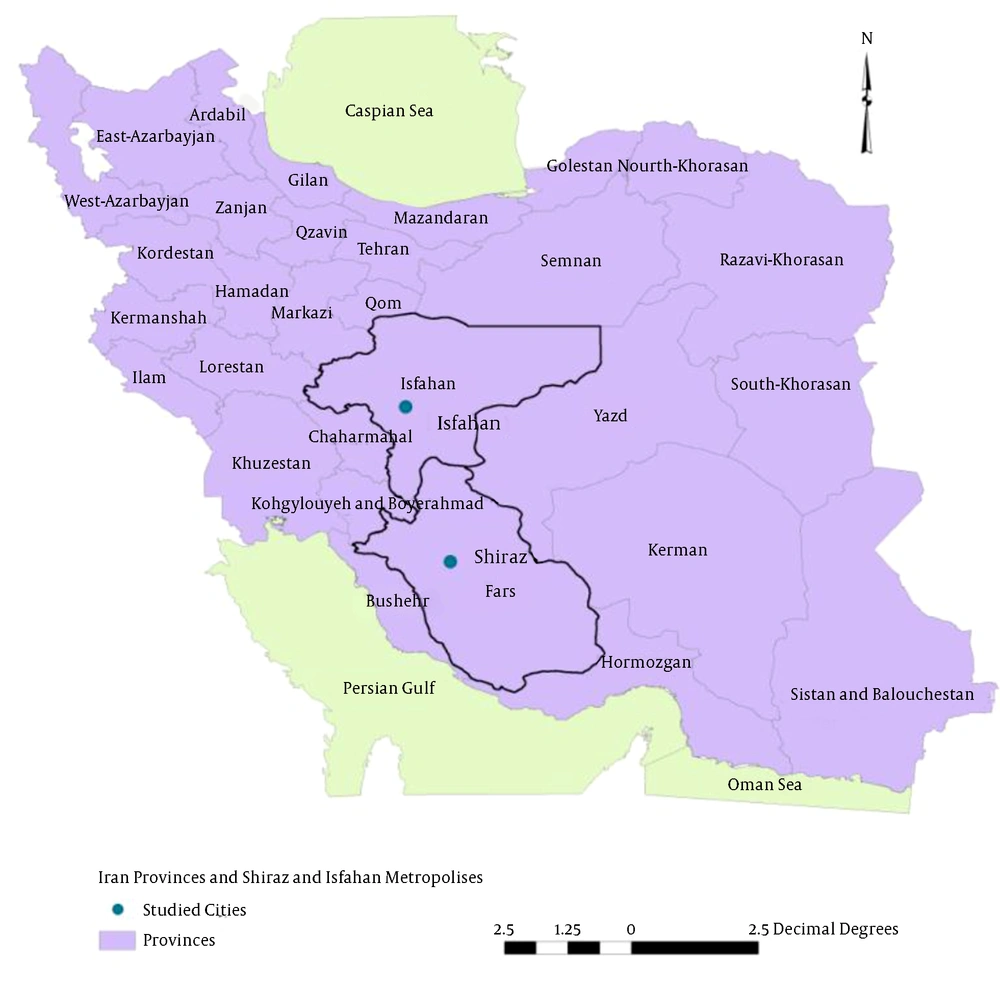
Figure 1.
Shiraz and Isfahan metropolises and Fars and Isfahan provinces are prominently shown. Shiraz and Isfahan cities and rural areas of Fars and Isfahan provinces have been known as ACL and ZCL foci of CL, respectively for decades.
3.2. Microscopic Examination
Cutaneous slide preparations were subjected to conventional direct microscopic examination to assess existence of Leishmania amastigotes. The average parasite number on each slide was graded based on the numbers of Leishmania amastigotes in high power field (HPF) using 10 × eyepiece and 100 × objective lenses as; negative (0 parasite/1000 HPF), + (1 - 10 parasites/1000 HPF), ++ (1 - 10 parasites/100 HPF), +++ (1 - 10 parasites/10 HPF) and ++++ (1 - 10 parasites/1HPF) (WHO 2010).
3.3. DNA Extraction by FTA Card
Twenty microliters of distilled water (DW) was added on each Giemsa stained slide and scratched using a sterile scalpel. A 5 µL aliquot of the suspension was then spotted on a 3 mm-piece of punched FTA cards (Whatman, the USA) and air dried for at least three hours at room temperature. The card was transferred to a tube containing 500 μL DW and vortexed for 5 seconds and transferred to a new tube containing 30 μL DW and incubated at 95°C for 20 minutes using a thermal cycler. After a short vortex, the tube was centrifuged for 30 s, the disk was discarded and DNA was used as the source of template in PCR analysis.
3.4. Nested-PCR
The nested-PCR performed using two sets of previously described primers (Macrogen Korea) (33); CSB2XF (5’-ATT TTT CGC GAT TTT CGC AGA ACG-3’) and CSB1XR (5’-CGA GTA GCA GAA ACT CCC GTT CA-3’) for the first round and 13Z (5’-ACT GGG GGT TGG TGT AAA ATA-3’) and LiR (5’-ACT GGG GGT TGG TGT AAA ATA-3’) for the second round. In the first round, PCR mixture included 5 μL of DNA, 0.5 µM of primers, 12.5 μL of 2x premix (Amplicon Denmark) and enough ddw up to 25 μL. The second-round of nested-PCR contained 1 μL of the first round PCR product as template, 0.5 µM of the second set of primers, 12.5 μL of premix and 10.5 μL of sterile DW. The PCR cycling program for both rounds was 95°C for 5 minutes, followed by 30 cycles of 94°C for 45 seconds, 60°C for 35 seconds and 72°C for 60 seconds and a final extension step at 72°C for 5 minutes in a thermocycler (Applied Biosystem model 2700). L. major isolate obtained from a well-defined patient and DW instead of DNA template included in all PCR runs as positive and negative controls, respectively. PCR products were electrophoresed onto 1.2% agarose gel stained with 0.5 μg/mL ethidium bromide for 90 min in 80 v in 1x TBE buffer (90 mM Tris-HCL, 90 mM boric acid, 2 mM EDTA) and visualized under ultraviolet light by transiluminator.
3.5. Statistical Analysis
To evaluate sensitivity and specificity of the kDNA-PCR and microscopy, slide preparations of patients clinically and epidemiologically diagnosed with CL and blood samples from healthy individuals obtained in a non-endemic region were used as positive and negative samples, respectively. Using the web calculator (Vassar Stats) available at http://www.vassarstats.net, McNemar’s test was used to compare the microscopy and nested-PCR results.
4. Results
Regarding microscopic examination, thirty slides were considered to have negative results as no amastigote was found in about 1000 HPF. Fifty four of 84 (64.2%) slides had positive results microscopically. The positive samples consisted slides from (+) to (++++) grades based on the parasite quantity including; 42 (+), 6 (++) 5 (+++) and only one (++++). Among the slides with positive findings in direct microscopy, 52 cases had positive results by nested-PCR. Thus, in comparison to microscopy method, the sensitivity of PCR was evaluated as 96%. From 30 negative controls, all had negative results by microscopic examination and PCR, therefore the specificity was evaluated as 100%. Thirty of 84 smear preparations had negative results by direct microscopy, while PCR showed unequivocal positivity in 27 of these 30 cases. Overall, ninety four percent (79/84) of slides had positive results for amplification of Leishmania kinetoplastid DNA by nested-PCR using FTA cards (Table 1 and Figure 2), while only 54 of 84 cases (64.3%) were diagnosed as CL by microscopy. Therefore, in comparison to clinico-epidemiological diagnosis, sensitivity of microscopic examination and nested-PCR using FTA cards were 64.2% and 94%, respectively. kDNA nested-PCR in comparison to microscopy showed a notable higher positivity rate for diagnosis (McNemar’s test, P < 0.0001).
Table 1. Graded Microscopy and kDNA Nested-PCR Results of Stained Slidesa
| Microscopic Results (Microscopy Grades) | Nested-PCR Positive |
|---|---|
| 1 (++++) | 1 |
| 5 (+++) | 5 |
| 6 (++) | 6 |
| 42 (+) | 40 |
| 30 (-) | 27 |
a-, 0 parasites/1000 HPF; +, 1 - 10 parasites/1000 HPF; ++, 1 - 10 parasites/100 HPF; +++, 1 - 10, parasites/10 HPF; ++++, 1 - 10 parasites/1HPF.
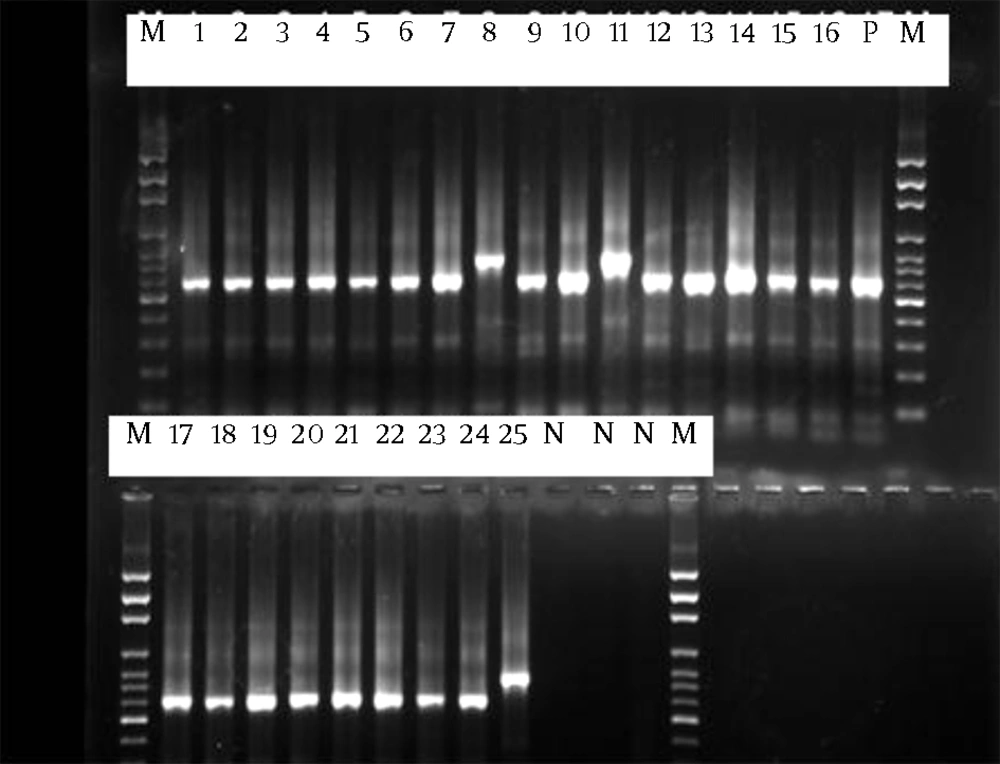
Figure 2.
M, 100 bp molecular ladder; P, positive controls; N, negative controls (distilled water); lanes 8, 11, and 25, L. tropica, the others, L. major.
Forty nine of 54 (90.7%) samples obtained from Shiraz city were identified as L. major based on the species-specific size (560 bp), while only 5 cases (9.3%) caused by L. tropica (750 bp). Twenty five of 30 cases obtained from Isfahan city were identified as L. major, while other five slides had negative results by PCR. Proportion of each species in traditional central areas and suburbs of each metropolis is presented in Table 2. Most cases from Shiraz were from suburbs and most isolates were L. major, while all isolates from central regions were identified as L. tropica. Cases from suburbs of Shiraz were mostly from east, northeast and southeast regions. Interestingly all cases from Isfahan were from suburbs and no patient was reported from traditionally central parts. Most Leishmania isolates were from east suburb border of Isfahan city (Figure 3).
Table 2. Distribution of CL Causative Agents in Different Regions of Shiraz and Isfahan Metropolises
| L. major | L. tropica | Total | |||
|---|---|---|---|---|---|
| Central Region | Suburbs | Central Region | Suburbs | ||
| Shiraz | 0 | 49 | 3 | 2 | 54 |
| Isfahan | 0 | 25 | 0 | 0 | 25 |
| Total | 0 | 74 | 3 | 2 | 79 |
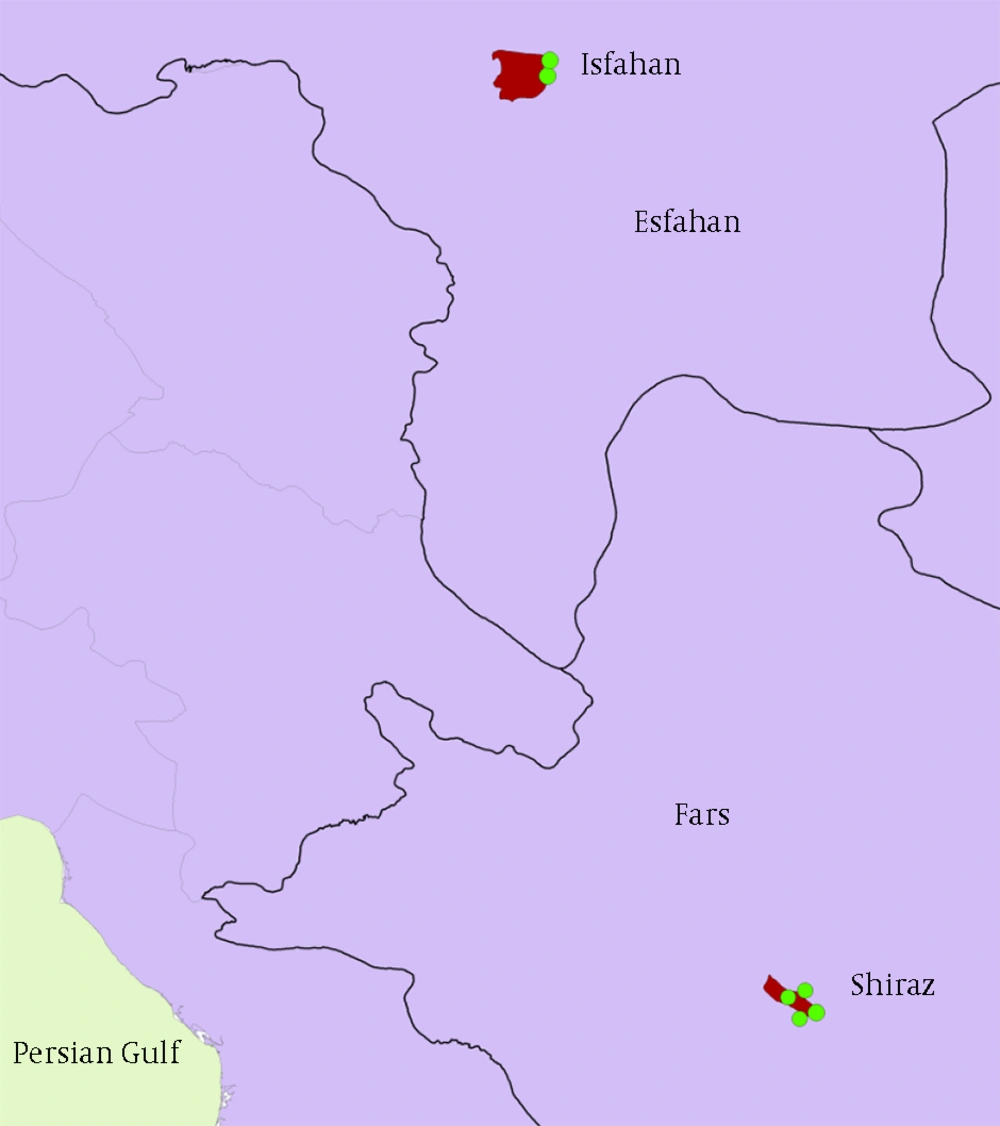
Figure 3.
Polygon Featurs of Shiraz and Isfahan Meteropolises (Brown Features) in Fars and Isfahan Provinces, Respectively and the Main Locations of CL Cases (Green Point) in These Cities
5. Discussion
In this study we indicated that FTA card technology is a rapid and sensitive method for extracting DNA from Giemsa-stained CL smears prepared in medical laboratories in Iran. FTA card DNA extraction and subsequent kDNA-PCR was able to diagnose Leishmania DNA in all clinically diagnosed CL cases having (++) to (++++) number of amastigotes in smears, while the result was different for lower amounts of amastigotes. PCR could detect CL in 67 of 72 microscopically one-plus or negative cases in comparison to 42/72 for the microscopic method. Difference in diagnostic ability of FTA card-nested-PCR in comparison to direct microscopy (especially for those microscopically negative Giemsa-stained smears), clearly showed that this approach would be useful in cases with lower number of parasite or where health staff are not enough expert to provide adequate samples. High sensitivity of PCR following routine phenol/chloroform DNA extraction method or DNA purification by commercial kits in comparison to parasitological methods for diagnosis of leishmaniasis has been reported in different studies (24, 34-38). Our study showed that FTA card DNA extraction followed by nested-PCR was notably more sensitive than microscopy examination of cutaneous smears.
In many cases, because of the scarce amount of sample, only one microscopic preparation is obtained and for performing other tests like PCR, the only source of DNA is the same slide. Therefore, a highly sensitive but easy method for extracting DNA can facilitate later DNA amplification from cutaneous leishmaniasis slide preparations. FTA cards have been evolved for easy obtaining and long-term preserving DNA. Also spotting samples on FTA cards could facilitate transportation and storing the clinical specimens (39, 40). Unlike heterogeneous distribution of Leishmania amastigote in microscopic slides, scraping of stained smears suspended in water or TE buffer and produced homogenous suspension could decrease heterogeneity of Leishmania amastigotes distribution in the FTA card imprints, thus the chance of parasite detection would be increased. Kato et al. presented FTA cards as a useful tool for field and ecological works where researcher prefers to get Leishmania DNA directly from CL lesions by contact of the scrapped material of lesions with filter paper (32). Furthermore, FTA cards were used successfully for isolation of DNA from lesions contaminated with secondarily bacterial infection to decrease the chance of bacteremia and soft tissue infection rather than lesion scraping or biopsy procedures (41). Also Fata et al. (42) advised FTA cards for massive CL epidemiological screening studies and transportation of CL DNA from remote areas to research centers. Likewise, the largest sampling and DNA isolation and molecular typing on the American cutaneous leishmaniasis were performed in Argentina using FTA card technology (43).
Our study was designed to extract DNA by FTA cards from the samples obtained under routine procedures of smear preparation and Giemsa staining by diagnostic laboratories technicians in Isfahan and Shiraz metropolises. Isfahan and Shiraz cities have been identified as anthroponotic cutaneous leishmaniasis endemic foci, while rural districts of both Fars and Isfahan provinces have been known as the foci of Zoonotic cutaneous leishmaniasis (5, 6, 44-47). Our study showed that all CL cases from Isfahan city and more than 90% of cases from Shiraz city were L. major. Also a study on the phylogeny of L. tropica in South Iran showed that L. major is the dominant species obtained from human cases in Shiraz city and its suburb (16). Nevertheless, recent findings are not in concordance with some previous data. Although some patients with rural origin may indicate their residential address as city when referred to CL control centers and known as citizens of these metropolises, the main cause of this epidemiologic change can be explained by another reason. Isfahan and Shiraz cities as the capital cities of Fars and Isfahan provinces, respectively and as the most important cities after Tehran city (the capital of Iran) have been largely extended in the recent years. So some villages in suburb of these cities are now belonged to urban region or in close proximity of cities while ZCL patterns persist in these originally rural regions (6, 44, 48). Some evidences showed decrease in CL cases from old and traditional central area of Shiraz city (unpublished data) where epidemiologic findings had showed ACL pattern. Our work also showed that low numbers of CL cases (3/54) were obtained from Shiraz central region, although L. tropica identified in all 3 cases. Furthermore, no CL cases were found in traditional regions of Isfahan in our work. Isfahan CL control center chairman announced that no CL cases were reported from central and traditional regions of Isfahan city in recent years (Personnel communication). Overall, it seems that ACL has been decreased in the center of metropolises and ZCL increased in the suburbs where considered as villages till recent years. Presumed epidemiological pattern was to some extent similar to what reported from eastern Saudi Arabia, Al-hassa city where its suburbs extended to the rural areas in which L. major was isolated from both Phlebotomus vectors and gerbil reservoirs (47). In addition to extension of border of cities to surrounding ZCL foci, immigration of people from villages to suburbs of metropolises may play role for emergence or increase of ZCL in these regions (49), but regarding close proximity of ZCL foci with Shiraz and Isfahan cities, people immigration from far villages to cities may not be the main cause of dominancy of L. major in the metropolises suburbs.
We strongly advise a study on the molecular epidemiology of CL accompanied with GIS (geographical information systems)-based discrimination of old and new urban regions in Isfahan and Shiraz cities to clarify the recent pattern of CL.
As conclusion, FTA card was shown to be a very useful and applicable tool to facilitate DNA extraction from Giemsa stained tissue smears, especially in cases with low amount of leishman bodies and encourage researchers and diagnostic laboratories staff in Iran and similar developing countries to deal with PCR approach for diagnosis of CL. Molecular epidemiology of CL in two Shiraz and Isfahan metropolises interestingly showed dominancy of L. major, the main cause of ZCL in their suburbs and L. tropica in central Shiraz. No CL case was found in central Isfahan. Regarding expansion of these cities to new suburbs area, upcoming studies should be designed to discriminate samples from new and old urban regions to give a correct view on CL patterns in these regions.

