Ulcerative colitis is a type of inflammatory bowel disease characterized by chronic inflammation of the colon and rectum, resulting in long-term mucosal inflammation and ulceration (
26,
27). The traditional gold standard treatments for ulcerative colitis include surgery and the administration of drugs such as 5-aminosalicylic acid, corticosteroids, and immunosuppressants (
28). A recent study demonstrated that the composition of the fecal microbiota in ulcerative colitis patients differs significantly from that of healthy individuals, suggesting that microbial alterations may play a role in the disease (
29). However, some patients do not achieve clinical improvement with conventional drug regimens, posing a significant challenge to the effective management of ulcerative colitis (
30).
As a result, alternative treatment options, such as traditional and herbal medicines, have been actively explored, with some already being introduced into clinical practice (
31,
32). There is ongoing and effective development of traditional therapies for ulcerative colitis in both preclinical and clinical studies. Numerous herbal medicines have been integrated into traditional medical systems, showing various therapeutic effects on ulcerative colitis, including analgesic, antibacterial, anti-inflammatory, and anti-diarrheal properties, as well as the ability to regulate immune responses, inhibit macrophage/monocyte activity, and adjust inflammatory processes (
33,
34).
Phytochemical investigations of plants in the
Ulmaceae family have revealed the presence of active compounds such as terpenoids, alkaloids, glycosides, carbohydrates, steroids, sterols, saponins, tannins, proteins, and flavonoids. Key bioactive compounds isolated from these plants, such as β-amyrin, β-sitosterol, holopterin-A, holopterin-B, hederagenin, hexacosanol, beta-D-glucose, friedlin, epifriedlin, 2-aminonaphthoquinone, and 1,4-naphthalenedione, are considered responsible for their medicinal properties (
35).
Common compounds identified in elm (
Ulmus spp.) plants include mucilage, tannins, caffeic acid derivatives (especially chlorogenic acid, CGA), and sterols such as β-sitosterol and stigmasterol. Mucilage, composed of highly hydratable and gel-forming polysaccharides, contains biologically active compounds such as flavonoids, alkaloids, and terpenoids. For instance, flavonoids act as anti-inflammatory agents by inhibiting the enzymes cyclooxygenase and lipoxygenase, key players in arachidonic acid metabolism. Additionally, flavonoids help modulate oxidative bursts in neutrophils, reducing reactive oxygen species and accelerating wound healing (
36). Tannins, another group of natural compounds, exhibit notable anti-inflammatory, antiviral, antimicrobial, immunomodulatory, antitumor, and hepatoprotective activities (
37). Caffeic acid, a major representative of hydroxycinnamic acids, has various physiological and pharmacological properties, including antiviral, antioxidant, anti-inflammatory, anticarcinogenic, immunomodulatory, antidiabetic, cardioprotective, antiproliferative, and hepatoprotective effects (
38). Moreover, previous studies have shown that sterols, particularly β-sitosterol, can reduce the mRNA expression of pro-inflammatory cytokines, thereby contributing to their anti-inflammatory potential (
39).
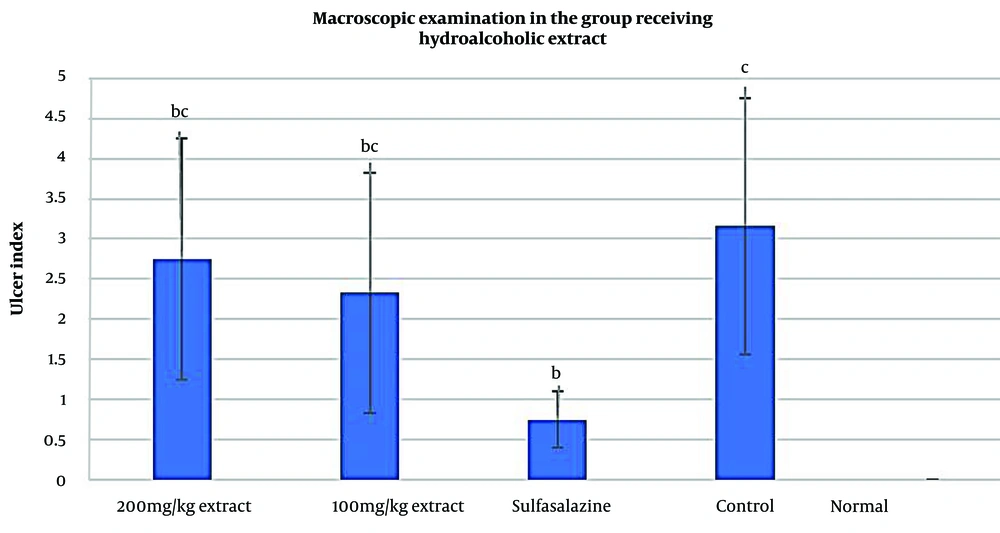
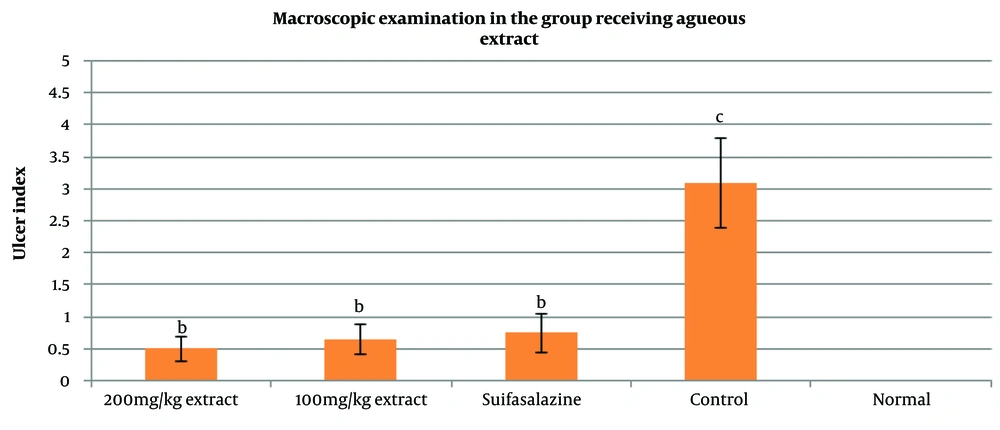
In this study, it was shown that both groups receiving the hydroalcoholic extract of Ulmus minor at doses of 100 and 200 mg/kg exhibited some improvement, although the improvement was less pronounced compared to the sulfasalazine group. Additionally, the results in both groups receiving the hydroalcoholic extract were significant compared to the control and sulfasalazine groups (P < 0.05). The groups receiving the aqueous extract of Ulmus minor at doses of 100 and 200 mg/kg showed very favorable effects, with a significant difference observed when compared to the control group (P < 0.05). However, there was no significant difference in comparison with the sulfasalazine group.
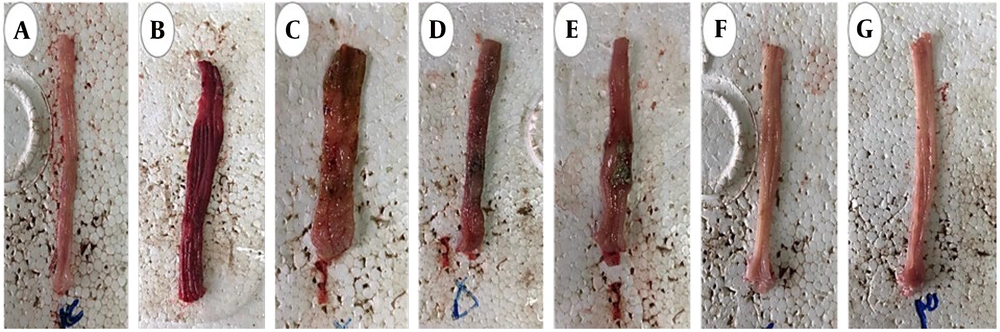
Overall, the results from the macroscopic examinations indicated that the aqueous extract of Ulmus minor leaves at a dose of 200 mg/kg had the most beneficial effect on colon tissue when compared to the groups treated with hydroalcoholic extracts at doses of 100 and 200 mg/kg and the aqueous extract at 100 mg/kg. This favorable effect, compared to the control group, was statistically significant (P ˂ 0.05).
Supporting these findings, research conducted in 2022 by DʼAngiolo et al. focused on the phytochemical investigation of
Ulmus minor subspecies. The results of this study demonstrated that the extract (6.25 - 50 μg/mL) significantly inhibited the release of nitric oxide (NO) and the expression of inducible nitric oxide synthase (iNOS) and cyclooxygenase-2 (COX-2) in macrophages. These data highlight the anti-inflammatory properties of several compounds isolated from
Ulmus minor, suggesting their potential use in nutrition (
35). In a 2007 study by Lee et al., the immunomodulating effects of
Ulmus minor bark extract were investigated. The study focused on the proliferation of spleen cells and the capacity to produce cytokines, including interleukin (IL)-1beta, IL-6, and tumor necrosis factor (TNF)-alpha, in rat peritoneal cells. The results showed that spleen cell proliferation increased when treated with
Ulmus minor bark extract in combination with lipopolysaccharide or concanavalin A at a concentration of 500 mg/kg body weight, compared to the control group. Furthermore, the highest production of IL-6 and TNF-alpha was observed at a concentration of 500 mg/kg body weight. In conclusion, this study demonstrates that
Ulmusdavidiana var.
japonica (a variety of
Ulmus minor bark) extract can enhance immune properties such as spleen cell proliferation and cytokine production in activated macrophages, and it may offer protective effects in mice (
40).
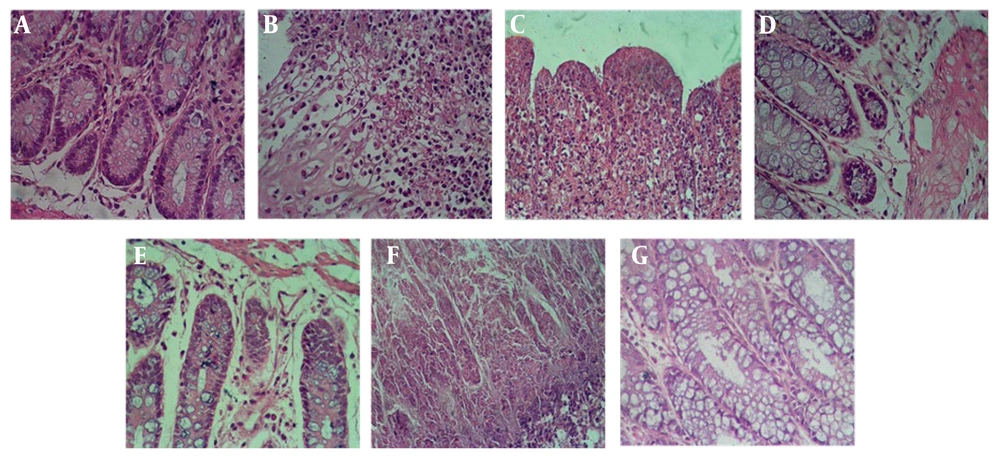
Administration of hydroalcoholic and aqueous extracts of Ulmus minor leaves, along with sulfasalazine, led to a significant reduction in pathological lesions, particularly in the necrosis and inflammation caused by acetic acid in the colon tissues. Histological examinations of the groups treated with sulfasalazine showed mild inflammation, partial healing of secretory glands, and mild wounds. In the group receiving the aqueous extract of Ulmus minor leaves at a dose of 100 mg/kg, mild wounds and inflammation were observed, along with the preservation of glandular structures and mucosal restoration. Secretory gland regeneration was also noted.
A 2017 study by You-Suk et al. investigated whether administration of
Ulmus minor bark could improve immune competence and mitigate radiation-induced intestinal damage in irradiated mice. The results showed that radiation exposure reduced T cell proliferation in the spleen and decreased interleukin-1β and interleukin-6 levels from macrophages by week 2. Supplementation with
Ulmus minor bark extract at a low concentration (50 mg/kg body weight; EB-50) increased T and B cell proliferation in irradiated mice. Histological analysis revealed that
Ulmus minor-50 bark treatment mitigated intestinal damage caused by radiation, resulting in lower histological grades in comparison to the irradiated control group at week 4. The extract also decreased glutathione levels by day 5 and week 2, and reduced myeloperoxidase activity by week 4, suggesting that
Ulmus minor bark may alleviate radiation-induced intestinal inflammation by improving immune modulation and reducing oxidative stress. These findings confirm the results of the present study, highlighting the potential protective effects of
Ulmus minor bark (
41).
5.1. Conclusions
Both groups receiving hydroalcoholic extracts of Ulmus minor leaves at doses of 100 mg/kg and 200 mg/kg showed slight improvements, although the improvement rate was lower compared to the sulfasalazine group but higher than the control group (P < 0.05). In the groups receiving aqueous extract, both 100 mg/kg and 200 mg/kg doses produced favorable effects, with significant differences observed compared to the control group (P < 0.05). However, no significant difference was found when compared to the sulfasalazine group. Overall, macroscopic examinations indicated that the aqueous extract of Ulmus minor leaves at 200 mg/kg had the best protective effect on colon tissue. The results showed that treatment with hydroalcoholic extracts at doses of 100 mg/kg and 200 mg/kg, and aqueous extract at 100 mg/kg, had favorable effects compared to the control group, with a significant difference (P < 0.05).