Jundishapur J Nat Pharm Prod

Image Credit:Jundishapur J Nat Pharm Prod

Protective Effects of Coenzyme Q10 Against Urogenital Damage Induced by 2.45 GHz Wi-Fi Radiofrequency Radiation in Rats

Author(s):
Esmaeil MousapourEsmaeil Mousapour1,*, Arash KarimiArash Karimi2, Sina EbrahimiSina Ebrahimi1, 2, Annahita RezaieAnnahita Rezaie3, Kaveh RahimiKaveh Rahimi4, Mahboobeh DehvariMahboobeh Dehvari5, 6, Maasomeh EzzatigiviMaasomeh Ezzatigivi4, Ali SasaniAli Sasani7, Ali Safaie NezhadAli Safaie Nezhad8
1Department of Urology, School of Medicine, Golestan Hospital, Ahvaz Jundishapur University of Medical Sciences, Ahvaz, Iran
2Department of Urology, School of Medicine, Imam Khomeini Hospital, Ahvaz Jundishapur University of Medical Sciences, Ahvaz, Iran
3Department of Pathology, Shahid Chamran University of Ahvaz, Ahvaz, Iran
4Department of Biology, Shahid Chamran University of Ahvaz, Ahvaz, Iran
5Department of Environmental Health Engineering, Faculty of Public Health, Ahvaz Jundishapur University of Medical Sciences, Ahvaz, Iran
6Environmental Technologies Research Center, Medical BasicSciences Research Institute, Ahvaz Jundishapur University of Medical Sciences, Ahvaz, Iran
7Department of Healthcare Services Management, Jundishapur University of Medical Sciences, Ahvaz, Iran
8Department of Urology, Jundishapur University of Medical Sciences, Ahvaz, Iran

Jundishapur Journal of Natural Pharmaceutical Products:Vol. 21, issue 1; e169131
Published online:Jun 06, 2026
Article type:Research Article
Received:Dec 20, 2025
Accepted:Jan 27, 2026
How to Cite:Mousapour E, Karimi A, Ebrahimi S, Rezaie A, Rahimi K, et al. Protective Effects of Coenzyme Q10 Against Urogenital Damage Induced by 2.45 GHz Wi-Fi Radiofrequency Radiation in Rats. Jundishapur J Nat Pharm Prod. 2026;21(1):e169131. doi: https://doi.org/10.5812/jjnpp-169131

Abstract

Background:

Wi-Fi exposure has been associated with oxidative stress and reproductive toxicity; however, protective strategies remain under investigation.

Objectives:

This study aimed to evaluate the protective effects of coenzyme Q10 (CoQ10) against oxidative stress–mediated reproductive and renal damage induced by prolonged exposure to 2.45 GHz Wi-Fi radiofrequency radiation in male Wistar rats by assessing oxidative stress markers, antioxidant enzyme activities, sperm parameters, testosterone levels, and testicular and renal histopathological changes.

Methods:

Male Wistar rats (n = 40) were allocated to the control, Wi-Fi, Wi-Fi+CoQ10, Coenzyme Q10 (CoQ10), and vehicle groups. Animals were exposed to Wi-Fi radiation at 2.45 GHz [specific absorption rate (SAR) ≈ 0.9 W/kg, 7 h/day for 8 weeks]. CoQ10 was administered orally at 150 mg/kg/day. Oxidative stress markers [malondialdehyde (MDA)], antioxidant enzyme activities [superoxide dismutase (SOD), catalase (CAT), glutathione peroxidase (GPx)], sperm parameters, testosterone levels, and histopathology of the testes and kidneys were assessed. Statistical analyses were performed using one-way ANOVA followed by Tukey’s post-hoc test.

Results:

Wi-Fi exposure significantly increased MDA levels in the testes and kidneys (P < 0.01, η2 = 0.39) and reduced antioxidant enzyme activities (P < 0.01, η2 = 0.41). Sperm count, motility, and testosterone levels declined markedly (P < 0.05). Histopathological changes were evident in the seminiferous tubules and renal tissues. CoQ10 supplementation alone reduced MDA (P < 0.05) and increased antioxidant enzyme activities above baseline (P < 0.05). Combined treatment (Wi-Fi+CoQ10) partially restored enzyme activities and attenuated oxidative stress compared with that in the Wi-Fi group (P < 0.05).

Conclusions:

Prolonged Wi-Fi exposure at 2.45 GHz (SAR ≈ 0.9 W/kg) induces oxidative stress-mediated damage in reproductive and renal tissues, resulting in impaired sperm quality and hormonal imbalance. CoQ10 supplementation demonstrated protective effects by reducing oxidative damage and partially restoring reproductive indices. These findings suggest that continuous Wi-Fi exposure may pose reproductive risks, whereas antioxidant strategies such as CoQ10 could mitigate these effects.

1. Background

The rapid expansion of wireless communication systems has led to widespread reliance on Wi-Fi networks, particularly those operating at 2.45 GHz, across residential, educational, and industrial settings. Although these technologies offer substantial convenience, accumulating experimental evidence suggests that prolonged exposure to such electromagnetic fields may adversely affect male reproductive function. Several studies have reported reductions in sperm concentration, motility, and viability, along with structural alterations in testicular tissue following Wi-Fi exposure (1-3).
Oxidative stress is widely regarded as the primary mechanism underlying these biological disturbances. Excessive production of reactive oxygen species (ROS) within reproductive organs can induce lipid peroxidation, DNA fragmentation, and germ cell apoptosis (4-6). Leydig cells, which are responsible for testosterone synthesis, appear particularly vulnerable to oxidative injury, potentially leading to hormonal imbalance and impaired spermatogenesis (7, 8).
Given these concerns, antioxidant compounds have attracted attention as potential protective agents. Coenzyme Q10 (CoQ10), or ubiquinone, is a lipid-soluble mitochondrial molecule that serves as a key component of the electron transport chain and as a potent free radical scavenger (9-11). Experimental evidence indicates that CoQ10 supplementation can improve sperm quality, increase testosterone levels, and preserve testicular architecture in models exposed to electromagnetic radiation (12-14).
Beyond reproductive health, CoQ10 has demonstrated protective effects against various harmful stimuli, including chemical toxicants, strong electromagnetic fields, and ionizing radiation (15-17). Its ability to strengthen antioxidant defenses, limit lipid peroxidation, and stabilize mitochondrial function provides a mechanistic basis for its potential to counteract Wi-Fi-induced oxidative injury in urogenital tissues (18, 19).

2. Objectives

This study hypothesizes that prolonged exposure to 2.45 GHz Wi-Fi radiofrequency radiation induces oxidative stress-mediated reproductive and renal damage in male rats and that CoQ10 supplementation can mitigate these adverse effects. The objective is to evaluate biochemical, histological, and reproductive outcomes to determine the protective role of CoQ10.

3. Methods

This experimental study was conducted in 2025 at the Animal Research Center of Jundishapur University of Medical Sciences, Ahvaz, Iran. All procedures followed international guidelines for the care and use of laboratory animals. A total of forty adult male Wistar rats (200 - 250 g, 8 - 10 weeks old) were used, correcting the previous inconsistency (written as 32). Each of the five groups contained eight rats (n = 8).
The rats were housed in polypropylene cages (four rats per cage) under controlled conditions: temperature 22 ± 2°C, relative humidity 50 - 60%, and a 12 h light/dark cycle. A standard pellet diet (Pars Animal Feed Co., Iran) and tap water were provided ad libitum. The animals were confirmed to be free of common pathogens.
The sample size was calculated using G*Power software (power 80%, α = 0.05) based on effect sizes reported in previous studies. The effect size used for the calculation was Cohen’s f = 0.40, derived from prior Wi-Fi exposure studies (1, 2). Rats were randomly assigned to five groups (n = 8 per group) using a random number table. Histological and biochemical assessments were performed by investigators blinded to group allocation. The groups were:
- Control group: No Wi-Fi exposure, no CoQ10 supplementation.
- Wi-Fi group: Exposed to Wi-Fi radiation (2.45 GHz) for 7 h/day for 8 weeks.
- Q10 group: Received CoQ10 orally at 150 mg/kg without Wi-Fi exposure.
- Wi-Fi + Q10 group: Exposed to Wi-Fi as above and received CoQ10 orally at 150 mg/kg.
- Vehicle group: Received corn oil only, without CoQ10.
Wi-Fi radiation was generated using a standard router (TP Link Archer C6, China) operating at 2.45 GHz. Rats were placed 30 cm away from the source in their cages. The specific absorption rate (SAR) was measured using a calibrated spectrum analyzer (Narda SRM 3006, Germany) and maintained at 0.1 - 0.2 W/kg. Background electromagnetic sources, such as mobile phones and Bluetooth devices, were eliminated during exposure. The daily exposure duration of 7 h/day was selected based on previous studies reporting significant reproductive effects under similar conditions (1).
CoQ10 (Sigma Aldrich, USA) was freshly prepared daily by dissolving it in corn oil. The solution was administered orally by gavage at 150 mg/kg/day in a volume of 1 mL/100 g body weight at 9:00 AM each morning. The vehicle group received corn oil alone.
At the end of the 8-week exposure period, rats were anesthetized with ketamine (80 mg/kg) and xylazine (10 mg/kg). Blood was collected via cardiac puncture into plain tubes, allowed to clot, and centrifuged at 3000 rpm for 15 minutes. Serum was stored at -20°C until analysis. The testes and kidneys were excised immediately, rinsed in cold saline, and divided into two portions. One portion was fixed in 10% neutral buffered formalin for 48 h, processed, embedded in paraffin, sectioned at 5 µm, and stained with hematoxylin-eosin (H&E). Three sections per organ were examined under light microscopy (×40, ×100, ×400). The other portion was snap frozen in liquid nitrogen and stored at -80°C until oxidative stress and antioxidant enzyme assays.
Epididymal sperm count, motility, viability, and morphology were assessed under light microscopy following WHO guidelines. Serum testosterone was measured using ELISA kits (Monobind Inc., USA; Cat. No. 3725 300).
In the histopathology scoring system, tissue sections were evaluated using a semi-quantitative scale ranging from 0 to 3 (0 = normal, 1 = mild changes, 2 = moderate changes, 3 = severe changes). Inter-observer reliability was assessed by two independent pathologists, with Cohen’s kappa coefficient > 0.80 indicating strong agreement.
Malondialdehyde (MDA) levels were determined using the thiobarbituric acid reactive substances (TBARS) method. Antioxidant enzyme activities [superoxide dismutase (SOD), catalase (CAT), glutathione peroxidase (GPx)] were measured using commercial kits (Randox Laboratories, UK; Cat. Nos. SD125, CA251, GPX123). Results were normalized to protein content measured by the Bradford assay. Serum creatinine and urea were measured using an autoanalyzer (Hitachi 902, Japan).
Data were analyzed using SPSS version 22 (IBM Corp., USA) and GraphPad Prism version 9 (GraphPad Software, USA). Results are expressed as mean ± standard deviation (SD). Normality was tested using the Shapiro-Wilk test, and homogeneity of variances was assessed using Levene’s test. One-way ANOVA was applied for normally distributed data, followed by Tukey’s post-hoc test. For non-normal data, the Kruskal-Wallis test was used. Effect sizes (η2) were calculated, and P < 0.05 was considered statistically significant.

4. Results

Throughout the eight-week experimental period, the general condition of the animals was monitored. The control and CoQ10 groups exhibited normal behavior and appropriate weight gain. In contrast, the Wi-Fi group showed a relative reduction in body weight and mild lethargy. The Wi-Fi + Q10 group exhibited moderate weight gain with slight behavioral restlessness. The vehicle group was comparable to the control group, with no remarkable changes (Table 1).
Table 1.General Observations and Animal Health During the 8-Week Experimental Period (N = 8) a
GroupsInitial Body Weight (g)Final Body Weight (g)Behavioral ChangesUnexpected Mortality
Control210 ± 12315 ± 15NormalNone
Wi-Fi212 ± 11298 ± 18 (P < 0.05 vs. control) bMild lethargyNone
Q10209 ± 13320 ± 14NormalNone
Wi-Fi + Q10211 ± 12310 ± 16Slight restlessnessNone
Vehicle210 ± 10312 ± 15NormalNone

a Values are expressed as mean ± standard deviation (SD).

b One-way ANOVA followed by Tukey’s post-hoc test. P < 0.05 compared with control; η2 values reported in text

Sperm quality was significantly affected by Wi-Fi exposure. The Wi-Fi group showed a marked reduction in sperm count, motility, viability, and normal morphology compared with the control group. Administration of CoQ10 alone improved sperm parameters relative to control values, whereas combined treatment (Wi-Fi + Q10) partially restored sperm quality compared with the Wi-Fi group. The vehicle group showed results similar to the control group (Table 2).
Table 2.Effects of Wi-Fi Exposure and Coenzyme Q10 Supplementation on Sperm Parameters in Wistar Rats a
GroupsSperm Count (× 106/mL)Motility (%)Viability (%)Normal Morphology (%)
Control85 ± 678 ± 582 ± 480 ± 5
Wi-Fi62 ± 7 (P < 0.05 vs. control) b55 ± 6 (P < 0.05) b58 ± 5 (P < 0.05) b60 ± 6 (P < 0.05) b
Q1090 ± 5 (P < 0.05 vs. Wi-Fi)82 ± 4 (P < 0.05)85 ± 3 (P < 0.05)83 ± 4 (P < 0.05)
Wi-Fi + Q1075 ± 6 (P < 0.05 vs. Wi-Fi)70 ± 5 (P < 0.05)72 ± 4 (P < 0.05)73 ± 5 (P < 0.05)
Vehicle84 ± 677 ± 581 ± 479 ± 5

a Values are expressed as mean ± standard deviation (SD).

b Effect size (η2 = 0.42 for sperm count) is reported.

Serum testosterone concentrations were significantly reduced in rats exposed to Wi-Fi radiation compared with the control group. CoQ10 supplementation alone increased testosterone levels above baseline values, whereas combined treatment (Wi-Fi + Q10) partially restored testosterone levels compared with the Wi-Fi group. The vehicle group showed results similar to the control group (Table 3).
Table 3.Serum Testosterone Levels in Experimental Groups a
GroupsSerum Testosterone (ng/mL)
Control4.8 ± 0.4
Wi-Fi3.1 ± 0.3 (P < 0.05 vs. control) b
Q105.2 ± 0.5 (P < 0.05 vs. Wi-Fi)
Wi-Fi + Q104.2 ± 0.4 (P < 0.05 vs. Wi-Fi)
Vehicle4.7 ± 0.4

a Values are expressed as mean ± standard deviation (SD).

b Effect size (η2 = 0.38) is reported.

Histopathological alterations were observed in testicular tissue. The Wi-Fi group showed degeneration of seminiferous tubules, reduced Leydig cell integrity, and moderate interstitial inflammation. CoQ10 supplementation alone preserved normal histology, whereas combined treatment (Wi-Fi + Q10) partially prevented tissue damage compared with the Wi-Fi group (Table 4).
Table 4.Semi-Quantitative Scoring of Testicular Histopathology a
GroupsSeminiferous Tubule IntegrityLeydig Cell MorphologyInterstitial Inflammation
Control0.2 ± 0.10.1 ± 0.10.1 ± 0.1
Wi-Fi2.5 ± 0.3 (P < 0.05 vs. control) b2.2 ± 0.4 (P < 0.05) b2.0 ± 0.3 (P < 0.05) b
Q100.3 ± 0.1 (P < 0.05 vs. Wi-Fi)0.2 ± 0.1 (P < 0.05)0.2 ± 0.1 (P < 0.05)
Wi-Fi + Q101.2 ± 0.2 (P < 0.05 vs. Wi-Fi)1.0 ± 0.2 (P < 0.05)1.1 ± 0.2 (P < 0.05)
Vehicle0.3 ± 0.10.2 ± 0.10.2 ± 0.1

a Values are expressed as mean ± standard deviation (SD).

b Histopathology scores analyzed with Kruskal-Wallis test (η2 = 0.45)

Renal histopathology also showed significant changes. The Wi-Fi group exhibited tubular degeneration, interstitial inflammation, and mild glomerular alterations compared with the control group. CoQ10 supplementation alone preserved normal renal histology, whereas combined treatment (Wi-Fi + Q10) partially reduced tissue damage relative to the Wi-Fi group (Table 5).
Table 5.Semi-Quantitative Scoring of Renal Histopathology a
GroupsTubular DamageInterstitial InflammationGlomerular Changes
Control0.2 ± 0.10.1 ± 0.10.1 ± 0.1
Wi-Fi2.3 ± 0.3 (P < 0.05 vs. control) b2.0 ± 0.3 (P < 0.05) b1.5 ± 0.2 (P < 0.05) b
Q100.3 ± 0.1 (P < 0.05 vs. Wi-Fi)0.2 ± 0.1 (P < 0.05)0.2 ± 0.1 (P < 0.05)
Wi-Fi + Q101.1 ± 0.2 (P < 0.05 vs. Wi-Fi)1.0 ± 0.2 (P < 0.05)0.8 ± 0.2 (P < 0.05)
Vehicle0.3 ± 0.10.2 ± 0.10.2 ± 0.1

a Values are expressed as mean ± standard deviation (SD).

b Histopathology scores analyzed with Kruskal-Wallis test (η2 = 0.41).
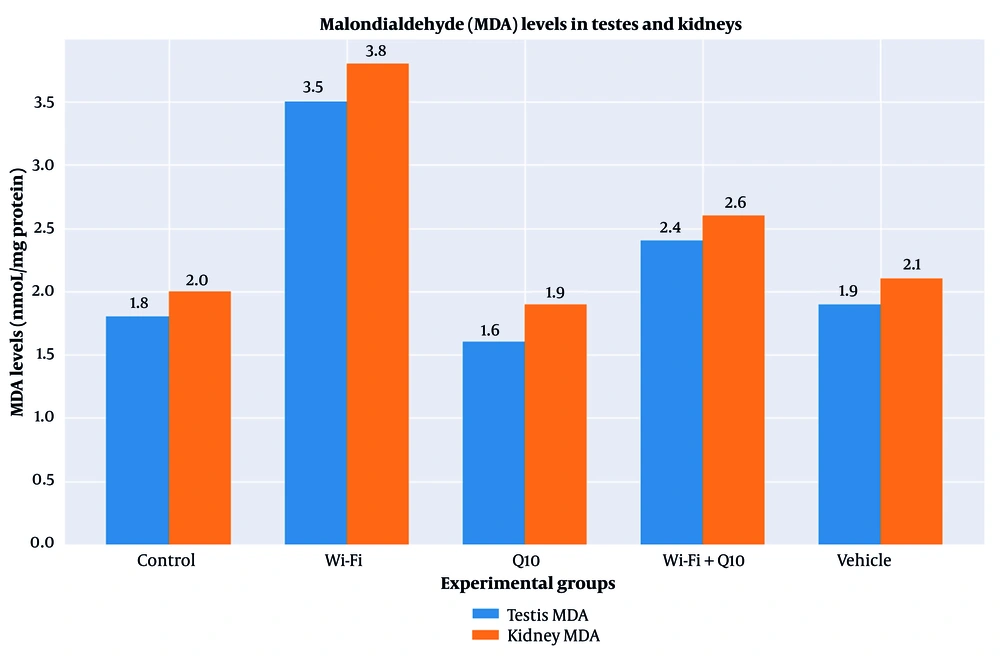
Wi-Fi exposure significantly increased MDA levels in both testicular and renal tissues. The Wi-Fi group exhibited markedly elevated MDA levels, indicating increased lipid peroxidation. In contrast, CoQ10 supplementation alone reduced MDA levels compared with the control group, highlighting its antioxidant potential. Combined treatment (Wi-Fi + Q10) partially attenuated oxidative stress compared with the Wi-Fi group. The vehicle group showed values similar to the control group (Figure 1).
Malondialdehyde (MDA) levels in testes and kidneys across experimental groups (data are presented as mean ± standard deviation (SD); n = 8; one-way ANOVA followed by Tukey’s post-hoc test. P &lt; 0.05 compared with control; η<sup>2</sup> = 0.39).
Figure 1.

Malondialdehyde (MDA) levels in testes and kidneys across experimental groups (data are presented as mean ± standard deviation (SD); n = 8; one-way ANOVA followed by Tukey’s post-hoc test. P < 0.05 compared with control; η2 = 0.39).

Wi-Fi exposure significantly reduced antioxidant enzyme activities in both testicular and renal tissues. The Wi-Fi group showed decreased SOD, CAT, and GPx activities compared with the control group. CoQ10 supplementation alone enhanced antioxidant enzyme activities above baseline values, whereas combined treatment (Wi-Fi + Q10) partially restored enzyme activities relative to the Wi-Fi group. The vehicle group showed results similar to the control group (Figure 2).
Antioxidant enzyme activities [superoxide dismutase (SOD), catalase (CAT), glutathione peroxidase (GPx)] in testes and kidneys across experimental groups (data are presented as mean ± standard deviation (SD); n = 8; one-way ANOVA followed by Tukey’s post-hoc test; P &lt; 0.05 compared with control; η<sup>2</sup> = 0.41).
Figure 2.

Antioxidant enzyme activities [superoxide dismutase (SOD), catalase (CAT), glutathione peroxidase (GPx)] in testes and kidneys across experimental groups (data are presented as mean ± standard deviation (SD); n = 8; one-way ANOVA followed by Tukey’s post-hoc test; P < 0.05 compared with control; η2 = 0.41).

5. Discussion

The present study demonstrated that prolonged exposure to 2.45 GHz Wi-Fi radiofrequency radiation induced significant reproductive and renal alterations in male Wistar rats, whereas CoQ10 supplementation exerted protective effects. These findings are consistent with previous reports linking radiofrequency electromagnetic fields to oxidative stress and reproductive dysfunction (20-21). The novelty of our work lies in the dual-organ assessment, in which both testicular and renal outcomes were evaluated simultaneously, thereby broadening the scope of Wi-Fi–related toxicity research.
In the reproductive system, Wi-Fi exposure reduced sperm count, motility, viability, and testosterone levels, accompanied by histopathological damage to the seminiferous tubules and Leydig cells. These outcomes align with earlier studies reporting impaired spermatogenesis and hormonal imbalance following radiofrequency electromagnetic field exposure (22-23). CoQ10 supplementation improved sperm quality and preserved testicular architecture, likely through its antioxidant and mitochondrial-stabilizing properties (24, 25).

5.1. Kidney-Specific Findings

Unlike many prior studies that focused primarily on reproductive endpoints, our investigation revealed that Wi-Fi exposure also induced renal tubular degeneration, interstitial inflammation, and mild glomerular changes. These alterations suggest that oxidative stress is not confined to reproductive tissues but extends to renal structures, potentially compromising systemic homeostasis. CoQ10 supplementation preserved renal histology and enhanced antioxidant enzyme activities, indicating a protective role beyond the reproductive system (26, 27).
Oxidative stress emerged as a central mechanism underlying both reproductive and renal damage. Elevated MDA levels and reduced antioxidant enzyme activities (SOD, CAT, GPx) in Wi-Fi-exposed rats confirm an imbalance between pro-oxidant and antioxidant systems. CoQ10 supplementation restored antioxidant enzyme activities and reduced lipid peroxidation, supporting its role as a potent free radical scavenger (28, 29).

5.2. Conclusions

These findings suggest that continuous Wi-Fi exposure may pose reproductive risks, whereas antioxidant strategies such as CoQ10 supplementation could help mitigate these effects. Future studies should investigate long-term outcomes, dose-response relationships, and the translation of these results into human clinical contexts to provide stronger evidence for practical recommendations.

5.3. Limitations

This research has several limitations. First, it was conducted in an animal model, which may not fully represent human reproductive physiology. Second, the standardized exposure conditions may not accurately reflect real-world Wi-Fi usage patterns. In addition, the short duration of supplementation and follow-up restricts conclusions regarding the long-term protective effects of CoQ10. While these findings provide valuable insights, caution is warranted when extrapolating these results to humans. The exposure setup (7 hours per day at 30 cm) and the high CoQ10 dose (150 mg/kg/day) do not directly correspond to typical human scenarios. Moreover, the specific sensitivity of Wistar rats may not be applicable to other genetic backgrounds. Therefore, although the study supports the biological plausibility of Wi-Fi-induced oxidative stress and CoQ10's protective role, its clinical relevance is limited and requires further investigation in human models. In summary, this study shows that Wi-Fi radiofrequency radiation causes oxidative stress-related damage in reproductive and renal tissues, and that CoQ10 supplementation helps mitigate these effects (30, 31).
Future research should include sham-exposed controls, mechanistic assays (such as ROS quantification and mitochondrial function), and clinically relevant dosing regimens to enhance translational applicability. Our study found that prolonged exposure to Wi-Fi radiation at 2.45 GHz adversely affected male reproductive health, with declines in sperm parameters and testosterone levels, along with histopathological changes in the testes and kidneys. These changes were closely associated with increased oxidative stress, whereas CoQ10 supplementation played a protective role by partially restoring reproductive indices and reducing oxidative damage.

Acknowledgments

Footnotes

References

  • 1.
    Shokri S, Soltani A, Kazemi M, Sardari D, Mofrad FB. Effects of Wi-Fi (2.45 GHz) exposure on apoptosis, sperm parameters and testicular histomorphometry in rats: a time course study. Cell J (Yakhteh). 2015;17(2):322.
  • 2.
    Atasoy HI, Gunal MY, Atasoy P, Elgun S, Bugdayci G. Immunohistopathologic demonstration of deleterious effects on growing rat testes of radiofrequency waves emitted from conventional Wi-Fi devices. J Pediatr Urol. 2013;9(2):223-9. [PubMed ID: 22465825]. https://doi.org/10.1016/j.jpurol.2012.02.015.
  • 3.
    Dasdag S, Taş M, Akdag MZ, Yegin K. Effect of long-term exposure of 2.4 GHz radiofrequency radiation emitted from Wi-Fi equipment on testes functions. Electromagn Biol Med. 2015;34(1):37-42. [PubMed ID: 24460421]. https://doi.org/10.3109/15368378.2013.869752.
  • 4.
    Mortazavi SAR, Megha K, Shams SF, Mohammadi S, Mortazavi SMJ. Radiation from mobile phones and cell towers, risks, and protection. 615(7951). In: Bentham Science Publishers; 2023. p. 292-325. [PubMed ID: 36859543]. [PubMed Central ID: PMC9995271]. https://doi.org/10.2174/9789815136890123010013.
  • 5.
    Nabavi SS, Salehi Behbahani SM, Jalili Shahandashti F, Toloueitabar Y, Hamedpour H, Gholizadeh B, et al. Prevalence and associated factors of postoperative fever in pediatric congenital heart surgery: a systematic review. Int Cardiovasc Res J. 2025;19(19). e164931. https://doi.org/10.5812/icrj-161516.
  • 6.
    Agarwal A, Gupta S, Sharma RK. Role of oxidative stress in female reproduction. Reprod Biol Endocrinol. 2005;3(1). 28. [PubMed ID: 16018814]. [PubMed Central ID: PMC1215514]. https://doi.org/10.1186/1477-7827-3-28.
  • 7.
    De Iuliis GN, Newey RJ, King BV, Aitken RJ. Mobile phone radiation induces reactive oxygen species production and DNA damage in human spermatozoa in vitro. PLoS One. 2009;4(7). e6446. [PubMed ID: 19649291]. [PubMed Central ID: PMC2714176]. https://doi.org/10.1371/journal.pone.0006446.
  • 8.
    Houston BJ, Nixon B, King BV, De Iuliis GN, Aitken RJ. The effects of radiofrequency electromagnetic radiation on sperm function. Reproduction. 2016;152(6):R263-R76. [PubMed ID: 27601711]. https://doi.org/10.1530/REP-16-0126.
  • 9.
    Salvio G, Cutini M, Ciarloni A, Giovannini L, Perrone M, Balercia G. Coenzyme Q10 and Male Infertility: A Systematic Review. Antioxidants (Basel). 2021;10(6):874. [PubMed ID: 34070761]. [PubMed Central ID: PMC8226917]. https://doi.org/10.3390/antiox10060874.
  • 10.
    Alahmar AT, Calogero AE, Singh R, Cannarella R, Sengupta P, Dutta S. Coenzyme Q10, oxidative stress, and male infertility: A review. Clin Exp Reprod Med. 2021;48(2):97-104. [PubMed ID: 34078005]. [PubMed Central ID: PMC8176150]. https://doi.org/10.5653/cerm.2020.04175.
  • 11.
    Genova ML, Pich MM, Biondi A, Bernacchia A, Falasca A, Bovina C, et al. Mitochondrial production of oxygen radical species and the role of coenzyme Q as an antioxidant. Exp Biol Med (Maywood). 2003;228(5):506-13. [PubMed ID: 12709577]. https://doi.org/10.1177/15353702-0322805-14.
  • 12.
    Safarinejad MR. Efficacy of coenzyme Q10 on semen parameters, sperm function and reproductive hormones in infertile men. J Urol. 2009;182(1):237-48. [PubMed ID: 19447425]. https://doi.org/10.1016/j.juro.2009.02.121.
  • 13.
    Alahmar AT. Coenzyme Q10 improves sperm motility and antioxidant status in infertile men with idiopathic oligoasthenospermia. Clin Exp Reprod Med. 2022;49(4):277-284. [PubMed ID: 36482502]. [PubMed Central ID: PMC9732077]. https://doi.org/10.5653/cerm.2022.05463.
  • 14.
    Lewin A, Lavon H. The effect of coenzyme Q10 on sperm motility and function. Mol Aspects Med. 1997;18:213-219. [PubMed ID: 9266524]. https://doi.org/10.1016/s0098-2997(97)00036-8.
  • 15.
    Bhagavan HN, Chopra RK. Coenzyme Q10: absorption, tissue uptake, metabolism and pharmacokinetics. Free Radic Res. 2006;40(5):445-53. [PubMed ID: 16551570]. https://doi.org/10.1080/10715760600617843.
  • 16.
    Crane FL. Biochemical functions of coenzyme Q10. J Am Coll Nutr. 2001;20(6):591-8. [PubMed ID: 11771674]. [PubMed Central ID: PMC10299949]. https://doi.org/10.1080/07315724.2001.10719063.
  • 17.
    Schuermann D, Mevissen M. Manmade Electromagnetic Fields and Oxidative Stress-Biological Effects and Consequences for Health. Int J Mol Sci. 2021;22(7):3772. [PubMed ID: 33917298]. [PubMed Central ID: PMC8038719]. https://doi.org/10.3390/ijms22073772.
  • 18.
    Dehdari Ebrahimi N, Shojaei-Zarghani S, Taherifard E, Dastghaib S, Parsa S, Mohammadi N, et al. Protective effects of melatonin against physical injuries to testicular tissue: a systematic review and meta-analysis of animal models. Front Endocrinol (Lausanne). 2023;14. 1123999. [PubMed ID: 36798664]. [PubMed Central ID: PMC9927015]. https://doi.org/10.3389/fendo.2023.1123999.
  • 19.
    Santini SJ, Cordone V, Falone S, Mijit M, Tatone C, Amicarelli F, et al. Role of mitochondria in the oxidative stress induced by electromagnetic fields: focus on reproductive systems. Oxid Med Cell Longev. 2018;2018(1). 5076271. [PubMed ID: 30533171]. [PubMed Central ID: PMC6250044]. https://doi.org/10.1155/2018/5076271.
  • 20.
    Lin JC. Radio-frequency radiation safety and health: mental process of children and mobile-phone electromagnetic fields. URSI Radio Sci Bull. 2006.
  • 21.
    Martelli A, Testai L, Colletti A, Cicero AFG. Coenzyme Q10: clinical applications in cardiovascular diseases. Antioxidants (Basel). 2020;9(4):341. [PubMed ID: 32331285]. [PubMed Central ID: PMC7222396]. https://doi.org/10.3390/antiox9040341.
  • 22.
    Kamali K, Taravati A, Sayyadi S, Gharib FZ, Maftoon H. Evidence of oxidative stress after continuous exposure to Wi-Fi radiation in rat model. Environ Sci Pollut Res Int. 2018;25(35):35396-35403. [PubMed ID: 30343375]. https://doi.org/10.1007/s11356-018-3279-0.
  • 23.
    Engwa GA, EnNwekegwa FN, Nkeh-Chungag BN. Free radicals, oxidative stress-related diseases and antioxidant supplementation. Altern Ther Health Med. 2022;28(1):114-128. [PubMed ID: 32827401].
  • 24.
    Dutta S, Sengupta P, Izuka E, Menuba I, Nwagha U. Oxidative and nitrosative stress and female reproduction: roles of oxidants and antioxidants. J Integr Sci Technol. 2024;12(3):754-754. https://doi.org/10.62110/sciencein.jist.2024.v12.754.
  • 25.
    Sawie HG, Ahmed OM, Shabana ME, Elqattan GM, EL-Kassaby MI, Abou- Seif HS. Ferulic acid attenuated diethylnitrosamine-provoked hepato-renal damage and malfunction by suppressing oxidative stress, abating inflammation and upregulating nuclear factor erythroid-related factor-2 signaling. Egypt Pharm J. 2024;23(1):16-27. https://doi.org/10.4103/epj.epj_79_23.
  • 26.
    Gutierrez-Mariscal FM, Arenas-de Larriva AP, Limia-Perez L, Romero-Cabrera JL, Yubero-Serrano EM, López-Miranda J. Coenzyme Q10 supplementation for the reduction of oxidative stress: clinical implications in the treatment of chronic diseases. Int J Mol Sci. 2020;21(21):7870. [PubMed ID: 33114148]. [PubMed Central ID: PMC7660335]. https://doi.org/10.3390/ijms21217870.
  • 27.
    Liu Q, Sun Y, Cui Q, Cheng J, Killpartrik A, Kemp AH, et al. Characterization, antioxidant capacity, and bioaccessibility of coenzyme Q10 loaded whey protein nanoparticles. LWT. 2022;160. 113258. https://doi.org/10.1016/j.lwt.2022.113258.
  • 28.
    Al-Maatheedi M, Rasheed S, Asim R. Role of coenzyme Q10 on some physiological aspects of male rat exposure to silicon dioxide nanoparticles. Open Vet J. 2026;16(1):492-492. https://doi.org/10.5455/OVJ.2026.v16.i1.46.
  • 29.
    Khedr MA, Goma AA, Rashed RR, Tohamy HG, Shukry M, El-Kazaz SE. Khedr MA, Goma AA, Rashed RR, Tohamy HG, Shukry M, El-Kazaz SE. Thymol alleviates silica dioxide nanoparticle-induced reproductive performance toxicity via antioxidant and anti-inflammatory mechanisms in male rats. Sci Rep. 2025;15(1):23913. [PubMed ID: 40615456]. [PubMed Central ID: PMC12227668]. https://doi.org/10.1038/s41598-025-23913-x.
  • 30.
    Weller SG, McCredden JE, Leach V, Chu C, Lam AKY. A scoping review and evidence map of radiofrequency field exposure and genotoxicity: assessing in vivo, in vitro, and epidemiological data. Front Public Health. 2025;13. 1613353. [PubMed ID: 40809778]. [PubMed Central ID: PMC12343714]. https://doi.org/10.3389/fpubh.2025.1613353.
  • 31.
    Jangid P, Rai U, Ahmed S, Singh S, Singh R. Non-thermal biological effects of radiofrequency electromagnetic radiation: mechanistic insights into male reproductive vulnerability in the era of ubiquitous exposure. Reprod Toxicol. 2025;138. 109087. [PubMed ID: 41161550]. https://doi.org/10.1016/j.reprotox.2025.109087.

Crossmark
Crossmark
Checking
Share on
Metrics

Purchasing Reprints

  • Copyright Clearance Center (CCC) handles bulk orders for article reprints for Brieflands. To place an order for reprints, please click here (   https://www.copyright.com/landing/reprintsinquiryform/ ). Clicking this link will bring you to a CCC request form where you can provide the details of your order. Once complete, please click the ‘Submit Request’ button and CCC’s Reprints Services team will generate a quote for your review.
Search Relations

Author(s):

Related Articles