
1. Context
1.1. Overview of Lung Cancer and the Need for New Therapeutic Strategies
Lung cancer remains one of the most common and lethal malignancies worldwide, accounting for a large proportion of cancer-related mortality each year. Non-small cell lung cancer (NSCLC) represents about 85% of cases, whereas small cell lung cancer (SCLC) constitutes a smaller but more aggressive subtype that is often diagnosed at an advanced stage and associated with rapid progression and early metastasis. Despite advances in screening, molecular diagnostics, and multimodal treatment approaches, the overall five-year survival of patients with advanced lung cancer remains unsatisfactory, largely due to late diagnosis, tumor heterogeneity, and the development of resistance to systemic therapies. Conventional chemotherapy is limited by narrow therapeutic indices and severe systemic toxicity, while targeted therapies and immune checkpoint inhibitors, although effective in selected subsets, frequently lose efficacy because of adaptive resistance and tumor immune evasion. These clinical and biological challenges highlight the need for innovative therapeutic strategies that can provide more selective tumor killing, deeper tissue penetration, and improved safety profiles.
1.2. Clinical and Biological Challenges in Current Lung Cancer Management
Current lung cancer management relies on a combination of surgery, radiotherapy, cytotoxic chemotherapy, targeted small-molecule inhibitors, and immunotherapy. Platinum-based regimens remain a cornerstone of systemic treatment but are often accompanied by dose-limiting toxicities and incomplete tumor control. Targeted therapies directed against specific oncogenic drivers (e.g., EGFR, ALK, ROS1) initially achieve high response rates, yet secondary mutations, activation of bypass pathways, and phenotypic changes often culminate in acquired resistance (1). Immune checkpoint inhibitors have improved outcomes in some patients; however, primary resistance, immune-cold tumor microenvironments, and immune-related adverse events restrict their broad applicability. Moreover, several biological features of lung tumors complicate therapeutic success: dense and heterogeneous tumor architecture, hypoxic regions, abnormal vasculature, and an immunosuppressive microenvironment. These factors collectively reduce drug penetration, shield tumor cells from immune surveillance, and promote survival pathways such as PI3K/Akt, MAPK, NF-κB, and CK2 signaling (2). Consequently, there is a compelling rationale for therapeutic approaches that can simultaneously improve tumor selectivity, modulate key survival pathways, and overcome physical and biological barriers to drug delivery.
1.3. Anticancer Peptides as Promising Therapeutic Agents in Lung Cancer
Anticancer peptides (ACPs) have gained increasing attention as a distinct class of therapeutic agents capable of addressing some of the limitations of current lung cancer treatments. Anticancer peptides are typically short sequences of amino acids that can be rationally designed or derived from natural sources. They exhibit several advantageous properties, including relatively small molecular size, high structural tunability, and the ability to combine targeting and cytotoxic functions in a single molecule. Many ACPs display preferential binding to cancer cells due to differences in membrane composition, surface charge, and receptor expression when compared with normal cells. This selectivity can result in direct cytotoxic effects through membrane permeabilization, pore formation, or induction of apoptosis and necrosis. Other peptides exert their effects by modulating intracellular signaling pathways, interfering with angiogenesis, or altering the tumor microenvironment (2, 3). In addition, peptide-based therapeutics can be engineered to exhibit improved stability, serum half-life, and resistance to proteolysis, thereby enhancing their in vivo performance. In lung cancer, multiple in vivo studies have shown that peptide-based interventions can inhibit tumor growth, reduce metastatic burden, and, in some cases, prolong survival. These include both peptides with intrinsic antitumor activity and peptides used as targeting moieties or delivery enhancers in combination with chemotherapeutics, toxins, radionuclides, or nucleic acids (1, 4, 5). In this structured systematic review, the primary focus is placed on natural peptides and peptides directly derived from natural sources that demonstrate anticancer activity in lung cancer models. In addition, we include peptide-inspired designs to reflect common translational practice in which natural peptide architectures inform optimization and engineered delivery systems. Operationally, we define "peptide-inspired" as peptides or peptide-based systems that meet at least one of the following criteria: (1) Sequence derived from an endogenous or naturally occurring peptide/protein fragment (or explicitly described as a mimetic of such a fragment); (2) structural or interaction-motif mimicry of a naturally occurring peptide/protein interface (even if the final sequence is engineered); and/or (3) incorporation of established naturally occurring targeting/penetrating peptide motifs (e.g., RGD/iRGD, T7) as functional components of in vivo therapeutic systems. Under this framework, fully synthetic but biomimetic constructs such as CIGB-300 (CK2 substrate-motif mimic) and amyloid-beta-mimetic peptide amphiphiles (CPTNP) are considered eligible as peptide-inspired
2. Methods
A structured systematic literature search was conducted exclusively in the PubMed database to identify primary in vivo studies evaluating peptide-based anticancer strategies in lung cancer models. The search was limited to articles published in English between January 2015 and December 2025. We acknowledge that single-database searching may omit relevant studies (particularly those indexed only in Embase, Scopus, or Web of Science), introducing a risk of selection bias; therefore, this work should be interpreted as a structured systematic review with a qualitative (non-meta-analytic) synthesis rather than an exhaustive evidence capture. Eligible studies were required to be peer-reviewed original research articles reporting in vivo experiments in animal models of lung cancer (xenograft, syngeneic, or orthotopic). Studies were included if they investigated (A) natural-origin peptides or peptides derived from natural sources, or (B) peptide-inspired constructs meeting our operational definition (see below), including peptide-drug conjugates and peptide-functionalized delivery systems (e.g., peptide-nanoparticles or peptide-liposomes). Included studies were required to report quantifiable antitumor outcomes (e.g., tumor growth inhibition, metastatic burden, survival, apoptosis, and/or pathway modulation).
Operational definition of "peptide-inspired": studies were eligible if the peptide/peptide-system met one or more of the following: (1) Sequence derived from an endogenous or naturally occurring peptide/protein fragment, or explicitly described by the original authors as a mimetic of such a peptide; (2) structural or interaction-motif mimicry of a naturally occurring peptide/protein interface (even if the final sequence is engineered); and/or (3) use of naturally occurring targeting/penetrating peptide motifs (e.g., RGD/iRGD, T7) as functional ligands in vivo. This definition was applied to ensure conceptual consistency when including engineered platforms and fully synthetic constructs.
Risk-of-bias/quality assessment: a formal SYRCLE (or ARRIVE-based) risk-of-bias tool was not applied to individual studies. We recognize that this omission is a limitation for a systematic review designation, because domains such as randomization, blinding, allocation concealment, attrition reporting, and sample-size estimation are relevant across heterogeneous preclinical designs. Accordingly, we interpret study-level internal validity with caution and provide a descriptive appraisal of commonly underreported bias-relevant items in the discussion.
Mechanistic categorization: because many peptide platforms exert multi-modal effects, each study was assigned a primary mechanistic cluster based on the mechanism most directly supported by in vivo outcome-linked experiments; secondary mechanisms were discussed narratively but were not double-counted in cluster totals.
Publication bias/small-study effects: formal assessments (e.g., funnel plots) were not performed because outcome definitions, follow-up durations, and reporting of variance/sample size were heterogeneous across studies, precluding comparable quantitative effect sizes across a sufficient number of studies within any single endpoint category
This review was conducted and reported in accordance with the PRISMA 2020 statement; the PRISMA checklist is provided (Appendix 2 in Supplementary File) and the study-selection process is summarized in a PRISMA flow diagram (Appendix 1 in Supplementary File). Titles/abstracts and full texts were screened independently by two reviewers. Disagreements were resolved by discussion. A total of 29 eligible in vivo studies were included in the final qualitative synthesis. The complete PubMed search strategy (including MeSH terms, Boolean operators, and applied limits) is provided in Appendix 3 in Supplementary File.
Studies were excluded if they were limited to in vitro experiments, computational or in silico analyses, molecular docking studies, reviews, meta-analyses, editorials, commentaries, conference abstracts, or if they lacked primary experimental data. Additional exclusion criteria included studies that did not involve peptide-based therapeutic agents, investigated peptides unrelated to anticancer activity, or were conducted in non-lung cancer models without an appropriate in vivo lung tumor system. Non-English publications and studies published outside the predefined 2015 - 2025 timeframe were not considered. Following database retrieval, records were screened at the title and abstract level, and full-text articles of potentially relevant studies were subsequently assessed to confirm eligibility prior to inclusion in the final qualitative synthesis.
The PubMed search was performed using combinations of the following keywords and Boolean operators: (‘lung cancer’ OR NSCLC OR SCLC) AND (peptide OR anticancer peptide OR tumor-targeting peptide OR peptide-drug conjugate OR peptide nanoparticle). Records were screened in two stages (title/abstract, then full text). Duplicates and non-eligible publications were removed, and only studies meeting the predefined in vivo lung cancer model criteria were retained for qualitative synthesis. Key variables extracted included peptide origin/design, model type, dosing/route, and quantifiable antitumor outcomes.
3. Natural and Naturally Derived Peptides as Promising Therapeutic Agents for Lung Cancer
Although the inclusion criteria of this review prioritize in vivo lung cancer models, several peptides discussed in this section were initially characterized through complementary in vitro experiments that elucidate their molecular mechanisms, cellular targets, and cytotoxic profiles. In such cases, in vivo validation data are explicitly highlighted as the primary evidence for antitumor efficacy, while in vitro findings are referenced only to support mechanistic interpretation. Peptides lacking in vivo evaluation are not considered standalone therapeutic candidates but are discussed in a limited context to illustrate mechanistic diversity or structure–activity relationships. Table 1 summarizes representative natural and naturally derived ACPs that have been investigated in lung cancer models, for which in vivo antitumor efficacy constitutes the principal criterion for inclusion.
Table 1.
Natural-Origin Peptides Investigated in Lung Cancer Settings (in vitro and in vivo)
| Peptide (Ref) | Origin/Source | Peptide Class | Lung Cancer Model | Key Antitumor Effects |
|---|---|---|---|---|
| SIO (6) | Sepia esculenta (marine ink) | Marine-derived natural peptide | Lung cancer cell lines | Apoptosis induction via Bcl-2/Bax modulation and caspase activation |
| LVTX-8 (7) | Spider venom | Venom-derived natural peptide | Lung cancer cell lines | Inhibition of proliferation and migration; p53 pathway activation |
| Smp24 (8) | Scorpio maurus palmatus (scorpion venom) | Venom-derived AMP | A549 xenograft mouse model | Membrane disruption, mitochondrial dysfunction, ROS generation, tumor growth suppression |
| MENK (9) | Endogenous human peptide | Endogenous regulatory peptide | Lung cancer cell lines; Immune models | Apoptosis induction; NK-cell–mediated immune activation |
| Human β-defensin-3/Defb14 (10) | Mammalian host-defense peptide | Endogenous AMP | Lewis lung carcinoma mouse model | Tumor growth inhibition; Immune modulation |
| HPRP-A1 (11) | Helicobacter pylori | Bacteria-derived cationic peptide | Lung cancer cell lines | Membrane disruption, ROS-mediated apoptosis |
| Dermaseptin-PP (12) | Frog skin secretion | Amphibian-derived AMP | H157 xenograft nude mouse model | Tumor growth inhibition; Membrane disruption; Intrinsic and extrinsic apoptosis |
Abbreviations: SIO, sepia ink oligopeptide; MENK, methionine enkephalin.
3.1. Rationale for Using Natural Peptides in Lung Cancer Therapy
In recent years, increasing attention has been directed toward natural peptides as novel therapeutic candidates for lung cancer treatment. Conventional anticancer therapies, such as chemotherapy and radiotherapy, are often associated with severe side effects and the development of drug resistance. In contrast, natural peptides exhibit several advantageous properties, including biocompatibility, low molecular weight, higher selectivity toward cancer cells, and reduced systemic toxicity, making them attractive alternatives for targeted cancer therapy. Collectively, these features position peptide-based strategies as versatile and mechanistically precise therapeutic platforms in lung cancer, encompassing natural peptides, engineered constructs, and peptide-guided delivery systems (Figure 1).
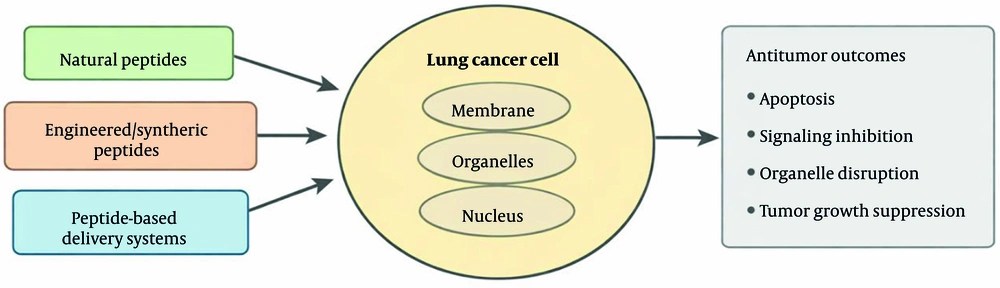
Figure 1.
Simplified schematic overview of peptide-based therapeutic strategies in lung cancer; natural peptides, engineered peptides, and peptide-guided delivery systems interact with lung cancer cells to induce intracellular dysfunction and suppress tumor growth through multiple anticancer mechanisms.
3.2. Marine-Derived Natural Peptides
One well-studied marine-derived peptide is Sepia ink oligopeptide (SIO), which is isolated from the ink of Sepia esculenta. Experimental studies have demonstrated that SIO effectively inhibits lung cancer cell proliferation by inducing apoptosis. Mechanistically, SIO modulates the Bcl-2/Bax balance and activates caspase-dependent apoptotic pathways, leading to programmed cell death in lung cancer cells (6). These findings highlight the therapeutic potential of marine natural peptides in lung cancer management.
3.3. Venom-Derived Natural Peptides
Another important natural peptide is LVTX-8, a toxin-derived peptide isolated from spider venom. LVTX-8 has been shown to significantly suppress both proliferation and migration of lung cancer cells. Transcriptomic and mechanistic analyses indicate that LVTX-8 exerts its anticancer activity by regulating genes involved in the p53 signaling pathway, thereby promoting apoptosis and inhibiting tumor progression (7). This evidence supports the use of venom-derived peptides as a unique class of anticancer agents.
Smp24 is a cationic antimicrobial peptide purified from the venom of the Egyptian scorpion Scorpio maurus palmatus. Guo et al. reported that Smp24 exerts potent antiproliferative effects against several lung cancer cell lines, including A549, H3122, PC-9, and H460, with micromolar IC₅₀ values and relatively low cytotoxicity toward normal lung fibroblasts (MRC-5) (8). Mechanistic in vitro studies demonstrated that Smp24 disrupts plasma membrane integrity, perturbs the cytoskeleton, and induces mitochondrial dysfunction accompanied by ROS accumulation, eventually leading to necrosis-like cell death and inhibition of migration and invasion. In an A549 xenograft mouse model, Smp24 significantly suppressed tumor growth and conferred antitumor protection at tolerated doses, with low acute toxicity reported in treated animals (8). The combination of selective cytotoxicity, anti-migratory effects, and in vivo tumor suppression supports the potential of Smp24 as a natural venom-derived lead for lung cancer chemotherapy.
3.4. Endogenous Human Peptides with Anticancer Activity
Among endogenous peptides, Methionine enkephalin (MENK) plays a dual role in lung cancer suppression. MENK not only directly inhibits tumor cell proliferation but also enhances anti-tumor immune responses, particularly by activating natural killer (NK) cells. At the molecular level, MENK regulates the OGFr/Bcl-2/Bax/caspase-3 signaling axis, resulting in apoptosis induction in lung cancer cells (9). These findings suggest that endogenous peptides may offer both cytotoxic and immunomodulatory benefits.
Human β-defensin-3 (hBD3) is a mammalian host-defense peptide with broad antimicrobial activity and significant immunomodulatory functions (10). Dysregulation of β-defensins has been reported in various cancers, including lung cancer, and accumulating evidence suggests that these peptides can influence tumor growth, immune responses, and inflammation. In a key study, the mouse homolog Defb14 was evaluated in a Lewis lung carcinoma model. Continuous local infusion of Defb14 near subcutaneous Lewis lung carcinoma tumors in mice led to a significant reduction in tumor weight compared with vehicle controls, demonstrating that β-defensin-type peptides can exert direct antitumor effects in vivo in lung cancer settings (10). In vitro, hBD3 and related defensins induced cell death in lung cancer cell lines, further supporting their dual antimicrobial and antitumor capabilities. Although defensins are endogenous peptides rather than exogenous therapeutics, their demonstrated anticancer effects in lung carcinoma models highlight host-defense peptides as another category of natural molecules with translational potential. They may serve either as direct therapeutic agents, as templates for designing more stable analogues, or as immune-modulating components in combination regimens.
3.5. Bacteria-Derived Cationic Peptide
HPRP-A1, a cationic peptide derived from Helicobacter pylori, represents another naturally derived anticancer peptide. HPRP-A1 has been reported to disrupt cancer cell membranes and enhance intracellular reactive oxygen species (ROS) generation, ultimately leading to apoptotic cell death. When used alone or in combination with other peptides, HPRP-A1 exhibits strong antiproliferative effects against lung cancer cells (11).
3.6. Amphibian-Derived Peptide
Dermaseptin-PP is a cationic, amphipathic peptide originally isolated from frog skin secretion and belongs to the dermaseptin family of antimicrobial peptides. Dong et al. identified Dermaseptin-PP as a novel peptide with both broad-spectrum antimicrobial activity and potent antitumor effects against several human cancer cell lines, including the NSCLC cell line H157 (12). In vitro, Dermaseptin-PP selectively inhibited the proliferation of H157 lung cancer cells while exhibiting low hemolytic activity and limited cytotoxicity toward normal endothelial cells, indicating a degree of tumor selectivity. In a nude-mouse H157 xenograft model, repeated administration of Dermaseptin-PP led to significant, dose-dependent tumor growth inhibition without obvious hepatopulmonary toxicity or major body weight loss (12). Histological and mechanistic analyses showed that Dermaseptin-PP exerts a dual mode of action: (1) Direct disruption of the cancer cell membrane, and (2) activation of both extrinsic and intrinsic apoptotic pathways, with upregulation of Fas/FasL, FADD, cytochrome-c, Apaf-1, caspase-9, and caspase-3 in tumor tissue. This combination of membranolytic and apoptosis-inducing effects suggests that Dermaseptin-PP can overcome some forms of chemoresistance that rely on intracellular signaling alone. More recently, Dermaseptin-PP has also been used as a tumor-penetrating motif to modify paclitaxel liposomes, where it enhanced intratumoral penetration and increased antitumor efficacy in A549 NSCLC models, further underscoring its value as a natural targeting/penetration peptide in lung cancer drug delivery (12).
4. Peptide–Drug Conjugates in Non-small Cell Lung Cancer and Small Cell Lung Cancer
4.1. Epidermal Growth Factor Receptor–Targeted P6-SN38 Peptide–Drug Conjugate
One of the most advanced examples is the cyclic epidermal growth factor receptor–targeting peptide–drug conjugate P6-SN38, where the short cyclic peptide P6 is conjugated via a mono-succinate linker to SN38, the active metabolite of irinotecan. In vitro, P6-SN38 shows sub-micromolar cytotoxicity on epidermal growth factor receptor–positive NSCLC cell lines while sparing epidermal growth factor receptor–negative cells, confirming the selectivity of the peptide carrier. In vivo, the conjugate selectively accumulates in epidermal growth factor receptor–overexpressing NSCLC xenografts and demonstrates superior antitumor activity compared with free SN38 and even the epidermal growth factor receptor–specific antibody cetuximab. A single-agent dose of 10 mg/kg eradicates epidermal growth factor receptor–positive tumors in a dual epidermal growth factor receptor+/epidermal growth factor receptor− xenograft model with good systemic tolerability, but does not affect epidermal growth factor receptor–negative tumors, highlighting both on-target efficacy and a strong dependence on receptor expression (1).
4.2. Somatostatin Receptor 2–Targeted LanTC-DM1 in Small Cell Lung Cancer
In SCLC, LanTC-DM1 is an optimized somatostatin receptor 2–targeted peptide–drug conjugate derived from the approved peptide drug lanreotide. LanTC was obtained by strategic amino-acid substitutions and disulfide-bond modifications to enhance stability and receptor binding. Conjugation of the cytotoxic payload emtansine (DM1) yields LanTC-DM1, which shows potent anti-tumor efficacy in somatostatin receptor 2–positive SCLC models, with improved in vivo stability and favorable pharmacokinetics compared with less-optimized lanreotide analogs. Cryo-EM and functional analyses indicate efficient receptor binding, internalization, and payload release, positioning LanTC-DM1 as a promising SCLC–directed peptide–drug conjugate platform (13).
4.3. Integrin α6–Targeting RWYD-MMAE in Lung Adenocarcinoma
Integrin-targeted peptide–drug conjugates are represented by the RWYD-MMAE conjugate, where a peptide binding integrin α6 (overexpressed in lung adenocarcinoma) is tethered to the microtubule inhibitor monomethyl auristatin E (MMAE). In lung adenocarcinoma models, RWYD-MMAE selectively accumulates in α6-positive tumors and induces significant tumor regression with limited systemic toxicity compared with non-targeted MMAE (14). This supports integrin α6 as a relevant surface biomarker for peptide-guided cytotoxic delivery in lung cancer.
5. Synthetic Bioactive Peptides and Transformable Peptide Nanomaterials
Beyond naturally occurring peptides, a growing body of evidence highlights the therapeutic value of synthetic and engineered peptides that are derived from, or structurally inspired by, natural peptide sequences. These engineered constructs preserve key biological features of their natural counterparts while incorporating rational modifications to improve stability, intracellular targeting, and mechanistic precision. Beyond peptide–drug conjugates, several engineered peptides act as cytotoxic or signaling-modulatory agents themselves, or as transformable nanomaterials that alter intracellular organelles in lung tumors. Accordingly, this section focuses on synthetic bioactive peptides and transformable peptide nanomaterials that extend natural peptide-based therapeutic principles in lung cancer models by enabling kinase inhibition, epigenetic regulation, mitochondrial targeting, and stimuli-responsive structural transformation, as summarized in Table 2.
Table 2.
Engineered and Synthetic Anticancer Peptides in Lung Cancer Models
| Peptide/System (Ref) | Design Strategy | Target/Mechanism | Lung Cancer Model | Key Antitumor Effects |
|---|---|---|---|---|
| CIGB-300 (2) | Synthetic CK2-inhibitory peptide | CK2 phospho-acceptor site blockade; Anti-angiogenic and anti-metastatic signaling modulation | Lung cancer xenograft models | Suppression of tumor growth and metastatic burden; Reduced microvessel density; Inhibition of CK2-dependent pathways |
| CPTNP (Amyloid-β-mimetic peptide amphiphiles) (4) | Transformable, stimuli-responsive peptide nanomaterial | Lysosomal targeting; Acid-triggered nanoparticle-to-nanofibril conversion; LMP induction | NSCLC xenograft models | Lysosomal disruption and tumor cell death; Synergistic enhancement of cisplatin efficacy with limited toxicity |
| EIP103/M-EIP103 (15) | Nuclear-targeted engineered peptide | EZH2 inhibition; Epigenetic regulation via nuclear delivery | Lung cancer in vivo models | Marked tumor growth inhibition through modulation of chromatin regulators |
| 17BIPHE2 (3) | Synthetic derivative of LL-37 | Enhanced tumor selectivity; ERK pathway modulation; Apoptosis induction | NSCLC A549 xenograft model | Significant tumor growth suppression and pro-apoptotic activity |
| S6540 (16) | Optimized venom-derived synthetic peptide | Mitochondrial targeting; Caspase-independent apoptosis (AIF translocation) | A549 xenograft model | Reduced tumor burden with lower toxicity than cisplatin; Mitochondrial dysfunction |
5.1. CIGB-300: a Casein Kinase 2–Inhibitory Synthetic Peptide
CIGB-300 is a clinical-stage synthetic peptide designed to inhibit casein kinase 2 by binding its phospho-acceptor sites. In lung cancer models, CIGB-300 reduces angiogenesis, invasion, and metastasis rather than acting as a classical cytotoxic agent (2). In vivo, CIGB-300 suppresses tumor growth and decreases metastatic burden in lung cancer xenografts, associated with downregulation of casein kinase 2–dependent signaling and decreased microvessel density (2). This peptide exemplifies how rational sequence design can target a specific kinase-substrate interface to modulate key hallmarks of malignancy.
5.2. Transformable Amyloid-β–Mimetic Peptide Amphiphiles (CPTNP)
In the work by Baehr and co-workers, amyloid-β mimetic peptide amphiphiles are designed to form cell-penetrating transformable peptide nanoparticles (CPTNP) that traffic to lysosomes in NSCLC cells (4). Once exposed to the acidic lysosomal environment, these amphiphiles transform from nanoparticles into nanofibrils, causing lysosomal membrane permeabilization, lysosomal disruption, and tumor cell death (4). In NSCLC xenograft models, CPTNP displays micromolar cytotoxicity and, when combined with low-dose cisplatin, synergistically enhances cisplatin efficacy with limited systemic toxicity (4). This is a prototypical example of an engineered peptide material whose antitumor effect depends on stimuli-responsive structural conversion inside lung cancer cells.
5.3. Nuclear-Targeted Enhancer of Zeste Homolog 2–Inhibitory Peptide (EIP103)
Another engineered peptide is the EIP103 peptide (and its modified variant M-EIP103), which is designed to inhibit the epigenetic regulator enhancer of zeste homolog 2 and is further equipped with nuclear-targeting features (15). In lung cancer models, EIP103/M-EIP103 show marked tumor growth inhibition in vivo, demonstrating the feasibility of delivering therapeutic peptides directly to the nucleus to modulate chromatin regulators associated with lung cancer progression (15). This strategy contrasts with surface-receptor–targeted peptide–drug conjugates by focusing on intracellular epigenetic machinery rather than extracellular or surface receptors.
5.4. Synthetic Derivatives of Bioactive Peptides
For instance, the antimicrobial peptide derivative 17BIPHE2 is derived from the human cathelicidin LL-37 but redesigned to enhance antitumor selectivity and reduce toxicity (3). In NSCLC A549 xenografts, 17BIPHE2 significantly suppresses tumor growth and induces apoptosis, partly through modulation of the ERK signaling pathway (3). Similarly, the venom-derived antitumor peptide S6540 has been refined to exploit mitochondrial targeting and induction of caspase-independent apoptosis in A549 xenografts (16). S6540 enters lung cancer cells, disrupts mitochondrial integrity, decreases Bcl-2 at the mitochondrial membrane, and triggers apoptosis-inducing factor nuclear translocation, ultimately reducing tumor burden with lower toxicity than cisplatin (16). Although these peptides are inspired by natural sources (host-defense peptides and scorpion venom), the optimized sequences and mechanistic tailoring position them within a broader engineered peptide landscape.
6. Peptide-Functionalized Delivery Systems for Lung Cancer Therapy
Peptide-functionalized nanocarrier systems have emerged as a prominent strategy for improving the therapeutic index of anticancer agents in lung cancer models. By incorporating short targeting peptides or cell-penetrating sequences onto nanoparticle surfaces, these systems enhance tumor selectivity, intracellular delivery, endosomal escape, and overall drug bioavailability. Across the studies included in this review, liposomes, polymer-based nanoparticles, micelles, dendrimers, and siRNA carriers demonstrate markedly improved performance when conjugated to tumor-targeting or tumor-penetrating peptides. Representative peptide-functionalized delivery platforms evaluated in lung cancer models are summarized in Table 3. The following subsections outline the principal categories of peptide-guided delivery systems investigated in vivo.
Table 3.
Peptide-Functionalized Delivery Systems for Lung Cancer Therapy
| Peptide/System (Ref) | Peptide Function | Carrier Type | Therapeutic Cargo | Lung Cancer Model | Key Outcomes |
|---|---|---|---|---|---|
| T7 peptide (HAIYPRH) (17) | Transferrin receptor targeting | LNPs | siRNA (Bcl-2, Akt-1) | NSCLC xenograft model | Enhanced tumor accumulation, efficient gene silencing, significant tumor growth inhibition with low toxicity |
| Dermaseptin-PP (12) | Tumor-penetrating peptide | Paclitaxel-loaded liposomes | Paclitaxel | NSCLC xenograft model | Improved intratumoral penetration and enhanced antitumor efficacy |
| CP7 peptide (18) | FGFR1 targeting | Cationic liposomes | Mcl-1 siRNA | NSCLC xenograft model | Increased tumor uptake, efficient gene knockdown, marked tumor suppression |
| Tumor-penetrating peptide (unspecified) (19) | Cell penetration and endosomal escape | PAMAM dendrimers | siRNA | Lung cancer xenograft model | Enhanced intratumoral penetration and significant tumor growth inhibition |
| HM-3 (RGD-modified peptide) (20) | Anti-angiogenic and integrin targeting | Combination with VNP20009 | Sox2 shRNA | NSCLC in vivo model | Strongest tumor suppression among treatment groups |
Abbreviations: LNPs, lipid nanoparticles; NSCLC, non-small cell lung cancer.
6.1. Transferrin Receptor–Targeted T7-Modified Liposomes
The T7 peptide (HAIYPRH) is a high-affinity ligand for the transferrin receptor, which is frequently overexpressed on NSCLC cells. In the study by Cheng et al. (17), T7-functionalized lipid nanoparticles (T7-LNPs) were developed for dual targeting of Bcl-2 and Akt-1. T7 modification significantly increased nanoparticle uptake in transferrin receptor–positive lung cancer cells and enhanced siRNA-mediated knockdown of both targets. In vivo, T7-LNPs demonstrated superior tumor accumulation, improved gene-silencing efficacy, and enhanced inhibition of tumor growth compared with unmodified carriers. Systemic toxicity remained minimal, indicating that T7-mediated targeting can substantially improve the therapeutic window of nanoparticle-based lung cancer treatments.
6.2. Dermaseptin-PP–Functionalized Liposomes as Tumor-Penetrating Systems
Dermaseptin-PP, beyond its intrinsic anticancer activity, has been applied as a tumor-penetrating peptide to improve intratumoral drug distribution. Dong et al. (12) reported that paclitaxel-loaded liposomes modified with Dermaseptin-PP exhibited significantly improved penetration into dense NSCLC tumor tissue. These findings demonstrate that natural peptides can serve as biological penetration enhancers, addressing poor drug infiltration within solid lung tumors.
6.3. Integrin-Targeting RGD and iRGD Systems
Integrin αvβ3 and αvβ5 are overexpressed in lung tumors and associated vasculature. Nanocarriers modified with RGD or iRGD peptides leverage this overexpression to achieve selective tumor targeting. These systems consistently demonstrate deeper tumor penetration, higher intratumoral drug levels, and enhanced antitumor effects relative to their non-targeted counterparts.
6.4. HM-3: An RGD-Modified Antiangiogenic Peptide for Non-small Cell Lung Cancer Therapy
A notable example of combinatorial peptide therapy is the use of HM-3 together with the tumor-targeting bacterium VNP20009 delivering Sox2 shRNA. This approach achieved the strongest in vivo tumor suppression among all treatment conditions, illustrating the therapeutic potential of peptide-based combination regimens (20).
7. Mechanisms of Peptide-Based Therapies in Lung Cancer Models
Peptide-based therapeutics evaluated in lung cancer models exhibit a broad mechanistic spectrum, ranging from targeted inhibition of oncogenic kinases to organelle-directed cytotoxicity and modulation of tumor-associated inflammatory pathways. Unlike conventional chemotherapeutic agents that exert largely nonspecific cytotoxic effects, mechanistically engineered peptides engage well-defined molecular targets or intracellular vulnerabilities that are preferentially exploited by lung cancer cells. Across the analyzed studies, four recurrent mechanistic clusters can be identified: (1) Kinase and signaling pathway inhibition; (2) NF-κB modulation and inflammatory suppression; (3) mitochondrial and lysosomal disruption; and (4) anti-angiogenic and anti-metastatic functions. As described in Methods, mechanistic clusters reflect the primary in vivo-linked mechanism per study; multi-mechanism effects are discussed but not double-counted in totals.
7.1. Casein Kinase 2 Inhibition and Downstream Signaling Modulation
Casein kinase 2 is a constitutively active serine/threonine kinase implicated in lung cancer proliferation, survival, invasion, and neoangiogenesis. The synthetic peptide CIGB-300, designed to bind casein kinase 2 phospho-acceptor motifs, has demonstrated consistent antitumor activity in vivo. In NSCLC and murine LL/2 models, CIGB-300 suppressed tumor cell adhesion, migration, and metastatic spread, accompanied by inhibition of casein kinase 2–dependent phosphorylation events and reduction in microvessel density (2). These findings suggest that direct interference with casein kinase 2–mediated signaling offers a rational strategy for attenuating tumor progression and metastatic competence in lung cancer.
7.2. NF-κB Pathway Modulation and Proapoptotic Peptide Activity
In persistent inflammatory microenvironments characteristic of many lung tumors, NF-κB contributes to chemoresistance and immune evasion. The tumor-penetrating peptide CIGB-552 enhances apoptosis through stabilization of COMMD1, a negative regulator of NF-κB, thereby diminishing nuclear p65 accumulation and repressing transcription of anti-apoptotic genes (21). In vivo administration of CIGB-552 leads to measurable tumor-growth inhibition and increased apoptotic indices in NSCLC xenografts. This highlights the therapeutic potential of peptides that modulate inflammatory pathways central to lung cancer biology.
7.3. Mitochondrial Dysfunction and Reactive Oxygen Species–Dependent Cytotoxicity
Multiple engineered peptides in lung cancer models act through selective mitochondrial injury, a vulnerability frequently exploited in cancer therapeutics. The venom-derived engineered peptide S6540 induces mitochondrial depolarization, structural disruption, and Bcl-2 downregulation, ultimately triggering a caspase-independent apoptotic cascade through nuclear translocation of apoptosis-inducing factor (16). Consistent antitumor activity was observed in A549 xenografts, with superior tolerability compared to cisplatin. Similarly, the LL-37 derivative 17BIPHE2 exerts antitumor activity by disrupting mitochondrial membrane potential and inducing reactive oxygen species accumulation, concomitant with suppression of ERK signaling (3). These peptides highlight mitochondria as high-value intracellular targets and demonstrate that engineered cationic sequences can achieve selective organelle-directed cytotoxicity in lung tumors.
7.4. Lysosomal Destabilization and Stimuli-Responsive Nanostructural Transformation
Organelle-targeting approaches also include lysosomal disruption. CPTNPs, amyloid-β–mimetic transformable peptide nanoparticles, undergo a pH-triggered structural shift from spherical nanoparticles to fibrillar assemblies within lysosomes (4). This transition leads to lysosomal membrane permeabilization, release of hydrolytic enzymes, and rapid induction of cell death. In vivo, CPTNPs inhibited NSCLC tumor growth and enhanced cisplatin efficacy, illustrating how stimuli-responsive peptide architectures can exploit lysosomal fragility to amplify cytotoxicity.
8. Anti-angiogenic and Anti-metastatic Peptide Mechanisms
Additionally, mitochondrial- or cytoskeleton-targeting peptides such as S6540 and R-Lycosin analogs (22) have demonstrated anti-migratory effects that may limit metastatic progression. Casein kinase 2–inhibitory CIGB-300 also exerts secondary anti-angiogenic effects, underscoring the mechanistic overlap between proliferation, invasion, and vascular remodeling (2).
8.1. HM-3
HM-3 exemplifies antiangiogenic peptides, acting through integrin αvβ3 binding and consequent suppression of MEK1 and AKT1 signaling in endothelial cells. Consistent with this, tumor specimens exhibit markedly reduced CD31⁺ microvessel density following HM-3 treatment (20).
9. Discussion
A key observation emerging from the analyzed studies is that natural peptides do not act as indiscriminate cytotoxins but rather exploit distinct molecular and cellular vulnerabilities characteristic of lung cancer. Across diverse peptide origins—including marine organisms, venomous species, amphibians, microbes, plants, and endogenous human peptides—antitumor efficacy converges on a limited set of mechanistic axes. These include inhibition of oncogenic kinases and signaling pathways, modulation of NF-κB–driven inflammatory networks, induction of mitochondrial or lysosomal dysfunction, and suppression of angiogenesis and metastatic dissemination. Such convergence suggests that natural peptides, despite their structural diversity, preferentially engage stress-response pathways that are disproportionately relied upon by malignant lung epithelial cells.
Importantly, several natural peptides demonstrated measurable tumor suppression in vivo with limited acute tolerability signals as reported (commonly qualitative observation and/or body-weight monitoring), which contrasts with the well-established systemic toxicity burden of many conventional chemotherapeutics. Venom-derived peptides such as Smp24 and amphibian-derived dermaseptins exemplify this paradigm by combining rapid membranolytic or organelle-disruptive activity with a degree of tumor selectivity; however, comprehensive toxicology (hematology/clinical chemistry and multi-organ histopathology), chronic toxicity, and immunogenicity were inconsistently evaluated across studies. Similarly, endogenous peptides and host-defense molecules, including enkephalins and defensins, highlight the capacity of evolutionarily conserved immune mediators to exert direct antitumor effects while simultaneously shaping the tumor immune microenvironment.
Another major insight from this review is the growing role of natural peptides as functional components of drug delivery systems rather than solely as standalone cytotoxic agents. Tumor-targeting and tumor-penetrating peptides, such as T7, RGD/iRGD motifs, and Dermaseptin-PP, markedly enhance intratumoral accumulation, cellular uptake, and therapeutic efficacy of nanocarriers in vivo. These findings underscore a critical conceptual shift: natural peptides increasingly serve as biological navigators that guide therapeutics through physiological barriers intrinsic to lung tumors, including abnormal vasculature, dense extracellular matrices, and endosomal sequestration.
Accordingly, these approaches should be interpreted as proof-of-concept rather than evidence of an established therapeutic class. Future work should prioritize immunocompetent and orthotopic models, standardized efficacy endpoints, bias-reducing experimental design (randomization, blinding, and sample-size estimation), and comprehensive evaluation of biodistribution, pharmacokinetics/pharmacodynamics, chronic toxicity, and immunogenicity to support translational decision-making.
Additional methodological limitations include reliance on a PubMed-only search strategy, which may have omitted relevant studies indexed exclusively in other databases and therefore introduces a risk of selection bias. Moreover, we did not perform a formal SYRCLE/ARRIVE risk-of-bias assessment, limiting the strength of inferences about internal validity in the presence of incomplete reporting of randomization, blinding, and sample-size estimation. Safety reporting was frequently limited to brief tolerability statements (often qualitative observation and/or body-weight monitoring), while comprehensive toxicology (hematology/clinical chemistry with multi-organ histopathology), immunogenicity, and chronic toxicity were inconsistently reported or absent. Together with the predominance of immunocompromised xenograft models and the absence of lung cancer clinical trial translation for the discussed peptides, these gaps underscore that the current evidence base is best viewed as preclinical proof-of-concept. Methodological evaluations indicate that a substantial minority of included references can be uniquely indexed in a single database; for example, in a prospective study of systematic review searches, 16% of included references were retrieved from only one database (23) .
Additional limitations include heterogeneity across animal models (e.g., subcutaneous xenografts versus orthotopic and syngeneic systems), dosing regimens, and outcome measures, which precluded a formal quantitative synthesis or meta-analysis. In addition, reporting of pharmacokinetic/biodistribution parameters and standardized safety endpoints was inconsistent, limiting cross-study comparability and translational interpretation.
9.1. Conclusions
In conclusion, the in vivo evidence indicates that natural, naturally derived, and peptide-inspired interventions can function as mechanistically diverse preclinical platforms against lung cancer (e.g., signaling inhibition, organelle disruption, anti-angiogenic effects, and improved delivery via targeting/penetration motifs). Nevertheless, the current literature is dominated by short-term efficacy testing in immunocompromised xenografts, with variable pharmacokinetic characterization and limited, non-standardized safety reporting. Accordingly, these approaches should be interpreted as proof-of-concept rather than evidence of an established therapeutic class. Future work should prioritize immunocompetent and orthotopic models, standardized efficacy endpoints, bias-reducing experimental design (randomization, blinding, and sample-size estimation), and comprehensive evaluation of biodistribution, pharmacokinetics/pharmacodynamics, chronic toxicity, and immunogenicity to support translational decision-making. Overall, the in vivo evidence summarized here should be interpreted as preclinical proof-of-concept. Further studies using more clinically relevant models, transparent reporting of bias-reducing design features, and comprehensive assessments of pharmacokinetics, immunogenicity, and safety are required before clinical translatability in lung cancer can be inferred.