Oxidative stress is caused by ROS and is the main by-product formed in the cells of aerobic organisms and has a close relationship with many pathological tables, such as cancer, heart diseases, and diabetes. Therefore, antioxidant activity is an essential feature for human health. It is believed that many of the biological functions may originate from this feature. Phenolics in natural products might protect the humankind against chronic diseases with their antioxidant action. Determining the antioxidant activity of the tested natural product is therefore accepted as a starting point for more comprehensive studies (
21). Many
in vitro assay are used to determine the antioxidant capacity of herbal extracts, and at least two different methods are recommended (
22,
23). Total phenolics content is often used to examine the antioxidant properties of plant extracts since it is useful, rapid, and cost-effective (
24). A direct relationship was found between the total polyphenolic contents and antioxidant capacity of many fruits and vegetables (
25). The FRAP method is frequently preferred to estimate the antioxidant power of a compound (
26). The DPPH scavenging assay is one of the most used methods because it reacts directly and rapidly to antioxidants in a simple manner (
23). Consequently, we preferred to determine the antioxidant capacity of WEP with these three different assays. TPC, FRAP, and DPPH results of WEP are presented in
Table 1. Orhan et al. demonstrated that the TPC value of water extract of
Primula vulgaris is 7.55 mg GAE/g extract (
4). Also, Demir et al. demonstrated that the TPC value of water extract of
Primula vulgaris is 89.6 μg GAE/mg extract. Besides, the FRAP and DPPH inhibition values of water extract of
Primula vulgaris are 43% and 99.5% for the concentration of 45 μg/mL in the same study, respectively (
11). The difference between our antioxidant activity results and those of other studies may be due to the plant species, type of extraction method, geographic region, harvest season, and post-harvesting conditions.
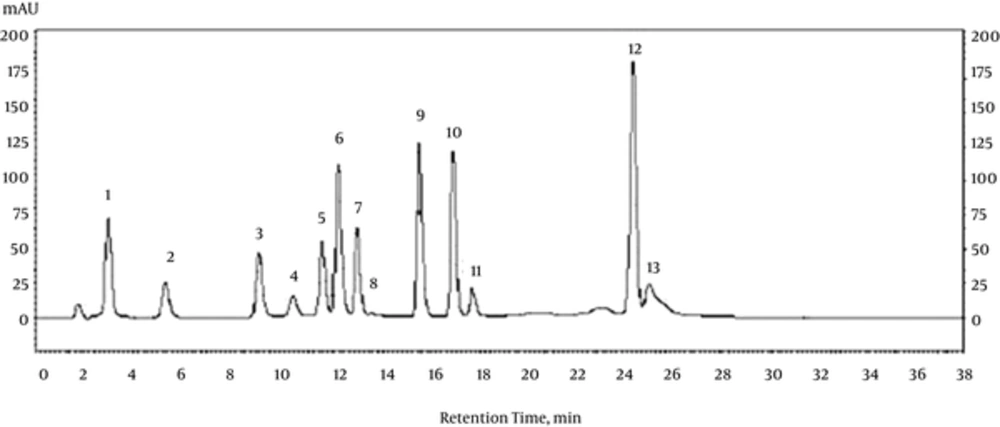
Several reports have described the use of HPLC with DAD for characterization and quantification of phenolic composition. It is known that HPLC presents higher robustness, reproducibility, and sensitivity, and it interfaces easily with a great range of detectors (
27-
29). Therefore, HPLC-DAD system was preferred for phytochemical analysis in this study, and eight phenolic compounds (gallic acid, protocatechuic acid, ρ-OH benzoic acid, catechin, vanillic acid, caffeic acid, ρ-coumaric acid and rutin) were determined in the WEP (
Table 2). The results of previous researches revealed that the genus
Primula is rich in polyphenolic compounds, such as quercetin, kaempferol, isorhamnetin, rutin, methoxy derivatives of flavone, and gallic acid (
10,
30-
32). Phenolic compounds are secondary metabolites of plants and can exhibit many medical properties (antioxidant, cardioprotective, anti-inflammatory, antimicrobial, anticancer, anti-ageing, etc.). Thus, polyhenols or natural products including polyphenols have allured increasing interest as potential agents for preventing and treating many oxidative stress-related diseases, such as cardiovascular diseases, cancer, ageing, diabetes mellitus, and neurodegenerative diseases (
33,
34).
Primula vulgaris is a medicinal plant, which has traditionally been used to treat many diseases (
1-
4). The positive therapeutical properties of
Primula vulgaris in traditional medicine may arise from these phenolic compounds. There was not any overlap between our phenolic composition results and the literature data. This situation may arise from the plant species and the number and kind of the used standards. We believe that the phenolic composition of
P. vulgaris might offer higher standard compounds should be changed with might reveal with further standard compounds.
The comet assay is frequently used to detect DNA damage in cellular level due to its cheapness, easiness, and more sensitivity than the other assays (
18,
19). Moreover, it has been considered as a favorable assay to evaluate the capacity of phytochemicals to protect cells against genotoxic agents (
35,
36). Therefore, we preferred to determine DNA damage using comet assay in this study. Methyl methanesulfonate, H
2O
2, ferrous sulfate, tert-butyl hydroperoxide, and doxorubicine have been reported to cause
in vitro DNA damage in cells in antigenotoxicity studies (
18,
20,
37,
38). In this study, H
2O
2 was used to generate oxidative DNA damage in fibroblast cells. H
2O
2 is a hydrofobic molecule; It can therefore diffuse into the cytoplasm quite easily and can be rapidly transformed into hydroxyl radicals by the Haber-Weiss or Fenton reactions. Hydroxyl radical is the most detrimental type of ROS and can induce various types of DNA damage, such as strand break, alkali-labile site, oxidized purine and pyrimidine (
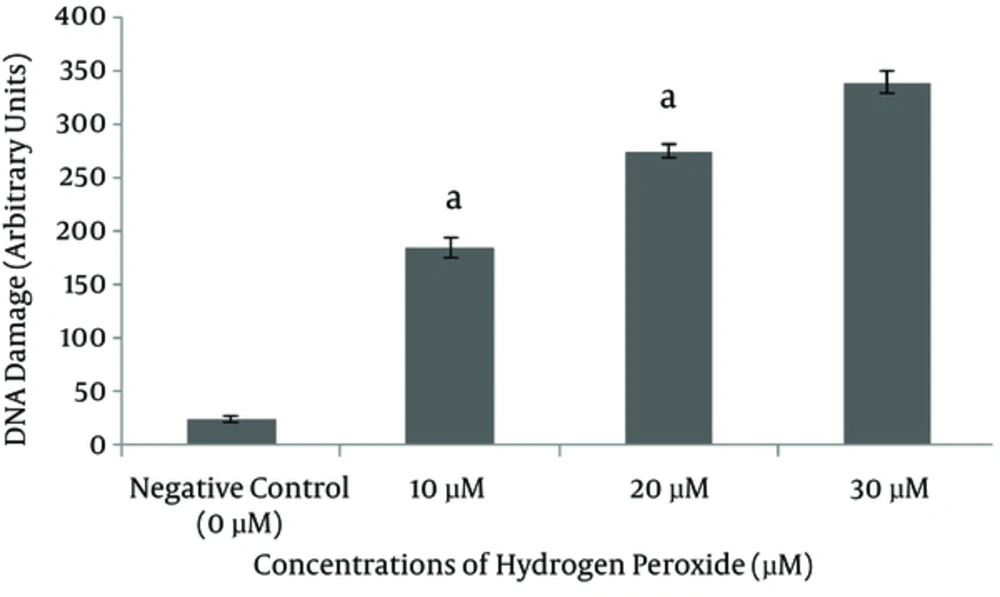
18). In this study, comet scoring was performed using a scale of 0 (no damage) to 3 (most damage) in visual analysis in the comet assay between 10 and 30 μM H
2O
2 damaging concentrations. A significant increase was induced in DNA damage with increasing the concentration of H
2O
2 (10, and 20 µM; P < 0.001 for all;
Figure 2). Maximum comet score is 300 on this scale, and the H
2O
2 concentration was therefore selected as 20 μM. Excessively long tails and DNA spectra scored at 4 were not included in this study, so 30 μM H
2O
2 was not preferred as an optimum concentration of H
2O
2. Previous reports have demonstrated that the damaging concentration of H
2O
2 in fibroblast cells changes between 10 and 100 μM. Thus, we used both concentrations of H
2O
2 (
18,
39,
40) and incubation time of H
2O
2 (5 Min), which were compatible with previous literature (
18,
41,
42). In this study,
Primula vulgaris extract, rich in phenolic compounds, was investigated for its protective effect on H
2O
2-induced oxidative DNA damage in foreskin fibroblast cells. The pretreatment time (1 hour) of fibroblast cells with WEP was established according to similar studies conducted on the antigenotoxic effect of natural products (
18,
41,
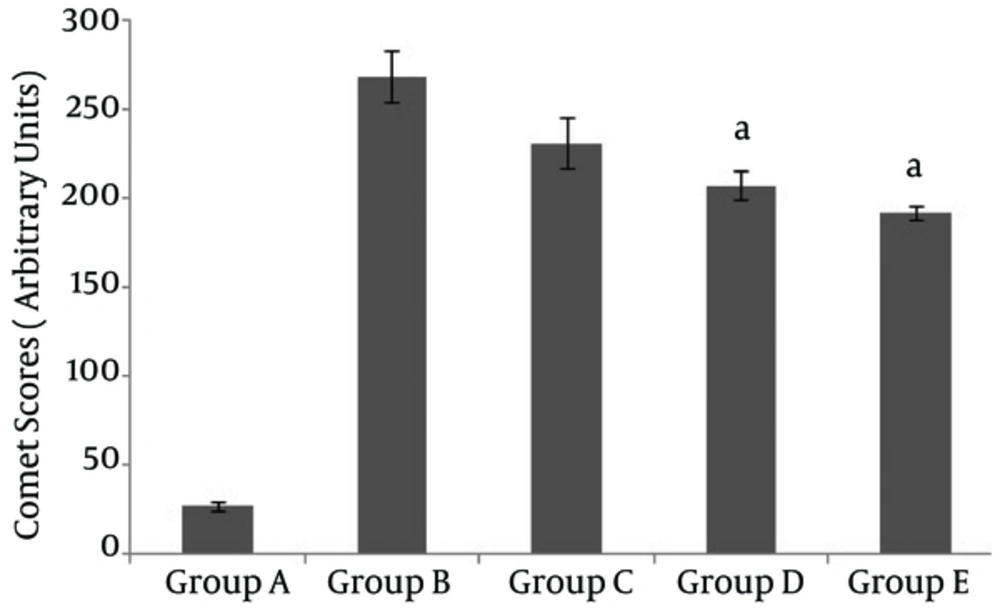
43). Cells were pretreated with different concentrations of WEP before H
22O
2 treatment, and comet scores were compared with only 20 μM H
2O
2 treatment group (the positive control). The only concentrations of 250 and 500 µg/mL WEP decreased DNA damage significantly (P < 0.001) (
Figure 3). The percentage reductions of H
2O
2-induced DNA damage by WEP were 16%, 25%, and 32% for concentrations of 100, 250, and 500 µg/mL WEP, respectively. Due to the pro-oxidant effect of the extract at greater than 500 µg/mL concentration on fibroblast cells, 500 µg/mL concentration was selected as the highest concentration following the preliminary tests. In our study, WEP did not return H
2O
2-induced DNA damage to negative control levels. This, in part, may be due to the pre-incubation time of one hour being too short. To date, no study has reported the effect of
Primula vulgaris extract on oxidative DNA damage by the comet assay. However, only Aslam et al. demonstrated that the ethanolic leaf extract of
Primula denticulata prevents DNA damage against oxidative stress on calf thymus DNA (
10). We believe that at this time the antigenotoxic effect of
P. vulgaris should be investigated both
in vitro condition with different treatment types (post or simultaneous) and
in vivo condition.
Many plants contain antioxidant components such as polyphenolic compounds, which protect cells against the detrimental effects of ROS (
9). The antioxidant property of polyphenolic compounds is attributed to their ability to donate electrons to ROS (
44). Aherne and O’Brien reported that preincubation with three flavonoids (quercetin, myricetin, and rutin) significantly protect human colon and liver cells against H
2O
2-induced DNA damage without affecting cell viability and activity of antioxidant enzymes (catalase and superoxide dismutase) (
45). Also, (+)-catechin exhibits a protective effect against heterocyclic amines-induced oxidative DNA damage in human liver cells and it is more efficient than (-)-epicatechin in preventing DNA damage (
36). In addition, the protective effects of benzoic acid, caffeic acid, coumaric acid, gallic acid and vanillic acid against DNA damage have been demonstrated in several
in vitro and
in vivo studies (
45-
48). In this study, many of these compounds were determined in the extract, and the antigenotoxic effects of WEP may arise from its phenolic content.
To our knowledge, this was the first study on phenolics composition, antioxidant and antigenotoxic effect of Primula vulgaris extract. Further studies are required for the isolation and identification of individual phenolic compounds in the extracts. Moreover, the phytochemical studies together with biological activity investigations are essential to reach a complete understanding of the medicinal applications.