
1. Background
Young adults are considered to be a potentially risk-taking population, and college transition is a significant period for every individual. Independence, separation from the parents, lack of supervision, and peer pressure significantly increase the risk of illicit drug use by these students, which may lead to academic failure and other issues in life (1).
In general, illicit drug use has been a major public health concern among students in the past few years (2). Illicit drug use is defined as the non-medicinal use of various drugs that are prohibited by international laws, such as amphetamine-type stimulants (ATS), cannabis, cocaine, heroin and other opioids, and ecstasy (3).
Illicit drug use is associated with numerous health problems, including premature death, disability, hepatitis, human immunodeficiency virus, and chronic diseases (4, 5). According to the United Nations Office Drug and Crime (UNODC) report in 2015, one billion individuals or approximately 5% of the global adult population use illicit drugs such as cannabis, opioids, amphetamines, and ecstasy (5). However, the studies conducted in the United States and European countries have indicated a recent upsurge in the prevalence of illicit drug use among students. For instance, the results of monitoring the future (MTF) indicated that the prevalence of illicit drug use among US students in 1991 and 2015 was 50.4% and 53.4%, respectively, which indicated the slightly rising trend in this regard (6). Furthermore, several studies have confirmed the high prevalence of illicit drug use in developing countries (4, 7-9). According to the studies conducted in the Middle East, illicit drug use is common among university students, while the findings reported in India, Kuwait, and Iran have denoted that 7%, 14.4%, and 5.2% of students use cannabis, illicit drugs, and both cannabis and marijuana, respectively (4, 10, 11).
Due to the distinct geographical condition of Iran and its neighboring location with Afghanistan, which is the world’s largest opium producer, illicit drug use is highly prevalent in Iran (12). Young adults constitute the vast majority of the Iranian population who are considered susceptible to illicit drug use (13). A study conducted on Iranian students indicated that hashish, opioids, and ATS are the most commonly used drugs among university students (14). Another study in Iran reported the rate of illicit substance abuse to be 2.9% among university students (9).
Previous studies have identified a number of factors associated with illicit drug use among university students, such as male gender, high-income families, single life, use of other substances (e.g., tobacco and alcohol), and unsafe sexual relations. Moreover, some other factors may be involved in this issues that have received less attention, such as physical fights, religious beliefs, and family support (10, 12, 15).
To date, few studies have been focused on illicit drug use and the associated factors among Iranian university students.
2. Objectives
The present study aimed to determine the prevalence of illicit drug use and identify the influential factors in a population of Iranian university students.
3. Methods
This cross-sectional study was conducted on the students of Bushehr University in 2017. The participants were selected via multistage sampling. Initially, the total number of the students of Bushehr University was calculated. Based on the number of the students, the proportion of the required samples was calculated in each college. In addition, classes were randomly selected as a cluster, and all the students of the selected classes were enrolled in the study. Finally, 977 students were selected and completed the self-administrated questionnaires; each student had 15 - 20 minutes to complete the questionnaire. The objectives of the research were explained to the participants, they were assured of confidentiality terms regarding their personal information, and participation was voluntary.
The research instrument has been previously used in the studies in this regard and designed based on the smoking and substance involvement screening test, which has been developed by the World Health Organization (WHO). The contents of the questionnaire have been previously validated by some researchers, and the validity was assessed by pretesting the questionnaire in a class of master of public health students (16). In this questionnaire, the developers have considered the current status of drug use in Iran (9). Initially, a pilot study was performed on 50 students to examine the feasibility of the questionnaire and collect the data to confirm its reliability, and the pilot test input was used to modify the instrument, with the Cronbach’s alpha estimated at 0.90.
The questionnaire included data on demographic variables and use of illicit drugs, such as cannabis, opium, heroin, steroidal substances, and other stimulants (e.g., amphetamine, methylphenidate, Ritalin, and ecstasy) during the lifetime, past year, past month, and daily/almost daily use within the past month.
Some of the items in the questionnaire provided data on the correlations between illicit drug use and other high-risk behaviors, including smoking habits, hookah smoking, alcohol consumption, and drugs use by the family members and friends. In addition, data on unsafe sexual relations and physical fights were collected and evaluated using the questionnaire.
Religious beliefs were evaluated using a 28-item questionnaire, the total score of which was within the range of 28 - 140, with the higher scores indicating significant religious beliefs and lower scores indicating average religious beliefs. Furthermore, family support was evaluated using a 13-item questionnaire, the score of which was within the range of 13 - 65, with the higher scores indicating better family support. Another article has been published regarding the other data collected by these two questionnaires (17).
The prevalence of the use of each illicit drug was determine in four different periods, including the lifetime, past year, past month, and daily/almost daily within the past month. As for smoking habits, hookah smoking, and alcohol consumption, data were collected on the past month, while the data on physical fights were recorded for the past year, and the data on unsafe sexual relations were recorded for the most recent intercourse. In the case of illicit drug use, data were collected regarding the lifetime use of the participants.
Data analysis was performed in SPSS version 16 using chi-square and independent t-test for a simple statistical analysis. For the estimation of the crude odds ratios (ORs) and adjusted ORs, univariate and multiple logistic regression models were employed, respectively. In addition, Hosmer-Lemeshow guidelines were used for the selection of the variables in the multiple logistic regression model (18). In all the statistical analyses, the P value of less than 0.05 was considered significant.
The study protocol was approved by the Ethics Committee of Shiraz University of Medical Sciences (ref. no.: IR.Sums.REC.1395.S1246), and written informed consent was obtained from all the participants.
4. Results
The mean age of the participants was 21.11 ± 2.32 years (range: 17 - 39 years). The majority of the participants were female (58.6%), and 13.1% were married. Table 1 shows the prevalence of using various illicit drugs by gender. According to the findings, the prevalence of using all the illicit drugs was higher in the male students (8.4%) compared to the females (0.9%). The prevalence of illicit drug use per lifetime, past year, past month, and daily/almost daily was estimated at 4%, 3.3%, 2.4%, and 0.9%, respectively. In addition, the prevalence of ATS use was higher compared to the other drugs in all the selected periods. According to the information in Table 1, the prevalence of the lifetime use of cannabis, ATS, opium, and heroin use was 1.3%, 1.5%, 1.5%, and 0.1%, respectively. On the other hand, the prevalence of drug use in the past year for cannabis, ATS, opium, and heroin use was 0.9%, 1.4%, 1.1%, and 0.1%, respectively.
Table 1.
Prevalence of Use of Illicit Drugs in University Students Based on Gendera
| Female (N = 573) | Male (N = 404) | Total (N = 977) | |
|---|---|---|---|
| Illicit drugsb | |||
| Lifetime use | 5 (0.9) | 34 (8.4) | 39 (4.0) |
| Past year use | 3 (0.5) | 29 (7.2) | 32 (3.3) |
| Past month use | 2 (0.3) | 21 (5.2) | 23 (2.4) |
| Daily/almost daily use in past month | 0 | 9 (2.2) | 9 (0.9) |
| Cannabis | |||
| Lifetime use | 1 (0.2) | 12 (3.0) | 13 (1.3) |
| Past year use | 0 | 9 (2.2) | 9 (0.9) |
| Past month use | 0 | 5 (1.2) | 5 (0.5) |
| Daily/almost daily use in past month | 0 | 3 (0.7) | 3 (0.3) |
| Amphetamine-type stimulants (ATS)c | |||
| Lifetime use | 1 (0.2) | 14 (3.5) | 15 (1.5) |
| Past year use | 1 (0.2) | 13 (3.2) | 14 (1.4) |
| Past month use | 0 | 11 (2.7) | 11 (1.1) |
| Daily/almost daily use in past month | 0 | 3 (0.7) | 3 (0.3) |
| Opium | |||
| Lifetime use | 3 (0.5) | 12 (3.0) | 15 (1.5) |
| Past year use | 2 (0.3) | 9 (2.2) | 11 (1.1) |
| Past month use | 2 (0.3) | 6 (1.5) | 8 (0.8) |
| Daily/almost daily use in past month | 0 | 3 (0.7) | 3 (0.3) |
| Heroin | |||
| Lifetime use | 0 | 1 (0.2) | 1 (0.1) |
| Past year use | 0 | 1 (0.2) | 1 (0.1) |
| Past month use | 0 | 1 (0.2) | 1 (0.1) |
| Daily/almost daily use in past month | 0 | 0 (0) | 0 (0) |
aValues are expressed as No. (%).
bCannabis, ATS, opium, and heroin.
cATS: Ritalin (methylphenidate), ecstasy (MDMA), and glass (methamphetamine).
4.1. Demographic Characteristics and the Correlated Variables with Illicit Drug Use
Table 2 shows the correlations between illicit drug use, demographic characteristics, and the influential factors in illicit drug use. The obtained results indicated significant associations between the lifetime use of the mentioned illicit drugs and gender, smoking habits, hookah smoking, alcohol consumption, working along with education, unsafe sexual relations, physical fights, illicit drug use by the family members and friends, religious beliefs, and family support (P < 0.05). However, the mean scores of religious belief and family support were significantly lower among the students who used any of the mentioned illicit drugs within their lifetime.
Table 2
. Demographic Characteristics and Correlated Variables of Illicit Drug Use in Iranian University Students (2017)a
| Characteristics | Illicit Drug Use (Lifetime) | Numbers | P Value | |
|---|---|---|---|---|
| No | Yes | |||
| Gender | < 0.001 | |||
| Male | 370 (91.6) | 34 (8.4) | 404 | |
| Female | 568 (99.1) | 5 (0.9) | 573 | |
| Marital status | 0.666 | |||
| Single | 816 (96.1) | 33 (3.9) | 849 | |
| Married | 122 (95.3) | 6 (4.7) | 128 | |
| Residence | 0.142 | |||
| Parental home | 227 (97.4) | 6 (2.6) | 233 | |
| Dormitory | 638 (95.90 | 27 (4.1) | 665 | |
| Personal home | 73 (92.4) | 6 (7.6) | 79 | |
| Residence status | 0.136 | |||
| Native | 499 (96.9) | 16 (3.1) | 515 | |
| Non-native | 439 (95.0) | 23 (5.0) | 462 | |
| Working along with education | < 0.001 | |||
| Yes | 128 (88.3) | 17 (11.7) | 145 | |
| No | 810 (97.4) | 22 (2.6) | 832 | |
| Smoking habits (past month) | < 0.001 | |||
| Yes | 50 (73.5) | 18 (26.5) | 68 | |
| No | 888 (97.7) | 21 (2.3) | 909 | |
| Hookah smoking (past month) | < 0.001 | |||
| Yes | 80 (85.1) | 14 (14.90) | 94 | |
| No | 858 (97.2) | 25 (2.8) | 883 | |
| Alcohol consumption (past month) | < 0.001 | |||
| Yes | 29 (74.4) | 10 (25.6) | 39 | |
| No | 909 (96.9) | 29 (3.1) | 938 | |
| Unsafe sexual relations | < 0.001 | |||
| Yes | 44 (80.0) | 11 (20.0) | 55 | |
| No | 894 (97.0) | 28 (3.0) | 922 | |
| Physical fights | < 0.001 | |||
| Yes | 56 (81.2) | 13 (18.8) | 69 | |
| No | 882 (97.1) | 26 (2.9) | 908 | |
| Illicit drug use by family members | < 0.001 | |||
| Yes | 39 (83.0) | 8 (17.0) | 47 | |
| No | 899 (96.7) | 31 (3.3) | 930 | |
| Illicit drug use by friends | ||||
| Yes | 62 (79.5) | 16 (20.5) | 78 | <0.001 |
| No | 876 (97.4) | 23 (2.6) | 899 | |
| Age, y | 21.09 ± 2.24 | 21.77 ± 3.80 | 21.12 ± 2.32 | 0.274 |
| Score of religious beliefs | 112.99 ± 20.34 | 102.42 ± 21.94 | 112.58 ± 20.50 | 0.002 |
| Score of family support | 50.83 ± 10.08 | 44.28 ± 14.21 | 50.57 ± 10.34 | 0.007 |
aValues are expressed as No. (%) or mean ± SD.
4.2. Logistic Regression Analysis
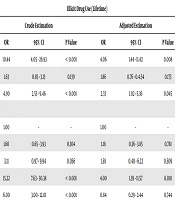
A logistic model was used to estimate the crude ORs for all the variables (Table 3), and the results indicated that smoking habits had the most significant effect compared to the other variables (OR = 15.22). The univariate analysis also demonstrated that the scores of family support and religious beliefs had significant effects on illicit drug use, and the higher scores of family support and religious beliefs led to the decreased ORs of illicit drug use to 0.95 and 0.98, respectively.
Table 3.
Logistic Regression Analysis of Associations Between Illicit Drug Use and Other Factors in Iranian University Students (2017)
| Variables | Illicit Drug Use (Lifetime) | |||||
|---|---|---|---|---|---|---|
| Crude Estimation | Adjusted Estimation | |||||
| OR | 95% CI | P Value | OR | 95% CI | P Value | |
| Gender (male) | 10.44 | 4.05 - 26.93 | < 0.001 | 4.06 | 1.44 - 11.42 | 0.008 |
| Residence status (non-native) | 1.63 | 0.85 - 3.13 | 0.139 | 1.86 | 0.76 - 0.4.54 | 0.173 |
| Working along with education | 4.90 | 2.53 - 9.46 | < 0.001 | 2.33 | 1.02 - 5.36 | 0.045 |
| Place of residence | ||||||
| Parental home | 1.00 | - | - | 1.00 | - | - |
| Dormitory | 1.60 | 0.65 - 3.93 | 0.304 | 1.18 | 0.36 - 3.85 | 0.781 |
| Personal home | 3.11 | 0.97 - 9.94 | 0.056 | 1.58 | 0.40 - 6.22 | 0.509 |
| Smoking habits (past month) | 15.22 | 7.63 - 30.38 | < 0.001 | 4.00 | 1.39 - 11.57 | 0.010 |
| Hookah smoking (past month) | 6.00 | 3.00 - 12.01 | < 0.001 | 0.84 | 0.29 - 2.44 | 0.744 |
| Alcohol consumption (past month) | 10.81 | 4.82 - 24.25 | < 0.001 | 2.39 | 0.75 - 7.63 | 0.139 |
| Unsafe sexual relations | 7.98 | 3.73 - 17.07 | < 0.001 | 2.31 | 0.85 - 6.28 | 0.100 |
| Physical fights | 7.87 | 3.84 - 16.15 | < 0.001 | 4.04 | 1.6 - 10.02 | 0.003 |
| Illicit drug use by family members | 5.95 | 2.57 - 13.79 | < 0.001 | 2.66 | 0.84 - 0.844 | 0.097 |
| Illicit drug use by friends | 9.83 | 4.94 - 19.56 | < 0.001 | 2.71 | 1.04 - 7.08 | 0.042 |
| Score of family support | 0.95 | 0.93 - 0.98 | < 0.001 | 0.99 | 0.96 - 1.02 | 0.562 |
| Score of religious beliefs | 0.98 | 0.97 - 0.99 | 0.002 | 1.00 | 0.99 - 1.02 | 0.542 |
Multiple logistic analysis was performed to control the possible effect of the confounding variables (Table 3). According to the information in Table 3, after adjustment for the other factors, male gender (OR = 4.06), working along with education (OR = 2.33), smoking habits (OR = 4.00), physical fights (OR = 4.04), and illicit drug use by friends (OR = 2.71) were associated with illicit drug use. Notably, the final model indicated that family support and religious beliefs had no significant effects on illicit drug use (P > 0.05).
5. Discussion
The results of the present study indicated that the lifetime, past year, and past month prevalence of illicit drug use was 4%, 3.3%, and 2.4%, respectively. In addition, the daily prevalence of illicit drug use was estimated at 0.9%, which is inconsistent with a study conducted in the United States, showing the lifetime, past year, and past month prevalence of illicit drug use to be 54.5%, 42.8%, and 24.3% among students, respectively (6). The studies conducted in European countries have also reported the lifetime prevalence of illicit drug use to be 18% in 2015 (19). The prevalence of illicit drug use in the present study was lower compared to Middle Eastern countries such as Kuwait and India (10, 11). Furthermore, a study conducted in Tehran (Iran) reported the prevalence of illicit drug use to be 2.9%, which is consistent with the results of the present study (9).
The definition of illicit drugs varies due to the different items and concepts used in various studies. The discrepancy in the prevalence rate of illicit drug use in different studies may be attributed to the definition of illicit drugs. In addition, most of the studies in this regard have mentioned the prevalence of the illicit drugs totally. Therefore, it is better to compare the prevalence of each specific illicit drug use separately as the prevalence of a specific illicit drug is significantly higher in some countries. For instance, the prevalence of opium use is relatively higher in Iran compared to western countries due to the vicinity to Afghanistan.
In the current research, the lifetime, past year, and past month prevalence of ATS use was 1.5%, 1.4%, and 1.1%, respectively. On the other hand, the results of the MTF study showed that the lifetime, past year, and past month prevalence of ATS use was 13.6%, 9.8%, and 3.8%, respectively (6). The prevalence of amphetamines use has been reported to be 2% in European countries and 1% in Asian countries (19, 20). In a study conducted on students in Tehran, the lifetime, past year, past month, and daily prevalence of amphetamine use was estimated at 1.3%, 0.5%, 0.06%, and 0.0%, respectively (14). In addition, the findings of a study conducted in Iran revealed that Ritalin is used by students to increase the time of their studies and improve academic function (21). Due to the high prevalence of ATS use in students and its side-effects, training interventions are required to increase the knowledge of ATS to reduce the prevalence of ATS use among students.
In the current research, the lifetime, past year, past month, and daily prevalence of opium use was estimated at 1.5%, 1.1%, 0.8%, and 0.3%, respectively. In a study performed on students in the United States, the prevalence of opium use was reported to be 2.4% (22). On the same note, Amin-Esmaeili et al. (14) reported the lifetime and past year prevalence of opium use to be 1.1% and 0.3%, respectively in the students of Tehran University of Medical Sciences. Another study in Iran reported the prevalence of opium use to be 2.2% (23).
The prevalence of heroin use was extremely low in the present study as only one male student reported heroin use. However, the lifetime and past year prevalence of heroin use has been reported to be 0.5% and 0.2% among the students in the United States (6). According to the findings reported in 35 Europe countries, the lifetime prevalence of heroin use was 1% (19), while another study conducted in Istanbul (Turkey) showed that 0.4% of students used heroin at least once (24). In the students in Tehran, the prevalence of heroin use was reported to be 0.1% (9).
In the present study, the lifetime, past year, past month, and daily prevalence of cannabis use was estimated at 1.3%, 0.9%, 0.5%, and 0.3%, respectively. Cannabis has been reported to be to be the most commonly used illicit drug among European students as 16% of the students reported cannabis use at least once (19). In the MTF study, the lifetime, past year, and past month prevalence of marijuana/hashish was reported to be 51%, 39.3%, and 22.2%, respectively (6). On the other hand, Peltzer et al. (20) reported the lifetime prevalence of cannabis use to be 0.9% in five Asian countries, while Amin-Esmaeili et al. (14) stated that the lifetime, past year, past month, and daily prevalence of illicit drug use was 0.8 %, 0.3%, 0.1%, and 0.0%, respectively, which is consistent with the results of the present study. The mentioned findings support the public health concern regarding illicit drug use among students (2).
According to the results of the final logistic model in the current research, the lifetime prevalence of illicit drug use was significantly associated with gender, working along with education, smoking habits, physical fights, and illicit drug use by friends, which is in line with the previous studies in this regard (9, 25). Similarly, Pengpid et al. (26) stated that smoking habits were positively associated with illicit drug use. Furthermore, a study conducted in Africa indicated that a history of physical fights over the past year and smoking habits were associated with illicit drug use (27). Similar results have also been reported in Iranian university students (15).
Several studies have confirmed the protective effects of family support and religious beliefs on high-risk behaviors as involvement in religious activities could considerably improve the behaviors of individuals to have a healthy life and comply with normative values (15, 28, 29). Our findings in this regard indicated that the mean score of religious belief was significantly lower in the students with a history of illicit drug use although religious beliefs were not considered statistically significant in the final regression model.
According to the univariate analysis in the present study, family support was another protective factor associated with illicit drug use as the students with lower family support were at a higher risk of illicit drug use. Numerous findings have shown that students with strong family support were less likely to report high-risk behaviors (30-32). Although family support was not considered significant in the final regression model of the current research, it could be regarded as a significant protective factor for illicit drug use in preventive interventions.
The results of the present study indicated that the prevalence of illicit drug use was higher among the male students compared to the females. The previous studies in Iran and other countries have also revealed that male students are more likely to use illicit drugs compared to females (15, 25, 26, 33). The higher odds of illicit drug use by male students could be due to the higher availability of illicit drugs to men, as well as their pleasure-seeking nature and more freedom, independence, and risk-taking behaviors.
Some studies have denoted a positive association between peer illicit drug use and the prevalence of illicit drug use (9, 34, 35). In this regard, the results of the present study indicated that illicit drug use by friends increased the odds of drug use among the students (OR = 2.71). Entering the university and post-secondary settings, living in the dormitory, and making new acquaintances accompanied with lifestyle changes are some of the influential factors in this regard. Due to the lack of parental supervision and peer pressure, university students are more vulnerable to illicit drug use and considered as a high-risk population. Therefore, educational, recreational, sports, and cultural programs for students, implementing training interventions for their parents, and providing educational interventions on life skills, social skills, and friendship programs could prevent the emergence of risky situations and reduce exposure to illicit drugs (36).
Previous studies have demonstrated the co-occurrence of high risk behaviors, which should be incorporated into the design and implementation of the preventive interventions in this regard (37, 38). It is suggested that comprehensive training and preventive interventions be designed and implemented to effectively reduce the prevalence of high-risk behaviors, such as illicit drug use, among university students.
5.1. Limitations of the Study
Due to the cross-sectional design of the study, the casual inference could not be identified based on our findings. Another limitation of the study was the use of self-report data, assuming that the participants completed the questionnaires with honesty.
5.2. Conclusions
This study aimed to determine the prevalence of illicit drug use and some of the influential factors in this regard. According to the results, the prevalence of illicit drug use was relatively low among the students, albeit significant, and illicit drug use by friends was observed to have a strong association. Longitudinal studies are required for consistent monitoring mechanisms and appropriate planning for interventional studies. Our findings could be used in the planning and evaluation of interventions based on the associated risk factors and protective factors of illicit drug use in universities.