
1. Background
In the last few decades, the rate of inactivity and lack of physical activity has increased rapidly in most societies, whether developed, developing, or underdeveloped, due to the growth of industry and technology (1). Thus, the benefits of regular physical activity affect society both individually and indirectly (2). Therefore, with the advent of positive psychology in recent decades, human strengths have been used as a shield against mental illness (3). In recent years, however, a group of mental health researchers has equated it with psychological function and conceptualized it as “psychological well-being." The absence of disease is not considered sufficient to feel healthy, but at the same time, being satisfied with life, adequate development, efficient and effective interaction with the world, positive energy and mood, and believing that he has good relations with society are the characteristics of a healthy individual (4). Psychological well-being can also be defined as happiness, joy, and having positive emotions in life, in which a person strives to develop his or her potential abilities (5). Therefore, health is a multidimensional concept that, in addition to not being sick and not being disabled, also includes the feeling of happiness and psychological well-being (6). Individuals who tend not to be bad often evaluate events and living conditions negatively. Anger, anxiety, and depression are often the conditions experienced by this group. Lane et al., (7) stated that the greater athletes' ability to perceive, identify, regulate, and accurately express emotions, the more cognitive resources they can allocate to their thoughts, leading to increased efficiency.
Therefore, enjoyment is one of the most important senses for participating and maintaining participation in sports (8). Sports development must be aligned with better design and more practical ways to encourage and increase interest, attendance, and performance in sporting events. Therefore, sports development should align with better design and more effective ways to promote and increase interest, participation, and performance in sports activities. Therefore, progression in activity and following a regular exercise program is referred to as adherence to sports. Commitment (adherence) to sports is a psychological state that shows the desire and decision of the individual to continue participating in sports (9).
The adherence to a routine exercise program is influenced by the interplay of various factors, including hygiene, economic conditions, social factors, psychological aspects, and demographic characteristics. Also, many different variables can interact with ethical factors and may generate barriers to regular exercise (10). For example, women's low adherence to sports compared to men may indicate that women spend more time on their various restraints, including family and baby care and job (11). In this model, sports commitment is defined as a “psychological construct expressing the desire and will to continue sports participation" (12). Nevertheless, despite all these profits of sports and physical exercise, women who face many difficulties in doing sports do not participate in sports regularly. In addition, it was emphasized that the economic status of their families is a more critical factor, especially for girls to participate in sports, than culture and religion (13). Women are additionally subject to gender stereotypes and are seen as weaker and more obedient, while allowing women to participate in recreational activities seen as challenging to dominate men (14).
In this regard, Muniz et al. believe that different measures are needed for men and women, as most social, economic, and demographic inequality reflect gender-based behavioral differences and the adverse effects of marriage and childbearing on participating in sports and recreational activities (15). On the other hand, researchers focusing on recreational and sports (competitive sports) also depict stereotypes that introduce Muslim women as “passive, weak, and oppressed" (16). In another study conducted by Rasekh et al. in Iran, they identified 9 chances and 19 difficulties for female athletes. Although research on women's sports in the domestic and foreign fields shows progress in Iranian women's sports, they do not show favorable growth compared to men's sports" due to social constraints and other factors (17). In addition, Motamedi et al. listed the biggest obstacles to women's participation in sports: Lack of time, male-dominated social culture, economic situation, and lack of investment in women's sports centers (18).
Thus, in many cases, a person's culture or religious beliefs can influence sports activities that they can participate in routinely (19). In this regard, in the case of Christianity, Catholics believe that excessive participation in sports may lead to the breakdown of family relationships. Participation in recreational activities also harms Catholic marital life and restricts the family's private life and joint social activities (20). Nevertheless, a person with high spiritual intelligence has flexibility, self-awareness, a capacity to face difficulties and hardships and beyond, a capacity for inspiration and intuition, a holistic view of existence, and a search for the fundamental questions of life is a critique of traditions and customs. This way, it can promote people's well-being and life expectancy (21). One's spirituality must strike a balance between life satisfaction and psychological well-being (22). Physical activity and exercise are also considered crucial matters for self-improvement (23).
Although, according to the above studies, there can be a relationship between psychological well-being and religious beliefs and adherence to recreational sports activities, there has not been a study on this topic yet. Given the above, the question arises: “Is there a relationship between psychological well-being and religious beliefs with adherence to recreational sports activities of the presentation model of structural equations?"
2. Methods
2.1. Subjects
The present research is descriptive-correlation in terms of applied purpose and design. The data collection method is survey research done through libraries and field studies. The statistical population for this study comprised all women who participated in leisure-time sports activities at parks and recreation sports centers during the summer of 2019. Since the population size was unlimited, a sampling method was employed, specifically the available random sampling technique. Based on the population volume and using the Krejcie and Morgan table, a sample size of 348 individuals within the age range of 20 - 40 years was selected.
2.2. Apparatus and Task
2.2.1. Psychological Well-being Questionnaire
The psychological well-being questionnaire was created by Carol Reef and revised by Hauser (24). This 18-item scale measures 6 subscales that include the factors of autonomy, environmental domination, self-improvement, good communication, life purpose, and self-acceptance. The summary scores of these 6 sub-headings are calculated as the total psychological well-being score. Each subscale is evaluated with 3 questions. Furthermore, a scale of 6 values from 1 (strongly disagree) to 6 (strongly agree) is considered to answer each question. Many appropriate studies have reported the validity and reliability of psychological well-being scales (25). The internal consistency of the subscales is appropriate, and Cronbach's alpha is found to be 0.77 and 0.90. Also, Joshanloo et al., while confirming the validity of this method, reported the internal consistency of its subscales between 0.73 and 0.88 (26). Sohrabi et al. obtained the reliability of the questionnaire using Cronbach's alpha coefficient of 0.88 (6).
2.2.2. Allport Religious Orientation Questionnaire
The allport religious orientation questionnaire consists of 21 sentences presented to the subject. After ensuring the participant's commitment to providing honest, genuine, and unbiased responses, they are kindly requested to select and specify one expression from the given options. The test questions have 4 options: (A) Strongly agree, (B) almost agree, (C) almost disagree, and (D) strongly disagree; thus, this questionnaire is graded on a 4-point Likert scale from 1 to 4. The test has no time or age limit. Its internal consistency using Cronbach's alpha is 0.71, and its test reliability is 0.74. On this scale, the options of expressions 1 to 12 measure the external religious orientation, and expressions 13 to 21 measure the internal religious orientation (Allport & Ross, 1967). This tool had good validity and reliability in Iran. In Zoghi Paydar et al.'s study, Cronbach's alpha was calculated as 0.81 for the dimension of internal religious orientation and 0.78 for the dimension of external orientation (27).
2.2.3. Adherence to the Sports Scale
The questionnaire on adherence to physical activity was used to measure adherence to physical activity. This questionnaire consists of 11 items and 3 components: The knowledge component (items 1 to 4), the equipment component (items 5 to 7), and the amplifiers component (items 8 to 11). This scale is rated from very low to very high according to the Likert scale of 5 degrees, and the reliability of this questionnaire was obtained through Cronbach's alpha of 0.86 (28). Ghaderi et al. obtained the reliability and validity of this questionnaire in Iran equal to 0.73 and 0.76 (29).
3. Results
In this section, we provide descriptive information related to research variables. The results showed that among the 384 women participating in this study, 249 are homemakers, and 135 are employed, with a frequency percentage of 8.64% and 2.35%, respectively. Moreover, they are divided into 2 groups in terms of age range. The first group consisted of 205 women (age range, 20 to 30 years), and the second group consisted of 173 women (age range, 31 to 40 years). Their frequency percentage is 4.53% and 1.45%, respectively.
The participants were divided into 3 groups based on the amount of sports activity per week. The first group engaged in 4 to 6 hours of sports per week and included 215 people. The second group engaged in 7 to 9 hours of sports per week and included 129 people. The third group engaged in 10 to 12 hours of sports per week and had the lowest number of participants, 40 people. The frequency percentage of each group was 56%, 6.33%, and 4.10%, respectively. This means that the majority of participants were in the first group, which had 4 to 6 hours of sports activity per week.
Table 1 provides descriptive information related to the variables of psychological well-being and religious beliefs. The studied indicators are the mean and SD. As shown in Table 1, the descriptive indicators of the psychological well-being variable and its components show that the highest average is related to the environmental mastery index, with an average of 3.33, and the lowest average is related to the goal of life index, with an average of 3.12. Furthermore, the descriptive indicators indicate the variable of religious beliefs, indicating that the average component of internal religious orientation, with an average of 2.96, and the average component of external religious orientation, with an average of 3.68, have been obtained. Also, in descriptive indicators, the components of adherence to sports show that the average variable of adherence to sports is 3.22, and its SD is 0.6. Hence, it shows that the distribution of data is expected.
Table 1.
Descriptive Indicators of Psychological Well-being Variables
| Components of Psychological Well-being | Mean ± SD |
|---|---|
| Self-acceptance | 3.22 ± 0.62 |
| Environmental dominance | 3.33 ± 0.82 |
| Positive relationships with others | 3.23 ± 0.81 |
| Having a purpose in life | 3.12 ± 0.67 |
| Personal growth | 3.22 ± 0.53 |
| Independence | 3.21 ± 0.51 |
| Psychological well-being | 3.22 ± 0.53 |
| Components of religious beliefs | |
| Internal religious orientation | 2.96 ± 0.79 |
| External religious orientation | 3.68 ± 0.47 |
| The scale of adherence to sports (Adherence to sports) | 3.23 ± 0.6 |
In this study, the Pearson correlation coefficient test was used to examine the relationship between variables. The relationship between psychological well-being and adherence to sports, as well as the relationship between the components of well-being and adherence to sports, is shown in Table 2.
Table 2.
Pearson Correlation Coefficient Between Psychological Well-being and Its Components with Adherence to Sports
| Self-acceptance | Environmental Dominance | Positive Relationship with Others | Having a Purpose in Life | Personal Growth | Independence | Psychological Well-being | |
|---|---|---|---|---|---|---|---|
| Adherence to sports | 0.591 | 0.577 | 0.622 | 0.524 | 0.666 | 0.445 | 0.708 |
| Significance level | 0.001 | 0.001 | 0.001 | 0.001 | 0.001 | 0.001 | 0.001 |
According to the data in the table, which shows the result of the Pearson correlation coefficient, there is the highest positive and significant relationship between the 2 variables of personal growth and adherence to sports. Also, there is the lowest positive and significant relationship between the 2 variables of independence with adherence to sports.
In Table 3, we use the stepwise regression method. In this method, the predictor variables are entered into the equation, and the best prediction for the criterion variable is determined. For this hypothesis, initially, 6 dimensions of psychological well-being variables were entered into the equation, and the results will be presented below:
Table 3.
Summary of the Model for Predicting Adherence to Sports Through Psychological Well-being Indicators
| Model | Multiple Correlation Coefficient | The Squared Coefficient of Correlation | Genuine Explanation Coefficient | Statistics F | Significance Level | Watson_Camera Statistics |
|---|---|---|---|---|---|---|
| 1 | 0.666 | 0.443 | 0.442 | 304.2 | 0.001 | 2.05 |
| 2 | 0.69 | 0.476 | 0.473 | 173.19 | 0.001 | |
| 3 | 0.704 | 0.495 | 0.491 | 124.31 | 0.001 | |
| 4 | 0.715 | 0.511 | 0.506 | 99.11 | 0.001 |
Model 1: Self-improvement of the model
Model 2: Self-improvement, positive relations with others
Model 3: Self-improvement, positive relations with others, having a life purpose
Model 4: Self-improvement, positive relations with others, having a life purpose, environmental dominance
According to the results from Table 3, it can be stated that model 4 explains 0.511 of the changes in the criterion variable. As a general rule, if the observed Watson-Camera value is approximately between 1.5 and 2.5, the observations are independent. Here, the Watson-Camera statistic is acceptable. Also, the amount of F in all 4 models is significant, demonstrating that the models can predict the adherence variable significantly (Table 4).
Table 4.
Coefficients Obtained from Model 4
| Not Standardized Coefficients | Standardized Coefficients | P-Value | Tolerance | VIF | |||
|---|---|---|---|---|---|---|---|
| B | SE | Beta | t | ||||
| Constant | 0.67 | 0.143 | 4.67 | 0.001 | |||
| Self-improvement | 0.214 | 0.092 | 0.18 | 2.32 | 0.021 | 0.214 | 4.66 |
| Positive relations with others | 0.207 | 0.043 | 0.264 | 4.81 | 0.001 | 0.427 | 2.34 |
| Having a life purpose | 0.201 | 0.045 | 0.213 | 4.5 | 0.001 | 0.579 | 1.72 |
| Environmental dominance | 0.153 | 0.044 | 0.200 | 3.51 | 0.001 | 0.398 | 2.51 |
Also another hypothesis is linear regression. Collinearity occurs when 1 independent variable is a linear combination of other independent variables. If collinearity is high in a regression equation, there is a high correlation between the independent variables, and the model's squared coefficient of correlation may be high. In such cases, the model may appear to be valid, but it lacks significant independent variables, and the variables may influence each other. The lower the tolerance (near zero), the less information related to variables will be minor, and we will have problems using regression. The inflation variance is also the inverse of tolerance; as it increases, the variance of regression coefficients increases. The VIF and tolerance test results show that independent variables can be appropriate in predicting the variable of adherence to women's sports.
In Table 5, the results of the Pearson correlation coefficient between religious beliefs and adherence to sports show a significant relationship between the 2 variables of internal religious orientation and adherence to sports, but no significant relationship was detected between external religious orientation and adherence to sports. In Table 6, we use the stepwise regression method. In this method, the predictor variables are entered into the equation, and the best prediction for the criterion variable is determined. This indicates that the variable of internal religious orientation explains about 8% of the changes in adherence to sports.
Table 5.
Pearson Correlation Coefficient Between Religious Beliefs and Adherence to Sports
| The Pearson Correlation Coefficient | Internal Religious Orientation | External Religious Orientation |
|---|---|---|
| Adherence to sports | 0.293 | 0.061 |
| Significance level | 0.001 | 0.235 |
Table 6.
Summary of the Model for Predicting Adherence to Sports Through Internal Religious Orientation
| Multiple Correlation Coefficient | The squared Coefficient of Correlation | Genuine Explanation Coefficient | Standard Estimation Error | F | P-Value |
|---|---|---|---|---|---|
| 0.293 | 0.086 | 0.084 | 0.6 | 35.9 | 0.001 |
The results of Table 7 show that internal religious orientation has a positive and significant effect on adherence to sports (P = 0.001) and (t = 99.5) (Figure 1). The intensity of the effect is equal to 0.30. With a 1-unit increase in internal religious orientation, the adherence rate to sports in women increases by 0.30 units. Then, our main variables are of the latent variable's type and used the structural equation model method to investigate the effect of the main variables on each other. In Table 8, the values obtained are model indices, and the Fit model results show that the model indices are at a suitable level.
Table 7.
Coefficients Obtained from Model
| Not Standardized Coefficients | Standardized Coefficients | P-Value | |||
|---|---|---|---|---|---|
| B | SE | Beta | t | ||
| Constant | 2.47 | 0.12 | 20.66 | 0.001 | |
| Internal religious orientation | 0.234 | 0.039 | 0.293 | 5.99 | 0.001 |
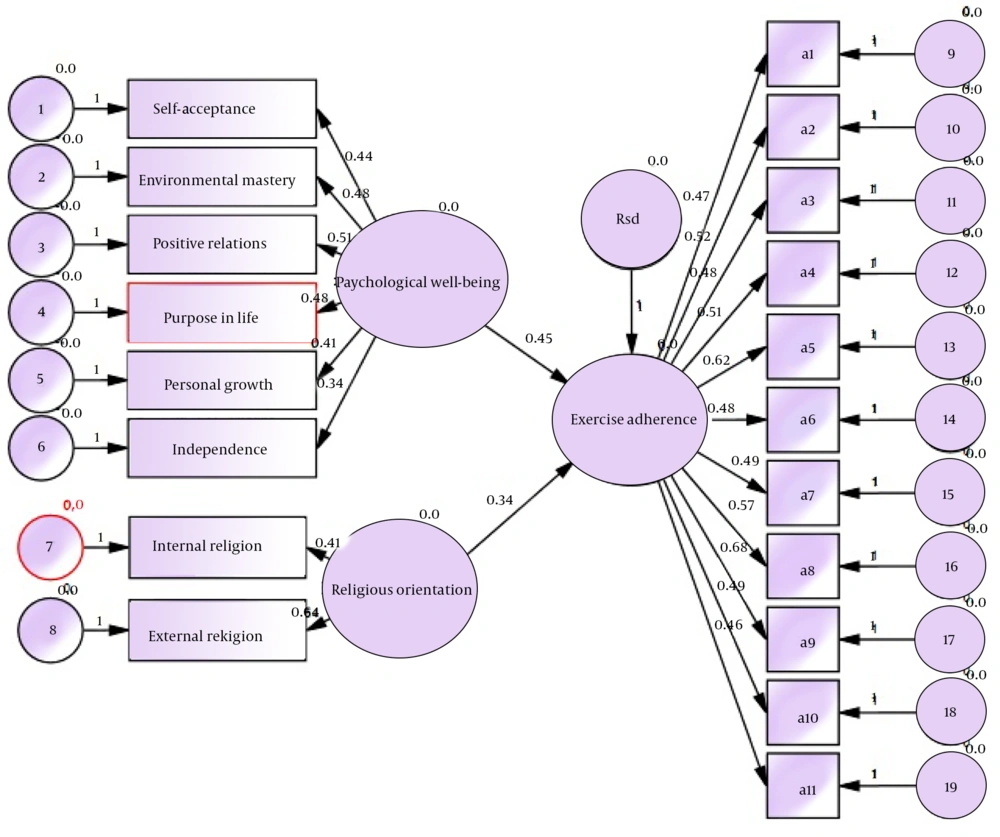
Figure 1.
Standard coefficients between variables of psychological well-being and religious orientation with adherence to sports
Table 8.
Obtained Values of Model Indices
| Criterion | Acceptable Limit | Points Earned |
|---|---|---|
| Chi-square | 254.425 | |
| Degrees of freedom | 179 | |
| The ratio of chi-square to the degree of freedom | Less than 2 | 1.42 |
| Goodness fit index (GFI) | Greater than and equal to 0.9 | 0.924 |
| Normalized fit index (NFI) | Greater than 0.9 | 0.914 |
| Comparative fit index (CFI) | Greater than 0.9 | 0.927 |
| Relative fit index (RFI) | Greater than 0.9 | 0.947 |
| The root mean square of the estimation aberration (RMSEA) | Less than 0.8 | 0.068 |
4. Discussion and Conclusions
The present study investigated the model of structural equations between psychological well-being and religious beliefs with adherence to recreational sports activities. The findings of this study showed a significant relationship between psychological well-being and adherence to sports. Also, the Pearson correlation coefficient results showed a significant relationship between the 2 variables of self-improvement and adherence to sports (0.666). However, there is the lowest positive and significant relationship between the 2 variables of independence with adherence to sports (0.445).
These findings are consistent with the research results of Vozikaki et al. (30-32). Previous researchers agree that perceived leisure time participation and well-being positively correlated (33). Moreover, the findings of Shamsipour Dehkordi (34) showed that physical activity and body mass index have an interactive role in cognitive function and psychological well-being. According to Anshel & Wells (35), the primary variables in sports performance are psychological well-being and mental health. Psychological well-being is defined as the development of an individual's natural talents. Perceived well-being is defined as a self-assessment of his or her own life (36).
Scientists have also considered both internal and external factors in this regard because a person is the product of the interaction of the environment with personal characteristics. Internally, individuals must perceive well-being mentally and externally; they must improve objective living conditions such as age, wealth, health, marriage, employment, income, housing, etc. (37). Therefore, extensive research has examined the motivations for participating in physical activity and sports and the reasons for quitting. Many of these studies have identified enjoyment as one of the main reasons for the tendency and adherence to physical activity and exercise (38). From this point of view, enjoyment is one of the most relevant reasons for participating and maintaining participation in sports. Conversely, theories can be theorized using biological and social methods (8).
As already mentioned in the results of the Pearson correlation coefficient, the relationship between personal growth and adherence to sports is greater than other components of psychological well-being. Hence, personal growth makes people know themselves more and achieve more ability and power. Therefore, people feel better about themselves, and regular participation in sports also increases self-confidence. Therefore, people should not hesitate in making their own decisions. This allows people to maintain their adherence to sports and even more so.
Another study finding showed a significant relationship between the 2 variables of internal religious orientation and adherence to sports, but no significant relationship was observed between external religious orientation and adherence to sports. The findings of the present researcher on the relationship between religiosity and participation in sports are consistent with the findings of Walseth and Strandbu (13). A study by Gholampour et al. in 2018 examined the impact of social and cultural factors on the desire to play sports among young people, especially women. In this study, 3,040,248 women were investigated, and it was shown that religious factors, which are among the subgroups of the sociocultural dimensions of a country, are related to women's view of sports (39).
Shahbazi et al., in a study with the aim of determining the indicators and spiritual and cultural characteristics of Iranian sports, found that there was a direct and meaningful relationship between religious identity and cultural indicators and sports (40). These studies are in line with the current study. It is not far from the expectation that the culture and religion that accompanies a person from childhood have an impact on all aspects of a person's life, especially his life activities. In 2017, Mirionsi and colleagues in Iran identified and prioritized the factors of religious-national identity effective in the cultural development of championship sports from the perspective of athletes. They declared fame and popularity, moral health, respectability, and desire to progress, as well as religious culture and value orientation as 5 factors related to religious-national identity. In this case, gender was considered as a confounding factor (41). In 2014, Parsamehr and Rasoulinejad explained the relationship between religiosity and sports participation theoretically and empirically. The findings of the research showed that women's religiosity was higher than men's, but men participated more in sports than women. Statistically, religiosity has a direct and significant relationship with sports participation. Among the dimensions of religiosity, the belief dimension has the strongest relationship with the sports participation variable (42). In every religion, especially Islam, the importance of doing sports for the health and dynamism of the body has been raised; thus, there will be a relationship between religion and sports, but what other factors affect this relationship is important. Gender is one of the factors that determine a person's duties and presence in society (42); thus, in our study, it was investigated, and this relationship was confirmed.
Kim found the effect of religion and religious practices positively affected personal and social health (43). Inconsistent studies include research by Damirchi et al. (44), which cited the fear of harming religious beliefs, while Lenneis and Pfister (45) cited a lack of experience in sports and leisure time activities as introducing an imitation factor for women's participation in recreational sports. Many researchers have proven that religious and cultural factors create significant barriers to participation in sports (46-48).
Many of the findings of this study showed that restrictions such as “religion and culture" and “broadcast media" significantly impacted female students in each city. Khalaf also support these findings (49). According to a study, the most crucial reason for our country's lack of women's sports is the lack of equipment and facilities (50). These include the lack of access to suitable gyms, the high cost and lack of sports equipment for women, the inappropriate schedule of gyms, and also the lack of attention of officials to women's sports in the community can be an obstacle that leads to low participation of women in sports. In addition, the small contribution of women's sports to television broadcasting over time, despite their increased participation, has been emphasized by Cooky et al., (51) and Wanneberg, (52).
Especially in developing countries, due to the increasing role of women in society (53) and given the active role of women in today's society, it is necessary to provide a basis for greater participation. Women bring sports culture into their lives together with sports activities. This situation increases their activities in daily life and causes an increase in their physical, mental, and joy in life. Creating a suitable environment for women's sports is recognized as an important national problem, and the incidence of women's sporting activities is a global indicator of their status in society (54). Lenneis and Pfister (45) cited the lack of experience in sports and leisure activities and the living environment as a model for women's participation in recreational sports. Thus, the barriers stated in Hanley's research are that most Muslim women cover their bodies completely (in some sports not allowed), Ramadan (participating in sports during fasting can be difficult), and racism (because of bad experiences, some minorities may not participate in sports). Religion may also affect people's participation in certain sports activities. For example, some sportswear codes contradict religious beliefs, so only 3 women from Muslim countries competed in the 2012 London Olympics. Iran's national women's soccer team was also banned from the 2012 London Olympics due to their clothing (including the hijab) violating FIFA Olympic rules. Qatar’s women's basketball team also withdrew from the 2014 South Korean Asian Games to protest FIBA rules banning Muslim headscarves in the competition.
Also, another study shows that there is a significant relationship between psychological well-being and internal religious orientation and a significant relationship with external religious orientation (44). These results are consistent with the findings of Garc´ıa-Alandete and Valero, and Yeganeh (55, 56). Explaining these findings, it can be said that the external religious orientation, unlike the internal religious orientation, which is related to the true faith, strong religious beliefs, and inner motivation of individuals, depends on external stimuli and values. Naturally, such an approach to religion is less related to human excellence and perfection, especially psychological well-being (44).
Considering that age and economic status are recognized as the main components related to mental abilities and cultural perspective, and the amount of people's sports activities on a routine basis can have an impact on their view of sports, these 2 variables are considered confounding. One of the limitations of this study was that these 2 variables were not adjusted in the tests. Also, the data of this study was collected by self-report, which is another limitation of this study. There are many areas for improvement in research on women's participation in sports. Therefore, researchers can study other variables such as marital status (being married or single), family dynamics, social conditions, cultural type, environment, climate, and sex discrimination (patriarchy in adherence to women's sports). This exploration is driven by the hope that the girls of this land, who will become our future mothers and play a crucial role in generational transfer, will have the opportunity to experience enhanced vitality and improved health throughout their lives.