1. Background
Hearing loss has been linked to an increased fall risk, particularly in older adults. Individuals with hearing loss exhibit slower gait speed, worse mobility, fall more frequently compared to normal hearing individuals, and have greater postural sway in noisy environments (1-4). However, there is unclear evidence determining the full impact of hearing impairment on balance (5). In a real-world setting, individuals with hearing loss are attending to auditory sounds, such as speech, while simultaneously attempting to stand, walk, or cross obstacles (6). It is plausible that when performing daily postural tasks while attending to sounds, individuals with hearing loss are performing dual-tasks of and have a higher risk of loss of balance and falling (7).
Dual-task demands are highly relevant to balance control because real-world environments often require individuals to maintain postural stability while simultaneously processing sensory information or performing cognitive tasks (8). Reactive balance, which involves rapid, automatic responses to unexpected perturbations, may be particularly vulnerable under dual-task paradigms (7). When auditory attention is required, such as listening to speech in noise, while responding to sudden balance challenges, competition for attentional resources could compromise postural control (9). This interaction highlights the importance of studying how hearing loss, which increases auditory processing demands, influences reactive balance performance in dual-task scenarios (7, 9).
Incidences of hearing loss and balance problems are higher in older adults, and the consequences of loss of balance and falls have a major impact on this population (4). Studying the effect of hearing loss on balance control in older adults can be confounded and/or compounded by the multitude of age-related changes in the neuro-musckulosekeletal and cognitive systems that contribute to decreased balance control (2, 10). Studies have explored hearing loss simulation and related methods to improve audiological assessments, investigate sudden hearing loss trends, and optimize hearing aid benefit (11-14). However, minimal studies have investigated the effect of simulated hearing loss on the control of reactive balance in young adults alone (15). Research studies testing the control of reactive balance in have a particular translational potential due to ability to create unexpected, similar to real-life loss of balance conditions in a controlled environment (16).
A biomechanical outcome measure commonly used to analyze reactive balance is maximum Center of Pressure – Center of Mass (COP-COM) distance during compensatory steps (10, 17). Center of Pressure (COP) and Center of Mass (COM) interact closely with one another to maintain postural stability during both anticipatory stepping (i.e., gait initiation) and compensatory stepping (i.e., unexpected loss of balance) (18). The maximum COP-COM distance is considered an indicator of robustness in the balance control system (19).
A standardized auditory outcome measure commonly used to assess hearing loss is the the Bamford-Kowal-Bench Speech-In-Noise (BKB-SIN). The BKB-SIN consists of a target voice and multi-talker babble. The test is commonly used to determine whether an individual with hearing loss would benefit from a hearing aid or cochlear implant (20). The test consists of simple sentences such as, “The truck drove up the road.” Subjects are scored on how accurately they can repeat back the underlined words, which consists of either three or four words per sentence. Scores are tallied and the total score is subtracted from 23.5, providing a speech-in-noise ratio that the test-taker will correctly repeat 50% of the sentences (21). A speech-in-noise ratio is the volume of speech relative to the background noise, with +0 being the speech and background noise are the same level and +10 being the speech is 10 dB higher than the background noise (22). A higher score on the BKB-SIN indicates a poorer performance (21).
2. Objectives
We created a novel auditory and balance dual-task paradigm to investigate the effect of hearing loss on balance control. Healthy, young adults performed an auditory task under normal hearing and simulated hearing loss conditions while simultaneously maintaining standing balance during unexpected surface translations. We hypothesized that sudden acute simulated hearing loss while listening and responding to the BKB-SIN would negatively impact balance control manifested by a decreased maximum COP-COM distance during the first compensatory step, and increased reaction time for initiating the first compensatory step; particularly while performing the dual auditory-postural task compared to a no audio or normal auditory condition.
3. Methods
3.1. Power Analysis
We conducted an a priori power analysis from pilot data and standard clinical normative values for healthy young adults, using G*Power 3.1.9.2 based on an ANOVA: F-tests, repeated measures, within-factor (effect size f = 0.58, α = 0.05, 1 − β = 0.80, df = 1). Reasonable assumptions for correlation among measurements (ρ) and nonsphericity (ε) were based on pilot observations. Our power analysis determined a total sample size of 15 healthy young adults was required. Accounting for 33% attrition, the total sample size was determined to be 20 healthy young adults.
3.2. Subjects
Twenty-five healthy young adults provided informed consent to participate. Prior to enrollment, all individuals were verbally screened for the presence of balance-related impairments. Of the 25 enrolled participants, 19 completed both study visits. Six participants were excluded due to failing the screening at Visit 1 or being lost to follow-up. Baseline characteristics and results of cognitive and sensory screenings for the 19 completers are presented in Table 1. Participants who failed the screening did not complete all screening measures and, therefore, were not included in the baseline characteristics or screening data presented in Table 1.
Table 1.
Average Baseline Characteristic Values and Scores Among the Young, Healthy Adults a
| Baseline Characteristics | Values |
|---|---|
| Number of subjects (n) | 19 |
| Age (y) | 27.2 ± 3.1 |
| Height (cm) | 170.3 ± 9.0 |
| Weight (kg) | 73.2 ± 11.1 |
| Gender (%) | |
| Male | 42 |
| Female | 58 |
| Race (%) | |
| White | 63 |
| Asian | 26 |
| Black | 11 |
| Hand dominance (%) | |
| Right | 95 |
| Left | 5 |
| Cognitive and sensory screening | |
| Cognitive | |
| Word span test | 8.5 ± 1.9 |
| Auditory | |
| Cerumen impaction | Negative |
| Pure-tone threshold | < 20 dB HL at 500-4,000 Hz |
| Speech-in-noise (mean % ± SD) | 82 ± 8 |
| Visual | |
| Eye chart (mean score) | 20/15 |
| Somatosensory | |
| Ankle joint position (%) | 100 |
| Tuning fork (L foot) | 7.9 ± 0.2 |
| Tuning fork (R foot) | 7.9 ± 0.3 |
| Vestibular | |
| Dix-Hallpike maneuver | Negative signs/symptoms |
| Dynamic visual acuity (mean line difference) | 0 |
| Vestibular/ocular motor screening | Negative signs/symptoms |
| Sensory Integration | |
| Clinical test of sensory interaction and balance | 6/6 conditions |
a Values are presented as mean ± SD unless otherwise indicated.
3.3. Experimental Design
Visit 1: Cognitive and Sensory Screening
Subjects participated in cognitive, auditory, visual, vestibular, somatosensory, and sensory integration screening by a licensed physical therapist to ensure no undiagnosed impairments existed. Subjects who passed cognitive and sensory screenings were invited back to participate in dual-task auditory-balance testing (Table 1).
Visit 2: Balance testing: Dual-Task Auditory and Perturbation Protocol
Subjects were required to stand and maintain balance following unexpected surface translations while simultaneously listening and repeating back sentences from the standardized audiology outcome measure, the BKB-SIN test, played through the headphones at 60 dBA due to 60 dBA being the level of conversational speech (20). The BKB-SIN consists of a target voice and multi-talker babble/noise. There were three auditory conditions: (1) no audio sound; (2) normal hearing; and (3) simulated hearing loss.
Hearing loss was simulated using Adobe Audition. Five second clips of each sentence from the BKB-SIN were uploaded into the program. Five second clips of each sentence from the standardized audiology test, BKB-SIN, were uploaded into the program. The BKB-SIN consists of a target voice and multi-talker babble/noise. The voice and the multi-talker babble were separated from 1 track into 2 separate tracks with 1 track constituting the target voice and 1 track constituting the multi-talker babble (23). The decibel (dB) levels were manipulated at particular frequencies associated with moderate hearing loss. Moderate hearing loss values of decibel loss per frequency were obtained from The National Institute for Occupational Safety and Health (NIOSH) Hearing Loss Simulator (24). Moderate hearing loss was simulated by applying Fast Fourier Transform (FFT) filtering parameters (Logarithmic scale, FFT size: 2048, Blackman window) in Adobe Audition to the separated track of the voice, according to previous research simulating hearing loss (11-14) (Figure 1).
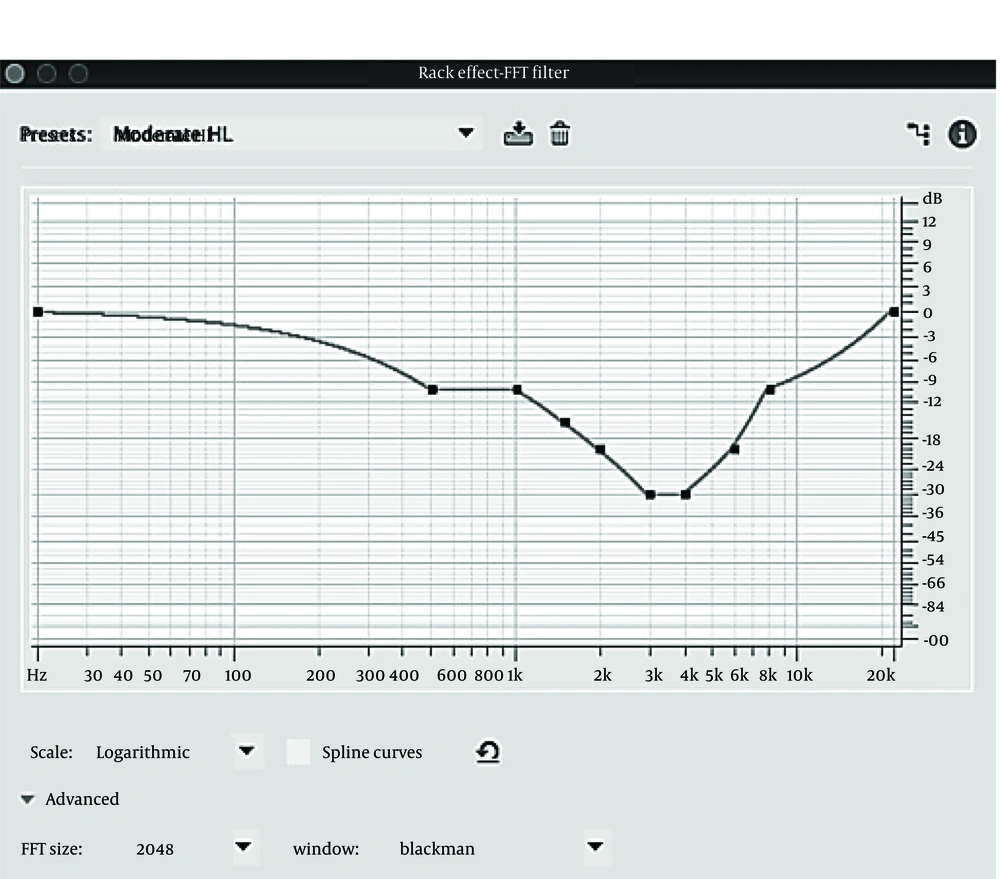
Figure 1.
Settings used to simulate moderate hearing loss. Screenshot of the Adobe Audition FFT Filter configured to approximate a moderate sensorineural hearing loss based on published audiometric threshold patterns. Frequency-specific attenuation was applied using a logarithmic scale and spline-interpolated control points to reproduce characteristic mid- to high-frequency reductions. These filter settings were used to generate the simulated hearing loss audio stimuli for experimental conditions.
Subsequently, the voice and babble/noise were recombined in one file maintaining the Speech-in-Noise (SIN) ratio associated with each sentence of the BKB-SIN test. A total of 3 lists each containing 8 short sentences were manipulated to simulate hearing loss; the other 3 lists of the BKB-SIN were used in their original state. No sentence was heard more than one time by each subject in the study. Subjects used Bose® QuietComfort 35 wireless headphones to listen to sentences and limit any additional environmental noise during testing. A licensed audiologist objectively calibrated and verified the simulated hearing loss settings in the laboratory, confirming both the decibel level and the appropriate signal-to-noise ratio (SNR) for accuracy.
A Vicon 12 camera Motion Analysis System collected kinematic data from 54 reflective markers placed on anatomical landmarks of the body (Figure 2). The Motek Medical V-gait treadmill system with two separate force plates mounted underneath each belt delivered perturbations and recorded force data. Perturbations consisted of backward surface translations to simulate a real-word unexpected event that creates a loss of balance in the forward direction requiring 1 or more compensatory steps forward to maintain balance. Three levels of balance conditions were delivered at accelerations: Level “0” (0 m/s2), with no backward surface translations, resulting in the single task of listening and repeating back the sentence; level “1” backward surface translations at acceleration of 2 m/s2; and level “2” backward surface translations at acceleration of 5 m/s2. An overhead harness system equipped to support up to 181 kg was in place to preventing injury or a fall to the floor.
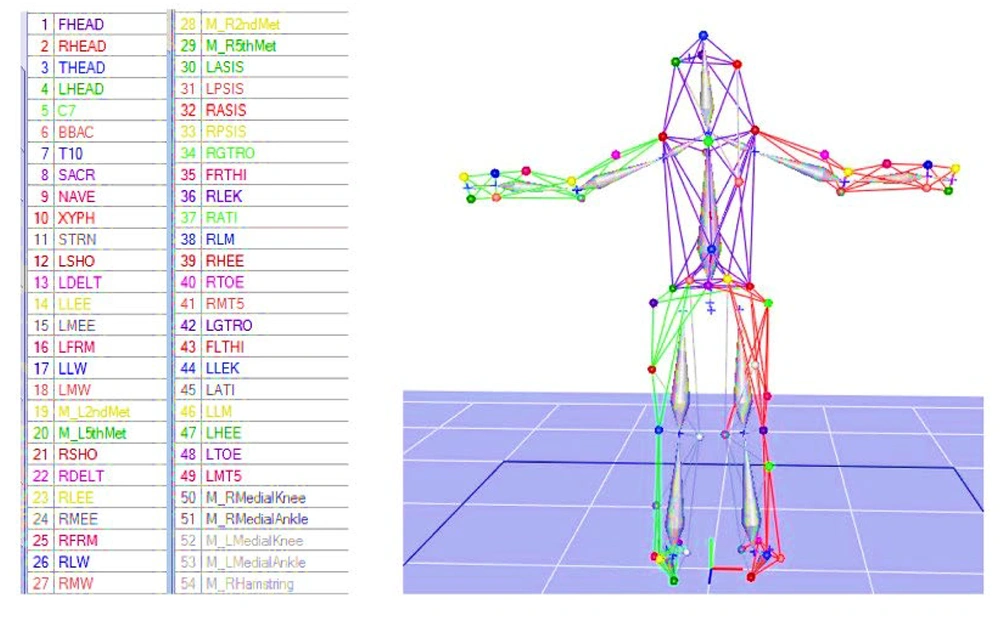
Figure 2.
Three-dimensional motion capture marker set and skeletal model. The figure illustrates the full-body biomechanical model with all 54 retroreflective markers labeled and positioned on anatomical landmarks. Marker trajectories were used to define segment orientations and joint kinematics throughout data collection. The right, left, and midline markers are shown in distinct colors for clarity, and the reconstructed skeletal model demonstrates the spatial relationships among segments during static calibration.
Single- and dual-task auditory–balance conditions were randomized to minimize potential learning or order effects for both the BKB-SIN auditory task and reactive balance responses. Randomization was performed using a pre-generated Excel file that accounted for perturbation level, auditory condition, and signal-to-noise ratio (SNR), ensuring balanced exposure across all experimental factors. Each participant completed a total of 64 trials, which were organized into four sets to reduce fatigue and maintain data quality. Between sets, participants were given scheduled mental and physical breaks to mitigate cognitive load and physical strain. This structured approach minimized habituation to perturbations and controlled for fatigue and learning effects across trials, preserving the integrity of the dual-task paradigm while maintaining participant safety and engagement (Table 2).
Table 2.
Randomization Table for Experimental Conditions a
| Variables and Randomization Table | Surface Translation Level | ||
|---|---|---|---|
| Level 0 | Level 1 | Level 2 | |
| Auditory condition | |||
| Repeat back | |||
| Simulated hearing loss | 8 | 8 | 8 |
| Normal hearing | 8 | 8 | 8 |
| No repeat back | |||
| No audio | 30sec | 8 | 8 |
| 16 | 24 | 24 | |
| 64 trials + 30sec Quiet Stance | |||
a The table depicts the distribution of trials across all combinations of auditory condition (simulated hearing loss, normal hearing, or no audio), task demand (repeat-back vs. no repeat-back), and surface translation levels (levels 0, 1, and 2). Each auditory condition–surface level pairing was presented with the number of trials shown, yielding a total of 64 randomized trials, plus an additional 30-second quiet stance condition.
3.4. Outcome Measures
Primary outcome measures were: Performance on the BKB-SIN, the maximum COP-COM distance during the first compensatory step, and the reaction time for initiating the first compensatory step.
Maximal distance between COP and COM has been documented in the literature as a stability measure (25). In gait initiation, the dissociation of COP from COM (COP-COM) is a requirement for the first step and is considered a measure of robustness of balance control system; the larger the COP-COM distance, the more robust the balance control is considered to be (26). Therefore, COP-COM was chosen as an appropriate measure of postural stability.
3.5. Data Processing
Kinematic and force data were processed using MATLAB. COP was measured using ground reaction forces from the force plates and COM was extrapolated using the sacral marker as described in Yang and Pai, 2014 (27). We used the sacral marker as a proxy for whole-body COM because it provides a reasonable approximation of COM location during upright stance and perturbations, while reducing time and equipment costs, making the approach more feasible and clinically applicable. Baseline values for COP-COM were calculated in the 30 frames before the surface translation (0.25 seconds). The maximum COP-COM distance was calculated within the window of time from surface perturbation to completion of the first compensatory step, indicated by placement of the stepping leg heel on the force plate. Both heel marker data and force data were used to confirm initiation and completion of reactive step. All maximum COP-COM distances were normalized to subject height.
Reaction time was determined as the time in milliseconds (ms) from start of surface perturbation to the point in time when the heel marker of the stepping foot transitioned from accelerating backward while receiving the surface translation to accelerating forward in the opposite direction while responding with a compensatory step. Calculation of reaction time was assessed within the window from surface perturbation initiation to maximum acceleration of the heel marker during first compensatory forward step.
3.6. Data Analysis
The BKB-SIN scores, maximum COP-COM distance, and reaction time values from the 8 trials of same combination of auditory-balance conditions were averaged by person, resulting in an average outcome score per combination of conditions. For each outcome measure, a repeated measures ANOVA models (Stata 13.1) using auditory condition, and balance condition as predictors. All independent variables were coded as categorical with time, auditory, and balance conditions designated as repeated measures variables.
4. Results
The overall mean BKB-SIN score under the normal auditory condition was 7.7 ± 1.2 dB (hearing level) HL and under the simulated hearing loss condition was 16.8 ± 2.5 dB HL. The overall mean BKB-SIN scores under the normal hearing condition with perturbation level 0 was 8.1 ± 0.8 dB HL, with level 1 was 7.7 ± 1.3 dB HL, and with Level 2 was 7.2 ± 1.6 dB HL; the overall mean BKB-SIN scores under the simulated hearing loss condition with perturbation level 0 was 17.9 ± 2.0 dB HL, with Level 1 was 16.2 ± 2.7 dB HL, and with Level 2 was 16.5 ± 2.7 dB HL. Young adults performed significantly worse on the BKB-SIN under the simulated hearing loss condition compared to the normal hearing condition at each surface translation level 0, 1, and 2. BKB-SIN scores were significantly affected by perturbation level, F(2, 38) = 7.61, P = 0.002, and by hearing condition, F(1, 19) = 1063.17, P < 0.001, although the interaction was not significant, F(2, 38) = 2.13, P = 0.13 (Figure 3).
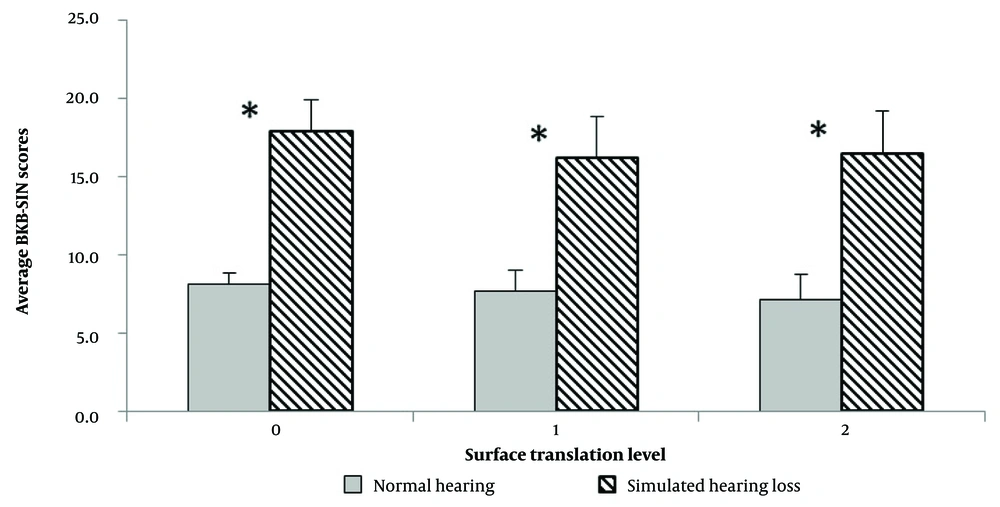
Figure 3.
Average BKB-SIN scores across surface translation levels for the normal hearing and simulated hearing loss conditions. Mean speech-in-noise thresholds ( ± SE) are shown for each surface translation level (0, 1, and 2). Across all levels, participants in the simulated hearing loss condition demonstrated significantly poorer (higher) BKB-SIN scores compared to the normal hearing condition, as indicated by asterisks.
The average for maximum COP-COM distance during the no repeat back condition was 8.9 ± 2.4 centimeters (cm) at level 1, and 19.0 ± 4.5 cm at level 2. The average for maximum COP-COM distance during the normal hearing condition was 9.0 ± 2.2 cm at level 1, and 18.6 ± 4.1 cm at level 2. The average for maximum COP-COM distance during the simulated hearing loss condition was 9.0 ± 1.9 cm at level 1, and 18.8 ± 5.3 cm at level 2. Maximum COM-COP distance increased significantly across perturbation levels, F(2, 165) = 700.08, P < .0001, ηp² ≈ .89, while auditory condition had no significant effect, F(2, 165) = 0.15, P = 0.95. (Figure 4). There was no significant interaction between hearing condition and perturbation level.
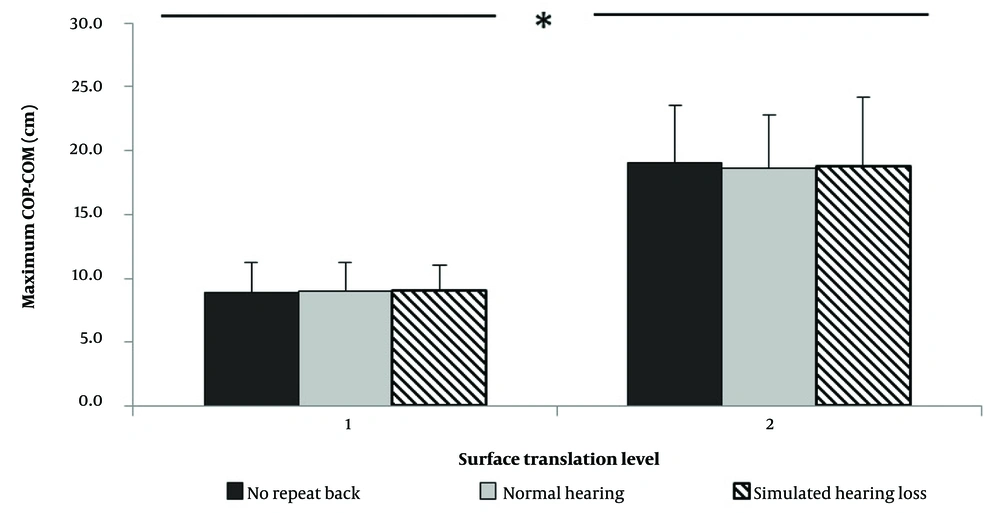
Figure 4.
Maximum COP–COM displacement as a function of surface translation level and auditory condition. Mean maximum center of pressure–center of mass (COP–COM) separation ( ± SE) is shown for each auditory condition (no repeat back, normal hearing, and simulated hearing loss) during perturbation levels 1 and 2. Across conditions, COP–COM displacement was significantly greater at level 2 compared to level 1, as indicated by the bracket and asterisk, reflecting increased postural challenge at higher perturbation magnitudes.
The average reaction time during the no repeat back condition was 301 ± 51 milliseconds (ms) at level 1, and 216 ± 14 ms at level 2. The average reaction time during the normal hearing condition was 308 ± 50 ms at level 1, and 214 ± 18 ms at level 2. The average reaction time during the simulated hearing loss condition was 292 ± 55 ms at Level 1, and 210 ± 19 ms at level 2. Reaction time was significantly affected by perturbation level, F(1, 18) = 34.73, P < 0.001, ηp² = 0.65, but not by hearing condition, F(2, 36) = 1.64, P = 0.21, ηp² = .08, and the interaction showed only a nonsignificant trend, F(2, 36) = 2.49, P = 0.097, ηp² = 0.12 (Figure 5).
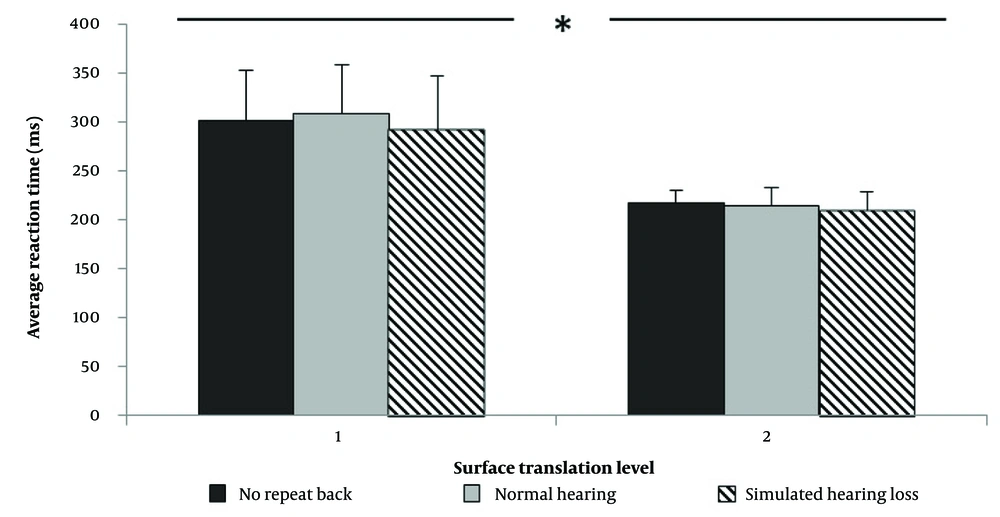
Figure 5.
Average reaction time across surface translation levels and auditory conditions. Mean reaction times (± SE) are shown for each auditory condition (no repeat back, normal hearing, and simulated hearing loss) during perturbation levels 1 and 2. Reaction times were significantly faster at level 2 compared to level 1, as indicated by the bracket and asterisk, reflecting quicker motor responses under higher perturbation demands.
5. Discussion
The results suggest subjects performed significantly worse on the BKB-SIN under the simulated hearing loss condition. However, there were no statistically significant differences in reactive balance outcomes (maximum COP-COM distance or step initiation time) between normal hearing and simulated hearing loss conditions. Across all trials, subjects’ maximum COP-COM increased as the perturbation level increased and reaction time decreased as the perturbation level decreased, but these changes were consistent across all auditory conditions. These findings suggest that acute simulated hearing loss does not impair reactive balance performance in healthy young adults during a dual-task paradigm.
The results of our study suggest that acute simulated hearing loss alone may not produce measurable deficits in reactive balance among young adults with optimally functioning sensorimotor systems. Consistent with prior research, listening performance declined under a noisy dual-task paradigm, yet reactive balance remained stable, indicating that young adults likely possess sufficient attentional reserve to manage both tasks simultaneously (7, 28). This adaptability may reflect task-prioritization processes, whereby individuals allocate greater attention to the task perceived as most threatening; in this case, participants may have prioritized postural stability, particularly at perturbation intensities that required compensatory stepping responses (29). Furthermore, because reactive stepping and compensatory balance strategies are highly automatic in young adults, relatively few cognitive resources may have been required to maintain stability, potentially masking any interference from simulated hearing loss (30). These findings may not generalize to older adults or individuals with chronic hearing loss, whose reduced sensory integration and attentional capacity may yield greater dual-task interference (7).
The observed COP–COM patterns are also consistent with biomechanical literature showing that perturbations near 2.0 m/s² commonly elicit a stepping strategy, resulting in greater separation between center of mass and center of pressure (31). The increased COP–COM distance at level 2 compared to level 1 supports this expected response hierarchy. Similarly, the reaction time results align with existing evidence on compensatory stepping and dual-task performance in healthy young adults, demonstrating faster responses under lower perturbation demands (32).
Our findings are limited by the use of healthy young adults, which restricts generalizability to older adults or clinical populations with hearing loss (7). The laboratory setting may not fully replicate real-world dual-task demands, such as walking in complex environments while processing speech (29). Additionally, our sample size was relatively small and based on normative clinical data and pilot results. Assumptions of normality and sphericity were not formally tested, which should be considered when interpreting the statistical results. Finally, acute simulated hearing loss does not capture the chronic, progressive nature of presbycusis or its associated cognitive and neuromuscular changes (4).
These findings suggest that acute simulated hearing loss does not impair reactive balance in healthy young adults, indicating that fall risk associated with hearing loss, also known as presbycusis, in older adults may involve additional factors beyond auditory input alone (33). Recent evidence has linked presbyscusis to greater cognitive decline compared to individuals with normal hearing, as well as with neurodegenerative diseases associated with aging, such as Alzheimer’s disease (34, 35). Anatomical and functional brain changes occurring independent of age-effects are associated with not only with auditory processing, but also with attentional processing, and have been identified in individuals with age-associated hearing loss (36). Therefore, manipulating auditory input to simulate hearing loss may not address the full scope of functional brain changes occurring in addition to or as a result of hearing loss, particularly with the older adult population.
Clinically, these results underscores the need for comprehensive fall prevention strategies that address multisensory integration, cognitive load, and age-related changes rather than focusing solely on hearing loss (4, 7). Understanding these interactions can inform rehabilitation approaches and guide audiology and physical therapy practices toward more holistic interventions for populations at risk of falls.
5.1. Future Directions
Our attempt to simulate hearing loss in young healthy adults was unable to elucidate the contribution of hearing loss to balance deficits observed in the older adult populations with hearing loss. Currently, limited research exists describing an underlying mechanism that explains how and why individuals with hearing loss fall more often than individuals with normal hearing; therefore, further research is needed. Potential mechanisms to explain the relationship between hearing loss and increased risk for falls include:
1. Physiological: Various physiological theories exist, such as a shared blood supply of the cochlea and vestibular system or a gene that plays a role in the association between hearing loss and balance deficits (37).
2. Social: The vicious cycle occurs of social isolation due to difficulty hearing and communicating, decreased physical activity, leading to weakness and increased risk for falls (38).
3. Perceptual: Hearing loss may create an incomplete or inaccurate representation of environmental sounds (e.g., the proximity of a fire truck’s siren), putting the individual at risk of unexpected events that could lead to a fall (39).
4. Cognitive: An individual with hearing loss is constantly performing a dual-task of maintaining balance while processing environmental sounds, such as speech, thus dividing the individual’s attention and increasing the risk of falling (9).
Future research should explore these mechanisms in older adults and clinical populations to better understand the link between hearing loss and fall risk. Future studies should also include larger, more diverse samples and real-world mobility tasks to enhance ecological validity.
5.2. Conclusions
In healthy young adults, simulated hearing loss does not negatively impact postural control. These individuals may either prioritize the postural task or simultaneously respond to balance perturbations while attending to an auditory task, likely due to sufficient redundancy in their systems (29, 30). Further research is needed to determine whether a causal relationship exists between hearing loss and balance deficits and, if so, which underlying mechanisms play a key role. Understanding these mechanisms will support the development of clinical assessment tools and targeted interventions for individuals, particularly older adults, with hearing loss and balance impairments.