
1. Background
Most of the medical officers in combat units, medical companies, and graded supporting hospitals of the Chinese People’s Liberation Army (PLA) are graduated from military medical universities. Although these students will serve as medical doctors, they may develop to be the leader of a medical unit or medical director in a command. To help students gain some conceptual and practical experience in preparing, organizing, and conducting health support services (HSS) in combat, an Integrated Military Medicine Exercise (IMME) is developed, and all students must take this course in the last semester before graduation. The annual IMME lasts about two weeks, and 300-500 students from different majors participate. The IMME that simulates real combat situations intends to enhance students' ability to deal with practical problems, to master the first-aid technique, and to improve their treatment skills and procedures of HSS.
1.1. Purpose or Rationale
Chemical, biological, radiological, and nuclear (CBRN) weapon attack, terrorism, and the incident may cause mass casualties, which one of the core tasks of medical defense personnel either during wartime or in peacetime is to handle these situations (1). In this line, various training courses are developed for different CBRN responders, such as first responders and hospital first receivers (2-4). CBRN casualty care is a major part of the IMME. Herein, we have introduced the training modules established for the course of Chemical Defense Medicine (CDM), which is related to chemical casualty care in the IMME, involving the activities related to the protection, decontamination, rescue, and treatment.
2. Methods
2.1. Scenario-Oriented Medical Support
Based on training requirements, current military situations, and contemporary combat mode, various exercise scenarios are designed to define types and frequencies of casualties. The students need to integrate what they have learned in clinical medicine, military medicine, and preventive medicine into a specific scenario to conduct medical support. The combat environment may be set in high altitude and mountains or coast and maritime to achieve specific training objectives. For example, one scenario is to exercise medical support after a chemical attack on a border defense operation in a mountainous area.
The students should know that close forest confines chemical warfare agents (CWA) with a higher local concentration and longer duration; CWA clouds may flow in low-lying valleys, and personnel should move to higher foothold, and proper evacuation vehicles should be considered.
As a compulsory course, the CDM is a specialized knowledge of medical protection against chemical weapon injuries. The CDM course contains CWA poisoning mechanisms, clinical manifestation, emergency rescue and treatment, and the procedure of HSS in chemical warfare or incidents. The training purpose is to deepen students' understanding of the theoretical knowledge and professional techniques as well as their combination throughout the exercise. An essential part of the teaching aspect is to plan CDM-related practice, such as casualty design forcing students to comprehensively apply their knowledge and skills of CDM in casualty care and HSS performance.
One year, the scenario of the drill was planned as that a combat infantry company encountered a sudden chemical weapon attack while they were advancing. Casualties needed on-site rescue and evacuation backward to MTF. In MTF, casualties were triaged according to their poisoning and contaminating condition, in addition to traumatic injuries. Chemically contaminated casualties were transferred either to the Chemical Casualty Care (CCC) or subjected to emergency medical treatment (EMT) with contamination on. In this scenario, participating students were supposed to exercise graded medical support both at the battlefield and in an MTF.
2.2. Outline of the IMME Process and Chemical Defense Activity Involved
To brief the process of the IMME, one previous exercise is used as an example in the following.
In that case, the IMME started with an emergency on-campus assembly of students with their subsistence for motorized mobilization before dawn. After reaching a suburban place, the students shifted to foot marching with inserted teaching activities on their way. When arriving at the training base, students set up a field hospital that its various departments are containerized in different tents. When setting field hospitals, factors such as wind direction, terrain, and space between tents should be considered.
This combat supporting hospital serves as a Role 2 medical treatment facility (MTF), and usually contains the following departments: Commander Office, Triage Station, Severe Wounded, Minor Wounded, Blood Supply, Laboratory Analysis (on-vehicle), X-ray (on-vehicle), Surgery Room (both in-tent and on-vehicle), Evacuation Station, Chemical Casualty Care (CCC), Radiation Casualty Care, Infectious Disease Control. The CCC is the department for decontaminating and treating chemical casualties, which has a decontamination station for chemical and nuclear-contaminated casualties.
On the next day, equipment operation, epidemic survey, and on-site rescue were separately demonstrated and practiced uniquely for CBRN defense medicine. In the following days, tent-oriented teaching was carried out. By performing tasks in rotation, the students will understand the tasks and working process of each department tent, as well as how to organize and conduct HSS under the attack of weapons of massive destruction (WMD). Students practiced in every department, and their knowledge and skills were evaluated by instructors.
Finally, a full functional drill was carried out with comprehensive exercise and evaluation. This drill simulated chemical, radiological, and biological attack separately, and the students were required to start buddy-aid as an organic doctor to conduct on-site rescue, as a team member dispatched from a medical facility, or as a medical personnel to manage a chemical casualty in the CCC. Through participating in all procedures of the drill, the students would formulate an operation roadmap for prehospital medical care of chemical casualties.
2.3. Establishment and Implementation of Modularized CDM Training in the Field Exercise
by combination of training objectives, exercise scenarios, and experience of foreign militaries (5), the following four modules are designed and applied in the field exercise.
Module I: Passing through a contaminated area with a protective posture.
This self-protection and unit maneuver module intends to operate in an environment with imminent or occurred chemical threat. In addition to assuming personal protection, CWA detection is also involved. This module is performed two times and takes one hour to explain, practice, and perform: one chemical attack during the foot marching on day one, and another in the middle of combat during the final drill. A detection team will be dispatched to identify the nature of the threat, identifying the dispersing method, concentrating the putative CWA, to grade and mark the CWA-contaminated area, and to report to the commander. Once decided to quickly pass through the contaminated area and to keep on operations, the commander gives instructions to the unit to take protection measures (e.g., using protective equipment, medical prophylaxis, and improvised protective materials).
This module is focused on avoiding chemical poisoning, understanding CWA delivery methods, and familiarization with the characteristics of chemical weapons. Students should be familiar with different protection postures and their related procedures, and they should understand that mask-only protective posture can protect them against vapor or aerosol of CWA to maintain the maximum fighting ability. The doffing and disposing of IPE are also included.
Module II: operating chemical defense equipment
The IPE includes a protective mask, suit, gloves, and over boots. In the donning and doffing of IPE, the students learn how to ensure the air-sealing effect of mask and suit. Although medical units may rely on chemical soldiers for CWA detection, medical personnel should be able to operate CWA detectors in case they work alone, such as to assess the edibility of possibly contaminated water and foods. In this module, the working principle and detailed method of operating CWA detectors, testing papers, field analysis box, and personal decontamination pack are demonstrated with CWA simulates. The personal decontamination pack, a glove with absorbing powder, is an individual necessity which should be practiced individually.
This module is a know-how training on the main chemical defense equipment and takes one day to get familiar with the equipment. Good competency in operating and applying these equipment lays a foundation for other training modules.
Module III: battlefield rescue (search and extraction, S&E)
Emergency field rescue is the most critical phase of countering chemical attacks, which helps to both save lives and to maintain combat ability. This is usually achieved by self- and buddy-aid rescue performed by combatants and the organic medical stuff, if available. Students should be familiarized with life-saving techniques and procedures, not only to perform rescue tasks as a participant in their career but also for training soldiers on tactical combat casualty care (TCCC) as an instructor. In addition to basic field care techniques (e.g., hemostasis, ventilation, wound dressing, immobilization, and casualty movement), the students will face massive casualties caused by CBRN weapons. This module is real combat-simulated, life-saving, time-limited, and task complicated. To effectively rescue chemical casualties, the most feasible efficient organization and cooperation should be available.
In situations with mass casualties, the staff should ask for support from a higher medical facility. Then, a medical rescue team should be dispatched to the chemical contaminated battlefield. The team usually composes medic or non-commissioned medical officer (NCO) with 4-5 folds numbers of litter bearers. The team enters the contaminated area from an upwind or lateral direction, conducts casualty searching and on-site first aid.
The scope of first aid covers CWA protection for casualties, antidote injection, life- and/or limb-saving, and immediate and gross decontamination. Extraction of the casualties to a relatively safe place outside the contaminated area and assembling at a casualty collection point (CCP) may be an easy and important way of on-site rescue if no other emergency manipulation is required. The CCP should be allocated with covert terrain and/or forest shady with obvious signs for transporting vehicle access.
Each group of students must spend half a day to practice battlefield rescue skills. In this module, students are encouraged to think actively and solve problems through their planning and practice. Moreover, students need to put forward their personal opinions on the acting plans concerning setting up the operation background, the way of simulated CWA dispersing, selecting sites for CCP, casualty making up and simulation, and rescue team and its equipment. The instructors are responsible for proving the whole procedure and making appropriate adjustments if needed. In this way, the students' abilities to understand, analyze, and solve problems of on-site rescue are expected to be enhanced.
Module IV: treatment of chemically contaminated casualties in CCC of Role 2 MTF
The combat supporting hospital that was set up at the beginning of the field exercise is supposed to be a typical Role 2 MTF, to which the casualties evacuated from the battlefield are sent. The CCC is a very important department in the management of chemically contaminated and/or poisoned casualties. The training objective of this module is an in-depth understanding of the tasks, personnel formation, equipment, medical countermeasures against a variety of CWAs, and the operating procedures of the CCC. The general task of CCC is summarized as 3D3T (i.e. detection, diagnosis, decontamination, triage, treatment, and transportation), as mentioned above. The CCC department consists of doctors, medical NCO, medical assistants, nurses, and litter bearers. All CCC staff should be in proper protection posture, except for personnel working in a clean area to treat clean casualties.
According to the assigned tasks, the staff of the CCC unit are divided into four groups of triage, monitoring, decontamination, and transportation elements. Any casualty who could survive the decontamination process should get medical treatment in a clean area after complete decontamination. Emergency medical treatment could be applied by triage officers and nurses upon casualties receiving in a contaminated environment and by medical supervisors during the decontamination procedure if applicable. Casualties of contamination-only or contamination with a minor injury may return to duty after decontamination.
The decontamination station is a specific and necessary functional unit of MTF. Usually, two decontamination corridors are set up, one for litter casualty and another for ambulatory casualties. The principles of casualty decontamination may include decontaminating (1) by priority, (2) as quick as possible, (3) as forward as possible, and (4) only what is necessary. Casualties who have finished decontamination should be transferred to the treatment group in a clean area of CCC before transferring to other departments. The staff in this treatment group are well-trained with chemical injury expertise. Different from the field manual of the US Army and NATO (6), the setup of this special treatment group in our field exercise could facilitate the efficient and professional management of chemical casualties.
The flow of casualties from CCC may be directed to (1) return to duty, (2) temporary holding/observing, (3) to other departments according to injuries other than poisoning, or (4) evacuation to a higher medical facility.
In addition to the injuries caused by conventional weapons, chemical weapons cause various damages based on their CWA nature, physical characteristics, and assumed protective posture. Chemical/poisoning combined injury is a special type of injury occurred after chemical attacks, and makes the triage and rescue more difficult and complicated. So that the trainees could have a better understanding of chemical combined injury (CCI) to differentiate it from simple chemical or conventional injury and to properly perform emergency medical treatment, decontamination, and treatment for casualties of CCI.
As mention before, this module contains several studying points as well as training techniques and procedures. Students are required to take one day to understand the function and required conditions of the CCC module. Importantly, the concept of the downwind location of both CCC in the whole MTF and decontamination station in the CCC, the contamination zoning of the working area, and the flow of casualties should be thoroughly appreciated by the students. In the IMME training, some new protocols developed in military medical research may also be integrated as an advancement of CDM (7, 8).
2.4. Program Evaluation
Evaluation is a useful step to improve both teaching and learning aspects. Once the study objectives of the field exercise are determined, the designing and conducting of the whole training process should consider the contents of training, class time and methods, equipment operation, team operation procedures, etc. The training methods we commonly applied are group class, lecture and discussion, equipment operation, procedure rehearsal, and full functional drill. The students will tactically apply medical countermeasures to save lives and limbs and strategically operate the procedure of HSS from planning the task to the implementation in a field exercise.
After fulfilling each module, students are subjected to an oral quiz for evaluating the learning points of the course. Another way of scoring technique and response procedure is completed by the instructor’s looking-on and scoring during the training of each module as well as the final functional drill. After action review (AAR) is a good way to stress the lessons learned and to get more impression on the whole process of the drill as well as the operational details of some key techniques and procedures.
3. Discussion
The course of Medical Countermeasures against CBRN Weapons covers damages caused by different injurious factors of CBRN origin. Herein, we concentrated on issues concerning CDM only. In previous years, the contents of the training program were not organized according to the functional units and its related organic equipment, which caused ambiguities for students about how to connect equipment and their performances with functional units and its tasks. When we integrated the functional unit and its equipment together to form an organic module, it is very straight forward to understand the training contents either by the configuration of each functional unit or by the task-required equipment. By exploiting the leading role of CDM in CBRN training and regarding our experience in CDM training, this modularized training mode in field exercise has been designed, established, and performed for years.
3.1. Rations of the Module
In IMME, the modules are set in close link with training tasks of the course, and the scenarios are designed in the way of simulating real chemical attack or incident. In designing these modules, a balance is maintained concerning the relationship between the actual requirements of combat forces and teaching objectives of the academic requirement for medical students so that the teaching and training of CDM can be integrated into the field exercise properly, reasonably, and systematically (Figure 1). On one aspect, each module is relatively independent, which makes a tailored training on the individual module or in combination, suitable for different trainees and objectives. On another aspect, these modules cover the whole training content and process from theory to practice. The vivid scenes of the drill help the trainees to deepen their understanding of the chemical defense task on the battlefield and to master the basic theories and skills to complete the tasks. Thus, the training and practice of CDM enable the students for both overall conceptual learning and detail training of specific tasks and techniques.
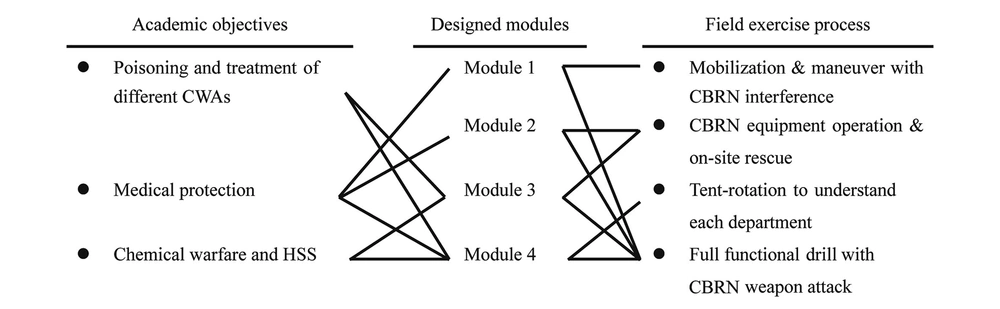
Figure 1.
The relationship between the designed modules with academic objectives of CDM and the integration of modules into a field exercise.
3.2. Core Sense Needs that Should be Built up by Students Concerning the CDM
With the annual IMME, we keep refreshing the contents related to the CDM based on the needs of combat troops. By designing different but inter-related modules, we provide the students with a platform to build up their ability to analyze and solve problems that are required for their future duty. After the IMME training, the students should establish the following important sense and understanding of CDM, which can be extended to the training of CBRN defense medicine.
Sense of protection. The trainees should understand and properly operate protection, considering preventive action, protection in accordance with contamination zoning, and proper protection duration.
Sense of counteracting CWA-specified toxicity. Considering the nature of CWA, its main life-threatening manifestation, and systemic supportive care.
Sense of decontamination. Considering the modes of decontamination, CWA-based decontamination, and contamination-based decontamination.
Sense of timeframe for medical care. Understanding the time frame of rescue for different chemical injuries, and considering medical and non-medical personnel-provided care, quick-acting CWA, and persistent CWA.
3.3. Limitation and Challenge
The scenarios of CBRN weapon attack in IMME are simulation-based, so the efficacy of decontamination, rescue, and treatment cannot be comprehensively evaluated. The key points of evaluation lie in the rationality and accuracy of the response, rather than the step-wise operation of medical care skills. Besides, the training process is cross-sectioned and focused on the Role 1 and 2 MTFs, and transportation to a higher medical facility also cannot be realized. Finally, more time should be allocated to train students on the whole CBRN medical rescue system in IMME.
In summary, the design and conduction of the modularized course training of CDM are a practical, flexible, and expandable training method for military medical students. It sets up an example for effectively carrying on the training of CBRN defense medicine in a field exercise.